Posts Tagged ‘fad’
“Eureka!”*…

Whence insight?…
New research published in BMC Psychology suggests that the structural wiring of the brain may play a significant role in how people solve problems through sudden insight. The study indicates that individuals who frequently experience “Aha!” moments tend to have less organized white matter pathways in specific language-processing areas of the left hemisphere. These findings imply that a slightly less rigid neural structure might allow the brain to relax its focus, enabling the unique connections required for creative breakthroughs.
For decades, scientists have studied the phenomenon of insight, which occurs when a solution to a problem enters awareness suddenly and unexpectedly. This is often contrasted with analytical problem solving, which involves a deliberate and continuous step-by-step approach.
While previous studies using functional MRI and EEG have mapped the brain activity that occurs during these moments, there has been little understanding of the underlying physical structure that supports them. The researchers behind the new study aimed to determine if stable differences in white matter—the bundles of nerve fibers that connect different brain regions—predict an individual’s tendency to solve problems via insight.
“For over two decades, neuroscience has mapped what happens in the brain during these moments using EEG and fMRI. We know from prior research that insight feels sudden, tends to be accurate, and involves distinct functional activation patterns — including a burst of activity in the right temporal cortex just before the solution reaches awareness,” said study authors Carola Salvi of the Cattolica University of Milan and Simone A. Luchini of Pennsylvania State University.
“But one major question remained open: what structural features of the brain might make some people more likely to experience insight in the first place?”
“Most previous white matter studies of creativity did not specifically focus on Aha! experiences. They measured how many problems people solved, or how creatively, not how they solved them (with or without these sudden epiphanies). Yet insight and non insight solutions are phenomenologically and neurally distinct processes.”
White matter acts as the communication infrastructure of the brain, transmitting signals between distant regions. To examine this structure, the researchers employed a technique called Diffusion Tensor Imaging (DTI). This method tracks the movement of water molecules within brain tissue.
“We wanted to know whether stable white matter microstructure — the brain’s anatomical wiring — differs depending on whether someone tends to solve problems through sudden insight or through deliberate step-by-step reasoning (non insight solutions),” Salvi and Luchini explained. “Diffusion tensor imaging (DTI) allowed us to examine this structural dimension directly.”…
… The findings offered a counterintuitive perspective on brain connectivity. The analysis revealed that participants who solved more problems via insight exhibited lower fractional anisotropy in the left hemisphere’s dorsal language network. This network includes the arcuate fasciculus and the superior longitudinal fasciculus, pathways that connect brain regions responsible for language production, comprehension, and semantic processing.
“One striking finding was that people who more frequently experienced insight showed lower fractional anisotropy in specific left-hemisphere dorsal language pathways, including parts of the arcuate fasciculus and superior longitudinal fasciculus,” Salvi and Luchini told PsyPost.
“At first glance, that might sound counterintuitive. Fractional anisotropy is often interpreted as reflecting the coherence or organization of white matter pathways. In many cognitive domains, higher fractional anisotropy is associated with better performance.”
“But insight may operate differently. The left hemisphere is typically involved in focused, fine-grained semantic processing — narrowing in on dominant interpretations of words and concepts. The right hemisphere, by contrast, is thought to support broader, ‘coarse’ semantic coding — integrating more distantly related ideas. Slightly lower fractional anisotropy in left dorsal language pathways may reflect a system that is less tightly constrained by dominant interpretations.
“In other words, it may allow a partial ‘release’ from habitual patterns of thought and it is in line with other studies where lesions in the left frontotemporal regions have been shown to increase artistic creativity,” Salvi and Luchini continued. “Taken together, these findings imply that left hemispheric regions play a regulatory role in creativity and that their disruption lifts this constraint, thus promoting novel ideas.”…
This somehow makes your correspondent feel better about his messy desk…
More at: “Neuroscientists identify a unique feature in the brain’s wiring that predicts sudden epiphanies,” from @psypost.bsky.social.
The journal paper: “The white matter of Aha! moments.”
* Archimedes (after one of his famous insights)
###
As we ruminate on revelation, we might recall that it was on this date in 1939 that the college fad of swallowing live goldfish began at Harvard: a freshman named Lothrop Withington, Jr., reportedly bragged to his friends that he had once eaten a live fish. They bet him 10 bucks he couldn’t do it again. Perhaps because he was running for Class President, he took the challenge…
The moment of truth came on March 3, within the hallowed halls of Harvard. Standing in front of a crowd of grinning classmates and at least one Boston reporter, Withington dropped an ill-fated 3-inch goldfish into his mouth, gave a couple chews and swallowed. “The scales,” he later remarked, “caught a bit on my throat as it went down.”
Soon the word spread to other colleges. Other students began to take up the challenge, swallowing more and more goldfish each time to top the last record. By the time students were downing dozens of live, wriggling goldfish to uphold their school’s honor, the Massachusetts legislature stepped in and passed a law to “preserve the fish from cruel and wanton consumption.” The U.S. Public Health Service began to issue warnings that the goldfish could pass tapeworms and disease to swallowers. Within a few months of its start, the fad died out.
– Source

“In the last analysis, a pickle is a cucumber with experience”*…
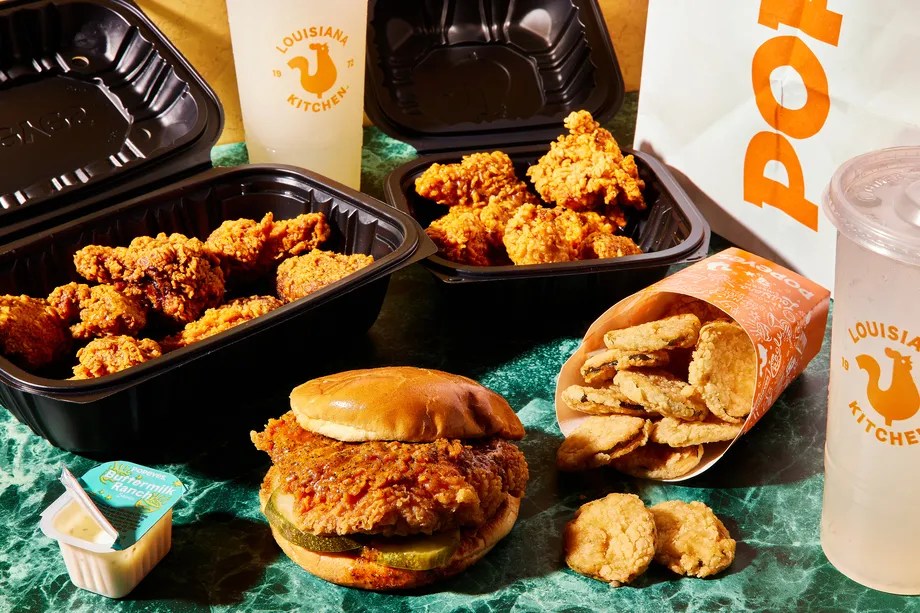
The pickle is Gen Z’s avocado; it’s a passion and a personality. But maybe, Jaya Saxena suggests, that’s missing the point…
In the Top Chef episode “Pickle Me This,” which aired on April 17, host Kristen Kish, in power clashing greens, announces that two teams of chefs must go head to head in creating an all-pickle dinner. The five-course meal was to feature different kinds of pickles in every course — not kimchi or achar necessarily, but instead the cornichons and dill of the European influence. There were charred pickles with cured mackerel, cucumber and celeriac pickle gelee, chef Massimo Piedimonte’s winning fried pickle cannolo, and of course a bread and butter pickle curd with dill ice cream. Individually, each dish sounded great, and judge Tom Colicchio said two of the dishes, including the dessert, were some of the best he’s ever had on the show.
Top Chef contestants often have to create meals utilizing an ingredient that’s in the culinary zeitgeist. Some of those meals are more successful than others. But a successful five-course meal of all things pickles illustrates the strange place in culture the pickle holds now: both cheffy and with diverse-enough flavor profiles to inspire chefs in fierce competition, but obvious and basic enough to also be a little bit of a joke. It’s the food of the moment, both sincerely and ironically.
As Rebecca Jennings wrote in Vox, pickles are Gen Z’s avocado, a viral food that people genuinely enjoy: They “pair well with other contemporary food trends like dirty martinis and canned cocktails, and fit right in with aesthetically pleasing butter boards and “girl dinner” spreads.” But people are also consuming pickles for the meme of it all. There are pickle chips, pickle popcorn, Flamin’ Hot pickle Cheetos, and pickle seltzer. Popeyes recently introduced an entire pickle menu, including pickle lemonade. 21Seeds wants you to make a spicy pickle martini with its tequila, and people are putting pickles in their soda. Sweetgreen has pickle ketchup, and of course Molly Baz has dill pickle mayo. And like any “it” food nowadays, the pickle has moved into fashion and home decor.
Like with any trend, though, it’s kind of exhausting when it’s everywhere. Pickles have become subject to the flavor-ification of actual foods; half the time, pickle-flavored anything is an unsatisfying approximation of the flavor of Central European-style pickled cucumbers — typically a combination of salt, vinegar, and artificial dill which evokes none of the live-culture fizz that hums through the real thing. It’s that complexity we crave, herbs and lactic acid and often spices like coriander.
But for the pickle to be the centerpiece of an entire five-course meal, or for it to be one’s personality to the point that it flavors every snack in one’s house, slightly misses the point of the pickle. A Popeyes meal of fried pickles and pickle glazed wings washed down with a pickle lemonade serves no refreshing alternative to the onslaught of puckering pickle potency. A filthy martini and a bowl of pickle popcorn offers no relief. What makes pickles great on a sandwich or a charcuterie board is usually that the pungent brine and preserving salt make for a great contrast to any creamy, sweet or rich ingredients. Pickles are salt and acid bombs that are delicious on their own, but also enhance every other flavor. It’s why olives are often served with bread and cheese plates have all that cheese. The back and forth is what makes pickles truly shine.
Obviously no one is forcing anyone to only consume pickles, and if that is indeed what your taste buds crave, then congrats on being the moment! But put pickles everywhere and they cease to be a treat, the shining zinging bite to zap you into whatever else you’re eating. Maybe they should stay a sometimes food…
The flavor of the moment: “Is There Too Much Pickle?” from @jayasaxena.com in @eater.bsky.social.
Possibly apposite?: “Will Gen Z’s Pivot to the Republican Party Last?– It’s not only young men who lean conservative. The youngest female voters are also abandoning the Democratic Party.” (gift article)
###
As we test our tastebuds, we might recall that it was on this date in 2009 that 12 year old Catherine Ralston ( a member of Gen Z) was named Easy-Bake “Baker of the Year” for her “Queen of Hearts Strawberry Tart.” The Easy-Bake Oven is, of course, a working toy oven that Kenner introduced in 1963 (more than 16 million Easy-Bake Ovens (in 11 models) had been sold by 1997), and which Hasbro still manufactures.

“When I die, I’m leaving my body to science fiction”*…

When it comes to cover design, the science fiction genre is often accused, along with romance novels, of having the most godawful cover design going. With their typical brilliance in style, Penguin embraces all the good, the bad and the comically ugly in traditional sci-fi design with their science fiction series. From the campy cartoon-style creatures and ridiculous, buxom alien babes of space opera, to the darkly stylized futuristic cities in dystopian futures Penguin covered it all with story selection and cover illustration…
Confidently judge books by their covers at “Penguin’s Science Fiction.”
[TotH to @MartyKrasney]
* Stephen Wright
###
As we travel through space and time, we might recall that it was on this date in 1963 that Arthur K. “Spud” Melin patented the Hula Hoop. In fact, both Melin’s company, Wham-O, and others had been selling millions of Martex (plastic) hoops since the late 50s. Melin’s innovation was an improved version- which, by virtue of the intellectual property protection, was available only from Wham-O.
No sensation has ever swept the country like the Hula Hoop. It remains the standard against which all national crazes are measured.
– Richard A. Johnson, American Fads


Spud Melin (left) and his Wham-O co-founder Richard Knerr
You must be logged in to post a comment.