Posts Tagged ‘trend’
“In the last analysis, a pickle is a cucumber with experience”*…
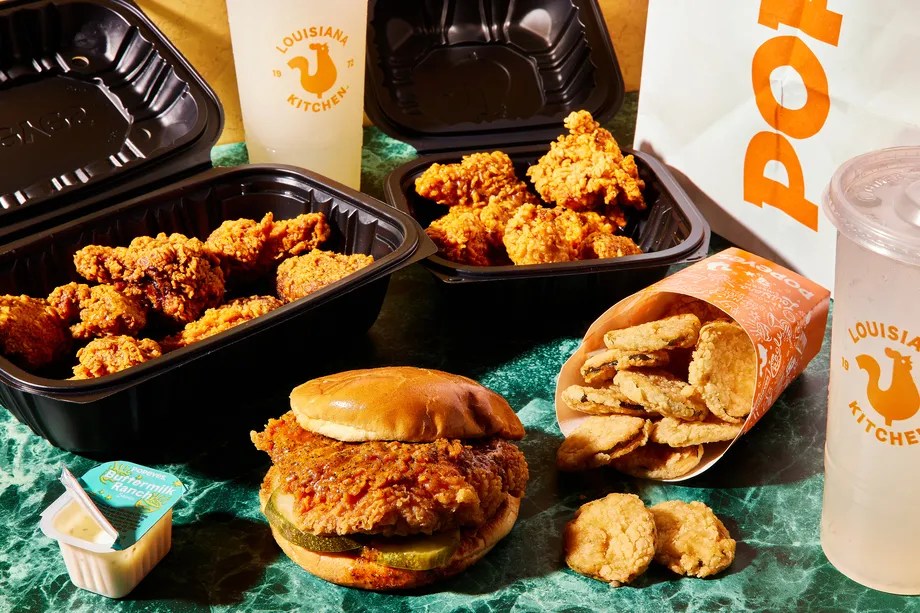
The pickle is Gen Z’s avocado; it’s a passion and a personality. But maybe, Jaya Saxena suggests, that’s missing the point…
In the Top Chef episode “Pickle Me This,” which aired on April 17, host Kristen Kish, in power clashing greens, announces that two teams of chefs must go head to head in creating an all-pickle dinner. The five-course meal was to feature different kinds of pickles in every course — not kimchi or achar necessarily, but instead the cornichons and dill of the European influence. There were charred pickles with cured mackerel, cucumber and celeriac pickle gelee, chef Massimo Piedimonte’s winning fried pickle cannolo, and of course a bread and butter pickle curd with dill ice cream. Individually, each dish sounded great, and judge Tom Colicchio said two of the dishes, including the dessert, were some of the best he’s ever had on the show.
Top Chef contestants often have to create meals utilizing an ingredient that’s in the culinary zeitgeist. Some of those meals are more successful than others. But a successful five-course meal of all things pickles illustrates the strange place in culture the pickle holds now: both cheffy and with diverse-enough flavor profiles to inspire chefs in fierce competition, but obvious and basic enough to also be a little bit of a joke. It’s the food of the moment, both sincerely and ironically.
As Rebecca Jennings wrote in Vox, pickles are Gen Z’s avocado, a viral food that people genuinely enjoy: They “pair well with other contemporary food trends like dirty martinis and canned cocktails, and fit right in with aesthetically pleasing butter boards and “girl dinner” spreads.” But people are also consuming pickles for the meme of it all. There are pickle chips, pickle popcorn, Flamin’ Hot pickle Cheetos, and pickle seltzer. Popeyes recently introduced an entire pickle menu, including pickle lemonade. 21Seeds wants you to make a spicy pickle martini with its tequila, and people are putting pickles in their soda. Sweetgreen has pickle ketchup, and of course Molly Baz has dill pickle mayo. And like any “it” food nowadays, the pickle has moved into fashion and home decor.
Like with any trend, though, it’s kind of exhausting when it’s everywhere. Pickles have become subject to the flavor-ification of actual foods; half the time, pickle-flavored anything is an unsatisfying approximation of the flavor of Central European-style pickled cucumbers — typically a combination of salt, vinegar, and artificial dill which evokes none of the live-culture fizz that hums through the real thing. It’s that complexity we crave, herbs and lactic acid and often spices like coriander.
But for the pickle to be the centerpiece of an entire five-course meal, or for it to be one’s personality to the point that it flavors every snack in one’s house, slightly misses the point of the pickle. A Popeyes meal of fried pickles and pickle glazed wings washed down with a pickle lemonade serves no refreshing alternative to the onslaught of puckering pickle potency. A filthy martini and a bowl of pickle popcorn offers no relief. What makes pickles great on a sandwich or a charcuterie board is usually that the pungent brine and preserving salt make for a great contrast to any creamy, sweet or rich ingredients. Pickles are salt and acid bombs that are delicious on their own, but also enhance every other flavor. It’s why olives are often served with bread and cheese plates have all that cheese. The back and forth is what makes pickles truly shine.
Obviously no one is forcing anyone to only consume pickles, and if that is indeed what your taste buds crave, then congrats on being the moment! But put pickles everywhere and they cease to be a treat, the shining zinging bite to zap you into whatever else you’re eating. Maybe they should stay a sometimes food…
The flavor of the moment: “Is There Too Much Pickle?” from @jayasaxena.com in @eater.bsky.social.
Possibly apposite?: “Will Gen Z’s Pivot to the Republican Party Last?– It’s not only young men who lean conservative. The youngest female voters are also abandoning the Democratic Party.” (gift article)
###
As we test our tastebuds, we might recall that it was on this date in 2009 that 12 year old Catherine Ralston ( a member of Gen Z) was named Easy-Bake “Baker of the Year” for her “Queen of Hearts Strawberry Tart.” The Easy-Bake Oven is, of course, a working toy oven that Kenner introduced in 1963 (more than 16 million Easy-Bake Ovens (in 11 models) had been sold by 1997), and which Hasbro still manufactures.

“Trees and people used to be good friends”*…

What’s old is new again… yet again…
If there’s a style that defines 2020, it has to be “cottagecore.” In March 2020, the New York Times defined it as a “budding aesthetic movement… where tropes of rural self-sufficiency converge with dainty décor to create an exceptionally twee distillation of pastoral existence.” In August, consumer-culture publication The Goods by Vox heralded cottagecore as “the aesthetic where quarantine is romantic instead of terrifying.”
Baking, one of the activities the quarantined population favored at the height of the pandemic, is a staple of cottagecore, whose Instagram hashtag features detailed depictions of home-baked goods. Moreover, the designer Lirika Matoshi’s Strawberry Dress, defined as The Dress of 2020, fully fits into the cottagecore aesthetic. A movement rooted in self-soothing through exposure to nature and land, it proved to be the antidote to the stress of the 2020 pandemic for many.
Despite its invocations of rural and pastoral landscapes, the cottagecore aesthetic is, ultimately, aspirational. While publications covering trends do point out that cottagecore is not new—some locate its origins in 2019, others in 2017—in truth, people have sought to create an escapist and aspirational paradise in the woods or fields for 2,300 years.
Ancient Greece had an enduring fascination with the region of Arcadia, located in the Peloponnesus, which many ancient Greeks first dismissed as a primitive place. After all, Arcadia was far from the refined civilization of Athens. Arcadians were portrayed as hunters, gatherers, and sensualists living in an inclement landscape. In the Hellenistic age, however, Arcadia became an idea in the popular consciousness more than a geographical place…
And the pastoral ideal resurfaced regularly therafter. Theocritus, Virgil, Longus, Petrarch, Shakespeare, Thomas Hardy, even Marie-Antoinette– keeping cozy in a countryside escape, through the ages: “Cottagecore Debuted 2,300 Years Ago,” from Angelica Frey (@angelica_frey) in @JSTOR_Daily.
* Hayao Miyazaki, My Neighbor Totoro
###
As we pursue the pastoral, we might recall that it was on this date in 1865, after four years of Civil War, approximately 630,000 deaths, and over 1 million casualties, that General Robert E. Lee surrendered the Confederate Army of Northern Virginia to the commander of the Union Army, Lieutenant General Ulysses S. Grant, at the home of Wilmer and Virginia McLean in the town of Appomattox Court House, Virginia… a one-time pastoral setting.

You must be logged in to post a comment.