Posts Tagged ‘religion’
“Nothing is so painful to the human mind as a great and sudden change”*…
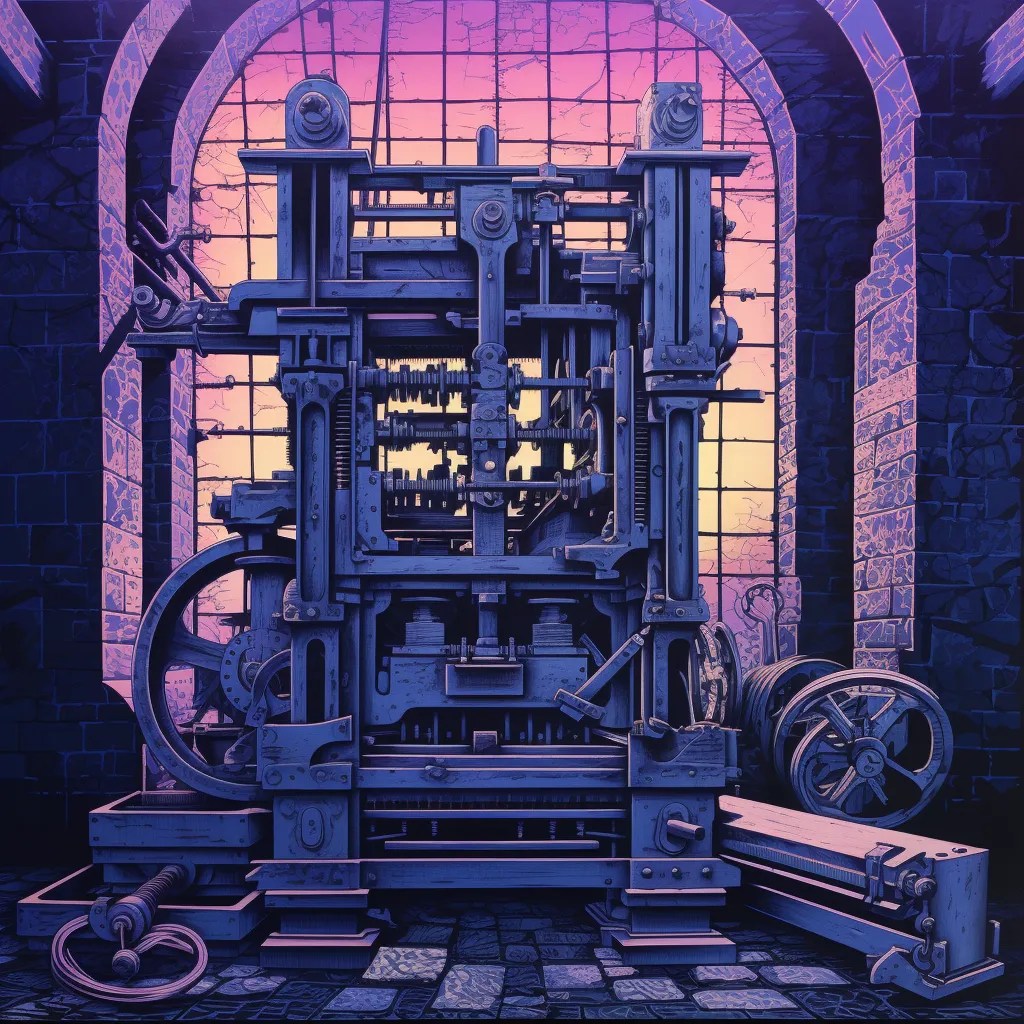
If an AI-infused web is the future, what can we learn from the past? Jeff Jarvis has some provocative thoughts…
The Gutenberg Parenthesis—the theory that inspired my book of the same name—holds that the era of print was a grand exception in the course of history. I ask what lessons we may learn from society’s development of print culture as we leave it for what follows the connected age of networks, data, and intelligent machines—and as we negotiate the fate of such institutions as copyright, the author, and mass media as they are challenged by developments such as generative AI.
Let’s start from the beginning…
In examining the half-millennium of print’s history, three moments in time struck me:
- After Johannes Gutenberg’s development of movable type in the 1450s in Europe (separate from its prior invention in China and Korea), it took a half-century for the book as we now know it to evolve out of its scribal roots—with titles, title pages, and page numbers. It took another century, until this side and that of 1600, before there arose tremendous innovation with print: the invention of the modern novel with Cervantes, the essay with Montaigne, a market for printed plays with Shakespeare, and the newspaper.
- It took another century before a business model for print at last emerged with copyright, which was enacted in Britain in 1710, not to protect authors but instead to transform literary works into tradable assets, primarily for the benefit of the still-developing industry of publishing.
- And it was one more century—after 1800—before major changes came to the technology of print: the steel press, stereotyping (to mold complete pages rather than resetting type with every edition), steam-powered presses, paper made from abundant wood pulp instead of scarce rags, and eventually the marvelous Linotype, eliminating the job of the typesetter. Before the mechanization and industrialization of print, the average circulation of a daily newspaper in America was 4,000 (the size of a healthy Substack newsletter these days). Afterwards, mass media, the mass market, and the idea of the mass were born alongside the advertising to support them.
One lesson in this timeline is that the change we experience today, which we think is moving fast, is likely only the beginning. We are only a quarter century past the introduction of the commercial web browser, which puts us at about 1480 in Gutenberg years. There could be much disruption and invention still ahead. Another lesson is that many of the institutions we assume are immutable—copyright, the concept of creativity as property, mass media and its scale, advertising and the attention economy—are not forever. That is to say that we can reconsider, reinvent, reject, or replace them as need and opportunity present…
Read on for his suggestion for a reinvention of copyright: “Gutenberg’s lessons in the era of AI,” from @jeffjarvis via @azeem in his valuable newsletter @ExponentialView.
* Mary Wollstonecraft Shelley, Frankenstein
###
As we contemplate change, we might spare a thought for Jan Hus. A Czech theologian and philosopher who became a Church reformer, he was burned at the stake as a heretic (for condemning indulgences and the Crusades) on this date in 1415. His teachings (which largely echoed those of Wycliffe) had a strong influence, over a century later, on Martin Luther, helping inspire the Reformation… which was fueled by Gutenberg’s technology, which had been developed and begun to spread in the meantime.

“Cogito, ergo sum”*…

Rene Descartes (and here), who laid the foundation for modern rationalism and ignited the interest in epistemology that began to grow in the 17th century, been called the father of modern philosophy. Erik Hoel argues that he had very influential help…
Princess Elisabeth of Bohemia—the first person to fully understand the paradoxical nature of the mind-problem, a mathematician, the possible romantic interest of Descartes, and an eventual abbess—was born in 1618, and lived in exile with her family in the Netherlands, a political refuge after her father’s brief reign. Her father’s rule had ended after he lost what was called the “Battle of the White Mountain,” for which he would be known via the sobriquet “the winter king,” having been in power for merely a season.
Elisabeth was a great philosopher in her own right—whip-smart and engaged by the intellectually stimulating times, she maintained numerous correspondences throughout her life on all manner of subjects. For her learning, within her family she was known as “the Greek,” and this was in a set of siblings that included an eventual king, another brother who was a famous scientist in addition to being a co-founder of the Hudson’s Bay Company, another sister who was a talented artist, and a further sister who was the eventual patron of Leibniz. Mathematician, philosopher, theologian, and politician, Elisabeth was, in her day, an important hub in that republic of letters that would become science.
The princess and Descartes only met in person a few times, but maintained a long correspondence over the years, exchanging a total of fifty-eight letters that have survived (more may not have). The correspondence began in 1643, and would last, on and off, until Descartes’s surprising death in 1650 (he died of pneumonia after being forced to wake early in the morning and walk through a cold castle to tutor a different and far more demanding queen). In the princess and the philosopher’s letters, Descartes usually signed off with “Your very humble and very obedient servant” and Elisabeth with “Your very affectionate friend at your service.”
Their letters are vivid historical reading—the two’s repartee is funny and humble and courteous, intimate and yet respectful of the difference in their classes (Elisabeth’s far above Descartes’s); but they also dig deep into Descartes’s philosophy, with Elisabeth always probing at holes and Descartes always on the defensive to cover them…
Philosophical letters from a possible Renaissance romance: “The mind-body problem was discovered by a princess,” from @erikphoel.
For more, see: “Princess Elizabeth on the Mind-Body Problem” (source of the image above) and Elizabeth’s entry in the Stanford Encyclopedia of Philosophy.
And for the likely inspiration for Descartes’ most famous phrase– St. Teresa of Ávila– see “One of Descartes’ most famous ideas was first articulated by a woman.”
* Rene Descartes
###
As we duel with duality, we might spare a thought for Buddhadasa (born Phra Dharmakosācārya). A Thai ascetic-philosopher, he was an innovative reinterpreter of Buddhist doctrine and Thai folk beliefs who fostered a reformation in conventional religious perceptions in his home country and abroad.
Buddhadasa developed a personal view that those who have penetrated the essential nature of religions consider “all religions to be inwardly the same,” while those who have the highest understanding of dhamma feel “there is no religion.”

“I don’t believe in astrology; I’m a Sagittarius and we’re skeptical.”*…

(Roughly) Daily has looked at almanacs before (e.g., here and here), but never with an eye to their astrological underpinnings. Livia Gershon plugs that gap…
Some Christians today see astrology as a clear affront to their beliefs, and possibly a dangerous manifestation of the occult. And yet, as historian T.J. Tomlin writes, through the eighteenth century, it was a central aspect of the almanacs that were ubiquitous in Protestant American homes.
By 1800, Tomlin writes, U.S. printers produced enough almanacs to provide one to every household in the country. People turned to the books for a clear, simple idea of how the universe worked. Their astrological calculations helped readers gain practical know-how about agricultural management, weather, and personal health.
…
Like the study of the natural world in general in that time and place, almanacs were rooted in Protestantism. They presented simple, widely held religious ideas—God’s power, redemption through Christ, the promise of heaven—to an increasingly literate public. “This was the liturgy of early American popular culture,” Tomlin writes.
But there were debates about what sort of astrology was compatible with this religious belief. “Natural astrology,” using the movements of heavenly bodies to draw conclusions about agriculture, medicine, and the weather, was widely regarded as “a way to illuminate God’s creative impulse in the universe,” Tomlin writes. But “judicial astrology,” predicting the events of individual lives or political affairs, might be seen as blasphemous…
Wildly popular, almanacs helped people understand farming and health through the movement of the planets, in a way compatible with their faith: “The Protestant Astrology of Early American Almanacs,” from @LiviaGershon in @JSTOR_Daily.
* Arthur C. Clarke
###
As we study the stars, we might send multi-faceted birthday greetings to the painter, sculptor, architect, musician, mathematician, engineer, inventor, physicist, chemist, anatomist, botanist, geologist, cartographer, and writer– the archetypical Renaissance Man– Leonardo da Vinci. Quite possibly the greatest genius of the last Millennium, he was born on this date in 1452.
While Leonardo’s attention (and thus his notebooks) extended to astronomy, there’s no evidence that he believed in astrology. That said, his chart has been cast myriad times (e.g., here).

Self-portrait in red chalk, circa 1512-15 [source]
“I really do believe in the New Jerusalem. I really do believe that we can all become better than we are. I know we can. But the price is enormous and people are not yet willing to pay it.”*…

A map to the promised land…
In his fifth-century commentary on Ezekiel’s vision of New Jerusalem, Jerome quotes the Aeneid, likening the path of salvation to a minotaur’s maze: “‘As once in lofty Crete the labyrinth is said to have had a route woven of blind walls’ . . . . So I, ente[r] the ocean of those scriptures and, so to speak, the labyrinth of God’s mysteries, of whom it is said ‘He made darkness his covert’ and ‘there are clouds in his circuit’.”
This 1705 maze (Dool-hoff), signed by the Dutch Catholic printer Claes Braau, also comes with clouded pathways, but here the way to New Jerusalem is cobbled by didactic verse. The broadsheet’s four dead-ends are burnished with spiritual gravity by its epigraphs: “There is a way which seemeth right unto a man, but the end thereof are the ways of death” (Proverbs 14.12) and “See then that ye walk circumspectly, not as fools, but as wise” (Ephesian 5:15). Each pathway is paved with texts that narrate vocational and moral choices at various lengths. The road dedicated to economic wealth is full of twists and turns, but ultimately leads to the same fate as the short meander through a trench describing vanity: your journey’s abrupt termination. Choosing the “wrong path” forces the puzzler to backtrack, should they want to meet the Lamb of God at the maze’s center. Luckily, there are many ways to reach salvation, such as by studying the seven liberal arts.
The Dool-hoff was published in Haarlem during a period when neighboring Amsterdam was awash with secular mazes. “Doolhof inns,” a type of surreal public house, became increasingly popular in the seventeenth-century, treating tipsy patrons to mechanical statues, uncanny waxworks, and disorienting hedge mazes. Claes Braau’s Dool-hoff strayed from the path of these “astonishing and unprecedented novelties”, in Angela Vanhaelen’s words, and their “Bacchic conviviality.” Instead, it drew upon an older Christian tradition, represented by cathedral labyrinths like the one at Chartres, which W. H. Matthews hypothesized might reference “the various degrees of beatitude by which the soul approaches heaven, as figured by Dante.” That is, a byzantine journey through the labyrinth of the world toward a paradise of the heart. In its marriage of text and spatial warren, the Dool-hoff formally recalls the script labyrinth of Johann Neudörffer (1539), the Geistlich Labyrinth of Eberhard Kieser (1611), and several other precursors…
The remarkable story of a remarkable document: “Dool-Hoff: A Dutch Maze with New Jerusalem at its Centre” (where you’ll find a larger version of the picture above), from @PublicDomainRev.
The translation of the text in the paths is here. You can also view the maze in the Rijksmuseum Collection on the Internet Archive.
* James Baldwin
###
As we find our ways, we might recall that it was on this date in 398 that the man we now know as St. John Chrysostom became the Bishop of Alexandria. An ascetic who railed against abuses of authority, he was a wisely-admired preacher, whose oratorial gifts earned him the name Chrysostom (“golden-mouth”). He was exiled in 403 for his outspoken criticism of his congregation, including Empress Eudoxia. After the church recalled him, he again offended Eudoxia, who exiled him again. He died three years later, in 407.
John is honored as a saint in the Oriental Orthodox, Eastern Orthodox, Catholic, Anglican, and Lutheran churches, among others.

“Look up at the stars and not down at your feet. Try to make sense of what you see, and wonder about what makes the universe exist.”*…

Our environment…
This map shows a slice of our Universe. It was created from astronomical data taken night after night over a period of 15 years using a telescope in New Mexico, USA. We are located at the bottom. At the top is the actual edge of the observable Universe. In between, we see about 200,000 galaxies.
Each tiny dot is a galaxy. About 200,000 are shown with their actual position and color. Each galaxy contains billions of stars and planets. We are located at the bottom. Our galaxy, the Milky Way, is just a dot. Looking up, we see that space is filled with galaxies forming a global filamentary structure. Far away from us (higher up in the map), the filaments become harder to see…
For a (much crisper, more vivid, and interactive) version: “The Map of the Observable Universe.”
* Stephen Hawking
###
As we explore, we might recall that it was on this date in 1616 that The Minutes of the Roman Inquisition recorded the conclusion that Galileo’s writings in support of Copernicus’ heliocentric view of the solar system were “foolish and absurd in philosophy, and formally heretical since it explicitly contradicts in many places the sense of Holy Scripture.” The next day, Galileo was called before Cardinal Bellarmine, who (on Pope Paul V’s instruction) ordered Galileo to abandon the teaching. Shortly thereafter, Copernicus’s De Revolutionibus and other heliocentric works were banned (entered onto the Index Librorum Prohibitorum) “until correction.”
Sixteen years later, Galileo “published” Dialogue Concerning the Two Chief World Systems (Dialogo sopra i due massimi sistemi del mondo)– that’s to say, he presented the first copy to his patron, Ferdinando II de’ Medici, Grand Duke of Tuscany. Dialogue, which compared the heliocentric Copernican and the traditional geo-centric Ptolemaic systems, was an immediate best-seller.
While there was no copyright available to Galileo, his book was printed and distributed under a license from the Inquisition. Still, the following year it was deemed heretical– and he joined Copernicus on the Index Librorum Prohibitorum: the publication of anything else Galileo had written or ever might write was also banned… a ban that remained in effect until 1835.

You must be logged in to post a comment.