Archive for November 2024
“We live in an age when the traditional great subjects – the human form, the landscape, even newer traditions such as abstract expressionism – are daily devalued by commercial art”*…

… But it wasn’t always so. A current exhibit at the Metropolitan Museum in New York is devoted to the work of (often anonymous) artists who illustrated commercial catalogs in the late 19th and early 20th centuries…
Art of Commerce: Trade Catalogs in Watson Library features a selection of the library’s extensive holdings of sale catalogs. Watson Library has almost two thousand trade catalogs published in many countries from the eighteenth century to the present. Objects featured include furniture, jewelry, tiles, ironwork, glasswork, lighting, stoves, tableware, textiles, decorative paper, artist’s materials, fashion, typography, automobiles, and musical instruments. Numerous catalogs illustrate works of art or related objects now in The Met collection.
The library has strong holdings of Art Deco trade catalogs including Modern furniture design = Le dessin moderne des meubles—a colorful furniture portfolio by Czech architect Karel Vepřek—and Van Clef Arpels présentent, an elegantly illustrated accessories publication designed by Draeger Frères, the most innovative graphic designers and printers of the period. Both catalogs are on display in the exhibition.
Trade or sale catalogs — also called commercial or manufacturer’s catalogs —are printed publications advertising products of a particular trade or industry. Sale catalogs were often used in shops or showrooms to promote a company’s products. Examples include the massive Reed and Barton catalog Artistic workers in silver & gold plate from 1885 that illustrates the entire inventory of the company…
Among the more unusual and appealing trade catalogs in the exhibition is a German Art Nouveau-inspired cake decorating book from 1910 and a baby carriage catalog from 1934 offering Art Deco styled tubular steel baby prams. These trade catalogs demonstrate the distillation of major art movements applied to quotidian objects.
The earliest trade catalog in the exhibition is Muster zu Zimmer-Verzierungen und Ameublements, a neo-classical interior design catalog by luxury German manufacturer Voss und Compagnie, offering entire rooms that can be bought en masse or as separate pieces. It is illustrated with richly toned hand-colored engravings that detail the design and color of the objects.
One of the library’s most fragile and weighty catalogs is Album des principaux modeles de verres: produits spéciaux en verre coulé. It is a magical trade catalog with sixty-five intact glass samples manufactured by French glassmaker Saint-Gobain. Founded during the time of Louis XIV, the company remains a manufacturer of glass for construction.
The majestic ironwork catalogue of Maison Garnier has pink-tinted papers and was bound in Morocco leather as a special copy for Rémy Garnier, the son of the firm’s founder. The firm’s initials are boldly blind stamped on the cover.
The most unusual and perhaps unexpected catalog, Urinoirs, illustrates the decorative ironwork structures of urinals (or pissoirs) that adorned the streets of Paris from the 1840s to the mid-twentieth century. The ornamentation of these structures demonstrates an impulse to beautify the animated street life of Paris and other cities…
See the items mentioned at the links above, and other articles in the exhibit here.
Beauty in the service of business: “Art of Commerce: Trade Catalogs in Watson Library,” from @metmuseum (where one can see the works on exhibit through March 4, 2025).
* Andy Warhol
###
As we browse, we might spare a thought for Oscar Fingal O’Flahertie Wills Wilde; the novelist, essayist, playwright, poet, and master of the bon mot died on this date in 1900.
As he said: “There are moments when art attains almost to the dignity of manual labor.”

“Only connect!”*…

… Mobile phone companies are doing their best to oblige– and so far over half of the world’s population is connected to mobile internet. But as Khadija Alam and Russell Brandom report (in the indispensable Rest of World) growing that number is getting harder. (Read to the end for a twist)…
When Facebook hit 1 billion users in 2012, CEO Mark Zuckerberg said that when it comes to getting another billion users, “The big thing is obviously going to be mobile.” In an interview at the time, Zuckerberg told Bloomberg, “As more phones become smartphones, it’s just this massive opportunity.”
Clearly, he was correct. A recent survey from Global System for Mobile Communications Association Intelligence (GSMA), the research wing of a U.K.-based organization that represents mobile operators around the world, found that 4.6 billion people across the globe are now connected to mobile internet — or roughly 57% of the world’s population.
Now, the rate of new mobile internet subscriber growth is slowing. From 2015 to 2021, the survey consistently found over 200 million coming online through mobile devices around the world each year. But in the last two years, that number has dropped to 160 million. Rest of World analysis of that data found that a number of developing countries are plateauing in the number of mobile internet subscribers. That suggests that in countries like Pakistan, Bangladesh, Nigeria, and Mexico, the easiest populations to get online have already logged on, and getting the rest of the population on mobile internet will continue to be a challenge. GSMA collects data by surveying a nationally representative sample of people in each country, and then it correlates the results with similar studies.
Max Cuvellier Giacomelli, the head of the Mobile for Development program at GSMA, said that large swaths of the world’s population still don’t have access to mobile internet primarily because of affordability. Although the cost of data has dropped radically in recent years, the International Telecommunication Union, a UN agency focused on information and communications technologies, notes that huge disparities between regions persist. The cost of data in Africa, for example, is more than twice that of the Americas, the second most expensive region…
… In countries including China, the U.S., and Singapore, a high share of the population is already connected to mobile internet — 80%, 81%, and 93%, respectively. So it’s no surprise that the rate of mobile internet subscriptions has slowed.
But the rate of new users has also slowed in countries including Bangladesh, Nigeria, and Pakistan — where only 37%, 34%, and 24% of the population currently use mobile internet.

Coverage continues to be a challenge, although data suggests that the issue is improving relatively quickly. Just 350 million people across the world, or 4% of the global population, still live in areas that are not covered by a mobile broadband network. According to GSMA, sub-Saharan Africa has the highest coverage gap of any global region. But between 2021 and 2023, mobile coverage in this area expanded from 83% to 87%.
Furthermore, recent advances in satellite technology have the potential to close this coverage gap by bringing mobile internet networks to rural or remote areas that lack mobile infrastructure. SpaceX’s Starlink, for example, is now available in over 100 countries and provides a roaming plan…
… Even in countries with high rates of mobile internet subscription, there are still stubborn pockets of people with no mobile internet access. In China, for example, 80% of the population has access to mobile internet. But subscription rates among the remaining 280 million people are slowing. Recent advances in satellite technology could bring mobile internet to new users in the country, especially in rural areas. In August, China began launching a satellite internet network [the Qianfan Constellation], set to rival SpaceX’s Starlink, in an effort to bring everyone online.
What happened to the “next billion” internet users? They’re already online: “New data shows the number of new mobile internet users is stalling,” from @khadijaalam_ and @russellbrandom in @restofworld.
Your correspondent finds himself pondering the final sentence in the piece: While the on-boarding of the unconnected 47% may be the result of a patchwork of local efforts, it’s clearly the goal of Starlink and the Qianfan Constellation to centralize connectivity… and the company– or government or culture– that controls the means of communication has a great deal of influence on what gets communicated and how. Nearly half the world’s population is in play, with all that that entails for geopolitics and geoeconomics; for example, see here (and the links therein)…
* E. M. Forster, Howards End
(R)D will be on its traditional Thanksgiving hiatus from today. Regular service will resume when we’re clear of Black Friday…
###
As we contemplate connectivity, we might recall that it was on this date in 1995 that Microsoft released Internet Explorer 2.0…
Nearly 6 months to the day after Bill Gates sent his Internet Tidal Wave memo recognizing the importance of the Internet, and only 3 months after releasing version 1.0, Microsoft releases Internet Explorer 2.0 for Windows 95 and Windows NT 3.5. IE 2.0 was still based on licensed code from Spyglass Mosaic, but was the first IE version to support now-common features such as SSL, JavaScript, and cookies. It was also the first version to allow the importing of bookmarks from Netscape Navigator, which at the time had a virtual monopoly on the web browser market. This was the first inklings of the “browser war” that was soon to erupt over the next few years.
– source

“One cannot conceive anything so strange and so implausible that it has not already been said by one philosopher or another”*…

Wisdom for the exquisite Existential Comics (“A philosophy comic about the inevitable anguish of living a brief life in an absurd world. Also jokes.”)…


Frege was an early philosopher of language, who formulated a theory of semantics that largely had to do with how we form truth propositions about the world. His theories were enormously influential for people like Russel, Carnap, and even Wittgenstein early in his career. They all recognized that the languages we use are ambiguous, so making exact determinations was always difficult. Most of them were logicians and mathematicians, and wanted to render ordinary language as exact and precise as mathematical language, so we could go about doing empirical science with perfect clarity. Russell, Carnap, and others even vowed to create an exact scientific language (narrator: “they didn’t create an exact scientific language”).
Later on, Wittgenstein and other philosophers such as J.L. Austin came to believe that a fundamental mistake was made about the nature of language itself. Language, they thought, doesn’t pick out truth propositions about the world at all. Speech acts were fundamentally no different than other actions, and were merely used in social situations to bring about certain effects. For example, in asking for a sandwich to be passed across the table, we do not pick out a certain set of facts about the world, we only utter the words with the expectations that it will cause certain behavior in others. Learning what is and isn’t a sandwich is more like learning the rules of a game than making declarations about what exists in the world, so for Wittgenstein, what is or isn’t a sandwich depends only on the success or failure of the word “sandwich” in a social context, regardless of what actual physical properties a sandwich has in common with, say, a hotdog.
“Is a Hotdog a Sandwich? A Definitive Study,” from @existentialcomics.com.
* René Descartes
###
As we add mayonnaise, we might send thoughtful birthday greetings to Norbert Wiener; he was born on this date in 1894. A computer scientist, mathematician, and philosopher, Wiener is considered the originator of cybernetics, the science of communication as it relates to living things and machines– a field that has had implications for implications for a wide variety of fields, including engineering, systems control, computer science, biology, neuroscience, and philosophy. (Wiener credited Leibniz as the “patron saint of cybernetics.)
His work heavily influenced computer pioneer John von Neumann, information theorist Claude Shannon, anthropologists Margaret Mead and Gregory Bateson, and many others. Wiener was one of the first to theorize that all intelligent behavior was the result of feedback mechanisms and could possibly be simulated by machines– an important early step towards the development of modern artificial intelligence.

“The past lives within the present, and our ancestors breathe through our children”*…
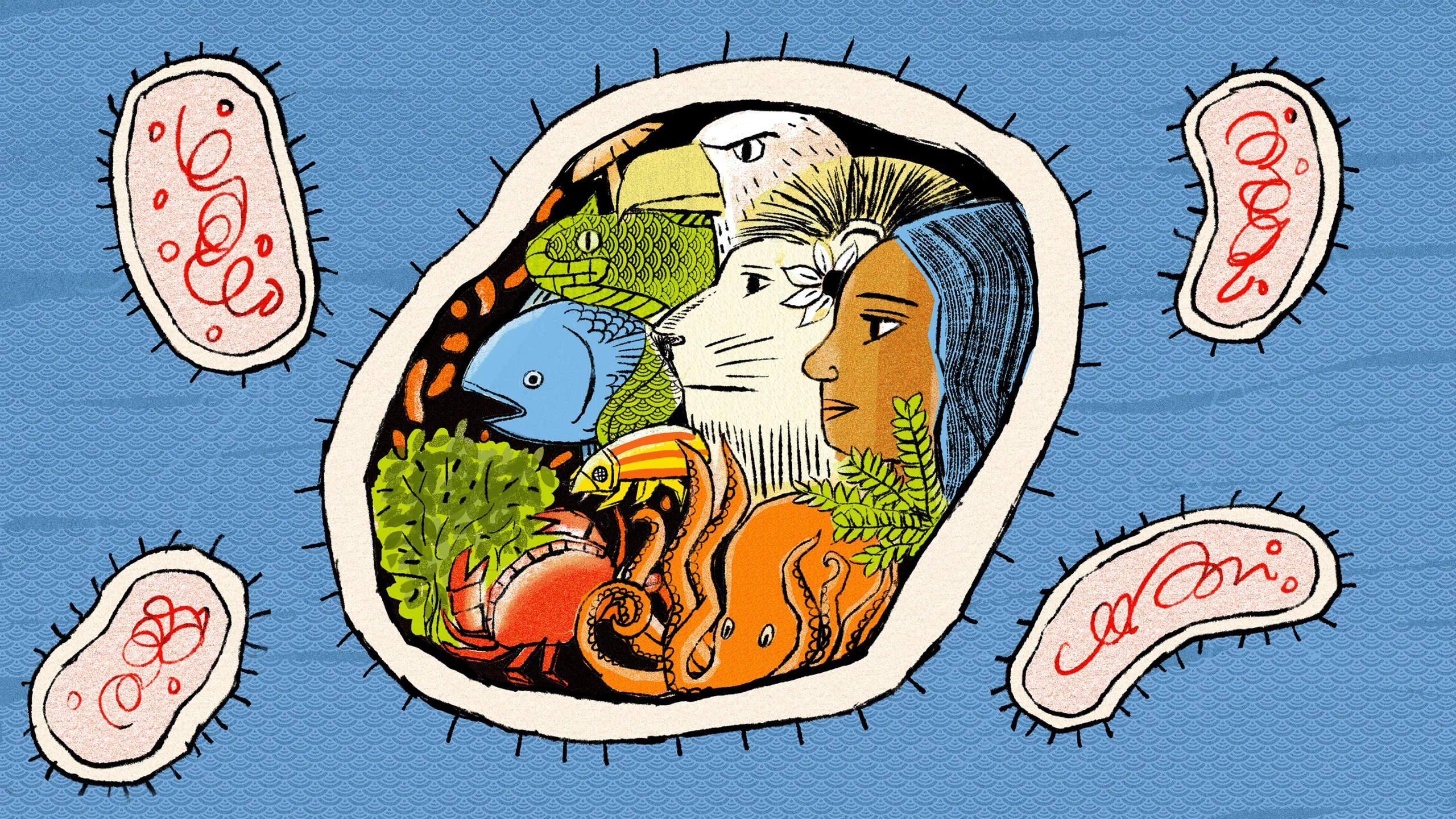
Indeed, that’s true all the way back. And as Jonathan Lambert explains, we now have more visibility on that distant past. The emerging understanding of our “last universal common ancestor” suggests it was a relatively complex organism living 4.2 billion years ago, a time long considered too harsh for life to flourish…
If you follow any path of ancestry back far enough, you’ll reach the same single point. Whether you begin with gorillas or ginkgo trees or bacteria that live deep in the bowels of the Earth — or yourself, for that matter — all roads lead to LUCA, the “last universal common ancestor.” This ancient, single-celled organism (or, possibly, population of single-celled organisms) was the progenitor of every varied form that makes a life for itself on our planet today.
LUCA does not represent the origin of life, the instance whereby some chemical alchemy snapped molecules into a form that allowed self-replication and all the mechanisms of evolution. Rather, it’s the moment when life as we know it took off. LUCA is the furthest point in evolutionary history that we can glimpse by working backward from what’s alive today. It’s the most recent ancestor shared by all modern life‚ our collective lineage traced back to a single ancient cellular population or organism.
“It’s not the first cell, it’s not the first microbe, it’s not the first anything, really,” said Greg Fournier, an evolutionary biologist at the Massachusetts Institute of Technology. “In a way, it is the end of the story of the origin of life.”
Still, understanding LUCA — whether it was simple or complex, and how quickly it emerged after life’s origin — could help answer some of our deepest questions about where we come from and whether we’re alone in the universe.
“[LUCA] tells our own story,” said Edmund Moody (opens a new tab), an evolutionary biologist at the University of Bristol. “It gives us a point from which we can look even further back.”
For half a century, biologists have focused on different kinds of physiological, genomic and fossil evidence to paint portraits of LUCA that sometimes clash dramatically. In 2024, Moody and a team of interdisciplinary researchers, including geologists, paleontologists, system modelers and phylogeneticists, combined their knowledge to build a probabilistic model that reconstructs modern life’s shared ancestor and estimates when it lived.
The analysis, published in Nature Ecology and Evolution in July, sketched a surprisingly complex picture of the cell. LUCA lived off hydrogen gas and carbon dioxide, boasted a genome as large as that of some modern bacteria, and already had a rudimentary immune system, according to the study. Its genomic complexity, the authors argue, suggests that LUCA was one of many lineages — the rest now extinct — living about 4.2 billion years ago, a turbulent time relatively early in Earth’s history and long thought too harsh for life to flourish.
The analysis reaches two conclusions that seem in conflict with each other, according to Aaron Goldman, who studies the molecular evolution of early life at Oberlin College and wasn’t involved in the new research. “The first is that LUCA was a complex cellular organism that likely lived in a complex ecological setting,” he said. “The second is that LUCA dates to a time that is pretty early in the history of Earth.” The results could mean that life evolved from a simple replicator into something resembling modern microbes remarkably quickly, he said. “That’s really exciting.”
“Our work suggests that those early steps of evolution weren’t hard; they’re pretty easy,” said co-author Phil Donoghue, an evolutionary biologist at the University of Bristol. “If you’re concerned with the origin of microbial-grade life, then that’s apparently very easy, and it should be quite common in the universe.”
Not all experts in the field agree, however. Some argue that a few hundred million years is not enough time for complex life to have evolved. The authors stress that their analysis is a first attempt to paint a fuller, admittedly fuzzy, picture of LUCA. “I fully expect and hope people prove us wrong in certain aspects,” said Moody, the paper’s lead author, especially if those new results offer a clearer view of the ancient ancestor of all life we know…
Eminently worth reading in full: “All Life on Earth Today Descended From a Single Cell. Meet LUCA,” from @evolambert in @QuantaMagazine.
###
As we look back, we might send microscopic birthday greetings to Lewis Thomas; he was born on this date in 1913. A physician, poet, etymologist, essayist, administrator, educator, policy advisor, and researcher, he distinguished himself in medicine and microbiology both for his suggestion that an immunosurveillance mechanism protects us from the possible ravages of mutant cells (an idea later championed by Macfarlane Burnett) and for his proposal that viruses have played a major role in the evolution of species by their ability to move pieces of DNA from one individual or species to another.
But Lewis is more widely known for his writing, perhaps most especially for his first two books– The Lives of a Cell: Notes of a Biology Watcher (which won National Book Awards in two categories) and The Medusa and the Snail: More Notes of a Biology Watcher (which won another National Book Award)– which underscored the interconnectedness of life by sketching the ways that what is seen under the microscope is similar to the way human beings live.

“It turns out that we’re actually capable of something other than neoliberalism and actually we’re really capable of enjoying ourselves more than we do under neoliberalism”*…

… but the path from here to there, the estimable Brad DeLong warns, could be overcast. In notes for his lectures to his Econ 135 class at Berkeley (“The History of Economic Growth,” shared in his terrific newsletter, Grasping Reality) he begins with an explanation of neoliberalism [also explained here– source of the image above], then considers what might be next…
So what is coming after neoliberalism?
First, one thing that is coming, at least here in America, is renewed or perhaps novel attention to places. Places have never been important in American identity. American identity has, instead, long been defined by a focus on mobility and opportunity. Americans are people who have moved to new places—undertaken errands unto the Wilderness—precisely because of the mistakes being made in and the limitations circumscribing their choices where they were. Americans are people who have abandoned some Old World because of its mistakes, and have moved to a New World to remake themselves and make a new society that will at least make different mistakes. The promise of more abundant resources and the chance to build a better life has driven this pattern of migration and reinvention. Thus the advice given to those who find their birth-region constraining or insufficiently prosperous has always been “go west!”: move to opportunity.
My Richardson ancestors were farmers in the hilly, rocky terrain of New England in the 1840s. Farming the land was difficult. To say that New England soil is “stony” is to greatly understate the case, as you can see even today from the ubiquitous stone walls found throughout New England all built from rocks that had to be removed from the fields before farming could even begin.
The Richardson family decided to leave New Hampshire and traveled down the Ohio River to St. Louis, where they established a pharmaceutical company: the Richardson Drug Company. The family story is that they specialized in cocaine—legal at the time, and their cocaine products were very low concentration, nothing like lines or crack. But, still, my ancestors became the very first cocaine pushers west of the Mississippi in St. Louis. The company was quite successful for two generations. Then, one New Year’s Day, a catastrophic fire destroyed their chemical plant. The fire department was, the story goes, slow to respond, as they were recovering from New Year’s Eve. And how does a catastrophic fire start when the plant is entirely shut down for the holiday. I am suspicious of my ancestors.
Rather than rebuild the plant, the Richardsons opted to take the large insurance settlement and shift their focus to banking. The course of the Richardsons is thus a very American story: change who you are and what you are doing and where you are doing several times over the course of even a few generations.
The Neoliberal Order was about capitalism but it was also about freedom. And one aspect of this freedom was freedom to successfully organize to resist being dominated by the behemoths of the New Deal Order: Big Government, Big Business, Big Labor, and also Big Cultural Expectations. The assumption that your husband should get a job with a large corporation and commute by car as you moved to suburbia and that you alone should raise the children was an essential part of the New Deal Order. And it called forth a middle-class feminist rebellion. The assumption that Blacks should largely stay in their place and be happy with slow advances toward equal rights and a small share of the benefits from social-insurance programs was an essential part of the bargains in the 1930s that formed the New Deal Order. The Black Civil Rights movement was not in itself neoliberal, but was an expression of the underlying anti-system anti-bureaucracy current. And with respect to land-use planning—Big Government bureaucrats should not be able to assist Big Finance money and Big Business bulldozers to order you around and bulldoze and “renew” your community. It was individual unbureaucratic enterpreneurship that was supposed to be beautiful. Hence NIMBYism (Not In My Backyard-ism) as we know it today is an important piece of the Neoliberal Order, as it actually was on the ground.
Consider San Francisco’s Embarcadero Freeway, an 8-story, 90-foot high structure that blocked views of the ocean and bay. Residents preferred to maintain the open views rather than prioritize faster commutes for drivers from Marin County. This was seen as a victory for rational, people-centered development at the time. And the post-1989 earthquake removal of the initial parts of the Embarcadero Freeway was a huge win—it resulted in a much more pleasant and open waterfront area for residents and visitors to enjoy.
But in the long run NIMBYism has been a disaster. Berkeley houses no more people now than it did fifty years ago. So housing prices have skyrocketed, and the guy who runs the Little Farm Children’s Center in Tilden Park has to commute from beyond the Altamont Pass.
NIMBYism killed America’s tradition of moving to opportunity stone dead. This has been a very powerful if indirect cause of rage against The Neoliberal Order Machine. Thus the growing call for place-based policies to make opportunity move to where people are, instead of assuming people will move to opportunity. The Polanyian right to the land—to keep Schumpeterian creative-destruction from destroying your community as a side-effect of its pursuit of profit—is and will take a more prominent role in whatever comes after the Neoliberal Order.
Second, the “after” will include explicit industrial policies. The Neoliberal Order was about hyperglobalization. Under the Neoliberal Order it was assumed that free trade and laissez-faire policies were beneficial for all. They were beneficial for the Global North as they heightened the concentration of high-value and high-externality activities like science, engineering, and worthwhile manufacturing within itself. And they were beneficial for the Global South because only the threat that economic activity and talented people would leave could curb the predatory instincts of Global South governments. The concerns of economists like W. Arthur Lewis that trade in a globalized market on terms increasingly tilted against primary products actually developed the fact of underdevelopment were pushed to one side.
But now the assumption that free trade works to concentrate high-value and high-externality activities like science, engineering, and worthwhile manufacturing in the United States is very much in doubt. The CHIPS Act of the Biden administration signals the end of the belief that the global market was working in America’s favor. The CHIPS Act represents a shift away from the implicit acceptance of the global market’s inequities now that they no longer seem to be working so strongly in America’s favor. Instead, there is now a demand for more explicit industrial policies as an alternative..
Third, the “after” will include a strong demand for champions of the people. There is growing recognition that neoliberalism has led to an unfair domestic plutocracy. The 2008 Republican presidential and vice-presidential ticket was almost composed of individuals who collectively owned 20 houses—John McCain owned 12 houses, and Mitt Romney owned 8. Political advisors felt that that foreclosed choosing Romney as likely to make the ticket look ridiculous, and so they prevailed on McCain to choose the very odd Alaska Governor Sarah Palin insted.
What to do about plutocracy, where there is a growing belief that the system is working not for the people but for the super-rich and for their rootless cosmopolite allies and clients? Power requires countervailing power. Hence what is needed is someone powerful to vindicate the interests of the common people, rather than of some privileged élite: a strongman to disrupt the status quo and the inertia of “business as usual”.
It has never been the case that the “strongman” has to come from the people. Indeed, often in history a plutocrat, oligarch, or aristocrat has been preferred—a “class traitor” as other members of Harvard’s Porcellian Society whispered about their fellow member, New Deal President Franklin Delano Roosevelt. The idea is that only someone who has thoroughly benefitted from being in the system and knows it inside and out will know enough about its vulnerability to be able to disrupt it.
Analogously, consider Andrew Jackson. He positioned himself as a defender of the common people against the system—land speculators, Philadelphia financiers, and corrupt politicians who together made sure that the people could not prosper as America grew.vJackson presented himself as an outsider who would protect the interests of the “Kentucky frontiersmen” against the domestic élite, even though he himself was no true frontiersman.
Indeed, the earliest examples of strongman politicians overthrowing existing oligarchic systems to vindicate at least the short-run interests of a broader “people” come from the early days of Classical Hellenic civilization. Peisistratos, Tyrant of Athens in the -500s, is the prime historical example. The Tyrants abolished debt slavery, canceled the debts of the overindebted, and redistributed land more equitably—paving the way for the establishment of Hellenic democracy, which was a very attractive civilization as far as the societies of domination of those days went.
Unfortunately for us, the champions of the people being chosen today appear more fascist than populist—more interested in telling people what to do to make them followers to burnish the glory of the leader than in lifting the burdens from the people by cancelling the debts and redistributing the land—and more kleptocrat than plutocrat, with the leader’s skills more in running a con game than in understanding the workings of the system.
Fourth, what is coming after the Neoliberal Order appears to be a politics of fear: fear of the diverse, fear of the woke, fear of the other—whatever the other is, people who seem strange and weird—and fear of the rootless cosmopolite.
In the last analysis, the Neoliberal Order fell because it did not deliver the goods. Free markets and largely ineffectual gestures at freeing-up individual autonomy from bureaucracy were not enough to create a society where people felt at home, even if there was a great expansion of individual freedom to choose elsewise than commanded by formerly-dominant social norms. But the failure of the past Order did not in itself bring a new one into existence. In this sense we are in a similar period of uncertainty to that of the late 1920s and early 1930s. Back then, before he died in Mussolini’s jail, the Marxist thinker Antonio Gramsci observed: “The Old Order is dying, and the New Order appears perhaps to be stillborn: now is a time of monsters”…
Oh, to be able to go back to school… Eminently worth reading in full: “Neoliberalism & After,” from @delong.bsky.social. See also the notes from a proximate lecture: “Post-2010 “Polycrisis”: Culture, Communications, Politics, & War.”
* “It turns out that we’re actually capable of something other than neoliberalism and actually we’re really capable of enjoying ourselves more than we do under neoliberalism. It feels that if neoliberalism is first about privatizing desire and imagination before the economy, then we’re in this process of publicizing it again.” – Rebecca Solnit
###
As we fumble with the future, we might recall that it was on this date in 1968 that 60 Minutes, which had premiered two months earlier, introduced its trademark “ticking stopwatch” opening logo/transition. 60 Minutes is, of course, the most-watched television news show in history.

Since near the show’s inception in 1968, the opening of 60 Minutes features a stopwatch. The Aristo (Heuer) design first appeared in 1978. On October 29, 2006, the background changed to red, the title text color changed to white, and the stopwatch was shifted to the upright position. This version was used from 1992 to 2006 (the Square 721 type was changed in 1998). Source
You must be logged in to post a comment.