Posts Tagged ‘mutant cells’
“The past lives within the present, and our ancestors breathe through our children”*…
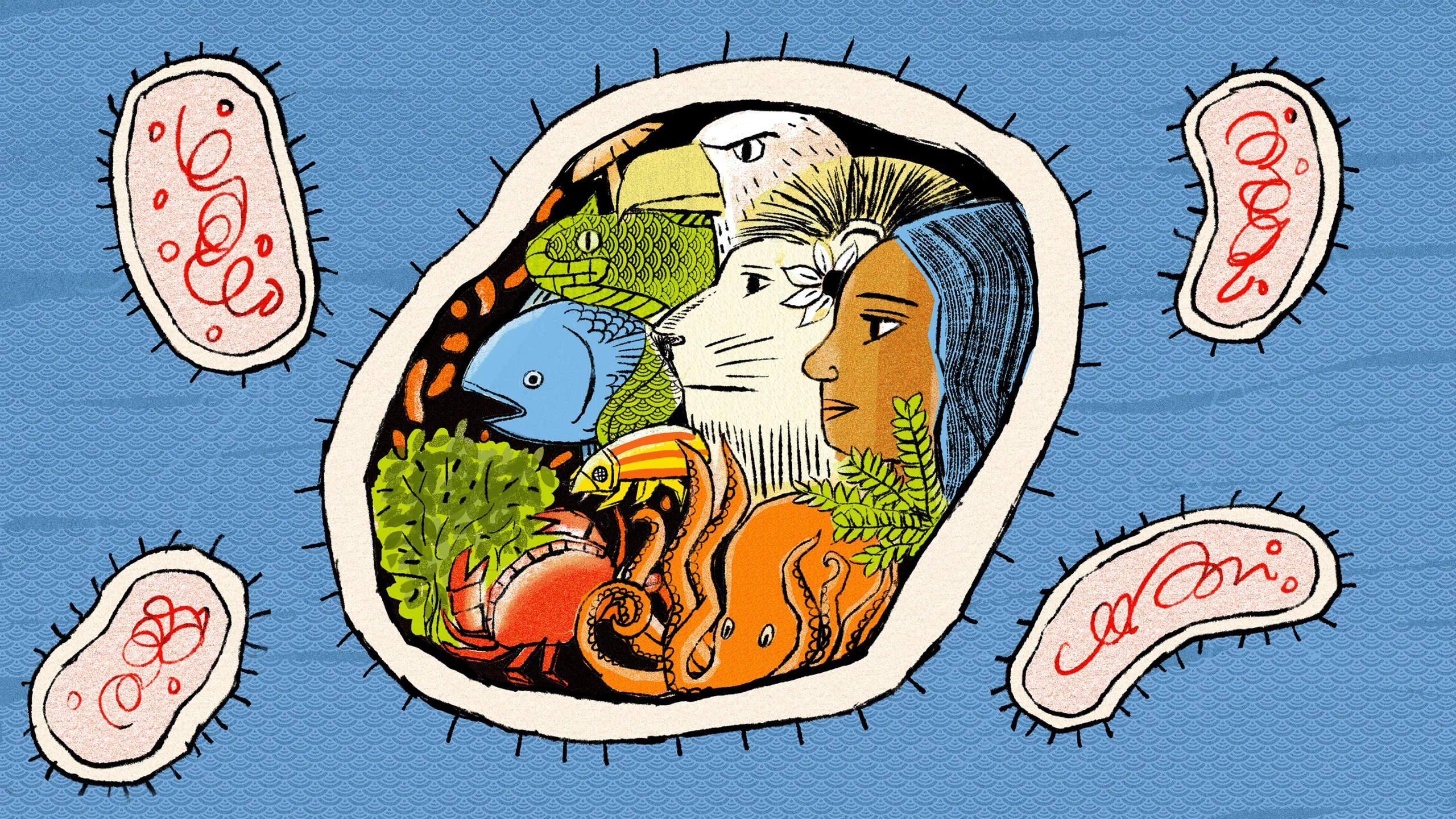
Indeed, that’s true all the way back. And as Jonathan Lambert explains, we now have more visibility on that distant past. The emerging understanding of our “last universal common ancestor” suggests it was a relatively complex organism living 4.2 billion years ago, a time long considered too harsh for life to flourish…
If you follow any path of ancestry back far enough, you’ll reach the same single point. Whether you begin with gorillas or ginkgo trees or bacteria that live deep in the bowels of the Earth — or yourself, for that matter — all roads lead to LUCA, the “last universal common ancestor.” This ancient, single-celled organism (or, possibly, population of single-celled organisms) was the progenitor of every varied form that makes a life for itself on our planet today.
LUCA does not represent the origin of life, the instance whereby some chemical alchemy snapped molecules into a form that allowed self-replication and all the mechanisms of evolution. Rather, it’s the moment when life as we know it took off. LUCA is the furthest point in evolutionary history that we can glimpse by working backward from what’s alive today. It’s the most recent ancestor shared by all modern life‚ our collective lineage traced back to a single ancient cellular population or organism.
“It’s not the first cell, it’s not the first microbe, it’s not the first anything, really,” said Greg Fournier, an evolutionary biologist at the Massachusetts Institute of Technology. “In a way, it is the end of the story of the origin of life.”
Still, understanding LUCA — whether it was simple or complex, and how quickly it emerged after life’s origin — could help answer some of our deepest questions about where we come from and whether we’re alone in the universe.
“[LUCA] tells our own story,” said Edmund Moody (opens a new tab), an evolutionary biologist at the University of Bristol. “It gives us a point from which we can look even further back.”
For half a century, biologists have focused on different kinds of physiological, genomic and fossil evidence to paint portraits of LUCA that sometimes clash dramatically. In 2024, Moody and a team of interdisciplinary researchers, including geologists, paleontologists, system modelers and phylogeneticists, combined their knowledge to build a probabilistic model that reconstructs modern life’s shared ancestor and estimates when it lived.
The analysis, published in Nature Ecology and Evolution in July, sketched a surprisingly complex picture of the cell. LUCA lived off hydrogen gas and carbon dioxide, boasted a genome as large as that of some modern bacteria, and already had a rudimentary immune system, according to the study. Its genomic complexity, the authors argue, suggests that LUCA was one of many lineages — the rest now extinct — living about 4.2 billion years ago, a turbulent time relatively early in Earth’s history and long thought too harsh for life to flourish.
The analysis reaches two conclusions that seem in conflict with each other, according to Aaron Goldman, who studies the molecular evolution of early life at Oberlin College and wasn’t involved in the new research. “The first is that LUCA was a complex cellular organism that likely lived in a complex ecological setting,” he said. “The second is that LUCA dates to a time that is pretty early in the history of Earth.” The results could mean that life evolved from a simple replicator into something resembling modern microbes remarkably quickly, he said. “That’s really exciting.”
“Our work suggests that those early steps of evolution weren’t hard; they’re pretty easy,” said co-author Phil Donoghue, an evolutionary biologist at the University of Bristol. “If you’re concerned with the origin of microbial-grade life, then that’s apparently very easy, and it should be quite common in the universe.”
Not all experts in the field agree, however. Some argue that a few hundred million years is not enough time for complex life to have evolved. The authors stress that their analysis is a first attempt to paint a fuller, admittedly fuzzy, picture of LUCA. “I fully expect and hope people prove us wrong in certain aspects,” said Moody, the paper’s lead author, especially if those new results offer a clearer view of the ancient ancestor of all life we know…
Eminently worth reading in full: “All Life on Earth Today Descended From a Single Cell. Meet LUCA,” from @evolambert in @QuantaMagazine.
###
As we look back, we might send microscopic birthday greetings to Lewis Thomas; he was born on this date in 1913. A physician, poet, etymologist, essayist, administrator, educator, policy advisor, and researcher, he distinguished himself in medicine and microbiology both for his suggestion that an immunosurveillance mechanism protects us from the possible ravages of mutant cells (an idea later championed by Macfarlane Burnett) and for his proposal that viruses have played a major role in the evolution of species by their ability to move pieces of DNA from one individual or species to another.
But Lewis is more widely known for his writing, perhaps most especially for his first two books– The Lives of a Cell: Notes of a Biology Watcher (which won National Book Awards in two categories) and The Medusa and the Snail: More Notes of a Biology Watcher (which won another National Book Award)– which underscored the interconnectedness of life by sketching the ways that what is seen under the microscope is similar to the way human beings live.

You must be logged in to post a comment.