Posts Tagged ‘Margaret Mead’
“What is it about maps? I could look at them all day”*…
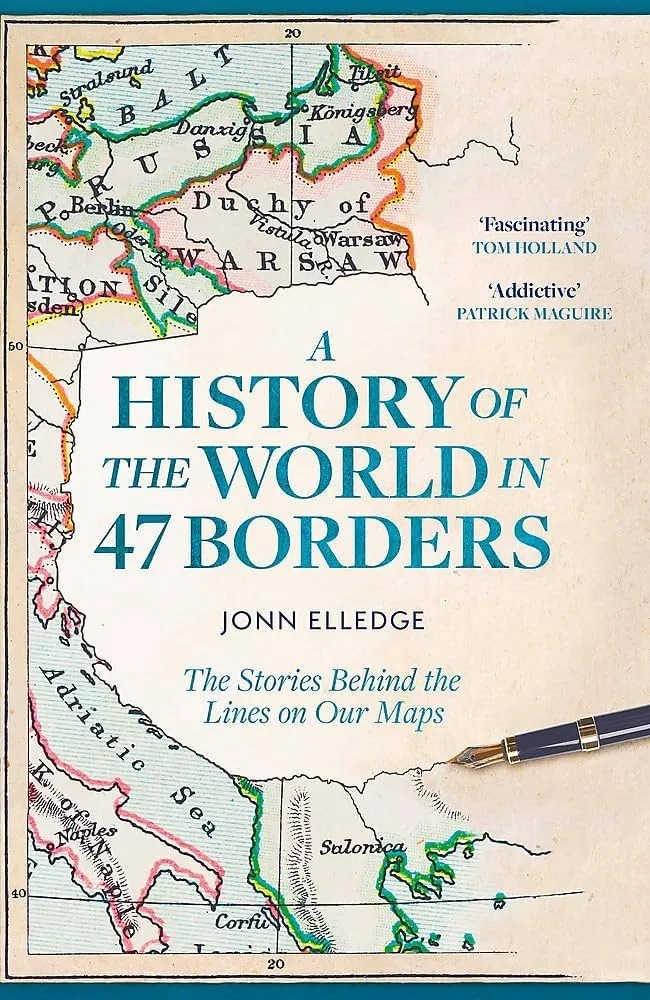
Jonn Elledge devotes the current issue of his nifty newsletter to a series of fascinating facts from his wonderful book, A Brief History of the World in 47 Borders (as it’s known in its U.S. edition, as compared to the less qualified title of the U.K. original pictured above)…
… Back in May, the good people at the UK’s leading maps and travel specialist bookshop Stanfords were kind enough to select my new book A History of the World in 47 Borders as their book of the month. And to promote it, they asked me to make a quick video, talking about it…
My initial thought was to list a single fact from each of the book’s 47 chapters, but that, I soon realised, would go on forever and take an absurd number of takes to get right. So in the end I decided on a top 10: that took an absurd number of takes to get right too, and also features me the wrong way round, for some reason, but at least it’s only three minutes long…
… as a special Christmas treat, not to mention shameless attempt to get more of you to buy the book for yourself or a loved one, here are all 47 of the facts I originally chose…
You’ll find tidbits like these:
The oldest known international border was the one between what today we call Upper Egypt and Lower Egypt. We know about it today because, sometime around 3100BCE, someone abolished it.
The Great Wall is not really one wall, but many. And the first Chinese emperor used to kidnap young men to make them build them.
The Open Borders Policies of Genghis Khan basically created the modern world.
In 1884, the great powers agreed to divide up the entire map of Africa without ever visiting. No Africans were in attendance, and one who’d asked for an invite, the Sultan of Zanzibar, was openly laughed at.
There’s a piece of Africa which two countries, Egypt and Sudan, both aggressively claim belongs to the other.
There’s an opera house in which the US/Canada border divides audience from stage.
There’s a coral atoll a thousand miles from Japan which is technically classed as a suburb of Tokyo.
Air traffic control zones cover the entire planet except the Galapagos Islands and the bit of the Arctic where Santa lives.
So much more at “47 Facts from A History of the World in 47 Borders,” from @jonnelledge.bsky.social
* Bill Bryson
###
As we muse on maps, we might send acutely observant birthday greetings to an astute student of the human animal, anthropologist Margaret Mead; she was born on this date in 1901. Best-known for her studies of the nonliterate peoples of Oceania, she was 23 when she first traveled to the South Pacific to conduct research for her doctoral dissertation. The book that resulted, Coming of Age in Samoa, was– and remains– a best-seller.

“One cannot conceive anything so strange and so implausible that it has not already been said by one philosopher or another”*…

Wisdom for the exquisite Existential Comics (“A philosophy comic about the inevitable anguish of living a brief life in an absurd world. Also jokes.”)…


Frege was an early philosopher of language, who formulated a theory of semantics that largely had to do with how we form truth propositions about the world. His theories were enormously influential for people like Russel, Carnap, and even Wittgenstein early in his career. They all recognized that the languages we use are ambiguous, so making exact determinations was always difficult. Most of them were logicians and mathematicians, and wanted to render ordinary language as exact and precise as mathematical language, so we could go about doing empirical science with perfect clarity. Russell, Carnap, and others even vowed to create an exact scientific language (narrator: “they didn’t create an exact scientific language”).
Later on, Wittgenstein and other philosophers such as J.L. Austin came to believe that a fundamental mistake was made about the nature of language itself. Language, they thought, doesn’t pick out truth propositions about the world at all. Speech acts were fundamentally no different than other actions, and were merely used in social situations to bring about certain effects. For example, in asking for a sandwich to be passed across the table, we do not pick out a certain set of facts about the world, we only utter the words with the expectations that it will cause certain behavior in others. Learning what is and isn’t a sandwich is more like learning the rules of a game than making declarations about what exists in the world, so for Wittgenstein, what is or isn’t a sandwich depends only on the success or failure of the word “sandwich” in a social context, regardless of what actual physical properties a sandwich has in common with, say, a hotdog.
“Is a Hotdog a Sandwich? A Definitive Study,” from @existentialcomics.com.
* René Descartes
###
As we add mayonnaise, we might send thoughtful birthday greetings to Norbert Wiener; he was born on this date in 1894. A computer scientist, mathematician, and philosopher, Wiener is considered the originator of cybernetics, the science of communication as it relates to living things and machines– a field that has had implications for implications for a wide variety of fields, including engineering, systems control, computer science, biology, neuroscience, and philosophy. (Wiener credited Leibniz as the “patron saint of cybernetics.)
His work heavily influenced computer pioneer John von Neumann, information theorist Claude Shannon, anthropologists Margaret Mead and Gregory Bateson, and many others. Wiener was one of the first to theorize that all intelligent behavior was the result of feedback mechanisms and could possibly be simulated by machines– an important early step towards the development of modern artificial intelligence.

“The Universe is not only queerer than we suppose, but queerer than we can suppose”*…

Complex nature
Albert Einstein said that the “most incomprehensible thing about the Universe is that it is comprehensible.” He was right to be astonished. Human brains evolved to be adaptable, but our underlying neural architecture has barely changed since our ancestors roamed the savannah and coped with the challenges that life on it presented. It’s surely remarkable that these brains have allowed us to make sense of the quantum and the cosmos, notions far removed from the ‘commonsense’, everyday world in which we evolved.
But I think science will hit the buffers at some point. There are two reasons why this might happen. The optimistic one is that we clean up and codify certain areas (such as atomic physics) to the point that there’s no more to say. A second, more worrying possibility is that we’ll reach the limits of what our brains can grasp. There might be concepts, crucial to a full understanding of physical reality, that we aren’t aware of, any more than a monkey comprehends Darwinism or meteorology. Some insights might have to await a post-human intelligence…
Abstract thinking by biological brains has underpinned the emergence of all culture and science. But this activity, spanning tens of millennia at most, will probably be a brief precursor to the more powerful intellects of the post-human era – evolved not by Darwinian selection but via ‘intelligent design’. Whether the long-range future lies with organic post-humans or with electronic super-intelligent machines is a matter for debate. But we would be unduly anthropocentric to believe that a full understanding of physical reality is within humanity’s grasp, and that no enigmas will remain to challenge our remote descendants…
Martin Rees (Lord Rees of Ludlow), cosmologist and astrophysicist, Astronomer Royal since 1995, past Master of Trinity College, Cambridge, and former President of the Royal Society, on the limits of human understanding (and how we might transcend them): “Black holes are simpler than forests and science has its limits.”
For a “companionable” take on the character of the knowledge that we do (seem to) have, see “Is Quantum Theory About Reality or What We Know?“; and for an argument that we should stop worrying about the limits of human knowledge, and start worrying about wasting the knowledge we already have, see here.
* J. B. S. Haldane, Possible Worlds and Other Papers (1927)
###
As we prepare to call (an artificially-intelligent) friend, we might send acutely observant birthday greetings to an astute student of the human animal, anthropologist Margaret Mead; she was born on this date in 1901. Best-known for her studies of the nonliterate peoples of Oceania, she was 23 when she first traveled to the South Pacific, to conduct research for her doctoral dissertation. The book that resulted, Coming of Age in Samoa, was– and remains– a best-seller.

“The world is a book and those who do not travel read only one page”*…

Color version of Abraham Ortelius’ Typus Orbis Terrarum, a map inserted into the first edition of Richard Hakluyt’s The Principal Navigations (1589) — Source
The Principle Navigations, Richard Hakluyt’s great championing of Elizabethan colonial exploration, remains one of the most important collections of English travel writing ever published. It recounts the escapades of famed explorers like Francis Drake and Walter Raleigh, at the same time that it preserves many stories of lesser known figures that surely would have been otherwise lost.
Nandini Das tours the book and puts it into historical and cultural context at “Richard Hakluyt and Early English Travel.”
* St. Augustine of Hippo
###
As we chart our courses, we might recall that it was on this date in 1937 that anthropologist Margaret Mead arrived on Samoa. The book that resulted, Coming of Age in Samoa, was– and remains– a best-seller, and launched her career as an expert on the non-literate peoples of Oceania.

Speaking of animals…


28 other examples of straight-talking signage at Decoded Stuff’s “30 Most Bizarre Zoo Signs.”
As we remember to keep our peanuts to ourselves, we might wish a Happy Birthday to an astute student of the human animal, anthropologist Margaret Mead; she was born on this date in 1901. Best-known for her studies of the nonliterate peoples of Oceania, she was 23 when she first traveled to the South Pacific, to conduct research for her doctoral dissertation. The book that resulted, Coming of Age in Samoa, was– and remains– a best-seller.
You must be logged in to post a comment.