Much of my life has been spent in and around religious traditions. I have feasted at Eid al-Fitr with my Muslim cousins, celebrated Seders at home with my in-laws, recited a Sanskrit mantra as I meditated alone, and attended a nuptial Mass conducted by a cardinal. In my childhood, I sang in an Anglican school choir in England, went to Sunday school back home in Ghana in an interdenominational church (dressed in my Sabbath finery), and murmured “Now I Lay Me Down to Sleep” in prayer each night before I retired. My weekly recitation of the Nicene Creed was quite sincere, even if I always had difficulty understanding how Christ could be of “one substance with the Father”; the words had some extra-semantic resonance. Like millions of people, I have experienced the inward peace that comes from meditation — the sense of oneness with everything that is spoken of in contemplative traditions from around the world; but I have felt that sense of communion, too, at the end of a long season of training, rowing with my fellow oarsmen in perfect concord on the Thames near Henley, when my body was working as hard as it ever has. Then, as in the daily meditations of my teenage years, I felt with the Blessed Julian of Norwich, who lived six centuries ago, that “all will be well and all will be well, and all manner of things will be well.” As a child, I gained security from a gold cross that hung on a chain around my neck, which had been blessed by a spirit that spoke through the mediumship of a modest Scottish postman, who also reassured me by transmitting benevolent messages from my long-dead English grandfather.
And because much of my childhood was spent in Kumasi, in Ghana’s Ashanti region, I followed my father in pouring libations to our ancestors, who were once as real to me as the God whose presence I felt when I prayed. We would offer spirituous beverage, in particular, to the founder of my father’s lineage, the warrior Akroma-Ampim. Nana Akroma-Ampim, begye nsa nom: Akroma-Ampim, our elder, come take this alcohol to drink. We would honor, too, our formidable greatgrandmother Takyiwah, or her brother Yao Antony, for whom, like Akroma-Ampim, I was named. Mind you, my father was an elder in his Methodist church and considered himself a good Christian; but as a proud Asante man, he also shared the “traditional” beliefs of the world where he grew up. If he dreamed, it meant that his sunsum — a spirit of consciousness — was traveling the realm; when he died, he believed, something would leave his body and join the ancestors, to be given offerings on occasion. He joined in practices related to Nyame, the sky god, as well as to Asase Yaa, the earth goddess, and to other spirits of divers kinds. There were ritual practices and prayers, and professional priests and shrines of varying degrees of authority and various scopes of jurisdiction. (When he visited friends in, say, Sierra Leone, he expected that, just as the people were different there, so the gods would be: alternative technologies of the divine.)
* Pope Francis (echoing Ramakrishna: “All religions are true. God can be reached by different religions. Many rivers flow by many ways but they fall into the sea. They all are one.”)
###
As we embrace understanding, we might recall that it was on this date in 1970 that Apple Records released George Harrison’s “My Sweet Lord.” Inspired by the Hindu god Krishna and the Christian hymn “Oh Happy Day,” it is a call to abandon religious sectarianism (using devices like the blending of the Hebrew word hallelujah with chants of “Hare Krishna” and Vedic prayer).
Harrison’s first release as a solo artist, it topped charts worldwide; it was the biggest-selling single of 1971 in the UK. In America and Britain, the song was the first number-one single by an ex-Beatle.
In order to bridge the yawning gulf between the humanities and the sciences, Gordon Gillespie suggests, we must turn to an unexpected field: mathematics…
In 1959, the English writer and physicist C P Snow delivered the esteemed Rede Lecture at the University of Cambridge [a talk now known as “The Two Cultures,” see here]. Regaled with champagne and Marmite sandwiches, the audience had no idea that they were about to be read the riot act. Snow diagnosed a rift of mutual ignorance in the intellectual world of the West. On the one hand were the ‘literary intellectuals’ (of the humanities) and on the other the (natural) ‘scientists’: the much-discussed ‘two cultures’. Snow substantiated his diagnosis with anecdotes of respected literary intellectuals who complained about the illiteracy of the scientists but who themselves had never heard of such a fundamental statement as the second law of thermodynamics. And he told of brilliant scientific minds who might know a lot about the second law but were barely up to the task of reading Charles Dickens, let alone an ‘esoteric, tangled and dubiously rewarding writer … like Rainer Maria Rilke.’
Sixty-plus years after Snow’s diatribe, the rift has hardly narrowed. Off the record, most natural scientists still consider the humanities to be a pseudo-science that lacks elementary epistemic standards. In a 2016 talk, the renowned theoretical physicist Carlo Rovelli lamented ‘the current anti-philosophical ideology’. And he quoted eminent colleagues such as the Nobel laureate Steven Weinberg, Stephen Hawking and Neil deGrasse Tyson, who agreed that ‘philosophy is dead’ and that only the natural sciences could explain how the world works, not ‘what you can deduce from your armchair’. Meanwhile, many humanities scholars see scientists as pedantic surveyors of nature, who may produce practical and useful results, but are blind to the truly deep insights about the workings of the (cultural) world. In his best-selling book The Fate of Rome (2017), Kyle Harper convincingly showed that a changing climate and diseases were major factors contributing to the final fall of the Roman Empire. The majority of Harper’s fellow historians had simply neglected such factors up to then; they had instead focused solely on the cultural, political and socioeconomic ones…
The divide between the two cultures is not just an academic affair. It is, more importantly, about two opposing views on the fundamental connection between mind and nature. According to one view, nature is governed by an all-encompassing system of laws. This image underlies the explanatory paradigm of causal determination by elementary forces. As physics became the leading science in the 19th century, the causal paradigm was more and more seen as the universal form of explanation. Nothing real fell outside its purview. According to this view, every phenomenon can be explained by a more or less complex causal chain (or web), the links of which can, in turn, be traced back, in principle, to basic natural forces. Anything – including any aspect of the human mind – that eludes this explanatory paradigm is simply not part of the real world, just like the ‘omens’ of superstition or the ‘astral projections’ of astrology.
On the opposing view, the human mind – be it that of individuals or collectives – can very well be regarded separately from its physical foundations. Of course, it is conceded that the mind cannot work without the brain, so it is not entirely independent of natural forces and their dynamics. But events of cultural significance can be explained as effects of very different kinds of causes, namely psychological and social, that operate in a sphere quite separate from that of the natural forces.
These divergent understandings underpin the worldviews of each culture. Naive realists – primarily natural scientists – like to point out that nature existed long before humankind. Nature is ordered according to laws that operate regardless of whether or not humans are around to observe. So the natural order of the world must be predetermined independently of the human mind. Conversely, naive idealists – including social constructivists, mostly encountered in the humanities – insist that all order is conceptual order, which is based solely on individual or collective thought. As such, order is not only not independent of the human mind, it’s also ambiguous, just as the human mind is ambiguous in its diverse cultural manifestations.
The clash of cultures between the humanities and the natural sciences is reignited over and over because of two images that portray the interrelationship of mind and nature very differently. To achieve peace between the two cultures, we need to overcome both views. We must recognise that the natural and the mental order of things go hand in hand. Neither can be fully understood without the other. And neither can be traced back to the other…
… The best mediator of a conciliatory view that avoids the mistake of the naive realist and the naive idealist is mathematics. Mathematics gives us shining proof that understanding some aspect of the world does not always come down to uncovering some intricate causal web, not even in principle. Determination is not explanation. And mathematics, rightly understood, demonstrates this in a manner that lets us clearly see the mutual dependency of mind and nature.
For mathematical explanations are structural, not causal. Mathematics lets us understand aspects of the world that are just as real as the Northern Lights or people’s behaviour, but are not effects of any causes. The distinction between causal and structural forms of explanation will become clearer in due course. For a start, take this example. Think of a dying father who wants to pass on his one possession, a herd of 17 goats, evenly to his three sons. He can’t do so. This is not the case because some hidden physical or psychological forces hinder any such action. The reason is simply that 17 is a prime number, so not divisible by three…
… In his ‘two cultures’ speech, Snow located mathematics clearly in the camp of the sciences. But… mathematics doesn’t adhere to the explanatory paradigm of causal determination. This distinguishes it from the natural sciences. Nevertheless, mathematics tells us a lot about nature. According to Kant, it does so because it tells us a lot about the human mind. Mind and nature are inseparable facets of the world we inhabit and conceive. So, why should the humanities not also count as a science? They can tell us just as much about that one world on a fundamental level as the natural sciences. Mathematics demonstrates this clearly…
… Mathematics undermines the causal explanatory paradigm not only in its natural scientific manifestations, but also in its uses in the humanities. We give explanations for a wide variety of phenomena by hidden causes way too often and way too fast, where the simple admission to having no explanation would not only be more honest, but also wiser. Wittgenstein spoke of the disease of wanting to explain. This disease shows itself not just in our private everyday exchanges and in the usual public debates, but also in scholarly discourse of the humanities. When confronted with individual or collective human thinking and behaviour, it is tempting to assume just a few underlying factors responsible for the thinking and behaviour. But, more often than not, there really is no such neat, analysable set of factors. Instead, there is a vast number of natural, psychological and societal factors that are all equally relevant for the emergence of the phenomenon one wants to explain. Perhaps a high-end computer could incorporate all these factors in a grand simulation. But a simulation is not an explanation. A simulation allows us to predict, but it doesn’t let us understand.
The aim of the humanities should not be to identify causes for every phenomenon they investigate. The rise and fall of empires, the economic and social ramifications of significant technological innovations, the cultural impact of great works of art are often products of irreducibly complex, chaotic processes. In such cases, trying to mimic the natural sciences by stipulating some major determining factors is a futile and misleading endeavour.
But mathematics shows that beyond the causal chaos there can be order of a different kind. The central limit theorem lets us see and explain a common regularity in a wide range of causally very different, but equally complex, natural processes. With this and many other examples of structural mathematical explanations of phenomena in the realm of the natural sciences in mind, it seems plausible that mathematical, or mathematically inspired, abstraction can also have fruitful applications in the humanities.
This is by no means meant to promote an uncritical imitation of mathematics in the humanities and social sciences. (The overabundance of simplistic econometric models, for instance, is a huge warning sign.) Rather, it is meant to motivate scholars in these fields to reflect more upon where and when causal explanations make sense. Complexity can’t always be reduced to a graspable causal explanation, or narrative. To the contrary, often the most enlightening enquiries are not those that propose new factors as the true explainers, but those that show by meticulous analysis that far more factors are crucially in play than previously thought. This, in turn, should motivate scholars to seek aspects of their subject of interest beyond causality that are both relevant and amenable to structural forms of explanation. Besides probability theory, chaos theoretical methods and game theory come to mind as mathematical sub-disciplines with potentially fruitful applications in this regard.
However, the main point of our discussion is not that mathematical applications in the humanities might bridge the gap between the natural sciences and the humanities. The point is that mathematics, not really belonging to either camp, shows them to be on an equal footing from the start. The natural scientific paradigm of explanation is not the role model any respectable form of enquiry has to follow. Mathematics shows that natural causes can’t explain every phenomenon, not even every natural phenomenon and not even in principle. So, there is no need for the humanities, the ‘sciences of the mind’, to always strive for explanations by causes that can be ‘reduced’ to more elementary, natural forces. Moreover, mathematics shows that causality, of any kind, is not the only possible basis on which any form of explanation ultimately has to stand. Take for example the semantic relationships between many of our utterances. It is not at all clear that these can be explained in terms of psychological causes, or any other causes. It is not unreasonable to believe that the world is irreducibly structured, in part, by semantic relations, just as it is structured by probabilistic relations…
… The divide between the natural sciences and the humanities does not stem from the supposed fact that only those mental phenomena are real that are explainable in natural-scientific terms. Nor is the divide due to some extra-natural mental order, determined by causal relationships of a very different kind than those studied in the natural sciences. The mental world and the physical world are one and the same world, and the respective sciences deal with different aspects of this one world. Properly understood, insofar as they deal with the same phenomena, they do not provide competing but complementary descriptions of these phenomena.
Mathematics provides the most impressive proof that a true understanding of the world goes beyond the discovery of causal relationships – whether they are constituted by natural or cultural forces. It is worth taking a closer look at this proof. For it outlines the bond that connects mind and nature in particularly bright colours. Kant understood this bond as a ‘transcendental’ one. The late Wittgenstein, on the other hand, demonstrated its anchoring in language – not in the sense of a purely verbal and written practice, but in the sense of a comprehensive practice of actions the mental and bodily elements of which cannot be neatly separated. In the words of Wittgenstein, ‘commanding, questioning, recounting, chatting are as much a part of our natural history as walking, eating, drinking, and playing.’
Mathematics too is part of this practice. As such, like every science, it is inseparably rooted in both nature and the human mind. Unlike the other sciences, this dual rootedness is obvious in the case of mathematics. One only has to see where it resides: beyond causality.
* C. P. Snow, The Two Culturesand the Scientific Revolution
###
As we come together, we might send carefully calculated birthday greetings to a man with a foot in each culture: Frank Plumpton Ramsey; he was born on this date in 1903. A philosopher, mathematician, and economist, he made major contributions to all three fields before his death (at the age of 26) on this date in 1930.
While he is probably best remembered as a mathematician and logician and as Wittgenstein’s friend and translator, he wrote three paper in economics: on subjective probability and utility (a response to Keynes, 1926), on optimal taxation (1927, described by Joseph E. Stiglitz as “a landmark in the economics of public finance”), and optimal economic growth (1928; hailed by Keynes as “”one of the most remarkable contributions to mathematical economics ever made”). The economist Paul Samuelson described them in 1970 as “three great legacies – legacies that were for the most part mere by-products of his major interest in the foundations of mathematics and knowledge.”
So much Political commentary seems to proceed by means of debate rather than report. This is an understandable consequence of new technology which makes engagement easy. Our heightened exposure to debate is a good thing, too. Open debate is democracy’s lifeblood. Yet popular political disagreement has taken on an odd hue. Rather than presenting facts and professing a view, commentators present views concerning the views of their opponents. And often, it’s not only views about opponents’ views, many go straight to views about opponents. Despite heated disagreements over Big Questions like healthcare, stem-cell research, abortion, same-sex marriage, race relations and global warming, we find a surprising consensus about the nature of political disagreement itself: All agree that, with respect to any Big Question, there is but one intelligent position, and all other positions are not merely wrong, but ignorant, stupid, naïve. And as a consequence, those who cling to these views must be themselves either ignorant or wicked. Or both.
A minute in the Public Affairs section of any bookstore confirms this: Conservatives should talk to liberals “only if they must” because liberalism is a “mental disorder.” Liberals dismiss their Conservative opponents, since they are “lying liars” who use their “noise machine” to promote irrationality.
Both views betray a commitment to the Simple Truth Thesis, the claim that Big Questions always admit of a simple, obvious, and easily-stated solution. The Simple Truth Thesis encourages us to hold that a given truth is so simple and so obvious that only the ignorant, wicked, or benighted could possibly deny it. As our popular political commentary accepts the Simple Truth Thesis, there is a great deal of inflammatory rhetoric and righteous indignation, but in fact very little public debate over the issues that matter most. Consequently, the Big Questions over which we are divided remain unexamined, and our reasons for adopting our different answers are never brought to bear in public discussion.
This brings us back to our original observation – there seems to be so much debate. Yet what passes for public debate is in fact no debate at all. No surprise, really. Debate or discussion concerning a Big Question can be worthwhile only when there is more than one reasonable position regarding the question; and this is precisely what the Simple Truth Thesis denies.
It would be a wonderful world were the Simple Truth Thesis true. Our political task simply would be to empower those who know the simple truth, and rebuke the fools who do not. But the Simple Truth Thesis is not true. In fact, it’s a fairytale—soothing, but ultimately unfit for a serious mind. For any Big Question, there are several defensible positions; it is precisely this feature that makes them big. Of course, to say that a position is defensible is not to say that it’s true. To oppose the Simple Truth Thesis is not to embrace relativism (which is itself a version of the Simple Truth view), nor is it to give up on the idea that there is truth; it is rather to give up on the view that the truth is always simple.
This intellectual distance is difficult because we feel invested in our own Big Answers. But it’s a fantasy to think that the billions of people with whom we disagree have all simply failed to appreciate the facts. This fantasy is easily dissolved once we come to realize that those who reject our own Big Answers often give good reasons for their views and against ours. We might not find ourselves convinced by their reasons, of course, but we can no longer see them as ignorant or foolish.
The lesson to draw is that there is a difference between being stupid and being wrong; the most important truths are often the most difficult to discern, even by the most careful and sincere inquirers. This lesson dismantles the Simple Truth Thesis and leads us to acknowledge that although there may be but one correct answer to each Big Question, there are several defensible views concerning which of the going answers is, indeed, correct. So if the Big Questions matter to us, we should be most eager to hear the reasons of our opponents. We should pursue real disagreement, with real interlocutors, not the cooked-up arguments against caricatured opposition on offer from the political commentary industry.
Democracy is the proposition that a just, peaceful, and morally decent society is possible among equals who disagree over Big Questions. Democracy tries to enable such a society by maintaining the conditions under which citizens could reason together, and, despite ongoing disagreement, come to see each other as reasonable. Citizens who see each other in this way can agree to share in the task of collective self-government despite ongoing and even growing discord over Big Questions. The Simple Truth Thesis repudiates this ideal. Accordingly, as our politics become more argumentative, they become less concerned with actual argument. Yet if we lose our capacity to argue with each other—to confront openly each other’s reasons—we will lose our capacity to see each other as equal partners in self-government, and thus we will lose our democracy…
As we dig Diogenes, we might send exciting birthday greetings to Otto Binder; he was born on this date in 1911. An author of science fiction and non-fiction books and stories, and comic books, he is best known as the co-creator of Supergirl and for his many scripts for Captain Marvel Adventures and other stories involving the entire superhero Marvel Family. He is credited with writing over 4,400 stories across a variety of publishers under his own name, as well as more than 160 stories under the pen-name Eando Binder.
Indeed, it was as Eando that he wrote “I, Robot” is a scifi short story , part of a series about a robot named Adam Link, that was published in the January 1939 issue of Amazing Stories. Very innovative for its time, “I, Robot” was one of the first robot stories to break away from Frankenstein clichés. It was reprised in two different comic series, and adapted into episodes of The Outer Limits.
Isaac Asimov— who is famous for his own I, Robot and the series of novels that followed from it, was heavily influenced by the Binder short story. In his introduction to the story in Isaac Asimov Presents the Great SF Stories (1979), Asimov wrote: “It certainly caught my attention. Two months after I read it, I began ‘Robbie’, about a sympathetic robot, and that was the start of my positronic robot series. Eleven years later, when nine of my robot stories were collected into a book, the publisher named the collection I, Robot over my objections. My book is now the more famous, but Otto’s story was there first.”
And we humans are, as Kit Yates explains, myth-making animals…
Unfortunately, when it comes to understanding random phenomena, our intuition often lets us down. Take a look at the image below. Before you read the caption, see if you can pick out the data set generated using truly uniform random numbers for the coordinates of the dots (i.e., for each point, independent of the others, the horizontal coordinate is equally likely to fall anywhere along the horizontal axis and the vertical coordinate is equally likely to fall anywhere along the vertical).
Three data sets, each with 132 points. One represents the position of the nests of Patagonian seabirds, another the position of ant colony nest sites and the third represents randomly generated coordinates. Can you guess which one is which?
The truly randomly distributed points in the figure are those in the left-most image. The middle image represents the position of ants’ nests that, although distributed with some randomness, demonstrate a tendency to avoid being too close together in order not to overexploit the same resources. The territorial Patagonian seabirds’ nesting sites, in the right-most image, exhibit an even more regular and well-spaced distribution, preferring not to be too near to their neighbors when rearing their young. The computer-generated points, distributed uniformly at random in the left-hand image, have no such qualms about their close proximity.
If you chose the wrong option, you are by no means alone. Most of us tend to think of randomness as being “well spaced.” The tight clustering of dots and the frequent wide gaps of the genuinely random distribution seem to contradict our inherent ideas of what randomness should look like…
…
… As a case in point, after noticing a disproportionate number of Steely Dan songs playing on his iPod shuffle, journalist Steven Levy questioned Steve Jobs directly about whether “shuffle” was truly random. Jobs assured him that it was and even got an engineer on the phone to confirm it. A follow-up article Levy wrote in Newsweek garnered a huge response from readers having similar experiences, questioning, for example, how two Bob Dylan songs shuffled to play one after the other (from among the thousands of songs in their collections) could possibly be random.
We ascribe meaning too readily to the clustering that randomness produces, and, consequently, we deduce that there is some generative force behind the pattern. We are hardwired to do this. The “evolutionary” argument holds that tens of thousands of years ago, if you were out hunting or gathering in the forest and you heard a rustle in the bushes, you’d be wise to play it safe and to run away as fast as you could. Maybe it was a predator out looking for their lunch and by running away you saved your skin. Probably, it was just the wind randomly whispering in the leaves and you ended up looking a little foolish—foolish, but alive and able to pass on your paranoid pattern-spotting genes to the next generation…
…
This… is just one example of the phenomenon known in the psychology literature as pareidolia, in which an observer interprets an ambiguous auditory or visual stimulus as something they are familiar with. This phenomenon, otherwise known as “patternicity,” allows people to spot shapes in the clouds and is the reason why people think they see a man in the moon. Pareidolia is itself an example of the more general phenomenon of apophenia, in which people mistakenly perceive connections between and ascribe meaning to unrelated events or objects. Apophenia’s misconstrued connections lead us to validate incorrect hypotheses and draw illogical conclusions. Consequently, the phenomenon lies at the root of many conspiracy theories—think, for example, of extraterrestrial seekers believing that any bright light in the sky is a UFO.
Apophenia sends us looking for the cause behind the effect when, in reality, there is none at all. When we hear two songs by the same artist back-to-back, we are too quick to cry foul in the belief that we have spotted a pattern, when in fact these sorts of clusters are an inherent feature of randomness. Eventually, the dissatisfaction caused by the clustering inherent to the iPod’s genuinely random shuffle algorithm led Steve Jobs to implement the new “Smart Shuffle” feature on the iPod, which meant that the next song played couldn’t be too similar to the previous song, better conforming to our misconceived ideas of what randomness looks like. As Jobs himself quipped, “We’re making it less random to make it feel more random.”…
As we ponder purported patterns, we might send carefully-discerned birthday greetings to a man who did in fact find a pattern (or at least a meaning) in what might have seemed random and meaningless: Robert Woodrow Wilson; he was born on this date in 1936. An astronomer, he detected– with Bell Labs colleague Arno Penzias– cosmic microwave background radiation: “relic radiation”– that’s to say, the “sound “– of the Big Bang… familiar to those of us old enough to remember watching an old-fashioned television after the test pattern was gone (when there was no broadcast signal received): the “fuzz” we saw and the static-y sounds we heard, were that “relic radiation” being picked up.
Their 1964 discovery earned them the 1978 Nobel Prize in Physics.
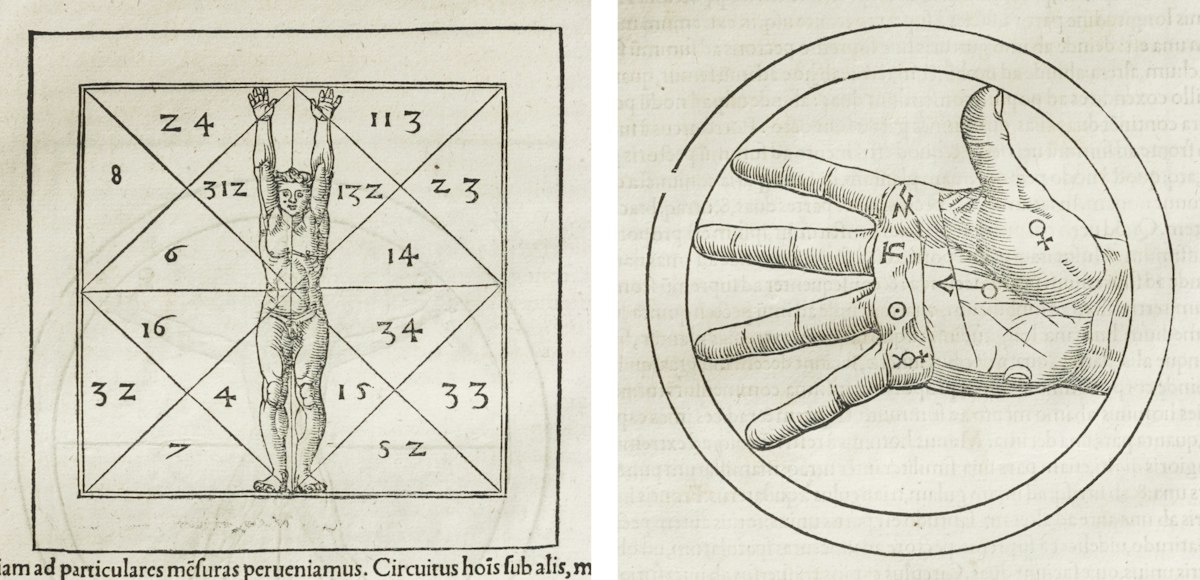
Two diagrams from Agrippa’s De occulta philosophia (1533) demonstrating the proportion, measure, and harmony of human bodies — Source: left, right
… And as we undertake to understand that structure, we use the lens– the mental models and language– that we have. The redoubtable Anthony Grafton considers and early 16th century attempt: Heinrich Cornelius Agrippa‘s De Occulta Philosophia libri III, Agrippa’s encyclopedic study of magic that was, at the same time, an attempt to describe the structure of the universe, sketching a path that leads both upward and downward: up toward complete knowledge of God, and down into every order of being on earth…
Heinrich Cornelius Agrippa’s manual of learned magic, De occulta philosophia (1533), explicated the ways in which magicians understood and manipulated the cosmos more systematically than any of his predecessors. It was here that he mapped the entire network of forces that passed from angels and demons, stars and planets, downward into the world of matter. Agrippa laid his work out in three books, on the elementary, astrological, and celestial worlds. But he saw all of them as connected, weaving complex spider webs of influence that passed from high to low and low to high. With the zeal and learning of an encyclopedist imagined by Borges, Agrippa catalogued the parts of the soul and body, animals, minerals, and plants that came under the influence of any given planet or daemon. He then offered his readers a plethora of ways for averting evil influences and enhancing good ones. Some of these were originally simple remedies, many of them passed down from Roman times in the great encyclopedic work of Pliny the Younger and less respectable sources, and lacked any deep connection to learned magic.
[Grafton describes the many dimensions of Agrippa’s compilation of the then-current state of magic…]
But few of the dozens of manuscript compilations that transmitted magic through the Middle Ages reflected any effort to impose a system on the whole range of magical practices, as Agrippa’s book did. He made clear that each of the separate arts of magic, from the simplest form of herbal remedy to the highest forms of communication with angels, fitted into a single, lucid structure with three levels: the elementary or terrestrial realm, ruled by medicine and natural magic; the celestial realm, ruled by astrology; and the intellectual realm, ruled by angelic magic. Long tendrils of celestial and magical influence stitched these disparate realms into something like a single great being…
Agrippa offered, in other words, both a grand, schematic plan of the cosmos, rather like that of the London Underground, which laid out its structure as a whole, and a clutch of minutely detailed local Ordinance Survey maps, which made it possible to navigate through any specific part of the cosmos. Readers rapidly saw what Agrippa had to offer. The owner of a copy of On Occult Philosophy, now in Munich, made clear in his only annotation that he appreciated Agrippa’s systematic presentation of a universe in which physical forms revealed the natures of beings and their relations to one another: “Physiognomy, metoposcopy [the interpretation of faces], and chiromancy, and the arts of divination from the appearance and gestures of the human body work through signs.” Agrippa’s book not only became the manual of magical practice, but it also made the formal claim that magic was a kind of philosophy in its own right…
As we take in the totality, we might send more modern birthday greetings to a rough contemporary of Agrippa’s, Evangelista Torricelli; he was born on this date in 1608. Even as Agrippa was trying to understand the world via magic, Torricelli, a student of Galileo, was using observation and reason to fuel the same quest. A physicist and mathematician, he is best known for his invention of the barometer, but is also known for his advances in optics, his work on the method of indivisibles, and “Torricelli’s Trumpet.” The torr, a unit of pressure, is named after him.





You must be logged in to post a comment.