Posts Tagged ‘Marvel’
“The pure and simple truth is rarely pure and never simple”*…

An all-too-timely 2016 piece from philosophy professors Scott Aikin and Robert Talisse…
So much Political commentary seems to proceed by means of debate rather than report. This is an understandable consequence of new technology which makes engagement easy. Our heightened exposure to debate is a good thing, too. Open debate is democracy’s lifeblood. Yet popular political disagreement has taken on an odd hue. Rather than presenting facts and professing a view, commentators present views concerning the views of their opponents. And often, it’s not only views about opponents’ views, many go straight to views about opponents. Despite heated disagreements over Big Questions like healthcare, stem-cell research, abortion, same-sex marriage, race relations and global warming, we find a surprising consensus about the nature of political disagreement itself: All agree that, with respect to any Big Question, there is but one intelligent position, and all other positions are not merely wrong, but ignorant, stupid, naïve. And as a consequence, those who cling to these views must be themselves either ignorant or wicked. Or both.
A minute in the Public Affairs section of any bookstore confirms this: Conservatives should talk to liberals “only if they must” because liberalism is a “mental disorder.” Liberals dismiss their Conservative opponents, since they are “lying liars” who use their “noise machine” to promote irrationality.
Both views betray a commitment to the Simple Truth Thesis, the claim that Big Questions always admit of a simple, obvious, and easily-stated solution. The Simple Truth Thesis encourages us to hold that a given truth is so simple and so obvious that only the ignorant, wicked, or benighted could possibly deny it. As our popular political commentary accepts the Simple Truth Thesis, there is a great deal of inflammatory rhetoric and righteous indignation, but in fact very little public debate over the issues that matter most. Consequently, the Big Questions over which we are divided remain unexamined, and our reasons for adopting our different answers are never brought to bear in public discussion.
This brings us back to our original observation – there seems to be so much debate. Yet what passes for public debate is in fact no debate at all. No surprise, really. Debate or discussion concerning a Big Question can be worthwhile only when there is more than one reasonable position regarding the question; and this is precisely what the Simple Truth Thesis denies.
It would be a wonderful world were the Simple Truth Thesis true. Our political task simply would be to empower those who know the simple truth, and rebuke the fools who do not. But the Simple Truth Thesis is not true. In fact, it’s a fairytale—soothing, but ultimately unfit for a serious mind. For any Big Question, there are several defensible positions; it is precisely this feature that makes them big. Of course, to say that a position is defensible is not to say that it’s true. To oppose the Simple Truth Thesis is not to embrace relativism (which is itself a version of the Simple Truth view), nor is it to give up on the idea that there is truth; it is rather to give up on the view that the truth is always simple.
This intellectual distance is difficult because we feel invested in our own Big Answers. But it’s a fantasy to think that the billions of people with whom we disagree have all simply failed to appreciate the facts. This fantasy is easily dissolved once we come to realize that those who reject our own Big Answers often give good reasons for their views and against ours. We might not find ourselves convinced by their reasons, of course, but we can no longer see them as ignorant or foolish.
The lesson to draw is that there is a difference between being stupid and being wrong; the most important truths are often the most difficult to discern, even by the most careful and sincere inquirers. This lesson dismantles the Simple Truth Thesis and leads us to acknowledge that although there may be but one correct answer to each Big Question, there are several defensible views concerning which of the going answers is, indeed, correct. So if the Big Questions matter to us, we should be most eager to hear the reasons of our opponents. We should pursue real disagreement, with real interlocutors, not the cooked-up arguments against caricatured opposition on offer from the political commentary industry.
Democracy is the proposition that a just, peaceful, and morally decent society is possible among equals who disagree over Big Questions. Democracy tries to enable such a society by maintaining the conditions under which citizens could reason together, and, despite ongoing disagreement, come to see each other as reasonable. Citizens who see each other in this way can agree to share in the task of collective self-government despite ongoing and even growing discord over Big Questions. The Simple Truth Thesis repudiates this ideal. Accordingly, as our politics become more argumentative, they become less concerned with actual argument. Yet if we lose our capacity to argue with each other—to confront openly each other’s reasons—we will lose our capacity to see each other as equal partners in self-government, and thus we will lose our democracy…
If only: “The Myth of Simple Truths,” in @3QD.
(Image above: source)
* Oscar Wilde
###
As we dig Diogenes, we might send exciting birthday greetings to Otto Binder; he was born on this date in 1911. An author of science fiction and non-fiction books and stories, and comic books, he is best known as the co-creator of Supergirl and for his many scripts for Captain Marvel Adventures and other stories involving the entire superhero Marvel Family. He is credited with writing over 4,400 stories across a variety of publishers under his own name, as well as more than 160 stories under the pen-name Eando Binder.
Indeed, it was as Eando that he wrote “I, Robot” is a scifi short story , part of a series about a robot named Adam Link, that was published in the January 1939 issue of Amazing Stories. Very innovative for its time, “I, Robot” was one of the first robot stories to break away from Frankenstein clichés. It was reprised in two different comic series, and adapted into episodes of The Outer Limits.
Isaac Asimov— who is famous for his own I, Robot and the series of novels that followed from it, was heavily influenced by the Binder short story. In his introduction to the story in Isaac Asimov Presents the Great SF Stories (1979), Asimov wrote: “It certainly caught my attention. Two months after I read it, I began ‘Robbie’, about a sympathetic robot, and that was the start of my positronic robot series. Eleven years later, when nine of my robot stories were collected into a book, the publisher named the collection I, Robot over my objections. My book is now the more famous, but Otto’s story was there first.”


“I suppose illustration tends to live in the streets, rather than in the hermetically sealed atmosphere of the museum, and consequently it has come to be taken less seriously”*…

But surely, it shouldn’t necessarily be so…
Old Book Illustrations was born of the desire to share illustrations from a modest collection of books, which we set out to scan and publish. With the wealth of resources available online, it became increasingly difficult to resist the temptation to explore other collections and include these images along with our own. Although it would have been possible to considerably broaden the time-frame of our pursuit, we chose to keep our focus on the original period in which we started for reasons pertaining to taste, consistency, and practicality: due to obvious legal restrictions, we had to stay within the limits of the public domain. This explains why there won’t be on this site illustrations first published prior to the 18th century or later than the first quarter of the 20th century.
We are not the only image collection on the web, neither will we ever be the largest one. We hope however to be a destination of choice for visitors more particularly interested in Victorian and French Romantic illustrations—we understand French Romanticism in its broadest sense and draw its final line, at least in the realm of book illustration, at the death of Gustave Doré.
We also focused our efforts on offering as many different paths and avenues as possible to help you find your way to an illustration, whether you are looking for something specific or browsing randomly. The many links organizing content by artist, language, publisher, date of birth, and more are designed to make searching easier and indecision rewarding…
And rewarding it is! See for yourself at Old Book Illustrations (@obillustrations)
(TotH to @Recomendo6)
* master illustrator Quentin Blake
###
As we visualize, we might send powerfully-drawn birthday greetings to Silvio “Sal” Buscema; he was born on this date in 1936. An illustrator and comic artist, he is best remembered for his time at Marvel, especially his ten-year run as artist of The Incredible Hulk and his eight-year run as artist of The Spectacular Spider-Man.
Comics were a family business. His elder brother John is similarly renown for his work on The Avengers, The Silver Surfer, and Conan the Barbarian.

Vengeance is…
Revenge may be a dish best eaten cold; but its best-known agents, The Avengers, are hot: Joss Whedon’s superhero mash-up is breaking box-office records at home and abroad.
Vancouver-based artist Jer Thorp has immersed himself in the foundation of the film, the Marvel series that has been published pretty much continuously since 1963…

All 570 Avengers covers (to date)
The blockbuster that opened in the U.S. this past weekend features six Avengers– Captain America, Iron Man, The Incredible Hulk, Thor, Hawkeye, and Black Widow. But lest we worry about available grist for sequels, Thorp reminds us that there are 127 more Avengers… The featured sextet appeared early and often; but as this plot suggests, there are plenty more heros where they cam from:

Number of appearances of each Avenger
Much more (sequence of appearance, gender balance, etc.) here. And that’s not all: in the best Hollywood tradition, Thorp teases his own sequel…
…the clever ones among you might be wondering if these patterns are tied to historical periods, or if they are linked to the preferences of specific writers, editors, or artists. Is that crowded patch of Gods in 1985 due to a cultural fascination with myth? Or do Mark Gruenwald & Jim shooter just really, really like Thor? Great questions, and ones that I’ll take a look at Part 2 of this post.
Like S.H.I.E.L.D., Thorp is just getting started…
[TotH to Flowing Data]
Fans of the other, wonderful-in-a-completely-different-way Avengers might go here.
***
As practice our Tony Stark impressions, we might recall that it was on this date in 1965, in the wee hours, in a motel room in Clearwater, Florida, that Keith Richards awoke, grabbed his guitar, turned on a small portable tape recorded, laid down the signature riff of “(I Can’t Get No) Satisfaction”… then dropped back into the arms of Morpheus.
“When I woke up in the morning, the tape had run out,” Richards recalled many years later. “I put it back on, and there’s this, maybe, 30 seconds of ‘Satisfaction,’ in a very drowsy sort of rendition. And then suddenly—the guitar goes ‘CLANG,” and then there’s like 45 minutes of snoring.”

Synaesthesia…
The grand old man of pit-diving, Iggy Pop, has gotten in touch with his inner chanteur. His new album, Préliminaires (officially released in the U.S. today), is ballad after ballad.
But perhaps as interestingly, The Shirtless One’s newest has lyrics based on French author Michel Houellebecq’s apocalyptic clone saga The Possibility of an Island… and so takes its place as the latest in a distinguished line (Dylan, Bowie, Pink Floyd, et al.) of rock albums based on important works of literature.
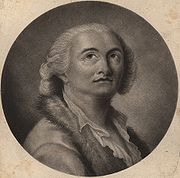
As we hum along, we might tip the birthday beret to Count Alessandro di Cagliostro, born on this date in 1744. In one popular version of his life, he was he was a nobleman and great magus; in the other, a scheming fraud. The latter holds that Cagliostro was born Giuseppe Balsamo to a poor family in Palermo, Sicily, and that, when his father died, he was educated at the expense of some of his mother’s relatives. It has been said that he robbed his uncle, forged a will, and spent time in Palermo’s prisons more than once. (Indeed, his reputation as a charlatan is so great that he shows up as a crooked character in Marvel’s Dr. Strange) In any case, it does seem that he was a “man of the era”– he knew and mixed with illustrious contemporaries like Mozart, Goethe, Casanova, and Catherine the Great… but apparently not his fellow noble and birthday buddy, the Marquis de Sade (who was born on this date four years earlier, in 1740).
You must be logged in to post a comment.