Posts Tagged ‘wit’
“Here is a book so dull that a whirling dervish could read himself to sleep with it. If you were to recite even a single page in the open air, birds would fall out of the sky and dogs drop dead”*…

Mark Frauenfelder surfaces a 1978 review from the marvelous Clive James…
In 1978, Clive James reviewed the official biography of Leonid Ilyich Brezhnev (General Secretary of the Communist Party of the Soviet Union from 1964 to 1982) by the Institute of Marxism-Leninism, CPSU Central Committee. “I read the whole thing from start to finish, waiting for the inevitable slip-up which would result in a living sentence. It never happened.”…
… Here’s an excerpt from the biography:
The plenum once again proved convincingly the CPSU’s monolithic unity, its stand on Leninist principles, and its political maturity. It demonstrated the fidelity of the Party and its Central Committee to Marxism-Leninism and expressed the unswerving determination of Communists to adhere to and develop steadfastly the Leninist standards of Party life and the principles of Party leadership, notably that of collective leadership, and boldly and resolutely to set aside every impediment to the creative work of Party and people...
“A review of the most boring book in the world,” from @boingboing.net.
And for the masochists among us: the full text of the biography.
* Clive James, from the review
###
As we tackle tedium, we might spare a thought for a spiritual forebearer of James: Samuel Johnson; he was born on this date in 1709. A poet, essayist, moralist, literary critic, biographer, editor, and lexicographer, Johnson’s best-known work was surely A Dictionary of the English Language, which he published in 1755, after nine years work– and which served as the standard for 150 years (until the completion of the Oxford English Dictionary [see the almanac entry in the “Clive James” link above]). That said, Dr. Johnson, as he was known, is probably best remembered as the subject of what Walter Jackson Bate called “the most famous single work of biographical art in the whole of literature”: James Boswell’s Life of Samuel Johnson.
But Johnson was, in his time, also a famous aphorist– the very opposite of a man he described to Boswell in 1784: “He is not only dull himself, but the cause of dullness in others”– a role he often played as an influential critic…
“What is written without effort is in general read without pleasure.”
“Worth seeing, yes; but not worth going to see.”
“A writer only begins a book. A reader finishes it.”
“I never desire to converse with a man who has written more than he has read.”
“A man who uses a great many words to express his meaning is like a bad marksman who, instead of aiming a single stone at an object, takes up a handful and throws at it in hopes he may hit.

Joshua Reynolds’ portrait of Dr. Johnson
“We live in an age when the traditional great subjects – the human form, the landscape, even newer traditions such as abstract expressionism – are daily devalued by commercial art”*…

… But it wasn’t always so. A current exhibit at the Metropolitan Museum in New York is devoted to the work of (often anonymous) artists who illustrated commercial catalogs in the late 19th and early 20th centuries…
Art of Commerce: Trade Catalogs in Watson Library features a selection of the library’s extensive holdings of sale catalogs. Watson Library has almost two thousand trade catalogs published in many countries from the eighteenth century to the present. Objects featured include furniture, jewelry, tiles, ironwork, glasswork, lighting, stoves, tableware, textiles, decorative paper, artist’s materials, fashion, typography, automobiles, and musical instruments. Numerous catalogs illustrate works of art or related objects now in The Met collection.
The library has strong holdings of Art Deco trade catalogs including Modern furniture design = Le dessin moderne des meubles—a colorful furniture portfolio by Czech architect Karel Vepřek—and Van Clef Arpels présentent, an elegantly illustrated accessories publication designed by Draeger Frères, the most innovative graphic designers and printers of the period. Both catalogs are on display in the exhibition.
Trade or sale catalogs — also called commercial or manufacturer’s catalogs —are printed publications advertising products of a particular trade or industry. Sale catalogs were often used in shops or showrooms to promote a company’s products. Examples include the massive Reed and Barton catalog Artistic workers in silver & gold plate from 1885 that illustrates the entire inventory of the company…
Among the more unusual and appealing trade catalogs in the exhibition is a German Art Nouveau-inspired cake decorating book from 1910 and a baby carriage catalog from 1934 offering Art Deco styled tubular steel baby prams. These trade catalogs demonstrate the distillation of major art movements applied to quotidian objects.
The earliest trade catalog in the exhibition is Muster zu Zimmer-Verzierungen und Ameublements, a neo-classical interior design catalog by luxury German manufacturer Voss und Compagnie, offering entire rooms that can be bought en masse or as separate pieces. It is illustrated with richly toned hand-colored engravings that detail the design and color of the objects.
One of the library’s most fragile and weighty catalogs is Album des principaux modeles de verres: produits spéciaux en verre coulé. It is a magical trade catalog with sixty-five intact glass samples manufactured by French glassmaker Saint-Gobain. Founded during the time of Louis XIV, the company remains a manufacturer of glass for construction.
The majestic ironwork catalogue of Maison Garnier has pink-tinted papers and was bound in Morocco leather as a special copy for Rémy Garnier, the son of the firm’s founder. The firm’s initials are boldly blind stamped on the cover.
The most unusual and perhaps unexpected catalog, Urinoirs, illustrates the decorative ironwork structures of urinals (or pissoirs) that adorned the streets of Paris from the 1840s to the mid-twentieth century. The ornamentation of these structures demonstrates an impulse to beautify the animated street life of Paris and other cities…
See the items mentioned at the links above, and other articles in the exhibit here.
Beauty in the service of business: “Art of Commerce: Trade Catalogs in Watson Library,” from @metmuseum (where one can see the works on exhibit through March 4, 2025).
* Andy Warhol
###
As we browse, we might spare a thought for Oscar Fingal O’Flahertie Wills Wilde; the novelist, essayist, playwright, poet, and master of the bon mot died on this date in 1900.
As he said: “There are moments when art attains almost to the dignity of manual labor.”

“Some people can stay longer in an hour than others can in a week”*…
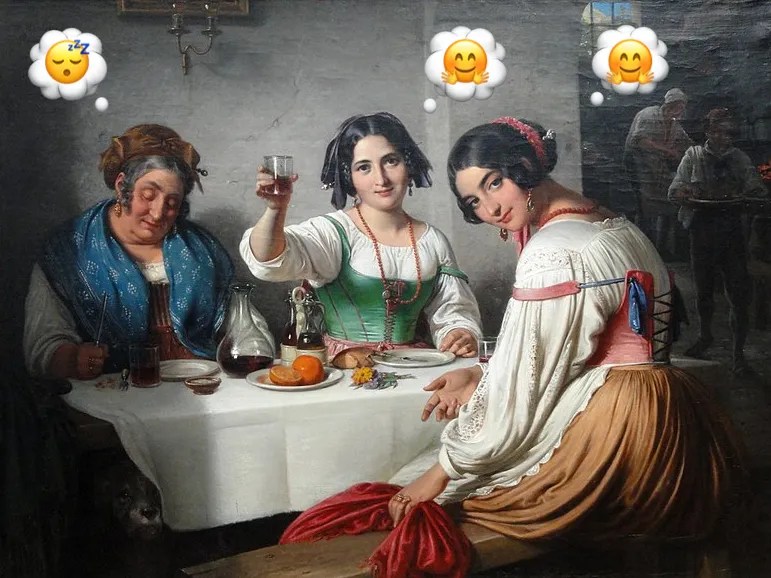
The ever-amusing Benjamin Errett on hospitality…
… The original word ghosti meant both guest and host specifically because of the deep connection between the two, “a mutual exchange relationship highly important to ancient Indo-European society.”…
That, as Beerbohm argues in his essay “Hosts and Guests,” is how we’ve evolved along with our words. There are natural hosts who keep a stocked drinks cart and jars of olives on hand. Obviously, it helps to have a generous olive budget. These people who arrange things just so are often bad guests.
A bad guest, Beerbohm writes, is either a parasite or a churl, the latter being someone like the freeloading poet Dante, who “received during his exile much hospitality from many hosts and repaid them by writing how bitter was the bread in their houses, and how steep the stairs were.” Poets!
To be perfectly positioned between parasitism and churlishness is to reciprocate the food and drink with good company, “radiating gratitude, but not too much of it; never intrusive, ever within call; full of dignity, yet all amenable; quiet, yet lively; never echoing, ever amplifying; never contradicting, but often lighting the way to truth; an ornament, an inspiration, anywhere.” If you’re particularly winning at this, you can save on room and board and no one will ever call you a mooch.
…
let’s reflect on how the who-would-you-invite-to-an-imaginary-dinner-party game is always less fun than it sounds. And yet the New York Times keeps asking authors in By the Book, despite the fact that Charlie Kaufman absolutely demolished the premise with this answer:
I see Oscar Wilde there, of course, Voltaire, Carol Saroyan Saroyan Matthau (wife of William Saroyan, William Saroyan, and Walter Matthau, and a writer in her own right), Hitler (not witty but quite a “get”), Edie Sitwell, Molière, Oscar Wilde (so witty I thought why not double him and place him on each end of the table so everyone could enjoy his witticisms?), Aristophanes, and Sir Kenneth Dover (to translate Aristophanes’ jokes for the other guests). That’s more than three, but one must assume there will be cancellations. Oh, and Jesus...
Be neither a parasite nor a churl- @benjaminerrett on hospitality: “The Wit’s Guide to Guests.”
* W. D. Howells
###
As we contemplate conviviality, we might consider the history of the visitor’s vehicle of choice, the automobile: it was on this date in 1903 that Ernest Pfennig, a Chicago dentist, became the first owner of a Ford automobile, a Model A. The two-(bench) seater weighed 1,240 lbs. and could reach a top speed of 28 mph. The Model A was the first car produced using pairs or trios of men working on each car; between 1903 and 1904, 1,750 cars were made.
Between 1903 and 1908, Ford produced the Models A, B, C, F, K, N, R, and S. Hundreds or a few thousand of most of these were sold per year. Then in 1908, Ford introduced the mass-produced Model T, which totaled millions sold over 18 years. While the Model T was famously available “in any color the customer wants, so long as it’s black,” the Model A was only sold in the color red.
(In 1927, Ford resurrected the “Model A” designation for the successor to its Model T; the revived Model A came in a variety of styles and colors…)

“Many a person will forget the past for a present”*…

… and many won’t, as Benjamin Errett explains…
… Do consider where many gifts end up: The fulskåp, defined in The Gentle Art of Swedish Death Cleaning as “a cupboard full of gifts you can’t stand to look at, and which are impossible to regift. Usually these are presents from distant aunts and uncles that you put on display when the giver comes to visit.”
The perfect gift for the person who has everything is either penicillin or a burglar alarm, as the old jokes have it. So there’s always the option of deliberately flubbing the gesture with a gag gift, which is what the British royal family reportedly does. Prince Harry once delighted the Queen with a shower cap that read “Ain’t life a bitch.”…
You shouldn’t have: “The Wit’s Guide to Gifts, ” from @benjaminerrett.
###
As we wrap it up, we might recall that it was on this date in 1946 that UNICEF (the United Nations International Children’s Emergency Fund) was launched. Among the most widespread and recognizable social welfare organizations in the world, with a presence in 192 countries and territories, it provides immunizations and disease prevention, administers treatment for children and mothers with HIV, enhances childhood and maternal nutrition, improves sanitation, promotes education, and provides emergency relief in response to disasters (most recently, e.g., the COVID epidemic and the invasion of the Ukraine).

“Slang is a language that rolls up its sleeves, spits on its hands and goes to work”*…

For example…

The slang of 19th century scoundrels and vagabonds: browse it in full at invaluable Internet Archive, “Vocabulum; or, The Rogue’s Lexicon.”
* Carl Sandburg
###
As we choose our words, we might send fashionable birthday greetings to George Bryan “Beau” Brummell; he was born on this date in 1778. An important figure in Regency England (a close pal of the Prince Regent, the future King George IV), he became the the arbiter of men’s fashion in London in the territories under its cultural sway.
Brummell was remembered afterwards as the preeminent example of the dandy; a whole literature was founded upon his manner and witty sayings, e.g. “Fashions come and go; bad taste is timeless.”

You must be logged in to post a comment.