Posts Tagged ‘philosophy of science’
“Real generosity towards the future lies in giving all to the present”*…

Iwan Rhys Morus suggests that we’re enthralled to a Victorian paradigm that haunts us still: the idea that inventors and entrepreneurs hold the keys to the utopian future…
Tech titans like Elon Musk and Jeff Bezos present themselves as men who could single-handedly shape the future. For their supporters, their ruthless drive toward success is their key virtue. And their showmanship — Musk sending a Tesla Roadster into space on a Falcon Heavy rocket, or Bezos sending Captain Kirk into orbit with Blue Origin — is a way of demonstrating that virtue and asserting they are in control.
We owe to the Victorians the idea that there is a firm link between virtue and technological agency. They established a powerful paradigm that continues to haunt us: that the future is (or can be) a utopia, and inventors and entrepreneurs are the ones who know how to get there.
While our notions of virtue have shifted today, we still assume that future-making is the prerogative of very specific sorts of innovators — even as their imagined identities have fractured and transformed. The assumption that innovation is the property of charismatic individuals still underlies the way we think about technology.
…
The seductive power of Victorian thinking about the relationship between character, technology, and the future remains pervasive, even if views about just what the proper character of the inventor should be have shifted….
With its focus on individual virtue, the Victorian vision of the future is an exclusive one. When we subscribe to this paradigm about how — and by whom — the future is made, we’re also relinquishing control over that future. We’re acknowledging that tomorrow belongs to them, not to us.
“Back To The Victorian Future,” by @irmorus1 in @NoemaMag. Eminently worth reading in full.
* Albert Camus
###
As we ponder power and its purpose, we might send inclusive birthday greetings to Jacques Lucien Monod; he was born on this date in 1910. A biochemist, he shared (with with François Jacob and André Lwoff) the Nobel Prize in Physiology or Medicine in 1965, “for their discoveries concerning genetic control of enzyme and virus synthesis.”
But Monod, who became the director of the Pasteur Institute, also made significant contributions to the philosophy of science– in particular via his 1971 book (based on a series of his lectures) Chance and Necessity, in which he examined the philosophical implications of modern biology. The importance of Monod’s work as a bridge between the chance and necessity of evolution and biochemistry on the one hand, and the human realm of choice and ethics on the other, can be seen in his influence on philosophers, biologists, and computer scientists including Daniel Dennett, Douglas Hofstadter, Marvin Minsky, and Richard Dawkins.

“Men knew better than they realized, when they placed the abode of the gods beyond the reach of gravity”*…

In search of a theory of everything…
Twenty-five particles and four forces. That description — the Standard Model of particle physics — constitutes physicists’ best current explanation for everything. It’s neat and it’s simple, but no one is entirely happy with it. What irritates physicists most is that one of the forces — gravity — sticks out like a sore thumb on a four-fingered hand. Gravity is different.
Unlike the electromagnetic force and the strong and weak nuclear forces, gravity is not a quantum theory. This isn’t only aesthetically unpleasing, it’s also a mathematical headache. We know that particles have both quantum properties and gravitational fields, so the gravitational field should have quantum properties like the particles that cause it. But a theory of quantum gravity has been hard to come by.
In the 1960s, Richard Feynman and Bryce DeWitt set out to quantize gravity using the same techniques that had successfully transformed electromagnetism into the quantum theory called quantum electrodynamics. Unfortunately, when applied to gravity, the known techniques resulted in a theory that, when extrapolated to high energies, was plagued by an infinite number of infinities. This quantization of gravity was thought incurably sick, an approximation useful only when gravity is weak.
Since then, physicists have made several other attempts at quantizing gravity in the hope of finding a theory that would also work when gravity is strong. String theory, loop quantum gravity, causal dynamical triangulation and a few others have been aimed toward that goal. So far, none of these theories has experimental evidence speaking for it. Each has mathematical pros and cons, and no convergence seems in sight. But while these approaches were competing for attention, an old rival has caught up.
The theory called asymptotically (as-em-TOT-ick-lee) safe gravity was proposed in 1978 by Steven Weinberg. Weinberg, who would only a year later share the Nobel Prize with Sheldon Lee Glashow and Abdus Salam for unifying the electromagnetic and weak nuclear force, realized that the troubles with the naive quantization of gravity are not a death knell for the theory. Even though it looks like the theory breaks down when extrapolated to high energies, this breakdown might never come to pass. But to be able to tell just what happens, researchers had to wait for new mathematical methods that have only recently become available…
For decades, physicists have struggled to create a quantum theory of gravity. Now an approach that dates to the 1970s is attracting newfound attention: “Why an Old Theory of Everything Is Gaining New Life,” from @QuantaMagazine.
* Arthur C. Clarke, 2010: Odyssey Two
###
As we unify, we might pause to remember Sir Arthur Stanley Eddington, OM, FRS; he died in this date in 1944. An astrophysicist, mathematician, and philosopher of science known for his work on the motion, distribution, evolution and structure of stars, Eddington is probably best remembered for his relationship to Einstein: he was, via a series of widely-published articles, the primary “explainer” of Einstein’s Theory of General Relativity to the English-speaking world; and he was, in 1919, the leader of the experimental team that used observations of a solar eclipse to confirm the theory.

“Supersymmetry was (and is) a beautiful mathematical idea. The problem with applying supersymmetry is that it is too good for this world.”*…

Physicists reconsider their options…
A wise proverb suggests not putting all your eggs in one basket. Over recent decades, however, physicists have failed to follow that wisdom. The 20th century—and, indeed, the 19th before it—were periods of triumph for them. They transformed understanding of the material universe and thus people’s ability to manipulate the world around them. Modernity could not exist without the knowledge won by physicists over those two centuries.
In exchange, the world has given them expensive toys to play with. The most recent of these, the Large Hadron Collider (LHC), which occupies a 27km-circumference tunnel near Geneva and cost $6bn, opened for business in 2008. It quickly found a long-predicted elementary particle, the Higgs boson, that was a hangover from calculations done in the 1960s. It then embarked on its real purpose, to search for a phenomenon called Supersymmetry.
This theory, devised in the 1970s and known as Susy for short, is the all-containing basket into which particle physics’s eggs have until recently been placed. Of itself, it would eliminate many arbitrary mathematical assumptions needed for the proper working of what is known as the Standard Model of particle physics. But it is also the vanguard of a deeper hypothesis, string theory, which is intended to synthesise the Standard Model with Einstein’s general theory of relativity. Einstein’s theory explains gravity. The Standard Model explains the other three fundamental forces—electromagnetism and the weak and strong nuclear forces—and their associated particles. Both describe their particular provinces of reality well. But they do not connect together. String theory would connect them, and thus provide a so-called “theory of everything”.
String theory proposes that the universe is composed of minuscule objects which vibrate in the manner of the strings of a musical instrument. Like such strings, they have resonant frequencies and harmonics. These various vibrational modes, string theorists contend, correspond to various fundamental particles. Such particles include all of those already observed as part of the Standard Model, the further particles predicted by Susy, which posits that the Standard Model’s mathematical fragility will go away if each of that model’s particles has a heavier “supersymmetric” partner particle, or “sparticle”, and also particles called gravitons, which are needed to tie the force of gravity into any unified theory, but are not predicted by relativity.
But, no Susy, no string theory. And, 13 years after the LHC opened, no sparticles have shown up. Even two as-yet-unexplained results announced earlier this year (one from the LHC and one from a smaller machine) offer no evidence directly supporting Susy. Many physicists thus worry they have been on a wild-goose chase…
Bye, bye little Susy? Supersymmetry isn’t (so far, anyway) proving out; and prospects look dim. But a similar fallow period in physics led to quantum theory and relativity: “Physics seeks the future.”
###
As we ponder paradigms, we might send insightful birthday greetings to Friedrich Wilhelm Ostwald; he was born on this date in 1853. A chemist and philosopher, he made many specific contributions to his field (including advances on atomic theory), and was one of the founders of the of the field of physical chemistry. He won the Nobel Prize in 1909.
Following his retirement in 1906 from academic life, Ostwald became involved in philosophy, art, and politics– to each of which he made significant contributions.

“One cannot walk down an avenue, converse with a friend, enter a building, browse beneath the sandstone arches of an old arcade without meeting an instrument of time.”*…
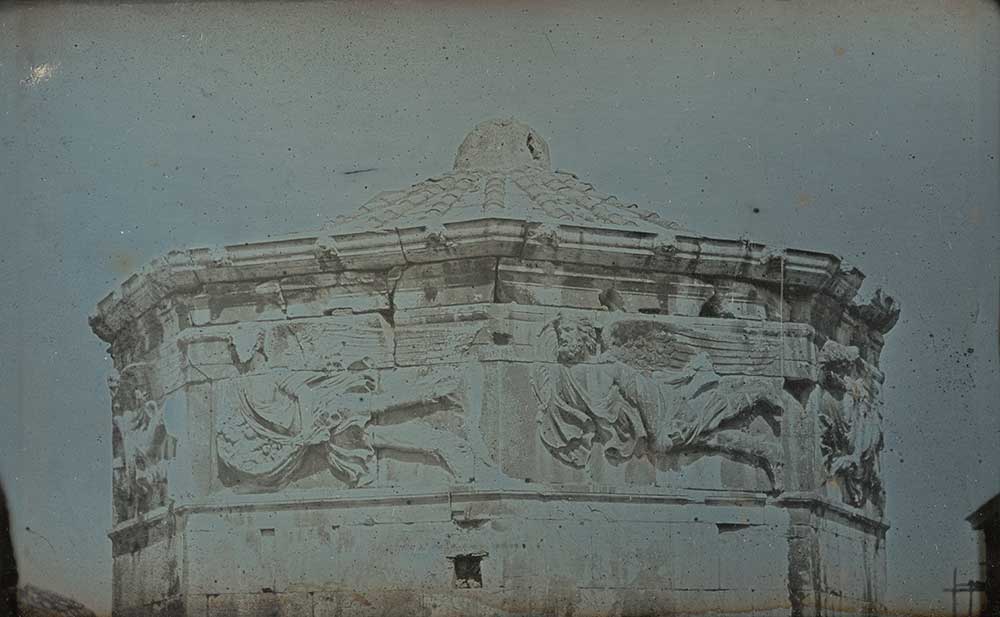
Time has ordered human life for millennia….
The Tower of the Winds, in the Greek city of Athens… is one of the best-preserved buildings from the ancient world. This octagonal marble tower, sited close to a busy marketplace at the foot of the hill of the famous Acropolis, rises forty-two feet into the air and measures twenty-six feet across, and it was an astonishing sight for the people of this crowded and vibrant city. The external walls were covered in brightly colored reliefs and moldings representing the eight winds, with each of the eight walls, and a semi-circular annex, carrying a sundial. Inside the ceiling was painted a stunning blue color covered with golden stars. At the center of the imposing interior was a water clock, which was fed from a sacred source high up on the hill of the Acropolis called the Clepsydra, a name which became synonymous with all water clocks. The clock is believed once to have driven a complex mechanical model of the heavens themselves, like a planetarium, orrery, or armillary sphere.
Nobody is quite sure when the Tower of the Winds was built, but it was probably about 140 bc. As with the sundial at the Roman Forum, we can think of it as an early public clock tower, giving Athenians the time of day as they went about their daily business at the market and elsewhere, and giving order to their lives. It was also symbolic of a wider order. The gods of the winds, depicted on its decorative panels, were allegories of world order; the stars inside, together with the water clock and its mechanical replica of the heavens, were symbolic of a cosmic order. Certainly, it was an astonishing spectacle.
But, also like the sundial proudly installed by Valerius in Rome, the Tower of the Winds may have carried a further message. If, as some historians believe, the structure was built by Attalos II, king of the Greek city of Pergamon, to commemorate the Athenian defeat of the Persian Navy in 480 bc, then it could serve as a vivid peacetime reminder of the military strength of the state—and the discipline needed to maintain it…
In empires around the world, the sight and sound of time from high towers had begun to organize the lives of the people, and project a message of power and order.
…
It is tempting, in the twenty-first century, to feel that we are the first generation to resent being governed by the clock as we go about our daily lives; that we are no longer in control of what we do and when we do it because we must follow the clock’s orders. During our long warehouse shifts, sitting at our factory workstations, or enduring seemingly never-ending meetings at the office, we might grumble that the morning is dragging on, but we cannot eat because the clock has not yet got around to lunchtime. But these feelings are nothing new. In fact, while the public sundial was new to Romans in 263 bc, it had been in widespread use long before that in other cities around the world; the first water clocks date back even further than sundials, more than 3,500 years to ancient Babylon and Egypt.
It is easy to think that public clocks are an inevitable feature of our lives. But by looking more closely at their history, we can understand better what they used to mean—and why they were built in the first place. Because wherever we are, as far back as we care to look, we can find that monumental timekeepers mounted high up on towers or public buildings have been put there to keep us in order, in a world of violent disorder.
Public time has been on the march for thousands of years: “Monumental Timekeepers,” an except from David Rooney‘s (@rooneyvision) About Time- A History of Civilization in Twelve Clocks. Via @longnow.
* Alan Lightman
###
As we watch the clock, we might send timely birthday greetings to George Alfred Leon Sarton; he died on this date in 1956. A chemist by training, his primary interest lay in the past practices and precepts of his field…an interest that led him to found the discipline of the history of science as an independent field of study. His most influential work was the Introduction to the History of Science (three volumes totaling 4,296 pages), which effectively founded that discipline. Sarton ultimately aimed to achieve an integrated philosophy of science that connected the sciences and the humanities– what he called “the new humanism.” His name is honored with the prestigious George Sarton Medal, awarded by the History of Science Society.

“The most incomprehensible thing about the world is that it is at all comprehensible”*…

There is an order to the ordered search for ordered understanding…
Science (from Latin scientia, meaning “knowledge”) is a systematic enterprise that builds and organizes knowledge in the form of testable explanations and predictions about the universe.
Modern science is typically divided into three major branches that consist of the natural sciences (biology, chemistry, physics, astronomy and Earth science), which study nature in the broadest sense; the social sciences (e.g. psychology, sociology, economics, history) which study people and societies; and the formal sciences (e.g. mathematics, logic, theoretical computer science), which study abstract concepts. There is disagreement, however, on the formal sciences being a science [as they use an a priori, as opposed to empirical, methodology]. Disciplines that use science, such as engineering and medicine, are described as applied sciences…
And there is a dazzling array of “branches” of the scientific endeavor:
• Acanthochronology – study of cactus spines grown in time ordered sequence
• Acarology – study of mites and ticks
• Aceology – science of remedies, or of therapeutics; iamatology
• Acology – study of medical remedies
• Acoustics – science of sound
• Actinobiology – synonymous with radiobiologyAdenology – study of glands…
Browse dozens and dozens at “Index of branches of science,” from Wikipedia… whose contributors may be erring on the generous side, as the list includes such entries as “Hamartiology” (the study of sin) and “Taxidermy” (the art of curing and stuffing animals).
* Albert Einstein
###
As we tackle taxonomy, we might recall that it was on this date in 2013 that Google experienced a five-minute outage affecting all of it’s services, including Google Search, YouTube, and Google Drive. During that brief period global internet traffic dropped 40%.

You must be logged in to post a comment.