Posts Tagged ‘agency’
“This was not that the subject was simple enough to be explained without mathematics, but rather that it was much too involved to be fully accessible to mathematics.”*…
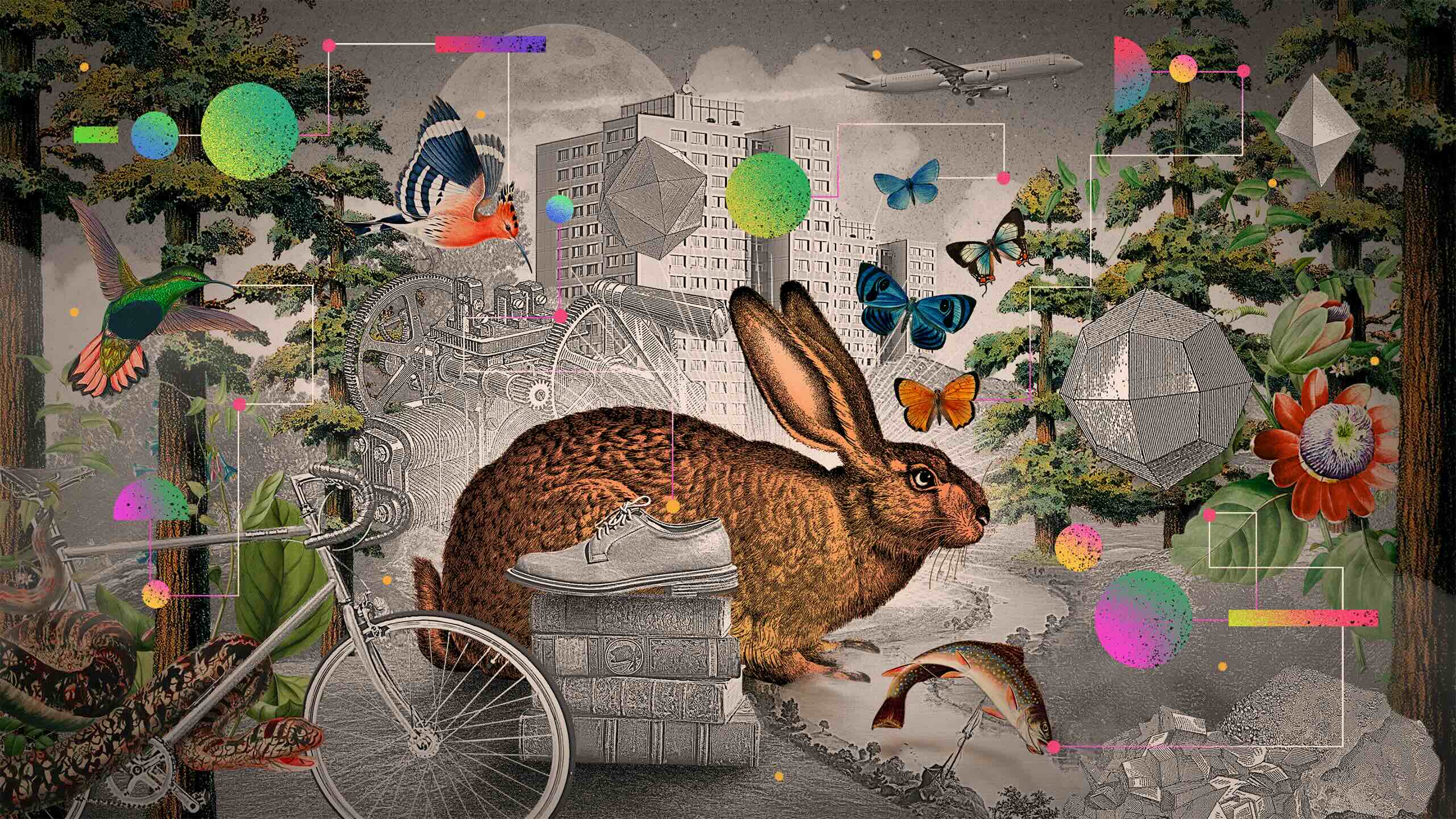
The idea of ‘biological agency’ — that life devises its own goals and behaves accordingly — complicates our understanding of what it means to be alive. But, Philip Ball asks, does it serve a scientific purpose?…
In 1993, a team led by the planetary scientist Carl Sagan tentatively concluded that there is life on Earth. Not much of a deduction, you might think — except that the researchers confined their evidence to observations made by the Galileo spacecraft, which had flown past our planet three years earlier on a looping journey to Jupiter. So great is the transformative power of life that its presence can be detected just from the light and radio waves our planet emits or reflects into space. Today we scan the cosmos for some of these telltale signatures light-years away.
Life leaves a mark, yet even now there’s no scientific consensus about what makes living things so different from inorganic substances like the rocks, gases, and oceans that are the sole components of dead worlds. Many scientists cite properties such as replication or metabolism. Others speak in more abstract terms about the way life is out of thermodynamic equilibrium with its surroundings. But some give another kind of answer. Living organisms are different because they do stuff for reasons.
It’s not enough to say that life is a nonequilibrium organized state through which there’s a constant flux of matter and energy. That description applies to hurricanes, too. But hurricanes just are. Only living entities have goals: to find food, to reproduce, to survive, sometimes simply to experience good things. (Dog owners will recognize that this is not just a human attribute.)
One way to express this idea is to say that living organisms have “agency.” It’s a hotly contested term. Some biologists reject it outright, at least for any organisms except humans, because we decide on our actions with conscious deliberation. (Whether we’re truly the only species to do so is another issue.) Others think that agency is a fundamental attribute of all life. Since there’s no agreed-upon definition of the term, to some extent it can mean whatever you want it to mean. But the debate about biological agency touches on fundamental issues in our understanding of what it means to be alive, because agency evokes a notion that biologists and philosophers have always wrestled with: teleology, the apparent purposiveness of life. If we admit agency into biology, do we open the floodgates to ideas about design, vitalism, or cosmic meaning? Or is it just a recognition of what makes life such a special state of matter?
To me, the notion of agency indeed speaks to our intuitive sense of what makes living things so special: not mere machines pushed around by environment and circumstance. I suspect that aversion to agency betrays a queasiness about confronting life as something more than some kind of genetic program. But there’s danger in the idea, too: It could so easily derail the work of studying the mechanistic explanations of how life works. I’m not looking to either bury or praise agency, but to explore whether it can be a scientifically productive idea…
[Ball unpacks the idea of agency, then reviews both scientific observations and the theories that they have provoked. He concludes…]
… I’m cautiously optimistic about the prospects of uniting such theoretical ideas with biological mechanisms. It seems unlikely to be coincidental, for example, that organisms that seem to show more agency also have molecular pathways that permit more openness to the influence of context and external information.
If we can get a clearer idea of what makes an agent, this could help us to understand how collective goals arise — as they did when multicellular organisms first arose long ago — and how they can break down, as in cancer. What’s more, a proper theory of agency might give us a clearer idea of what’s needed to make genuine artificial agents, not just computers and machines programmed with our own goals, but ones that can formulate their own. We might then also get a clearer idea of the potential benefits and dangers such truly agential machines might bring. But perhaps the most compelling argument for recognizing agency is that it might help us understand what makes life so different — not just humans, but life — that it is able to shape an entire planet in a manner visible from outer space.
Purpose? Goals? On the idea of “biological agency”: “Is Life Just Different?” from @philipcball.bsky.social in @quantamagazine.bsky.social.
* Erwin Schrödinger in What Is Life? (in which he wrestled, in his way, with Ball’s question, contending that life feeds on negative entropy) Full text here.
###
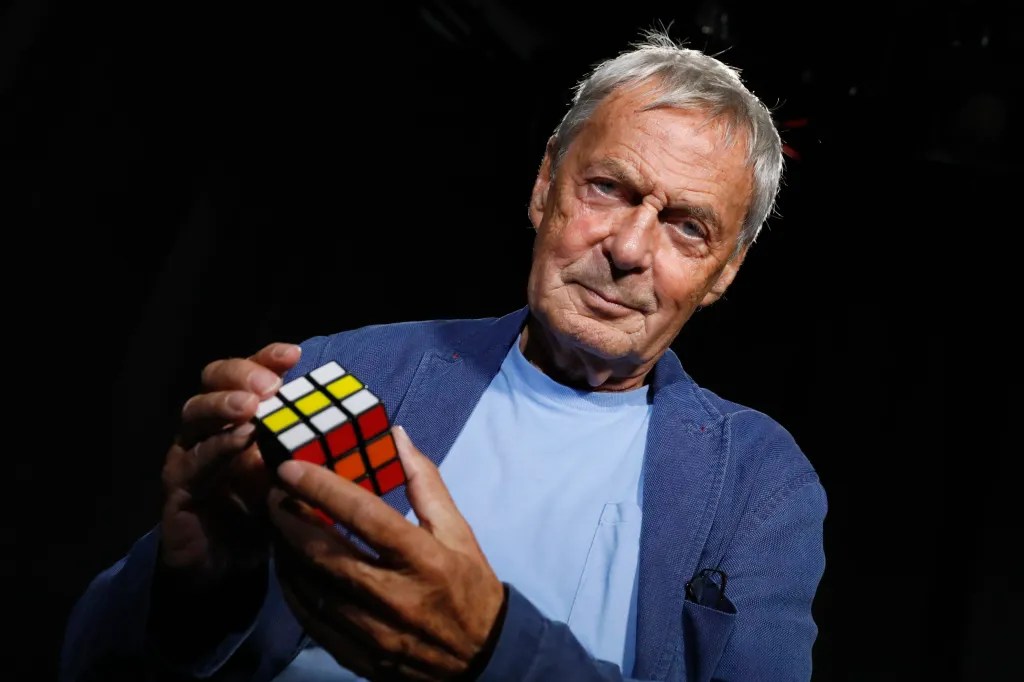
As we wonder why, we might send frustrated birthday greetings to Ernő Rubik; he was born on this date in 1944. An architect and inventor, he created the Rubik’s Cube (in 1974), which has become the world’s best-selling puzzle game, with over half a billion sold.
A Rubik’s Cube consists of 26 small cubes that rotate on a central axis; nine colored cube faces, in three rows of three each, form each side of the cube. After the cube arrangement is randomized (the highest level of entropy), the player must restore order (that’s to say, practice “negative entropy”), returning it to the original condition of faces with matching colors on each side — which is one among 43 quintillion possible configurations.
“Don’t throw the baby out with the bath water”*…
From Dynomight (and here), an argument that algorithms, while problematic today, aren’t necessarily evil…
What does “algorithmic ranking” bring to mind for you? Personally, I get visions of political ragebait and supplement hucksters and unnecessary cleavage. I see cratering attention spans and groups of friends on the subway all blankly swiping at glowing rectangles. I see overconfident charlatans and the hollow eyes eyes of someone reviewing 83 photo she just made her boyfriend take of her in front of a sunset. Most of all, I see dreams of creative expression perverted into a desperate scramble to do whatever it takes to please the Algorithm.
Of course, lots of people like algorithmic ranking, too.
I theorize that the skeptics are right and algorithmic ranking is in fact bad. But it’s not algorithmic ranking per se that’s bad—it’s just that the algorithms you’re used to don’t care about your goals. That might be an inevitable consequence of “enshittification”, but the solution isn’t to avoid all algorithms, but just to avoid algorithms you can’t control. This will become increasingly important in the future as algorithmic ranking becomes algorithmic everything…
Dynomight elaborates on the problem, its genesis, and a plausible answer: “Algorithmic ranking is unfairly maligned,” from @dynomighty.bsky.social.
###
As we rethink rankings, we might recall that on this date in 1969 a group at the top of most lists took it to the roof: The Beatles performed on the rooftop of their Apple Corps headquarters at 3 Savile Row, in central London’s office and fashion district. Joined by guest keyboardist Billy Preston, the band played a 42-minute set before the Metropolitan Police arrived and ordered them to “reduce the volume.” It was the final public performance of their career. The concert ended with “Get Back,” after which John Lennon quipped, “I’d like to say thank you on behalf of the group and ourselves, and I hope we’ve passed the audition.”
The full concert footage is available at the invaluable Internet Archive. Here, a taste of “Get Back”…
“I fear the day when the technology overlaps with our humanity. The world will only have a generation of idiots.”*…

Alva Noë on the importance of humans hanging on to their humanity– for all the promise and dangers of AI, computers plainly can’t think. To think is to resist – something no machine does:
Computers don’t actually do anything. They don’t write, or play; they don’t even compute. Which doesn’t mean we can’t play with computers, or use them to invent, or make, or problem-solve. The new AI is unexpectedly reshaping ways of working and making, in the arts and sciences, in industry, and in warfare. We need to come to terms with the transformative promise and dangers of this new tech. But it ought to be possible to do so without succumbing to bogus claims about machine minds.
What could ever lead us to take seriously the thought that these devices of our own invention might actually understand, and think, and feel, or that, if not now, then later, they might one day come to open their artificial eyes thus finally to behold a shiny world of their very own? One source might simply be the sense that, now unleashed, AI is beyond our control. Fast, microscopic, distributed and astronomically complex, it is hard to understand this tech, and it is tempting to imagine that it has power over us.
But this is nothing new. The story of technology – from prehistory to now – has always been that of the ways we are entrained by the tools and systems that we ourselves have made. Think of the pathways we make by walking. To every tool there is a corresponding habit, that is, an automatised way of acting and being. From the humble pencil to the printing press to the internet, our human agency is enacted in part by the creation of social and technological landscapes that in turn transform what we can do, and so seem, or threaten, to govern and control us.
Yet it is one thing to appreciate the ways we make and remake ourselves through the cultural transformation of our worlds via tool use and technology, and another to mystify dumb matter put to work by us. If there is intelligence in the vicinity of pencils, shoes, cigarette lighters, maps or calculators, it is the intelligence of their users and inventors. The digital is no different.
But there is another origin of our impulse to concede mind to devices of our own invention, and this is what I focus on here: the tendency of some scientists to take for granted what can only be described as a wildly simplistic picture of human and animal cognitive life. They rely unchecked on one-sided, indeed, milquetoast conceptions of human activity, skill and cognitive accomplishment. The surreptitious substitution (to use a phrase of Edmund Husserl’s) of this thin gruel version of the mind at work – a substitution that I hope to convince you traces back to Alan Turing and the very origins of AI – is the decisive move in the conjuring trick.
What scientists seem to have forgotten is that the human animal is a creature of disturbance. Or as the mid-20th-century philosopher of biology Hans Jonas wrote: ‘Irritability is the germ, and as it were the atom, of having a world…’ With us there is always, so to speak, a pebble in the shoe. And this is what moves us, turns us, orients us to reorient ourselves, to do things differently, so that we might carry on. It is irritation and disorientation that is the source of our concern. In the absence of disturbance, there is nothing: no language, no games, no goals, no tasks, no world, no care, and so, yes, no consciousness…
[Starting with Turing, Noë considers the relative roles of humans and technology across a number of spheres, including music…]
… The piano was invented, to be sure, but not by you or me. We encounter it. It pre-exists us and solicits our submission. To learn to play is to be altered, made to adapt one’s posture, hands, fingers, legs and feet to the piano’s mechanical requirements. Under the regime of the piano keyboard, it is demanded that we ourselves become player pianos, that is to say, extensions of the machine itself.
But we can’t. And we won’t. To learn to play, to take on the machine, for us, is to struggle. It is hard to master the instrument’s demands.
And this fact – the difficulty we encounter in the face of the keyboard’s insistence – is productive. We make art out of it. It stops us being player pianos, but it is exactly what is required if we are to become piano players.
For it is the player’s fraught relation to the machine, and to the history and tradition that the machine imposes, that supplies the raw material of musical invention. Music and play happen in that entanglement. To master the piano, as only a person can, is not just to conform to the machine’s demands. It is, rather, to push back, to say no, to rage against the machine. And so, for example, we slap and bang and shout out. In this way, the piano becomes not merely a vehicle of habit and control – a mechanism – but rather an opportunity for action and expression.
And, as with the piano, so with the whole of human cultural life. We live in the entanglement between government and resistance. We fight back…
… The telling fact: computers are used to play our games; they are engineered to make moves in the spaces opened up by our concerns. They don’t have concerns of their own, and they make no new games. They invent no new language.
The British philosopher R G Collingwood noticed that the painter doesn’t invent painting, and the musician doesn’t invent the musical culture in which they find themselves. And for Collingwood this served to show that no person is fully autonomous, a God-like fount of creativity; we are always to some degree recyclers and samplers and, at our best, participants in something larger than ourselves.
But this should not be taken to show that we become what we are (painters, musicians, speakers) by doing what, for example, LLMs do – i.e., merely by getting trained up on large data sets. Humans aren’t trained up. We have experience. We learn. And for us, learning a language, for example, isn’t learning to generate ‘the next token’. It’s learning to work, play, eat, love, flirt, dance, fight, pray, manipulate, negotiate, pretend, invent and think. And crucially, we don’t merely incorporate what we learn and carry on; we always resist. Our values are always problematic. We are not merely word-generators. We are makers of meaning.
We can’t help doing this; no computer can do this…
Eminently worth reading in full: “Rage against the machine,” from @alvanoe in @aeonmag.
For more, see Noë’s The Entanglement: How Art and Philosophy Make Us What We Are.
* Albert Einstein
###
As we resolve to wrestle, we might recall that it was on this date in 1969 that UCLA professor Leonard Kleinrock (aided by his student assistant Charley Kline) created the first networked computer-to-computer connection (with SRI programmer Bill Duvall in Palo Alto), via which they sent the first networked computer-to-computer communication)… or at least part of it. Duvall’s machine crashed partway through the transmission, meaning the only letters received from the attempted “login” were “lo.” The next month two more nodes were added (UCSB and the University of Utah) and the network was dubbed ARPANET.
Still, “lo”– perhaps an appropriate way to announce what would grow up to be the internet.

“Real generosity towards the future lies in giving all to the present”*…

Iwan Rhys Morus suggests that we’re enthralled to a Victorian paradigm that haunts us still: the idea that inventors and entrepreneurs hold the keys to the utopian future…
Tech titans like Elon Musk and Jeff Bezos present themselves as men who could single-handedly shape the future. For their supporters, their ruthless drive toward success is their key virtue. And their showmanship — Musk sending a Tesla Roadster into space on a Falcon Heavy rocket, or Bezos sending Captain Kirk into orbit with Blue Origin — is a way of demonstrating that virtue and asserting they are in control.
We owe to the Victorians the idea that there is a firm link between virtue and technological agency. They established a powerful paradigm that continues to haunt us: that the future is (or can be) a utopia, and inventors and entrepreneurs are the ones who know how to get there.
While our notions of virtue have shifted today, we still assume that future-making is the prerogative of very specific sorts of innovators — even as their imagined identities have fractured and transformed. The assumption that innovation is the property of charismatic individuals still underlies the way we think about technology.
…
The seductive power of Victorian thinking about the relationship between character, technology, and the future remains pervasive, even if views about just what the proper character of the inventor should be have shifted….
With its focus on individual virtue, the Victorian vision of the future is an exclusive one. When we subscribe to this paradigm about how — and by whom — the future is made, we’re also relinquishing control over that future. We’re acknowledging that tomorrow belongs to them, not to us.
“Back To The Victorian Future,” by @irmorus1 in @NoemaMag. Eminently worth reading in full.
* Albert Camus
###
As we ponder power and its purpose, we might send inclusive birthday greetings to Jacques Lucien Monod; he was born on this date in 1910. A biochemist, he shared (with with François Jacob and André Lwoff) the Nobel Prize in Physiology or Medicine in 1965, “for their discoveries concerning genetic control of enzyme and virus synthesis.”
But Monod, who became the director of the Pasteur Institute, also made significant contributions to the philosophy of science– in particular via his 1971 book (based on a series of his lectures) Chance and Necessity, in which he examined the philosophical implications of modern biology. The importance of Monod’s work as a bridge between the chance and necessity of evolution and biochemistry on the one hand, and the human realm of choice and ethics on the other, can be seen in his influence on philosophers, biologists, and computer scientists including Daniel Dennett, Douglas Hofstadter, Marvin Minsky, and Richard Dawkins.

You must be logged in to post a comment.