Posts Tagged ‘clocks’
“I wisely started with a map”*…

From Daniel O’Donohue, 29 print-ready folding globe templates (the one above is “Earth Today”; there are also globes of the sun, the moon, the planets, and lots of different “views” of Earth) — every one free to download, print, and fold, and every one customizable into other shapes or create your own, with your own pinned places. via the custom globe builder…
… This project started with a simple observation: we look at maps on screens all day, but almost nobody gets to hold a planet. A paper globe is the cheapest possible spacecraft — print a sheet, cut along the lines, fold, glue, and you are turning the actual shape of the world over in your hands.
Nothing here is decoration. Every globe is built from openly licensed scientific data — NASA satellite imagery, USGS planetary mosaics, Natural Earth cartography, NOAA ocean data, the Smithsonian’s volcano inventory — rendered through real map projections into print-quality PDFs. Each globe credits its source, and the source is always one click away.
The fold shapes are the classics of mathematical cartography: icosahedra, dodecahedra, gores like a 17th-century globemaker would cut, even the Airocean projection that unfolds the world onto twenty triangles with barely any distortion.
The curated globes are free — print as many as you like. When you want a globe that is yours alone — your places pinned, your countries highlighted, your choice of shape — the builder is where it happens…
Getting our minds– and out hands– around the places we are: “Folding Globes.”
Harmonic: “24 Times,” from Gysin-Vanetti: “A collection of twentyfour variations on the theme “clock” created for HeK… Each of these clocks shows time in a distinct form. The result is a sequence of numbers, letters or punctuation marks animated in different ways….”
* J. R. R. Tolkien
###
As we orient ourselves, we might spare a thought for William John McGee (or “WJ McGee, without the periods, as he referred to himself); he died on this date in 1912. An inventor, geologist, anthropologist, and ethnologist, he is remembered for his pioneering studies documenting the occurrence of waves of invasions and recessions of ice sheets in North America (thus establishing the complexity of the Great Ice Age). But he worked in a number of governmental and organizational capacities that contributed to teh development of geography as a discipline: e.g., as a director in the U.S. Geological Survey, and as a founder and president of the National Geographic Society. While on the staff of the Bureau of Soils, in 1918, he organized the landmark Conference of Governors on Conservation of Natural Resources, for whihc he has been called the “chief theorist of the conservation movement.”

“Nature is the source of all true knowledge”*…

Jonathan Keats on why– and how– clocks that use nature to measure time can reintegrate people into the environment and counteract the calamities of the Anthropocene…
In his studio on the east coast of Vancouver Island, the master clockmaker Phil Abernethy is crafting a timepiece that will be calibrated in a manner that no horologist has ever attempted. It won’t show the minutes and hours of an ordinary human day. Instead, his clock will display time as experienced by some of the oldest trees on the planet.
Using techniques he’s honed over a lifetime, Abernethy will machine the gears by hand in traditional materials such as steel and brass. But the pendulum will respond to the forest: When trees grow quickly, the hours will advance more rapidly; more lethargic growth will result in a slower tempo. Over centuries, the long-term fate of the canopy will be registered on a calendar that may deviate from the Gregorian date by decades or more.
Abernethy has been commissioned to fabricate the arboreal clock by the Nevada Museum of Art. Standing 12 feet tall, the clock will be the first physical manifestation of an environmental timekeeping project I have been developing over the past decade. Some of the clocks in the project respond to rivers; Abernethy’s enlists a stand of bristlecone pine trees in Nevada’s Great Basin as living timekeepers.
Fluctuations in the bristlecones’ growth rate, affected by environmental conditions ranging from local rainfall to planetary climate change, will be measured by analyzing the thickness of tree rings in microcores retrieved from the mountain each year. These data will be used to determine the center of gravity for the pendulum, which will swing slower or faster depending on the tree ring thickness. Though the clock face will display time in the usual way, it won’t serve as a mechanism for human planning — a technology to impose order on the environment for our convenience — but rather to pace our lives to match the lived reality of other organisms.
Abernethy’s arboreal clock, in other words, upsets more than just the standards of horology. The environmental calamity known as the Anthropocene is a consequence of a worldview in which all that is not human is construed as a resource — even time itself. Other life forms are going extinct at an unprecedented rate, laid waste at a pace set by the world economy. Factory farming and logging, fossil fuel and plastics production, mining, human construction and infrastructure — all disregard the timing with which nonhuman systems emerge, ebb and flow. The globalized logic of industry, with its planetary supply chain, must keep up with human demand, turning civilization itself into a manifestation of logistics.
Our mastery of the world is a mastery of time. And as every industrialist knows, mastery of time requires the precision of a master clock to provide a temporal standard against which everything can be measured and controlled. Whether regulated by the swing of a pendulum or the oscillations of a strontium atom — as the most advanced atomic clocks are today — the master clock operates without an external feedback mechanism. The clock has become the ultimate authority. To question it would be tantamount to questioning modernity.
The design of Abernethy’s arboreal clock may be novel, but the underlying ideas are ancient. They predate pendulums and gearwork, originating in an era when people observed time in relation to other beings in order for all to flourish together. Ancient but mostly forgotten, these ideas are urgently needed today. Whatever practical use it might have, the arboreal clock is intended primarily to serve as a philosophical instrument…
…
… Humankind appears to be the only species to have contrived clocks that count without reference to something outside of themselves. We also appear to be the only species to have use for these contraptions, to use time in this peculiar way. (Mumford astutely described clocks as “power machinery whose ‘product’ is seconds and minutes.”)
All life depends on timekeeping. But nonhuman life treats time as a mixed medium: entangled with the environment, dependent on other organisms…
…
… Near the peak of Mt. Washington in Nevada’s Great Basin, which rises more than 11,600 feet above sea level, the bristlecone pines are as scraggly as the tree in “A Charlie Brown Christmas.” Until very recently, bristlecones didn’t grow at this elevation. To walk down the slope is to stroll through time, eventually reaching trees that are several thousand years old and as solid as sculpted stone.
Over the past decade, I have gotten to know these trees, visiting with members of the Long Now Foundation, the organization that stewards part of the mountaintop and has partnered with me on the clock at the Nevada Museum of Art. By observing the trees and their embodied experience of time, I have been able to see the inadequacy of my wristwatch.
The trees sensitized me to the time reckoning of other life forms, both plants and animals. They attuned me to the time kept collectively in living systems such as rivers, where the flow rate is affected by the melting of glaciers and the eagerness of beavers, not to mention the unquenchable thirst of industrial agriculture. By gearing the flow of time to match the flow of the Susitna or Matanuska — as I have done in partnership with the Anchorage Museum — fluvial clocks can integrate people into local watersheds.
An arboreal clock can likewise integrate people into the forest. Or to be more accurate, it can reintegrate people into their ecosystems, counteracting the human denaturing of the Anthropocene…
Eminently worth reading in full: “A Clock In The Forest,” from @jonathonkeats in @NoemaMag @longnow.
* Leonardo da Vinci
###
As we think about time, we might also contemplate natural space, and spare a thought for Abraham Ortelius; he died on this date in 1598. A cartographer, geographer, and cosmographer, he created the first modern atlas, the Theatrum Orbis Terrarum (Theatre of the World)– “the book that invented the world.”
Ortelius is generally considered one of the founders (with Gemma Frisius and Gerardus Mercator) of the Netherlandish school of cartography and geography. He was an important geographer of Spain during the age of discovery– and the first person proposing that the continents were joined before drifting to their present positions.

“It’s easier to imagine the end of the world than the end of capitalism”*…

… so it’s useful to contemplate its beginning. David Rooney, in an excerpt from his book About Time…
Ömer Aga stood in the middle of Amsterdam’s Dam Square surrounded by his nineteen-strong party of advisers, interpreters and hosts, and gazed toward the huge new trading exchange that straddled the mighty Rokin canal, just to the south of the square. The year was 1614, and Aga was on a fact-finding mission to the Dutch Republic as the Ottoman Empire’s newest diplomatic emissary. Top of his list of must-see sights was this bold new building, completed just three years earlier. It was hard to miss, as it was the size of a soccer field and could accommodate thousands of traders in its 200-by-115-foot enclosed inner courtyard, but what Aga really noticed was the four-sided clock tower that loomed over the vast structure and the streets and canals all around, as well as the booming sound of its bell when they rang out the hours and then, at noon, tolled repeatedly for a few minutes before falling silent. Little did they realize it, but Omar Aga and his retinue were listening to one of the most significant clocks ever made. It was fitted to the world’s first stock exchange and sounded the birth of modern capitalism.
From the moment the Amsterdam exchange building first opened its doors in August 1611, traders were forbidden from trading anywhere else in the city. But the exchange did not just put spatial boundaries on trade. It concentrated traders in time, too. A few days before the new facility opened, the city council had issued a bylaw proclaiming that trading could only take place between the hours of 11 a.m. and noon, Monday to Saturday. At noon, the clock installed in the tower high above the exchange building would toll a bell for seven and a half minutes. If any traders were still in the exchange, or in the streets nearby, they would be fined. Additionally, trading was allowed between 6:30 p.m. and 7:30 p.m. during the summer months between May and August, and in winter evening trading took place for a thirty-minute period marked by a tolling bell at the city’s gates. At the end of evening trading, the exchange clock would again sound for seven and a half minutes and fines were issued for anyone caught trading after the bells fell silent.
Why were such strict limits placed on trading at the Amsterdam exchange? There were several reasons. One was a practical problem familiar to anybody involved with trade in a busy city center: time limits reduced congestion and disruption in the streets nearby. Another was that clocks made trading more efficient. Short, fixed trading hours concentrated buyers and sellers together, making it easier for each to find enough of the other. This increased the volume of trade, which was good for traders and for the city council collecting taxes on transactions. But clocks also helped prices to remain fair, as they could be used to regulate the people who occupied intermediate roles in the functioning of a market.
Some of the earliest references to mechanical clocks being used in towns and cities, in the Middle Ages and soon after, related to market restrictions. The first urban markets brought producers of food, cloth and so on into direct contact with the consumers of their wares. But as towns and cities grew, this model started to break down. It stopped making sense for every producer in the countryside to make the journey all the way to the center of towns. So, ‘intermediate trading’ emerged, whereby third parties might buy up the goods from several small producers somewhere on the edge of town, before bringing them in and selling them themselves at the market. Soon, a whole range of intermediate roles sprang up. Wholesalers, merchants, shopkeepers and peddlers were some, but intermediates also included financiers who advanced funds, and those speculating on the future in the hope of offsetting risk (whether because of bad harvests or other unpredictable events) and making more money. Some people occupied more than one role.
As populations grew and moved in increasing numbers to towns and cities, and markets began to sell more and more products, the rise of intermediate roles in market-based trade was inexorable, creating a new stratum of people who neither produced goods nor consumed them, but traded, speculated, brokered, hoarded, flipped and financed. Some market authorities feared intermediates would drive up prices or limit supplies and turned to clocks to control their involvement. Clocks meant that different groups could be treated differently at the market. In a sixteenth-century grain market, for instance, the first hours of trade could be restricted to residents, before bakers of bread could get in, and then the pastry bakers could enter. Only after several hours were wholesalers and other intermediate traders allowed in. But as societies and their market trading became ever more complex, the role of intermediates like brokers and financiers became increasingly important in keeping the flow of trading running smoothly. And, before long, finance became something that could be traded in its own right, and clocks took on a new regulatory role.
Amsterdam’s was not the first trading exchange. Antwerp and London had had exchanges since the sixteenth century where goods and money were traded, but Amsterdam was the first of a new kind of exchange: what became the modern securities exchange. As well as being a place to trade in commodities like salt or hides, people could also buy and sell financial assets. It started out as a place to buy and sell shares in the Dutch East India Company, an early joint-stock company and the first with freely tradable shares, but soon was used to trade other company shares, futures contracts and insurance policies as well as becoming the place to go for information about the state of the markets. The financial market had arrived, but its products, and the prices paid for them, which were time-dependent. The time at which each securities transaction was made, or would be enacted in the future, was central to this new type of trading to work fairly, everybody had to agree what time this was. In other words, trading needed time stamps, which is where the exchange clock came into its own. Clocks were no longer about excluding intermediates from the market. In the new exchanges, intermediates were the market — with the clock watching carefully over the whole thing…
The birth of modern capitalism and the role that timekeeping played in its nascence: The Amsterdam Stock Exchange, from @rooneyvision, via the invaluable @delanceyplace.
* Fredric Jameson (also sometimes attributed to Slavoj Žižek)
###
As we examine enterprise, we might recall that it was on this date in 1937 that Sylvan Goldman introduced the first shopping cart in his Humpty Dumpty grocery store in Oklahoma City.

“It is at Dusk that the most interesting things occur, for that is when simple differences fade away. I could live in everlasting Dusk.”*…

L. M. Sacasas on time and temporality…
… I’m tempted, as I often am, by the grand generalization, and I will yield. Pre-industrial culture was synchronized by the rhythms of nature, rhythms which were often imbued with sacral significance (a unity suggested by the shared root of cult, culture, and cultivate). Industrial culture was, as Lewis Mumford observed, driven not by the steam-engine but by the clock. Industrial time overthrew pre-industrial time—agricultural time, if you like—but yielded a new set of rhythms and patterns, with the 9-5 workday perhaps at its heart. Mass media, which is to say industrialized media, supplied its own public temporalities to the industrial age, a new quasi-sacral calendar with daily, seasonal, and yearly rituals, some of which were artificial simulations of the old pre-industrial rituals.
What we have now is a new temporal order. It is not a negation of industrial time, but a further development built upon the precision of mechanical time. Industrial time enabled the mass synchronizations industrial culture required. But now digital technology enables a new desynchronized society through even more refined timekeeping coupled with the computational capacity to mobilize and organize society along more fluid, just-in-time, and, yes, from a human perspective, stochastic patterns.
To put this another way, a culture ordered in its patterns, language, ethics, and imagination by the rhythms of the natural world gave way to a culture ordered in its patterns, language, ethics, and imagination by the rhythms of industrialized labor and mass media. While we might disagree as to the timing of the transition, it seems safe to say that we now inhabit yet another cultural configuration. To put it this way may seem like a banal restatement of the well-worn and contested pre-modern/modern/post-modern sequence. But I think it is useful to draw out the temporal dimension of these social dynamics. If we press into each of these four categories—patterns, language, ethics, and imagination—we will find surprising and profound links to the temporal heart beating out the dominant cultural rhythms, whether it be nature or the machine.
…
Inhabiting the order of measured, quantified time, as most of us do, already inhibits our capacity to imagine another way of being in time. Our enclosure within the human-built world, in both its analog and digital dimensions, obscures the markers of alternative temporal orders. It is possible, of course, to frame this as a liberation from the limits of time just as it is possible to frame our uprootedness as a liberation from the constraints of place. And, indeed, it sometimes is just that. But it is also possible that our liberation from older cultural forms, forms which were more directly informed by a place and its time, has been used against us. To be disembedded and desynchronized is also to become subject to the stochastic order of the digital economy.
The computer, after all, is, among other things, an agent of social organization and an instrument of control. But what forms of social organization does it enable and what forms of control does it make possible?
…
The most tempting thing is to go back to the kind of empirically verifiable harms which I mentioned in passing at the outset. That’s the surest way to make the case for a different set of practices, but, of course, that is itself part of the problem. Yes, there’s a case to be made on the grounds of basic health and well-being, ours and our fellow creatures, for seeking another way of ordering our material environment.
But I find myself reaching beyond such concerns to something more ambivalent and amorphous, toward not just the healthy but the good, toward a deep recalibration of our being in the world according to a different order of time. And perhaps in thinking again about the meaning of our experience of light and dark and, perhaps especially, the transitions between the two, we can discern a different set of rhythms. “We are not only creatures of the light,” Kohák reminds us. “We are creatures of the rhythm of day and night, and the night, too, is our dwelling place.”…
Eminently worth reading in full: “Whose Time? Which Temporality?” from @LMSacasas.
* Olga Tokarczuk, Drive Your Plow Over the Bones of the Dead
###
As we contemplate chronology, we might recall that it was on this date in 1918 that the U.S. Congress “standardized” time: the Standard Time Act (AKA, the Calder Act) became effective. Passed earlier in the year, it implemented across the U.S. both Standard Time (the creation of time zones anchored in UTC, the successor to GMT) and Daylight Saving Time.

“One cannot walk down an avenue, converse with a friend, enter a building, browse beneath the sandstone arches of an old arcade without meeting an instrument of time.”*…
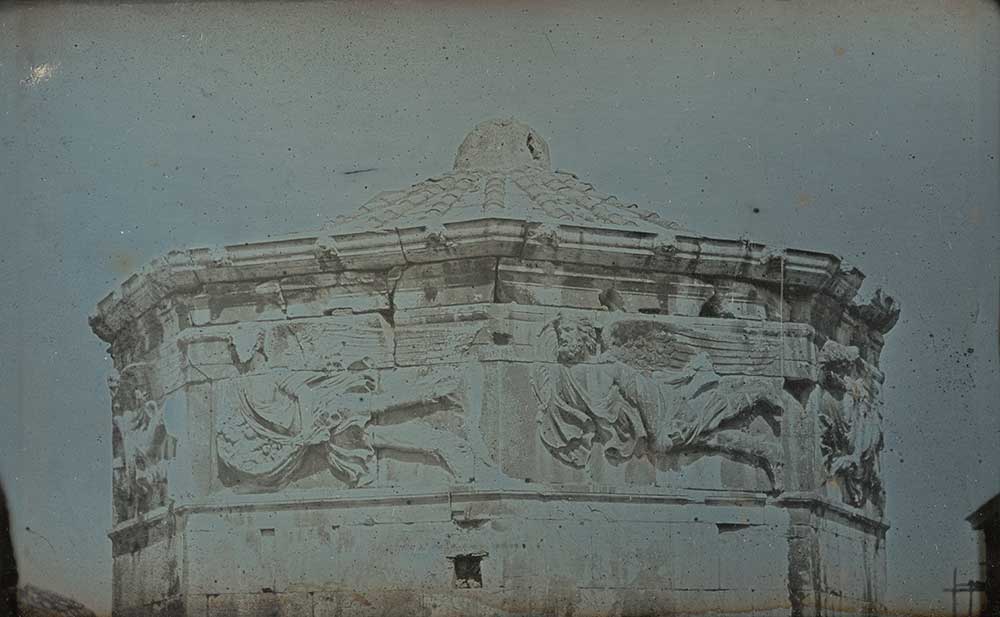
Time has ordered human life for millennia….
The Tower of the Winds, in the Greek city of Athens… is one of the best-preserved buildings from the ancient world. This octagonal marble tower, sited close to a busy marketplace at the foot of the hill of the famous Acropolis, rises forty-two feet into the air and measures twenty-six feet across, and it was an astonishing sight for the people of this crowded and vibrant city. The external walls were covered in brightly colored reliefs and moldings representing the eight winds, with each of the eight walls, and a semi-circular annex, carrying a sundial. Inside the ceiling was painted a stunning blue color covered with golden stars. At the center of the imposing interior was a water clock, which was fed from a sacred source high up on the hill of the Acropolis called the Clepsydra, a name which became synonymous with all water clocks. The clock is believed once to have driven a complex mechanical model of the heavens themselves, like a planetarium, orrery, or armillary sphere.
Nobody is quite sure when the Tower of the Winds was built, but it was probably about 140 bc. As with the sundial at the Roman Forum, we can think of it as an early public clock tower, giving Athenians the time of day as they went about their daily business at the market and elsewhere, and giving order to their lives. It was also symbolic of a wider order. The gods of the winds, depicted on its decorative panels, were allegories of world order; the stars inside, together with the water clock and its mechanical replica of the heavens, were symbolic of a cosmic order. Certainly, it was an astonishing spectacle.
But, also like the sundial proudly installed by Valerius in Rome, the Tower of the Winds may have carried a further message. If, as some historians believe, the structure was built by Attalos II, king of the Greek city of Pergamon, to commemorate the Athenian defeat of the Persian Navy in 480 bc, then it could serve as a vivid peacetime reminder of the military strength of the state—and the discipline needed to maintain it…
In empires around the world, the sight and sound of time from high towers had begun to organize the lives of the people, and project a message of power and order.
…
It is tempting, in the twenty-first century, to feel that we are the first generation to resent being governed by the clock as we go about our daily lives; that we are no longer in control of what we do and when we do it because we must follow the clock’s orders. During our long warehouse shifts, sitting at our factory workstations, or enduring seemingly never-ending meetings at the office, we might grumble that the morning is dragging on, but we cannot eat because the clock has not yet got around to lunchtime. But these feelings are nothing new. In fact, while the public sundial was new to Romans in 263 bc, it had been in widespread use long before that in other cities around the world; the first water clocks date back even further than sundials, more than 3,500 years to ancient Babylon and Egypt.
It is easy to think that public clocks are an inevitable feature of our lives. But by looking more closely at their history, we can understand better what they used to mean—and why they were built in the first place. Because wherever we are, as far back as we care to look, we can find that monumental timekeepers mounted high up on towers or public buildings have been put there to keep us in order, in a world of violent disorder.
Public time has been on the march for thousands of years: “Monumental Timekeepers,” an except from David Rooney‘s (@rooneyvision) About Time- A History of Civilization in Twelve Clocks. Via @longnow.
* Alan Lightman
###
As we watch the clock, we might send timely birthday greetings to George Alfred Leon Sarton; he died on this date in 1956. A chemist by training, his primary interest lay in the past practices and precepts of his field…an interest that led him to found the discipline of the history of science as an independent field of study. His most influential work was the Introduction to the History of Science (three volumes totaling 4,296 pages), which effectively founded that discipline. Sarton ultimately aimed to achieve an integrated philosophy of science that connected the sciences and the humanities– what he called “the new humanism.” His name is honored with the prestigious George Sarton Medal, awarded by the History of Science Society.

You must be logged in to post a comment.