Posts Tagged ‘exchange’
“A strange idea was pecking at his brain like a chicken in the egg, and very, very much absorbed him”*…

The estimable Brad DeLong shares the prose outline of one of his lectures…
[In] my “roots of property, exchange, and the division of labor” lecture [I try] to make novel and strange the idea people think that they “own” things: to impress students with how just plain weird that is. And then there are the next steps: That people enter into reciprocal gift-exchange relationships with or using things they “own” is really weird. That reciprocal gift-exchange transforms into cash-on-the-barrelhead one-shot economic “trade” is perhaps the weirdest of all. Where do these things come from? And what are the chances that any Turing-Class intelligent social creature would ever develop them? And how much less efficient and functional as an action-taking anthology-intelligence could the East African Plains Ape possibly be without these social-institutional things that underpin the global-scale societal coördination mechanism we call the “market economy”?
What if we see the idea of “owning” something is one of humanity’s strangest inventions? Before markets, before money, there was a peculiar leap: the belief that things could be “mine” even when I’m not looking. Explore how property and exchange, far from being “natural”, are peculiar to the East African Plains Ape, are societal-scale technologies that turned us into a market-making species, and how that leap—property and exchange—became the foundation of our economic world and of a great deal of our success as an action-taking anthology-intelligence.
That we believe in property and exchange is absolutely key to the “market” institutional mode of organizing the practical-action coördination side of humanity as a successful anthology intelligence. And that is not all that property is key to, for spheres of ownership, action, and control that can be readjusted are very important parts of our conceptual map for a great deal of our additional collective modes and mechanisms of societal organization. And these ideas—not just “I will growl and bite you if you try to drag this zebra carcasse I am eating right now away from me”, but that this is mine and it stays mine even if I am not right here growling—is really weird.
Where and how does it originate?
And why did it make sense for the first of the homines erecti who added this to their shared conceptual maps?…
Touching on the thinking of Doug Jones (who locates the cultural emergence of “property” in the development of the hand-axe), Adam Smith, Aristoteles of Stagire, John Locke, Jean-Jacques Rousseau, and Friedrich Engels, DeLong concludes…
However, once we have constructed this jenga tower on top of its foundations of reciprocity and ownership, one of very key pieces of humanity’s glory and power as an action-taking coördinated anthology-intelligence has fallen into place.
The true genius of the market system lies in its capacity to decentralize decision-making, to push choices and authority out to the periphery—out to the individuals and enterprises who are closest to the ground, who possess the granular, local knowledge that no distant central planner or bureaucratic committee could ever hope to match. In this way, the market harnesses and aggregates the dispersed intelligence of society, transforming millions of individual judgments, preferences, and bits of information into a coherent pattern of production and allocation.
The result is an astonishingly adaptive and responsive system, one that can, at its best, direct resources toward their most valued uses with a minimum of wasted effort. But, and this is crucial, this remarkable coördination is only truly effective for rival and excludible commodities—goods and services for which one person’s consumption precludes another’s, and for which access can be limited to those who pay. In these domains, the market’s invisible hand is real and powerful, allocating goods through the interplay of supply, demand, and price.
When markets are functioning well—when property rights are secure, when contracts are enforced, when information is sufficiently available—they become the central nervous system of a vast, intricate organism. They coordinate sprawling networks of production and exchange, linking together farmers, manufacturers, merchants, workers, and consumers in a web of mutual interdependence. It is the division of labor, enabled and deepened by the existence of wide and deep markets, that serves as the engine of productivity and prosperity. As Adam Smith observed, the specialization of tasks allows individuals to become more skilled and efficient, unleashing a flood of innovation and output that no autarkic household or command economy could hope to rival.
Yet—and this is a point too often ignored—the benefits of this productivity are not distributed evenly or automatically. Who gets what, and how much, is determined by the prevailing structure of bargaining power and the existing arrangements of property. The market does not guarantee justice, only efficiency; it delivers abundance, but it apportions that abundance according to the rules of the game, rules that are themselves the product of history, law, and politics. Thus, while the market is a marvel of coordination, it is never a substitute for vigilance about the distributional consequences it generates…
How ownership and trade have made us truly weird: “‘Property’ & ‘Exchange’ as a Coördination Mechanism at Societal Scale,” from @delong.social.
Apposite (and in the spirit of both DeLong’s concluding observation and Aristotle’s injunction: “Property should be in a general sense common, but as a general rule private… In well-ordered states, although every man has his own property, some things he will place at the disposal of his friends, while of others he shares the use of them.”): “Think LIke a Commoner“
* Fyodor Dostoyevsky, Crime and Punishment
###
As we ponder property, we might send insightful birthday greetings to one of its most sardonic observers, William Makepeace Thackeray; he was born on this date in 1811. A novelist and illustrator, he is best known for his satirical works, particularly his 1847–1848 novel Vanity Fair, a panoramic– and piercing– portrait of British society, and the 1844 novel The Luck of Barry Lyndon (which was, of course, adapted for a 1975 film by Stanley Kubrick.

“The bond of our common humanity is stronger than the divisiveness of our fears and prejudices”*…
Inanna Hamati-Ataya on the importance of understanding our place in the world…
In the 1990s, an entire generation was robbed of its historical consciousness by a powerful and seemingly unprecedented tale. This story, crafted as the Cold War came to an end, declared that real or imagined boundaries had stopped working as they once had. Humans were no longer contained within their old geographies or identities. They now inhabited a new world that appeared to be unhinged from the normal evolution of human society.
The concept chosen to capture this transformational moment in human history was ‘globalisation’. It described how new technologies and networks of connectivity had suddenly brought human communities closer together and made them permeable to an uncontrollable flow of people, ideas, goods and cultural practices, which all moved freely across the integrated markets of the world economy. In the wake of this transformation, new jargon emerged, expressing new anxieties: the world had truly become the ‘global village’ that Marshall McLuhan anticipated in the 1960s, but it was a world shaped by multinational corporations and ‘elite globalisers’, who spoke a common, hegemonic ‘global English’, and were spearheading a destructive ‘homogenisation’ (or ‘McDonaldisation’) of human cultures that national borders were too fragile to withstand.
During the past three decades, more people have begun viewing our ‘global’ world as a cursed fate. With its suffocating time-space compression, globalisation seems to have uncoupled us from the logic and flow of history. Our suspicious, bastard identities – patched together from a mishmash of cultures – appear incompatible with our ancestors’ ‘authentic’ traditions and ways of life. We have become strangers to the places they called home, to the ways they dressed, ate or communicated with one another. And, with no template for how to live and no experience to learn from, the deafening siren songs of anti-globalisation movements are now luring us back into the safer identities and boundaries of a lost, golden past.
This tale of globalisation is the most successful scare story of our times. And like all scare stories, it stimulates our fear of an overwhelming unknown.
But it’s all an illusion. There is no new global world.
Our present appears that way only because we have forgotten our common past. Globalisation didn’t begin in the 1990s, or even in the past millennia. Remembering this older shared history is a path to a different tale, which begins much, much earlier – long before the arrival of international supply chains, ocean-going sailing ships, and continent-spanning silk roads. The tale of globalisation is written across human history. So why do we keep getting the story so wrong?…
[She unpacks the answer to her questions, then turns to it implications…]
… In our own contemporary era, anti-globalisation movements have recently shifted from the far Left to the far Right of national and global politics. Justified resentment against the locally experienced injustices of the global economy and the growing disruptive effect of global climate change are now couched in resentment for the social and cultural dimensions of globalisation. Identitarianism, a political ideology that stresses the preservation of narrowly conceived ‘Western’ ethnicities and cultures, has accordingly become the easiest and most efficient strategy to mobilise local grievances, and direct them at whatever is perceived as a threat to the wellbeing of those suffering within. The ugly age of nationalism is back.
Is nationalist identitarianism the ethos we will now deploy to confront the common existential threats that await us in the coming century? Why wouldn’t it be? Does anyone doubt that national borders will be turned, once again, into sacred physical boundaries and fiercely defended against those fleeing the environmental, economic or military devastation of their homes? Do we doubt that eloquent voices animated by the most (ig)noble intentions will rise to justify patriotic bullets being aimed at ‘alien migrants’ and climate refugees? And that leaders will say these displaced people cannot be accommodated because of their numbers and cultures, and the threat they pose to our secure lives – to our ‘identity’?
Such scenarios are far too likely given the rise of xenophobic worldviews, such as the conspiratorial idea of a ‘Great Replacement’, in which elites – imagined to be Jews and other minorities – have begun executing a plan to replace so-called indigenous white Europeans with other populations of apparently greater and threatening reproductive vitality. These racialist worldviews dangerously converge with a public misunderstanding of ‘race’ as reflected in the recent craze for DNA ‘ancestry tests’. DNA has little to do with ‘identity’, as social and political ideologies have constructed it, and much to do with physical and social geography. Our genes are a result of human adaptive mobility, and the journeys, rich encounters and kin-making that our freedom of movement made possible over tens of thousands of years. Our genome does not tell our whole story, but the story it does tell shows how past globalisations made us what we are today.
As we search for ways of communing with one another beyond the stubborn ideology of difference, we should also prepare for vicious future distortions and manipulations of our current scientific and historical understanding of identity. Some humans today carry a few genes that their Pleistocene ancestors inherited from intercourse with our Eurasian Neanderthalian and Denisovan cousins, whom some communities of Homo sapiens encountered on their journeys of cosmopolitan expansion. How might such a genetic difference among us be interpreted and used in the future by those intent on pursuing identitarianism to its silliest or most murderous conclusions? Might they declare that some humans are not ‘pure’ enough to enjoy the full freedom, security and dignity we recognise as the natural rights of humankind? Or might they, on the contrary, elevate the Neanderthalian or Denisovan gene as a marker of Eurasian ‘distinction’ to recreate narratives of racial superiority, similar to those that once plagued archaeological thinking about the allegedly more ‘advanced’ nature of those human fossils laying the farthest away from the species’ original African homes?
Palaeontologists who insist on ascribing the label ‘humans’ to the entire Homo genus while reserving that of ‘modern humans’ to the surviving representatives of the lineage (ie, us) probably understand better than most the dangers of ideological manipulations of scientific taxonomies. But in the open marketplace where ideas freely flow in the name of freedom of thought and expression, how can we protect ourselves and one another from such dangers, if we still perceive plurality as a threat to survival, and cannot see the richness of our shared human culture?
The wars we wage against one another are all civil wars. Until we recognise them as such, they will remain tragedies we accept as natural – or horrors we cheer on in the name of grand notions sold to us by loud voices who know our fears too well (and know too little of the richness of our world and our history). We have always been global, and this is our shared identity. It is our unique way of being and remaining in the world as one family. Whatever we cherish in our humanity and culture has been crafted by our global journeys and encounters. Through them, we will continue to write the story of how we become us…
All of our religions, stories, languages, and norms were muddled and mixed through mobility and exchange throughout history: “There are no pure cultures,” from @berytia.bsky.social in @aeon.co.
Still, as Venkatesh Rao reminds us, the “vacuous over-large abstractions like “globalization” make us underestimate the horizontal historicity of the world.”
* Jimmy Carter
###
As we go with the flow, we might recall that it was on this date in 1690 (or so musicologists believe) that Johann Christoph Denner, inspired by a reeded recorder-like instrument called the chalumeau, designed and created a longer and keyed (so more widely-ranged) instrument that was quickly copied and modified by other makers– and became what we know as the clarinet. By 1791, Mozart was composing for the instrument; by Beethoven’s time, the clarinet was a staple member in the orchestra.
To the point of the essay above, it’s worth noting that the chalumeau– and thus the clarinet– were direct descendants of ancient Greek and ancient Egyptian reeded pipes… that may themselves have been modeled on similar instruments from Central and East Asia.

The clarinet, as depicted in Diderot’s Encyclopedia, 1776 (source)
“It’s easier to imagine the end of the world than the end of capitalism”*…

… so it’s useful to contemplate its beginning. David Rooney, in an excerpt from his book About Time…
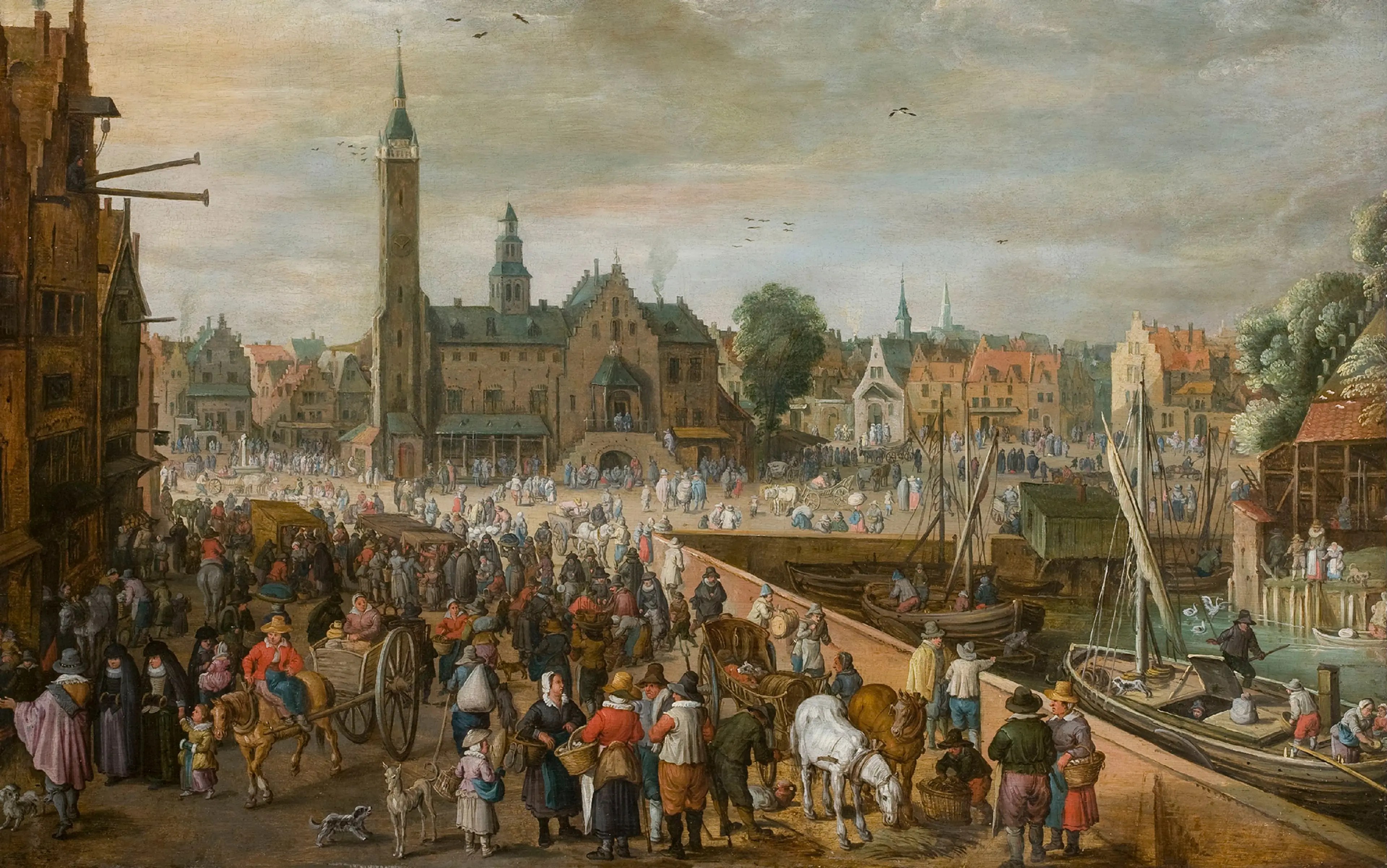
Ömer Aga stood in the middle of Amsterdam’s Dam Square surrounded by his nineteen-strong party of advisers, interpreters and hosts, and gazed toward the huge new trading exchange that straddled the mighty Rokin canal, just to the south of the square. The year was 1614, and Aga was on a fact-finding mission to the Dutch Republic as the Ottoman Empire’s newest diplomatic emissary. Top of his list of must-see sights was this bold new building, completed just three years earlier. It was hard to miss, as it was the size of a soccer field and could accommodate thousands of traders in its 200-by-115-foot enclosed inner courtyard, but what Aga really noticed was the four-sided clock tower that loomed over the vast structure and the streets and canals all around, as well as the booming sound of its bell when they rang out the hours and then, at noon, tolled repeatedly for a few minutes before falling silent. Little did they realize it, but Omar Aga and his retinue were listening to one of the most significant clocks ever made. It was fitted to the world’s first stock exchange and sounded the birth of modern capitalism.
From the moment the Amsterdam exchange building first opened its doors in August 1611, traders were forbidden from trading anywhere else in the city. But the exchange did not just put spatial boundaries on trade. It concentrated traders in time, too. A few days before the new facility opened, the city council had issued a bylaw proclaiming that trading could only take place between the hours of 11 a.m. and noon, Monday to Saturday. At noon, the clock installed in the tower high above the exchange building would toll a bell for seven and a half minutes. If any traders were still in the exchange, or in the streets nearby, they would be fined. Additionally, trading was allowed between 6:30 p.m. and 7:30 p.m. during the summer months between May and August, and in winter evening trading took place for a thirty-minute period marked by a tolling bell at the city’s gates. At the end of evening trading, the exchange clock would again sound for seven and a half minutes and fines were issued for anyone caught trading after the bells fell silent.
Why were such strict limits placed on trading at the Amsterdam exchange? There were several reasons. One was a practical problem familiar to anybody involved with trade in a busy city center: time limits reduced congestion and disruption in the streets nearby. Another was that clocks made trading more efficient. Short, fixed trading hours concentrated buyers and sellers together, making it easier for each to find enough of the other. This increased the volume of trade, which was good for traders and for the city council collecting taxes on transactions. But clocks also helped prices to remain fair, as they could be used to regulate the people who occupied intermediate roles in the functioning of a market.
Some of the earliest references to mechanical clocks being used in towns and cities, in the Middle Ages and soon after, related to market restrictions. The first urban markets brought producers of food, cloth and so on into direct contact with the consumers of their wares. But as towns and cities grew, this model started to break down. It stopped making sense for every producer in the countryside to make the journey all the way to the center of towns. So, ‘intermediate trading’ emerged, whereby third parties might buy up the goods from several small producers somewhere on the edge of town, before bringing them in and selling them themselves at the market. Soon, a whole range of intermediate roles sprang up. Wholesalers, merchants, shopkeepers and peddlers were some, but intermediates also included financiers who advanced funds, and those speculating on the future in the hope of offsetting risk (whether because of bad harvests or other unpredictable events) and making more money. Some people occupied more than one role.
As populations grew and moved in increasing numbers to towns and cities, and markets began to sell more and more products, the rise of intermediate roles in market-based trade was inexorable, creating a new stratum of people who neither produced goods nor consumed them, but traded, speculated, brokered, hoarded, flipped and financed. Some market authorities feared intermediates would drive up prices or limit supplies and turned to clocks to control their involvement. Clocks meant that different groups could be treated differently at the market. In a sixteenth-century grain market, for instance, the first hours of trade could be restricted to residents, before bakers of bread could get in, and then the pastry bakers could enter. Only after several hours were wholesalers and other intermediate traders allowed in. But as societies and their market trading became ever more complex, the role of intermediates like brokers and financiers became increasingly important in keeping the flow of trading running smoothly. And, before long, finance became something that could be traded in its own right, and clocks took on a new regulatory role.
Amsterdam’s was not the first trading exchange. Antwerp and London had had exchanges since the sixteenth century where goods and money were traded, but Amsterdam was the first of a new kind of exchange: what became the modern securities exchange. As well as being a place to trade in commodities like salt or hides, people could also buy and sell financial assets. It started out as a place to buy and sell shares in the Dutch East India Company, an early joint-stock company and the first with freely tradable shares, but soon was used to trade other company shares, futures contracts and insurance policies as well as becoming the place to go for information about the state of the markets. The financial market had arrived, but its products, and the prices paid for them, which were time-dependent. The time at which each securities transaction was made, or would be enacted in the future, was central to this new type of trading to work fairly, everybody had to agree what time this was. In other words, trading needed time stamps, which is where the exchange clock came into its own. Clocks were no longer about excluding intermediates from the market. In the new exchanges, intermediates were the market — with the clock watching carefully over the whole thing…
The birth of modern capitalism and the role that timekeeping played in its nascence: The Amsterdam Stock Exchange, from @rooneyvision, via the invaluable @delanceyplace.
* Fredric Jameson (also sometimes attributed to Slavoj Žižek)
###
As we examine enterprise, we might recall that it was on this date in 1937 that Sylvan Goldman introduced the first shopping cart in his Humpty Dumpty grocery store in Oklahoma City.

“In a free market the people are free, the ideas are locked up”*…

Back when I first studied gift exchange, I dismissed its economic importance—after all, it reflects only a tiny portion of all our transactions. Perhaps it might interest an anthropologist, but only as a kind of curiosity item, a refreshing but impractical alternative to the real substance of economic life. But as I see it now, the gift economy is much larger than I realized—in fact, it’s almost as large as the transaction-based economy. For a start, I’ve seen its predominance in my own life. My wife and I don’t charge my children for their meals or the hours of service we provide them. My friends dealing with elder care or community service or church activities operate off-the-grid, so to speak—at least from a conventional economic perspective. These are gift exchanges, pure and simple, and they are everywhere you look, even in a modern capitalist society.
But I’m concerned here with a different class of activities, ones that straddle these two spheres—and are hard to classify for that very reason. Artistic or creative pursuits, endeavors that are typically pursued for the intrinsic joy of sharing one’s gifts, are also frequently commoditized and placed on the market. Are they part of the gift economy or the transaction economy?…
The estimable Ted Gioia explores: “Gratuity: Who Gets Paid When Art Is Free.”
[image above: source]
* Lewis Hyde, The Gift: Creativity and the Artist in the Modern World
###
As we share and share alike, we might recall that it was on this date in 1927 that Mae West was sentenced to 10 days in a workhouse on Roosevelt Island (known then as “Welfare Island”) and fined $500 for obscenity for her play Sex… despite the fact that the play had run over a year before the police raided, and had been seen by 325,000 people– including members of the police department and their wives, judges of the criminal courts, and seven members of the district attorney’s staff.
In the event, she served eight days of her sentence, receiving two days off of time for “good behavior”– and the resulting publicity did great things for Ms. West’s notoriety nationwide.

You must be logged in to post a comment.