The estimable Brad DeLong shares the prose outline of one of his lectures…
[In] my “roots of property, exchange, and the division of labor” lecture [I try] to make novel and strange the idea people think that they “own” things: to impress students with how just plain weird that is. And then there are the next steps: That people enter into reciprocal gift-exchange relationships with or using things they “own” is really weird. That reciprocal gift-exchange transforms into cash-on-the-barrelhead one-shot economic “trade” is perhaps the weirdest of all. Where do these things come from? And what are the chances that any Turing-Class intelligent social creature would ever develop them? And how much less efficient and functional as an action-taking anthology-intelligence could the East African Plains Ape possibly be without these social-institutional things that underpin the global-scale societal coördination mechanism we call the “market economy”?
What if we see the idea of “owning” something is one of humanity’s strangest inventions? Before markets, before money, there was a peculiar leap: the belief that things could be “mine” even when I’m not looking. Explore how property and exchange, far from being “natural”, are peculiar to the East African Plains Ape, are societal-scale technologies that turned us into a market-making species, and how that leap—property and exchange—became the foundation of our economic world and of a great deal of our success as an action-taking anthology-intelligence.
That we believe in property and exchange is absolutely key to the “market” institutional mode of organizing the practical-action coördination side of humanity as a successful anthology intelligence. And that is not all that property is key to, for spheres of ownership, action, and control that can be readjusted are very important parts of our conceptual map for a great deal of our additional collective modes and mechanisms of societal organization. And these ideas—not just “I will growl and bite you if you try to drag this zebra carcasse I am eating right now away from me”, but that this is mine and it stays mine even if I am not right here growling—is really weird.
Where and how does it originate?
And why did it make sense for the first of the homines erecti who added this to their shared conceptual maps?…
Touching on the thinking of Doug Jones (who locates the cultural emergence of “property” in the development of the hand-axe), Adam Smith, Aristoteles of Stagire, John Locke, Jean-Jacques Rousseau, and Friedrich Engels, DeLong concludes…
However, once we have constructed this jenga tower on top of its foundations of reciprocity and ownership, one of very key pieces of humanity’s glory and power as an action-taking coördinated anthology-intelligence has fallen into place.
The true genius of the market system lies in its capacity to decentralize decision-making, to push choices and authority out to the periphery—out to the individuals and enterprises who are closest to the ground, who possess the granular, local knowledge that no distant central planner or bureaucratic committee could ever hope to match. In this way, the market harnesses and aggregates the dispersed intelligence of society, transforming millions of individual judgments, preferences, and bits of information into a coherent pattern of production and allocation.
The result is an astonishingly adaptive and responsive system, one that can, at its best, direct resources toward their most valued uses with a minimum of wasted effort. But, and this is crucial, this remarkable coördination is only truly effective for rival and excludible commodities—goods and services for which one person’s consumption precludes another’s, and for which access can be limited to those who pay. In these domains, the market’s invisible hand is real and powerful, allocating goods through the interplay of supply, demand, and price.
When markets are functioning well—when property rights are secure, when contracts are enforced, when information is sufficiently available—they become the central nervous system of a vast, intricate organism. They coordinate sprawling networks of production and exchange, linking together farmers, manufacturers, merchants, workers, and consumers in a web of mutual interdependence. It is the division of labor, enabled and deepened by the existence of wide and deep markets, that serves as the engine of productivity and prosperity. As Adam Smith observed, the specialization of tasks allows individuals to become more skilled and efficient, unleashing a flood of innovation and output that no autarkic household or command economy could hope to rival.
Yet—and this is a point too often ignored—the benefits of this productivity are not distributed evenly or automatically. Who gets what, and how much, is determined by the prevailing structure of bargaining power and the existing arrangements of property. The market does not guarantee justice, only efficiency; it delivers abundance, but it apportions that abundance according to the rules of the game, rules that are themselves the product of history, law, and politics. Thus, while the market is a marvel of coordination, it is never a substitute for vigilance about the distributional consequences it generates…
Apposite (and in the spirit of both DeLong’s concluding observation and Aristotle’s injunction: “Property should be in a general sense common, but as a general rule private… In well-ordered states, although every man has his own property, some things he will place at the disposal of his friends, while of others he shares the use of them.”): “Think LIke a Commoner“
* Fyodor Dostoyevsky, Crime and Punishment
###
As we ponder property, we might send insightful birthday greetings to one of its most sardonic observers, William Makepeace Thackeray; he was born on this date in 1811. A novelist and illustrator, he is best known for his satirical works, particularly his 1847–1848 novel Vanity Fair, a panoramic– and piercing– portrait of British society, and the 1844 novel The Luck of Barry Lyndon (which was, of course, adapted for a 1975 film by Stanley Kubrick.
As Sarah O’Connor observes, technology has changed the way many of us consume information, from complex pieces of writing to short video clips…
The year was 1988, a former Hollywood actor was in the White House, and Postman was worried about the ascendancy of pictures over words in American media, culture and politics. Television “conditions our minds to apprehend the world through fragmented pictures and forces other media to orient themselves in that direction,” he argued in an essay in his book Conscientious Objections. “A culture does not have to force scholars to flee to render them impotent. A culture does not have to burn books to assure that they will not be read . . . There are other ways to achieve stupidity.”
What might have seemed curmudgeonly in 1988 reads more like prophecy from the perspective of 2024. This month, the OECD released the results of a vast exercise: in-person assessments of the literacy, numeracy and problem-solving skills of 160,000 adults aged 16-65 in 31 different countries and economies. Compared with the last set of assessments a decade earlier, the trends in literacy skills were striking. Proficiency improved significantly in only two countries (Finland and Denmark), remained stable in 14, and declined significantly in 11, with the biggest deterioration in Korea, Lithuania, New Zealand and Poland.
Among adults with tertiary-level education (such as university graduates), literacy proficiency fell in 13 countries and only increased in Finland, while nearly all countries and economies experienced declines in literacy proficiency among adults with below upper secondary education. Singapore and the US had the biggest inequalities in both literacy and numeracy.
“Thirty per cent of Americans read at a level that you would expect from a 10-year-old child,” Andreas Schleicher, director for education and skills at the OECD, told me — referring to the proportion of people in the US who scored level 1 or below in literacy. “It is actually hard to imagine — that every third person you meet on the street has difficulties reading even simple things.”
In some countries, the deterioration is partly explained by an ageing population and rising levels of immigration, but Schleicher says these factors alone do not fully account for the trend. His own hypothesis would come as no surprise to Postman: that technology has changed the way many of us consume information, away from longer, more complex pieces of writing, such as books and newspaper articles, to short social media posts and video clips.
At the same time, social media has made it more likely that you “read stuff that confirms your views, rather than engages with diverse perspectives, and that’s what you need to get to [the top levels] on the [OECD literacy] assessment, where you need to distinguish fact from opinion, navigate ambiguity, manage complexity,” Schleicher explained.
The implications for politics and the quality of public debate are already evident. These, too, were foreseen. In 2007, writer Caleb Crain wrote an article called “Twilight of the Books” in The New Yorker magazine about what a possible post-literate culture might look like. In oral cultures, he wrote, cliché and stereotype are valued, conflict and name-calling are prized because they are memorable, and speakers tend not to correct themselves because “it is only in a literate culture that the past’s inconsistencies have to be accounted for”. Does that sound familiar?…
One recalls Plato’s report that Socrates lamented the introduction of writing (on the grounds that it would erode the centrality of the memory and memorization and the tradition of oral disputation). And one reckons that in retrospect, even as one acknowledges that Socrates wasn’t wrong, one is not sorry that writing came to play the foundational role that it has in scholarship, culture, and commerce.
So perhaps we’re just in the first steps of a transition on the other side of which a new kind of literacy has displaced the current one (and advanced our state of being in the same way that writing has). Perhaps. Even then, in the moment it’s anxiety-provoking: even if we are bound for a new (higher-order?) literacy, it’s the curse of the earlier phases of a tectonic cultural shift that what we’re losing is much clearer than what we may gain.
As we fumble toward the future, we might recall that it was on this date in 1992 that HAL 9000, the AI character (and main antagonist) in Arthur C. Clarke’s (and Stanley Kubrick’s) Space Odyssey series.
More specifically: In the film, HAL became operational on 12 January 1992, at the HAL Laboratories in Urbana, Illinois, as production number 3. The activation year was 1991 in earlier screenplays and changed to 1997 in Clarke’s novel written and released in conjunction with the movie.
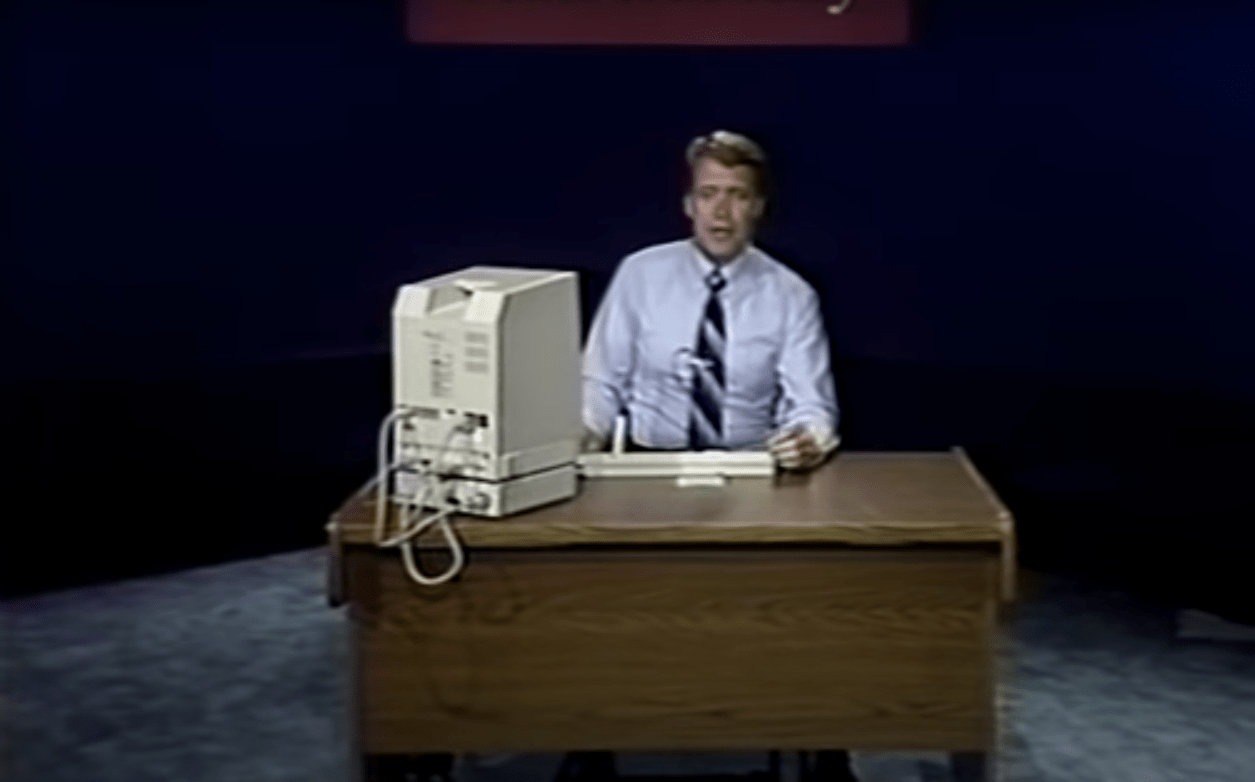
A Youtube video titled “THE MOST BORING VIDEO EVER MADE (Microsoft Word tutorial, 1989) has accrued over 1.5 million views despite its self-proclaimed boringness. The video, an hour and forty-seven-minute computer tutorial, appears to have been recorded in one long take. It’s a time capsule to the early days of home computers and despite the monotonous, sleep-inducing narration, the instructions are quite thorough. In the video’s comments, viewers point out the mind-blowing drama at minute 59 and the charming quote “no ‘command m’ for ‘miracle.'”
Pair with this 1984 video of Stanley Kubrick discussing his favorite software manuals:
* Andy Warhol
###
As we take on tedium, we might send qualified birthday greetings to Edward William Bok; he was born on this date in 1863. An editor and Pulitzer Prize-winning author, he is best remembered for his 30-year stewardship of the Ladies’ Home Journal.
Bok’s overall concern was to promote his socially conservative vision of the ideal American household, with the wife as homemaker and child-rearer. At the Ladies Home Journal, Bok authored more than twenty articles opposed to women’s suffrage, women working outside the home, woman’s clubs, and education for women. He wrote that feminism would lead women to divorce, ill health, and even death. Bok viewed suffragists as traitors to their sex, saying “there is no greater enemy of woman than woman herself.”
(See here for a glimpse at his ambitions and impact.)
Since the 1980s, several hundred tiles– all roughly the size of an American state license plate, and all bearing roughly the message above– have been found embedded in the pavement of roads in streets in two dozen major U.S. cities and four South American capitals.
There’s no consensus among scholars of the tiles as to their reference or meaning. It’s pretty widely held that the “Toynbee” reference is to historian Arnold Toynbee, perhaps to a passage (in Experiences):
Human nature presents human minds with a puzzle which they have not yet solved and may never succeed in solving, for all that we can tell. The dichotomy of a human being into ‘soul’ and ‘body’ is not a datum of experience. No one has ever been, or ever met, a living human soul without a body… Someone who accepts – as I myself do, taking it on trust – the present-day scientific account of the Universe may find it impossible to believe that a living creature, once dead, can come to life again; but, if he did entertain this belief, he would be thinking more ‘scientifically’ if he thought in the Christian terms of a psychosomatic resurrection than if he thought in the shamanistic terms of a disembodied spirit.
Others suggest that the tiles allude to Ray Bradbury’s story “The Toynbee Convector,” to Arthur C. Clarke’s story “Jupiter V,” or– perhaps, given the direct 2001 reference, most likely– to Stanley Kubrick’s film (in which, readers will recall, hibernating astronauts who had secret training were to be revived upon arrival on Jupiter).
And while there’s no agreement on the identity of the tiler, a majority of enthusiasts believe that “he” is from Philadelphia– both because the City of Brotherly Love hosts the highest concentration of the plaques and because a collection of tiles found there deviate from the norm to ascribe a plot to John S. Knight (of Knight-Ridder, the erst-while newspaper publishers), the Mafia, and others.
See a (nearly) complete list of tiles and their locations here, a set of photos here, and learn how they are implanted here. Visit this site for a peek at a Sundance award-winning documentary on the Tiles.
As we watch where we’re walking, we might recall that it was on this date in 1504 that Michelangelo’s 17-foot-tall marble David was unveiled in a public square outside the Palazzo della Signoria, the seat of civic government in Florence.
Last minute gift panic? No problem. Just wander over to Toy-A-Day, and download dozens of printable, foldable delights. From Superman to Mr. Natural (below), there’s something suitable for just about anyone on Santa’s list.
As we reach for the scissors, we might recall that it was on this date in 1971 that Stanley Kubrick’s adaption of Anthony Burgess’ A Clockwork Orange was released… Welly, welly, welly, welly, welly, welly, well.



 Franklin Square, Washington, DC (source)


You must be logged in to post a comment.