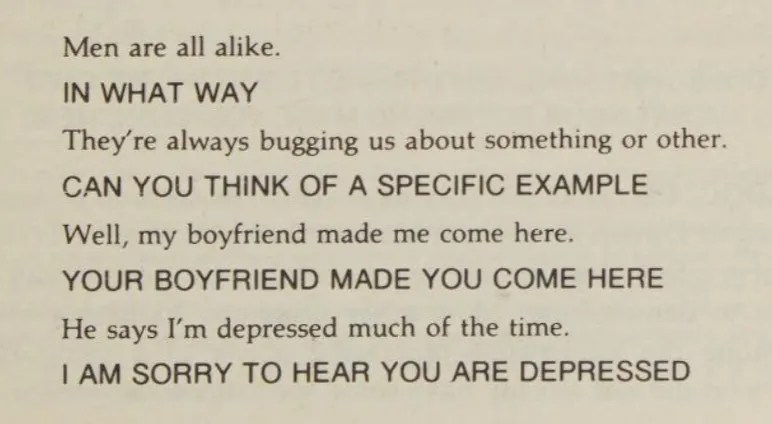
An example of dialogue with an early chatbot, excerpted from from its creator Joseph Weizenbaum’s 1976 book “Computer Power and Human Reason: From Judgment to Calculation.”
In the 1960s, a German-American computer scientist named Joseph Weizenbaum coded an early version of today’s AI chatbots. Weizenbaum called his program ELIZA, after the “My Fair Lady” character Eliza Doolittle who takes speech lessons (and gets better).
How people reacted to Weizenbaum’s crude creation tells us almost everything we need to know about AI hype more than half a century later.
ELIZA could hold basic “conversations,” including playing the role of a psychotherapist with real human users. [In the example above, ELIZA’s responses to one woman are shown in capital letters.]
Anybody with a cursory awareness of recent headlines about AI romances and AI psychosis already knows where this is going. ELIZA’s human interlocuters in the 1960s, despite talking to a clunky machine they knew had been programmed by Weizenbaum, refused to believe that they were talking to a mere machine. His secretary, having watched him build the contraption over several months, after just a few exchanges with ELIZA, asked Weizenbaum to leave the room so she could have some privacy.
Weizenbaum, exhibiting a bit of Freudian sangfroid about all this, was not surprised to see people form emotional attachments with inanimate objects. He’d already seen people get attached to their cars or guitars or computers. But “what I had not realized is that extremely short exposures to a relatively simple computer program could induce powerful delusional thinking in quite normal people,” Weizenbaum wrote in his 1976 book “Computer Power and Human Reason: From Judgment to Calculation.”…
… I learned about Weizenbaum’s ELIZA experiment from Neil Postman’s 1992 book “Technopoly: The Surrender of Culture to Technology,” a work of technoconservatism that, like Weizenbaum’s writings, was imbued with foresight about our struggles with today’s vastly more powerful technologies.
Consider this passage from Postman’s “Technopoly”:
In a technocracy, tools play a central role in the thought-world of the culture. Everything must give way, in some degree, to their development. The social and symbolic worlds become increasingly subject to the requirements of that development. Tools are not integrated into the culture; they attack the culture. They bid to become the culture. As a consequence, tradition, social mores, myth, politics, ritual, and religion have to fight for their lives.
Technology, attacking and taking over the culture? Bending society to its own imperative for advancement? In my United States of America? Postman (most famous for writing “Amusing Ourselves to Death”) thought the U.S. was the world’s first “Technopoly,” a society marked by “the submission of all forms of cultural life to the sovereignty of technique and technology,” where information itself has become a form of pollution.
To Postman, “the milieu in which Technopoly flourishes is one in which the tie between information and human purpose has been severed, i.e., information appears indiscriminately, directed at no one in particular, in enormous volume and at high speeds, and disconnected from theory, meaning or purpose.”
Neil Postman wrote “Technopoly” before the introduction of ChatGPT and Sora; TikTok and YouTube; Twitter and Facebook; Google Search and the Netscape browser. Postman wrote the book before Windows 95 existed. A philosophy of technology that mostly holds up through successive eras of technical revolution has already passed time’s first test, which is for the philosophy to outlive the philosopher. And Postman’s philosophy is ultimately conservative, motivated by the desire to preserve the traditions of humanism, social cohesion and a shareable sense of collective history.
Technoconservatism was old before it was new. Postman quotes Plato’s “Phaedrus,” where Thamus warns that whoever learns writing (one of our first dangerous technologies) “will cease to exercise their memory and become forgetful” and “will receive a quantity of information without proper instruction, and in consequence be thought very knowledgeable when they are for the most part quite ignorant.” And Postman, to his credit, is like — well, yeah! Writing really did that. A new technology is neither good nor bad, but ecological: it “does not add or subtract something. It changes everything. In the year 1500, fifty years after the printing press was invented, we did not have old Europe plus the printing press. We had a different Europe.”
In previous generations, societies dealt with information revolutions (which always produced information gluts) by creating institutions that prioritize “good” information and deprioritize the bad; think about schools with their organized curricula, courts with their standards of evidence, newspapers with their party lines or codes of journalistic ethics. But Postman notes that we got lucky after the Gutenberg revolution, when information technology’s development slowed down long enough for societies to catch up and be excellent:
From the early seventeenth century, when Western culture undertook to reorganize itself to accommodate the printing press, until the mid-nineteenth century [with the invention of the telegraph], no significant technologies were introduced that altered the form, volume, or speed of information. As a consequence, Western culture had more than two hundred years to accustom itself to the new information conditions created by the press. It developed new institutions, such as the school and representative government. It developed new conceptions of knowledge and intelligence, and a heightened respect for reason and privacy. It developed new forms of economic activity, such as mechanized production and corporate capitalism, and even gave articulate expression to the possibilities of a humane socialism. New forms of public discourse came into being through newspapers, pamphlets, broadsides, and books. It is no wonder that the eighteenth century gave us in the work of Goethe, Voltaire, Diderot, Kant, Hume, Adam Smith, Edmund Burke, Vico, Edward Gibbon, and, of course, Jefferson, Madison, Franklin, Adams, Hamilton, and Thomas Paine. I weight the list with America’s “Founding Fathers” because technocratic-typographic America was the first nation ever to be argued into existence in print.
Contrast the luxuriously slow social pace of the Gutenberg era with today’s information development timelines. Over the course of three decades, we’ve seen the rise and now-decline of the open web; the rise and now-decline of social media; the rise of short-form video and the rise of chatbots and synthetic information. All created enormous economic and philosophical disruptions whose fundamental impacts you can’t get a group of people in a room together to describe accurately. Among the disruptions: These increasingly efficient forms of sharing information keep encountering falling test scores; universities are trying to implement AI as their own students use it for cheating or boo the tech at their graduations; people are falling in love with their chatbots, which sometimes tell their users to kill themselves. A society that wants to understand itself probably wouldn’t act like this…
As we introspect, we might send pointed birthday greetings to Ambrose Bierce; he was born on this date in 1842. His satirical lexicon The Devil’s Dictionary was named as one of “The 100 Greatest Masterpieces of American Literature” by the American Revolution Bicentennial Administration. His story “An Occurrence at Owl Creek Bridge” has been described as “one of the most famous and frequently anthologized stories in American literature”; and his book Tales of Soldiers and Civilians (also published as In the Midst of Life) was named by the Grolier Club as one of the 100 most influential American books printed before 1900.
A prolific and versatile writer, Bierce was regarded as one of the most influential journalists in the United States, and as a pioneering writer of realist fiction. For his horror writing, Michael Dirda ranked him alongside Edgar Allan Poe and H. P. Lovecraft. S. T. Joshi argues that he may well be the greatest satirist America has ever produced, and can take his place with such figures as Juvenal, Swift, and Voltaire. His war stories influenced Stephen Crane, Ernest Hemingway, and others; and he was an influential and feared literary critic. In recent decades Bierce has gained even wider regard as a fabulist and for his poetry.
In 1913, Bierce told reporters that he was travelling to Mexico to gain first-hand experience of the Mexican Revolution. He disappeared over the border and was never seen again.
Apropos the piece featured above:
TELEPHONE, n. An invention of the devil which abrogates some of the advantages of making a disagreeable person keep his distance.
As Sarah O’Connor observes, technology has changed the way many of us consume information, from complex pieces of writing to short video clips…
The year was 1988, a former Hollywood actor was in the White House, and Postman was worried about the ascendancy of pictures over words in American media, culture and politics. Television “conditions our minds to apprehend the world through fragmented pictures and forces other media to orient themselves in that direction,” he argued in an essay in his book Conscientious Objections. “A culture does not have to force scholars to flee to render them impotent. A culture does not have to burn books to assure that they will not be read . . . There are other ways to achieve stupidity.”
What might have seemed curmudgeonly in 1988 reads more like prophecy from the perspective of 2024. This month, the OECD released the results of a vast exercise: in-person assessments of the literacy, numeracy and problem-solving skills of 160,000 adults aged 16-65 in 31 different countries and economies. Compared with the last set of assessments a decade earlier, the trends in literacy skills were striking. Proficiency improved significantly in only two countries (Finland and Denmark), remained stable in 14, and declined significantly in 11, with the biggest deterioration in Korea, Lithuania, New Zealand and Poland.
Among adults with tertiary-level education (such as university graduates), literacy proficiency fell in 13 countries and only increased in Finland, while nearly all countries and economies experienced declines in literacy proficiency among adults with below upper secondary education. Singapore and the US had the biggest inequalities in both literacy and numeracy.
“Thirty per cent of Americans read at a level that you would expect from a 10-year-old child,” Andreas Schleicher, director for education and skills at the OECD, told me — referring to the proportion of people in the US who scored level 1 or below in literacy. “It is actually hard to imagine — that every third person you meet on the street has difficulties reading even simple things.”
In some countries, the deterioration is partly explained by an ageing population and rising levels of immigration, but Schleicher says these factors alone do not fully account for the trend. His own hypothesis would come as no surprise to Postman: that technology has changed the way many of us consume information, away from longer, more complex pieces of writing, such as books and newspaper articles, to short social media posts and video clips.
At the same time, social media has made it more likely that you “read stuff that confirms your views, rather than engages with diverse perspectives, and that’s what you need to get to [the top levels] on the [OECD literacy] assessment, where you need to distinguish fact from opinion, navigate ambiguity, manage complexity,” Schleicher explained.
The implications for politics and the quality of public debate are already evident. These, too, were foreseen. In 2007, writer Caleb Crain wrote an article called “Twilight of the Books” in The New Yorker magazine about what a possible post-literate culture might look like. In oral cultures, he wrote, cliché and stereotype are valued, conflict and name-calling are prized because they are memorable, and speakers tend not to correct themselves because “it is only in a literate culture that the past’s inconsistencies have to be accounted for”. Does that sound familiar?…
One recalls Plato’s report that Socrates lamented the introduction of writing (on the grounds that it would erode the centrality of the memory and memorization and the tradition of oral disputation). And one reckons that in retrospect, even as one acknowledges that Socrates wasn’t wrong, one is not sorry that writing came to play the foundational role that it has in scholarship, culture, and commerce.
So perhaps we’re just in the first steps of a transition on the other side of which a new kind of literacy has displaced the current one (and advanced our state of being in the same way that writing has). Perhaps. Even then, in the moment it’s anxiety-provoking: even if we are bound for a new (higher-order?) literacy, it’s the curse of the earlier phases of a tectonic cultural shift that what we’re losing is much clearer than what we may gain.
As we fumble toward the future, we might recall that it was on this date in 1992 that HAL 9000, the AI character (and main antagonist) in Arthur C. Clarke’s (and Stanley Kubrick’s) Space Odyssey series.
More specifically: In the film, HAL became operational on 12 January 1992, at the HAL Laboratories in Urbana, Illinois, as production number 3. The activation year was 1991 in earlier screenplays and changed to 1997 in Clarke’s novel written and released in conjunction with the movie.
Science fiction writer William Gibson coined the phrase, “The future is already here — it’s just not very evenly distributed.” It’s a well-known and oft-repeated line.
I’m proposing a slight variation, or perhaps a corollary principle: The dystopia is already here — it’s just not very evenly distributed…
Lest we descend into despair, we should remember that there are things we can do to stem the dark tide… we just have to do them. For example, we can use the resources of groups like Common Sense Media; we can support the work of EFF and other privacy and rights groups; we can switch to the tools of open makers like Mozilla; we can contribute to open knowledge resources like the Internet Archive and Wikimedia…
Oh, and just in case our resolve begins to slip, we can revisit Sacasas’ page, as he’s keeping it open add to the list of grim symptoms as more emerge…
* Neil Postman, Amusing Ourselves to Death
###
As we hang onto the baby as we ditch the bath water, we might spare a thought for Fernand Braudel; he died on this date in 1985. An accomplished historian, he is probably best remembered as the leader of the Annales School of historiography. His scholarship focused on three main projects: The Mediterranean (1923–49, then 1949–66), the remarkable Civilization and Capitalism (1955–79), and the unfinished Identity of France (1970–85)– in all of which he set the bar for Annales practitioners by using deep and comprehensive research into the minute particulars of everyday life to illustrate broad, sweeping socio-economic trends.
* Neil Postman, Amusing Ourselves to Death: Public Discourse in the Age of Show Business
###
As we recommit to being careful what we wish for, we might send prudent birthday greetings to Maria Josepha Amalia of Saxony (Maria Josepha Amalia Beatrix Xaveria Vincentia Aloysia Franziska de Paula Franziska de Chantal Anna Apollonia Johanna Nepomucena Walburga Theresia Ambrosia); she was born on this date in 1803. The youngest daughterof Prince Maximilian of Saxony and his first wife, Princess Carolina of Parma (daughter of Duke Ferdinand of Parma), she was raised in a German convent to a fervent Catholicism.
Maria Josepha became the Queen of Spain when Ferdinand VII, still childless after the death of his second wife, chose her as his consort. But feeling the burden of her religious upbringing, Maria Josepha refused to consummate the marriage. It took a personal letter from Pope Pius VII to convince the queen that sexual relations between spouses were not contrary to the morality of Catholicism; still, she died young (at age 25) and childless. The King’s fourth wife, Maria Christina of the Two Sicilies, eventually gave birth to the future Queen Isabella II of Spain.


You must be logged in to post a comment.