Further, in a fashion, to yesterday’s post… J. F. Martel explores why art matters, arguing that when early humans first painted cave walls, they began to find out who they really were: our minds emerged from our images…
In 1940, rumours of secret passageways to an old manor lured four teenage boys into a hole in the ground near the village of Montignac in southwestern France. Instead of a tunnel laden with gold, they found a series of natural chambers bejewelled with exquisite paintings: horses and elk, ibex and bulls, almost perfectly preserved on the limestone walls. Experts examining the Lascaux caves in subsequent years using radiocarbon dating estimated that the paintings had been made some 19,000 years ago. [See here.] Today, the images are believed to be around 20,000 years old. But Lascaux is far from the oldest example of human art. Since 1940, many other caves have been found in Europe, Australia, Indonesia and Africa containing art no less astounding. Some of it is more than twice the age of the Lascaux murals.
Cave paintings at Lascaux, France. Courtesy Wikimedia
These discoveries have turned the questions of when and why humans invented art into central problems of the human sciences. As fair and poignant as such questions may be, they leave unaddressed the deeper mystery of what art is in the first place, where it comes from in the human soul, and what it might reveal to us about the nature of reality.
Popular legend holds that when Pablo Picasso visited the Lascaux cave a few years after its discovery, he emerged exclaiming: ‘We have invented nothing’ – art had appeared full-grown from its earliest instance. The common interpretation is that Picasso was humbly attributing the invention of art to our prehistoric ancestors rather than claiming it for himself and his contemporaries, or any human of the modern age. But perhaps this apocryphal story conveys a weirder truth, namely that no one really invented art. Instead, it was the other way around: art invented humanity…
[Martel develops his case (fascinatingly). He concludes…]
… The idea, then, that human beings invented art, that art ‘belongs’ to humanity, is true only after the fact. In a more primordial sense, art invented humanity by giving humans access to the process through which it brings forth a world, along with everything else.
What I mean here is that art did not serve to express a humanity that already existed. Rather, it acted as the mirror we needed to catch sight of our own image in the flux of nature. The question of when humans invented art leads us to imagine early humans much like ourselves, deciding one day to express themselves through symbols and figures. The assumption hidden in the question is that they already had minds like ours and simply chose, out of all the things they might have done on a frigid day in the Ice Age, to pick up ochre and make animal pictures. But the evidence, it seems to me, points the other way: it was the practice of making images, repeated over hundreds of generations, that occasioned the emergence of those minds we take for granted. We are putting the cart before the horse when we understand ourselves as the source of sense and meaning. In reality, we are participants in something that exceeds us, and the aesthetic, poetic dimension of great art reconnects us with that excess as a matter of course.
But again, we are led back to two kinds of art. Artifice is art that imitates nature: an attempt to represent the world on human terms, resulting either in imperfect reflections (according to Plato) or in perfected abstractions (according to Aristotle). Real art, by contrast, enacts natura naturans – that is, creation as such. If we can speak of imitation here at all, it is not in the sense of mechanical copying but of what the Christian mystics call imitatio Christi: the imitation that becomes instead of merely aping, a creative event transcending all the ways in which the intellect reduces things-in-the-making to things made.
Art alone puts us in touch with certain kinds of truth and beauty. And in that way, art restores us to reality. For it to succeed, however, it must be left to its own devices (or lack thereof). It must be free to eschew the logic of utility and to embody the freedom we stifle under the pressures of means-and-ends thinking.
‘All art,’ quipped Oscar Wilde in the preface to The Picture of Dorian Gray (1890), ‘is quite useless.’ For Wilde, art necessarily and essentially serves no purpose – and artists ought to know better than to wish it otherwise. At the same time, he elsewhere argued with equal conviction that if it weren’t for the efforts of the Impressionist painters, the London fog would not exist. It was they, he claimed in ‘The Decay of Lying’ (1891), who brought forth this aspect of the world, which had gone unseen until then:
Where, if not from the Impressionists, do we get those wonderful brown fogs that come creeping down our streets, blurring the gas-lamps and changing the houses into monstrous shadows? … The extraordinary change that has taken place in the climate of London during the last 10 years is entirely due to this particular school of Art … One does not see anything until one sees its beauty. Then, and then only, does it come into existence … There may have been fogs for centuries in London. I dare say there were. But no one saw them, and so we do not know anything about them. They did not exist till Art had invented them.
Claude Monet and his circle did not represent what was already present; they made present what had hitherto been absent. This power to make us see, for Wilde, is what makes art invaluable.
Is there a contradiction here? How can art be both invaluable and ‘quite useless’? It depends on how we define that last term. One might argue that if nobody paid attention to the fogs that crept through Victorian London until then, it was because there was no use in doing so. By attending to what no one cared to notice, the Impressionists drew from the invisible background of the human world a new entity that then became impossible to ignore. If art is useless for Wilde, it is only in the sense that it explores those regions of reality for which our present intellect has found no use – at least not yet. By making visible that which we could not see, to paraphrase Paul Klee, art expands our perception of the world. It thus fulfils a function precisely analogous to that of science; but whereas science is driven by an ideal of utility, art seeks what has not yet appeared on our radars. Artists alert us to what we do not yet know we do not know. Through their work, new realities, new ideas and new emotions become available.
Indeed, science begins – and can only begin – in the world that art has made. Ultimately, what we call art is the fruit of the human imagination’s capacity to go beyond immediate perception, to dream what lies around this corner, outside the human world. From this point of view, the hypothetical stage of the scientific method is nothing less than art: an exercise through which we step out of the mundanities of the actual to explore the possible as such, testing our dreams and extending our reach into the more-than-human.
This is why the French philosopher Gilles Deleuze in 1968 described aesthetics as a ‘science of the sensible’. Art, for him, makes the world that science later measures, but the world it makes is ultimately beyond all measurement because it is the world that exists before we divide it into lengths, magnitudes and quantities. Bergson, a major influence on Deleuze, had called this a ‘qualitative multiplicity’, closer in nature to a continuous melody than to a series of discrete, static things that can be isolated from one another. It is what comes first, because it is the Real itself.
Paradoxically, art is useful only if it is allowed to remain entirely useless – that is, entirely free to go where it will. Wilde finds an ally here in Baudelaire, who followed his observation of the strangeness of the beautiful with a sharp rebuke to those who would subordinate artistic beauty to a utilitarian logic. Baudelaire asks:
How could this necessary, irreducible, and infinitely varied strangeness … ever be controlled, amended, and corrected by Utopian rules conceived in some little scientific temple or other on this planet, without mortal danger to art itself?
The privileging of utility over uselessness, of work over play, is the death of art – and the death of the given world in which our utilitarian spirit must be grounded if it is to have purpose and meaning.
Today, art is pressed upon by forces that would subordinate it to all-too-human ends. Some say that it should educate and elevate impressionable minds, training them to behave in accordance with a preexisting moral code. Others claim that it should play a therapeutic role, either as an instrument of medicine or as a means of escape by which workers might regain their strength before the next working day. Still others insist that art ought to serve the needs of the state or the market, upholding the preconceived ideas of a polity that mistakes its limited view of reality for the whole of reality. The rise of artificial intelligence has only intensified this levelling of art into non-art. By definition, artificial intelligence is capable only of artifice, since it inhabits a virtual universe of things made (data) rather than things-in-the-making. To fail to distinguish between the artifice it generates and the true art it imitates is to mistake representation for creation, and so to blind ourselves to the very source of what makes both art and humanity possible.
Art must remain useless (or become it again), and it must do so in the name of truth as well as beauty. At the beginning of this essay, I distinguished two forms of each of these ideals: one that merely confirms what we think we know, and another that reminds us of the mystery that underlies all our partial knowledge and imperfect beliefs. Above all, art confronts us with that radical mystery, without which our problem-solving and utilitarianism would be pointless. This mystery is not a theory but a truth, the very ground of that truth whose splendour Plato called beauty, Herzog called ecstasy, and Keats, speaking to his urn, declared to be one with truth itself. It is ecstatic because it takes us outside ourselves, connecting us with the wonder that burns at the heart of the world, and which, out of every search for answers, calls forth new questions – and, with them, new reasons to live…
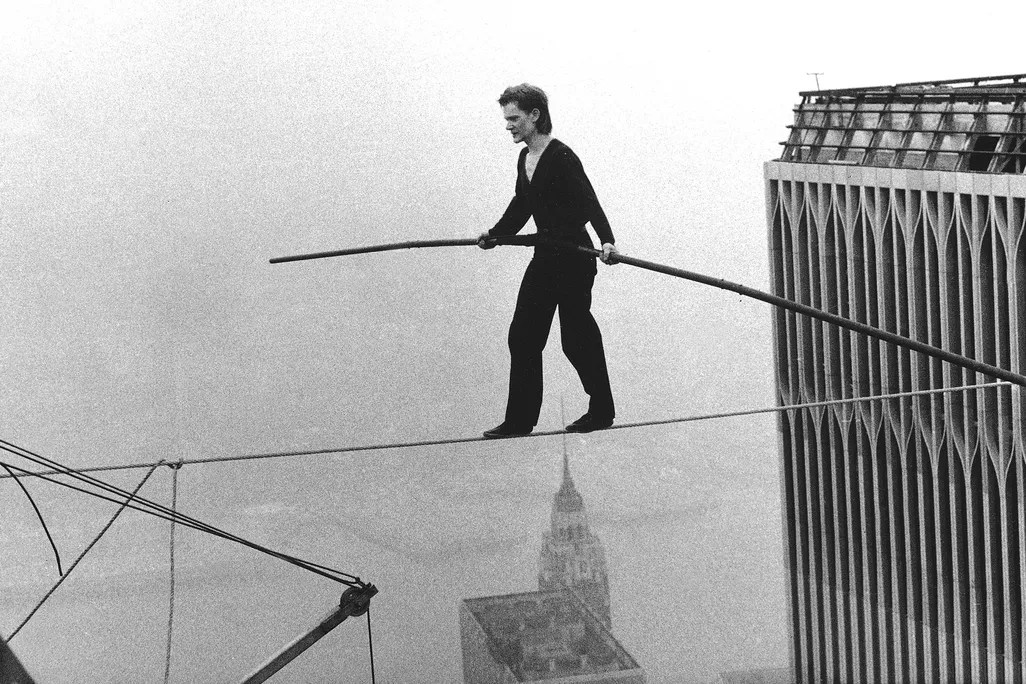
As we muse on the mystery of musing, we might recall that it was on this date in 1974 that French highwire artist Philippe Petit committed the “artistic crime of the century,” traversing a 200-foot steel cable across the 138-foot gap between the twin towers of the World Trade Center in New York City. 1,312 feet above the ground, he performed for 45 minutes, making eight passes along the wire, during which he walked, danced, lay down on the wire, and saluted observers from a kneeling position. Office workers, construction crews, and policemen cheered him on. The unpermitted/illegal performance took Petit six years of planning.

You must be logged in to post a comment.