Posts Tagged ‘Ambrose Bierce’
“The clearest way to see through a culture is to attend to its tools for conversation”*…
Matt Pearce revisits Neil Postman‘s 1992 Technopoly: The Surrender of Culture to Technology…
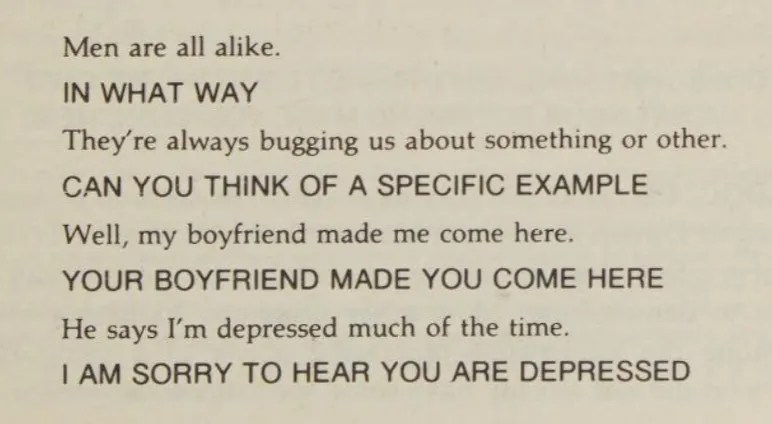
In the 1960s, a German-American computer scientist named Joseph Weizenbaum coded an early version of today’s AI chatbots. Weizenbaum called his program ELIZA, after the “My Fair Lady” character Eliza Doolittle who takes speech lessons (and gets better).
How people reacted to Weizenbaum’s crude creation tells us almost everything we need to know about AI hype more than half a century later.
ELIZA could hold basic “conversations,” including playing the role of a psychotherapist with real human users. [In the example above, ELIZA’s responses to one woman are shown in capital letters.]
Anybody with a cursory awareness of recent headlines about AI romances and AI psychosis already knows where this is going. ELIZA’s human interlocuters in the 1960s, despite talking to a clunky machine they knew had been programmed by Weizenbaum, refused to believe that they were talking to a mere machine. His secretary, having watched him build the contraption over several months, after just a few exchanges with ELIZA, asked Weizenbaum to leave the room so she could have some privacy.
Weizenbaum, exhibiting a bit of Freudian sangfroid about all this, was not surprised to see people form emotional attachments with inanimate objects. He’d already seen people get attached to their cars or guitars or computers. But “what I had not realized is that extremely short exposures to a relatively simple computer program could induce powerful delusional thinking in quite normal people,” Weizenbaum wrote in his 1976 book “Computer Power and Human Reason: From Judgment to Calculation.”…
… I learned about Weizenbaum’s ELIZA experiment from Neil Postman’s 1992 book “Technopoly: The Surrender of Culture to Technology,” a work of technoconservatism that, like Weizenbaum’s writings, was imbued with foresight about our struggles with today’s vastly more powerful technologies.
Consider this passage from Postman’s “Technopoly”:
In a technocracy, tools play a central role in the thought-world of the culture. Everything must give way, in some degree, to their development. The social and symbolic worlds become increasingly subject to the requirements of that development. Tools are not integrated into the culture; they attack the culture. They bid to become the culture. As a consequence, tradition, social mores, myth, politics, ritual, and religion have to fight for their lives.
Technology, attacking and taking over the culture? Bending society to its own imperative for advancement? In my United States of America? Postman (most famous for writing “Amusing Ourselves to Death”) thought the U.S. was the world’s first “Technopoly,” a society marked by “the submission of all forms of cultural life to the sovereignty of technique and technology,” where information itself has become a form of pollution.
To Postman, “the milieu in which Technopoly flourishes is one in which the tie between information and human purpose has been severed, i.e., information appears indiscriminately, directed at no one in particular, in enormous volume and at high speeds, and disconnected from theory, meaning or purpose.”
Neil Postman wrote “Technopoly” before the introduction of ChatGPT and Sora; TikTok and YouTube; Twitter and Facebook; Google Search and the Netscape browser. Postman wrote the book before Windows 95 existed. A philosophy of technology that mostly holds up through successive eras of technical revolution has already passed time’s first test, which is for the philosophy to outlive the philosopher. And Postman’s philosophy is ultimately conservative, motivated by the desire to preserve the traditions of humanism, social cohesion and a shareable sense of collective history.
Technoconservatism was old before it was new. Postman quotes Plato’s “Phaedrus,” where Thamus warns that whoever learns writing (one of our first dangerous technologies) “will cease to exercise their memory and become forgetful” and “will receive a quantity of information without proper instruction, and in consequence be thought very knowledgeable when they are for the most part quite ignorant.” And Postman, to his credit, is like — well, yeah! Writing really did that. A new technology is neither good nor bad, but ecological: it “does not add or subtract something. It changes everything. In the year 1500, fifty years after the printing press was invented, we did not have old Europe plus the printing press. We had a different Europe.”
In previous generations, societies dealt with information revolutions (which always produced information gluts) by creating institutions that prioritize “good” information and deprioritize the bad; think about schools with their organized curricula, courts with their standards of evidence, newspapers with their party lines or codes of journalistic ethics. But Postman notes that we got lucky after the Gutenberg revolution, when information technology’s development slowed down long enough for societies to catch up and be excellent:
From the early seventeenth century, when Western culture undertook to reorganize itself to accommodate the printing press, until the mid-nineteenth century [with the invention of the telegraph], no significant technologies were introduced that altered the form, volume, or speed of information. As a consequence, Western culture had more than two hundred years to accustom itself to the new information conditions created by the press. It developed new institutions, such as the school and representative government. It developed new conceptions of knowledge and intelligence, and a heightened respect for reason and privacy. It developed new forms of economic activity, such as mechanized production and corporate capitalism, and even gave articulate expression to the possibilities of a humane socialism. New forms of public discourse came into being through newspapers, pamphlets, broadsides, and books. It is no wonder that the eighteenth century gave us in the work of Goethe, Voltaire, Diderot, Kant, Hume, Adam Smith, Edmund Burke, Vico, Edward Gibbon, and, of course, Jefferson, Madison, Franklin, Adams, Hamilton, and Thomas Paine. I weight the list with America’s “Founding Fathers” because technocratic-typographic America was the first nation ever to be argued into existence in print.
Contrast the luxuriously slow social pace of the Gutenberg era with today’s information development timelines. Over the course of three decades, we’ve seen the rise and now-decline of the open web; the rise and now-decline of social media; the rise of short-form video and the rise of chatbots and synthetic information. All created enormous economic and philosophical disruptions whose fundamental impacts you can’t get a group of people in a room together to describe accurately. Among the disruptions: These increasingly efficient forms of sharing information keep encountering falling test scores; universities are trying to implement AI as their own students use it for cheating or boo the tech at their graduations; people are falling in love with their chatbots, which sometimes tell their users to kill themselves. A society that wants to understand itself probably wouldn’t act like this…
Read on for how we might — dare one suggest, should— act: “A society that wants to understand itself probably wouldn’t act like this,” from @mattdpearce.com.
Compare to/contrast with with Yuval Avnar‘s riff on Pascal’s musing on the implications of his invention, the “arithmetic machine” (an early, if not the first, modern mechanical calculator): “The Inventor of the Thinking Machine Didn’t Worry. Neither Should You.“
* Neil Postman, Amusing Ourselves to Death: Public Discourse in the Age of Show Business
###
As we introspect, we might send pointed birthday greetings to Ambrose Bierce; he was born on this date in 1842. His satirical lexicon The Devil’s Dictionary was named as one of “The 100 Greatest Masterpieces of American Literature” by the American Revolution Bicentennial Administration. His story “An Occurrence at Owl Creek Bridge” has been described as “one of the most famous and frequently anthologized stories in American literature”; and his book Tales of Soldiers and Civilians (also published as In the Midst of Life) was named by the Grolier Club as one of the 100 most influential American books printed before 1900.
A prolific and versatile writer, Bierce was regarded as one of the most influential journalists in the United States, and as a pioneering writer of realist fiction. For his horror writing, Michael Dirda ranked him alongside Edgar Allan Poe and H. P. Lovecraft. S. T. Joshi argues that he may well be the greatest satirist America has ever produced, and can take his place with such figures as Juvenal, Swift, and Voltaire. His war stories influenced Stephen Crane, Ernest Hemingway, and others; and he was an influential and feared literary critic. In recent decades Bierce has gained even wider regard as a fabulist and for his poetry.
In 1913, Bierce told reporters that he was travelling to Mexico to gain first-hand experience of the Mexican Revolution. He disappeared over the border and was never seen again.
Apropos the piece featured above:
TELEPHONE, n. An invention of the devil which abrogates some of the advantages of making a disagreeable person keep his distance.
– The Devil’s Dictionary

“A bookshelf is as particular to its owner as are his or her clothes; a personality is stamped on a library just as a shoe is shaped by the foot.”*…

As Anthony Powell once said, “Books do furnish a room.” But how to arrange that furniture?
The late French essayist and novelist Georges Perec understood the anxiety of shelving. In his 1978 essay “Brief Notes on the Art and Manner of Arranging One’s Books,” the title work of a newly issued collection, Perec’s discussion of the many schemes for handling your personal library only shows how utterly impossible the task is. You could, for instance, agree only to keep 361 books in your library — buy one book, get rid of one. But then, he writes, you’d have to decide what a “book” is. Is a three-volume series one book or three? Maybe it’s better to stick with 361 authors instead of books. But then some books are anonymous, and some books don’t make sense without others in the same genre, and . ..
Perec died in 1982. His home library contained more than 1,800 books.
Perec’s essay is somewhat tongue-in-cheek — he was an Oulipian, a tribe of literary gamesmen who found creativity in extreme restraint. (He’s probably most famous for his 1969 novel, translated into English as “A Void,” in which he avoided using the letter E.) But however deep the joke runs, he knew he was writing about a legitimate crisis — not so much one of shelving as of personal identity. How much mess will we accept in our lives? How much order? Shelving, he notes, exemplifies “two tensions, one which sets a premium on letting things be, on a good-natured anarchy, the other that exalts the virtues of the tabula rasa, the cold efficiency of the great arranging, one always ends by trying to set one’s books in order.”…
“Why bother organizing your books? A messy personal library is proof of life.” From Mark Athitakis (@mathitak)
[Image above: source]
* Alan Bennett
###
As we stack ’em high, we might send pointed birthday greetings to Ambrose Gwinnett Bierce; he was born on this date in 1842. His book The Devil’s Dictionary was named as one of “The 100 Greatest Masterpieces of American Literature” by the American Revolution Bicentennial Administration. His story “An Occurrence at Owl Creek Bridge” has been described as “one of the most famous and frequently anthologized stories in American literature”; and his book Tales of Soldiers and Civilians (also published as In the Midst of Life) was named by the Grolier Club as one of the 100 most influential American books printed before 1900.
A prolific and versatile writer, Bierce was regarded as one of the most influential journalists in the United States, and as a pioneering writer of realist fiction. For his horror writing, Michael Dirda ranked him alongside Edgar Allan Poe and H. P. Lovecraft. S. T. Joshi speculates that he may well be the greatest satirist America has ever produced, and can take his place with such figures as Juvenal, Swift, and Voltaire. His war stories influenced Stephen Crane, Ernest Hemingway, and others, and he was an influential and feared literary critic. In recent decades Bierce has gained wider respect as a fabulist and for his poetry.
In 1913, Bierce told reporters that he was travelling to Mexico to gain first-hand experience of the Mexican Revolution. He disappeared and was never seen again.
Conservative (noun): A statesman who is enamored of existing evils, as distinguished from the Liberal, who wishes to replace them with others.
The Devil’s Dictionary
“Ah, to think how thin the veil that lies Between the pain of Hell and Paradise”*…
 click here for enlargeable and navigable version
From the remarkable Russian periodical, INFOGRAFIKA (see also here), a handy map of Hell. per the title of this post, one just never knows when it might come in handy…
* George William Russell (AE)
###
As we bird-dog Beatrice, we might send sardonic birthday greetings to Ambrose Gwinnett Bierce; he was born on this date in 1842. A journalist, editor, short story writer, fabulist, and satirist, Bierce is probably best remembered for his short-story “An Occurrence at Owl Creek Bridge” (which Kurt Vonnegut considered the greatest American short story, a “work of flawless genius”) and, pace Dante, for his scathingly satirical lexicon The Devil’s Dictionary…
- Advice, n. The smallest current coin…
- Boundary, n. In political geography, an imaginary line between two nations, separating the imaginary rights of one from the imaginary rights of the other…
- Year, n. A period of three hundred and sixty-five disappointments…

Now you see ’em…
… Now you don’t.

Consider Wikipedia’s (incomplete* but fascinating) “List of People Who Disappeared Mysteriously“: from Spartacus and Edward V of England to Ambrose Bierce and D.B. Cooper, there’s still no trace…
[TotH to Parijata D. Mackey]
* There are about 900,000 missing persons cases per year– almost 2,500 per day– in the U.S. alone; in countries where politically-motivated “disappearances” occur and/or where human trafficking is an even more regular practice, the rates can run proportionately higher… And then, there are those who vanish while sailing or exploring or otherwise adventuring…
The rate of disappearance in the U.S. has risen six-fold since 1980; but as the Wikipedia list illustrates, vanishing certainly isn’t a recent phenomenon.
As we check the clasps on our ID bracelets, we might wish a hilarious Happy Birthday to writer-director Preston Sturges; he was born (Edmund Preston Biden) on this date in 1898. After a brief career as a Broadway playwright, Sturges sold a screenplay (The Power and the Glory, produced by Fox, starring Spencer Tracy) in 1933; the film did relatively well at the box office, but had a huge impact in Hollywood (e.g., its use of flashbacks and flashforwards was an acknowledged source of inspiration to the screenwriters of Citizen Kane). For the balance of that decade Sturges worked as a studio screenwriter, until, in 1939, he agreed to sell the script for The Great McGinty to Paramount for $1 in return for the chance to direct. The screenplay earned him an Academy Award, the first “Original Screenplay” Oscar; the success of the film assured his chance to continue in the Director’s chair.
Sturges worked in Hollywood for almost 30 years; but his legacy was built in the five years from 1939 through 1943, when he wrote and directed The Great McGinty, Christmas in July, The Lady Eve, Sullivan’s Travels, The Palm Beach Story, The Miracle of Morgan’s Creek, and Hail the Conquering Hero. Four of those films– The Lady Eve, Sullivan’s Travels, The Palm Beach Story, and The Miracle of Morgan’s Creek— are on the American Film Institute’s list of 100 Funniest American Films. Arguably they should all be– along with such later gems as The Sins of Harold Diddlebock and Unfaithfully Yours.

Hands up, Mother Nature!…
From The Firearm Blog:
Celebrated science fiction author Philip K. Dick published Project Plowshare as a serial between November 1965 and January 1966. The story, later expanded into the novel Zap Gun, is set in a world where seemingly deadly new weapons are “plowshared” into consumer products. It is ironic that just a few years after that novel was set, a defense giant is quite literally turning a new weapon system into an agricultural tool.
Defense giant Raytheon is well known for putting the “ray” into raygun. They developed the infamous Active Denial System that is designed to zap rioters with a non-lethal millimeter “pain ray”.

Active Denial System at Moody Air Force Base, Ga.
Raytheon realized that technology which can heat human skin at a distance can also be used to heat crops that are vulnerable to frost. One crop that is very sensitive to frost is grapes. In 2005 Ontario’s overall yield of processed grapes fell by 54% due to injuries sustained by the grapes during winter. In 2007 California experienced $800 million in crop losses due to freezing temperatures with navel oranges being the hardest hit.
Existing methods of frost prevention include heaters, wind machines, sprinklers and helicopters in emergencies. These methods all have significant downsides. They are either noisy, costly, inefficient or are only effective under certain environmental conditions.
Two moths ago Raytheon deployed a prototype of their newly developed Tempwave system to an Ontario vineyard. Tempwave sits atop a 25 feet pole and is powered by the grid. When its sensors detect weather conditions that may result in frost, its low-level microwave delivers energy directly to the crop without wasting energy on heating the intervening air. As long as the Tempwave system has enough power delivered to it, frost protection is guaranteed.

Tempwave proof of concept in a California orchard
Read the whole story– and the Raytheon press release– here.
As we read by the glow of our handguns, we might recall that it was on this date in 1972, the first “leap second day,” that one second was added to the world’s time in order to keep atomic clocks in sync with the Earth’s rotation. Since the adoption of this system in 1972, due firstly to the initial choice of the value of the second (1/86400 mean solar day of the year 1900) and secondly to the general slowing down of the Earth’s rotation (despite “the ice-skater effect”), it has been necessary to add over 20 seconds to Coordinated Universal Time (UTC).
 The U.S. Naval Observatory Master Clock
CLOCK, n. A machine of great moral value to man, allaying his concern for the future by reminding him what a lot of time remains to him.
–Ambrose Bierce, The Devil’s Dictionary, 1911
You must be logged in to post a comment.