Posts Tagged ‘time’
“You may delay, but time will not”*…
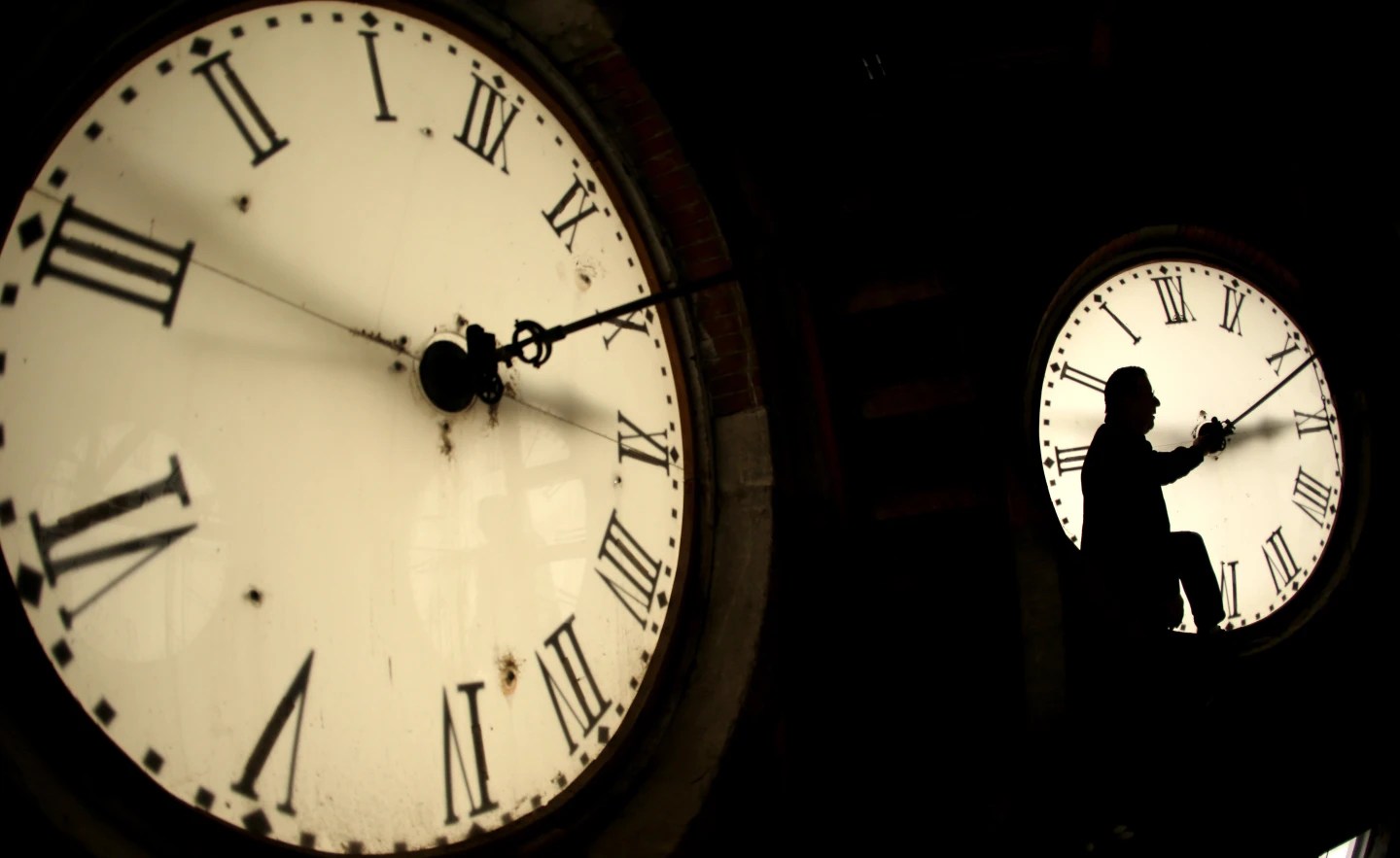
It turns out that our feeling that things are speeding up has some basis in science…
Earth’s changing spin is threatening to toy with our sense of time, clocks and computerized society in an unprecedented way — but only for a second.
For the first time in history, world timekeepers may have to consider subtracting a second from our clocks in a few years because the planet is rotating a tad faster than it used to. Clocks may have to skip a second — called a “negative leap second” — around 2029, a study in the journal Nature said Wednesday.
“This is an unprecedented situation and a big deal,” said study lead author Duncan Agnew, a geophysicist at the Scripps Institution of Oceanography at the University of California, San Diego. “It’s not a huge change in the Earth’s rotation that’s going to lead to some catastrophe or anything, but it is something notable. It’s yet another indication that we’re in a very unusual time.”
Ice melting at both of Earth’s poles has been counteracting the planet’s burst of speed and is likely to have delayed this global second of reckoning by about three years, Agnew said.
“We are headed toward a negative leap second,” said Dennis McCarthy, retired director of time for the U.S. Naval Observatory who wasn’t part of the study. “It’s a matter of when.”…
The full story: “A faster spinning Earth may cause timekeepers to subtract a second from world clocks,” from @AP.
For (even) more on leap seconds on their history, see “Will We Have a Negative Leap Second?“, by Demetrios Matsakis (also a retired director of time for the U.S. Naval Observatory).
See also: “Climate change is altering Earth’s rotation enough to mess with our clocks” (gift article): “in that one second, the Earth rotated about four football fields”
* Benjamin Franklin
###
As we muse on measurement, we might send carefully-observed birthday greetings to Sir Harold Spencer Jones; he was born on this date in 1890. An astronomer (indeed, for 23 years the tenth Astronomer Royal), he specialized in positional astronomy, particularly the motion and orientation of the Earth in space… a focus that helped him contribute to knowledge of the Earth’s rotation and improved timekeeping– efforts that led to Spencer Jones’ election (in 1947) as the first President of the Royal Institute of Navigation (which, In 1951, named its highest award, the Gold Medal, in his honor).

“The only reason for time is so that everything doesn’t happen at once”*…

Our lives are spread across range of ways that we spend our time. A newly-published study tracks time-use around the world…
How do you spend each day? Researchers sought answers to that basic question from people of various ages living around the world. They report that on an average day, people spend more than a third of their time focused on matters of health, happiness and keeping up appearances.
“We found that the single largest chunk of time is really focused on humans ourselves, a little more than 9 hours,” explained study author Eric Galbraith, of McGill University in Montreal, Canada. “Most of this—about 6.5 hours—is doing things that we enjoy, like hanging out, watching TV, socializing and doing sports,” he said. Reading and gaming also fall within this rubric.
The other 2.5 hours (out of the 9) are spent on hygiene, grooming and taking care of our own health and that of our kids, said Galbraith, a professor in the department of earth and planetary sciences.
Sleep and bedrest occupy the next largest chunk of time: more than 9 hours on average. That sounds like a lot of shut-eye, but Galbraith stressed this number reflects the average across the full age span, so it includes kids who might sleep up to 11 hours a day. “It also includes time in bed and not sleeping, which can be as much as one hour per day,” he said…
The remaining minutes? They seem to go toward getting organized, moving about or producing, creating and maintaining things and spaces…
For more findings and background on the methodology: “Sleep, cleaning, fun: Research reveals the average human’s day worldwide,” in @physorg_com.
* Albert Einstein
###
As we contemplate chronology, we might recall that it was on this date in 2011 that the Swedish game design house Mojang Studios released the first full version of Minecraft. A sandbox game created by Markus “Notch” Persson, it has become the best-selling video game in history, with over 300 million copies sold– and countless hours consumed…

“History is not the past but a map of the past, drawn from a particular point of view, to be useful to the modern traveler”*…

Timelines are now a commonplace. But as Emily Thomas explains, Joseph Priestley’s “A New Chart of History” revolutionized how we view history…
… Priestley (1733-1804) is best known for his scientific work, especially the co-discovery of oxygen. Yet he was also a teacher and a philosopher. As a teacher, Priestley sought to better communicate history to his students. He was fascinated by chronologies, texts ordering events. Since ancient Greece and Rome, chronologers used ‘time tables’ or grids to depict the order of events in time. An obvious problem with these chronologies, though, is that only so many events can fit on each page.
The mid-18th century saw many experiments in representing history, including Thomas Jefferys’ 1753 A Chart of Universal History. Jefferys was a mapmaker and his chart depicts empires almost as though they are countries on a map, allowing you to scan them all at once. Impressed, Priestley determined to create a chart of his own that readers could scan ‘at one view’. He made several innovations but one proved key: lines, inspired by his philosophy of time.
For this, Priestley drew on a seemingly unconnected topic: John Locke’s 1690 account of abstract ideas. For Locke, abstract ideas include ‘redness’, ‘triangle’, or ‘animal’. They are general ideas, produced when our minds consider particular things. Take a pint of milk, a stick of chalk and a lump of snow. I can consider these things while leaving out their particular features, ‘abstracting’ what is common to them: their whiteness. Many philosophers accepted some version of Locke’s account of abstraction, but puzzled over how to mentally visualise them. Locke writes that our abstract idea of a triangle ‘must be neither Oblique, nor Rectangle, neither Equilateral, Equicrural, nor Scalenon; but all and none of these at once’. Clearly we cannot picture such a thing. Priestley makes an alternative suggestion: represent abstract ideas using a variable particular. A child, he writes, has an idea of ‘what a triangle in general is’, even though all the ideas of triangles he ‘contemplates’ are ‘particular’. In other words, our picture of the abstract idea of a triangle can change: from equilateral to, say, scalene. In the same essay, Priestley argued that time is an abstract idea. And this view feeds into his timeline…
How Joesph Priestley’s “A New Chart of History” used the ideas of John Locke to revolutionize our undertstanding of history: “The Invention of Time,” from @emilytwrites in @HistoryToday.
Pair with “Putting Time in Perspective,” from @waitbutwhy.
###
As we ponder the past, we might send evocative birthday greetings to Jules Michelet; he was born on this date in 1798. Considered one of the founders of modern historiography, he is best known for his multivolume work Histoire de France (History of France).
Influenced by Giambattista Vico, Michelet emphasized on the role of people and their customs in shaping history, a major departure from the then-current emphasis on political and military leaders. He coined the term “Renaissance” (meaning “rebirth” in French) as a period in Europe’s cultural history that represented a break from the Middle Ages, creating a modern understanding of humanity and its place in the world. (The term “rebirth” and its association with the Renaissance can be traced to a work published in 1550 by the Italian art historian Giorgio Vasari. Vasari used the term to describe the advent of a new manner of painting that began with the work of Giotto, as the “rebirth (rinascita) of the arts.”)

“Everywhere is walking distance if you have the time”*…

Sara Walker and Lee Cronin suggest that time is not a backdrop, nor an illusion, nor an emergent phenomenon; rather, they suggest in an essay from The Santa Fe Institute, it has a physical size that can be measured in laboratories……
A timeless universe is hard to imagine, but not because time is a technically complex or philosophically elusive concept. There is a more structural reason: imagining timelessness requires time to pass. Even when you try to imagine its absence, you sense it moving as your thoughts shift, your heart pumps blood to your brain, and images, sounds and smells move around you. The thing that is time never seems to stop. You may even feel woven into its ever-moving fabric as you experience the Universe coming together and apart. But is that how time really works?
According to Albert Einstein, our experience of the past, present and future is nothing more than ‘a stubbornly persistent illusion’. According to Isaac Newton, time is nothing more than backdrop, outside of life. And according to the laws of thermodynamics, time is nothing more than entropy and heat. In the history of modern physics, there has never been a widely accepted theory in which a moving, directional sense of time is fundamental. Many of our most basic descriptions of nature – from the laws of movement to the properties of molecules and matter – seem to exist in a universe where time doesn’t really pass. However, recent research across a variety of fields suggests that the movement of time might be more important than most physicists had once assumed.
A new form of physics called assembly theory suggests that a moving, directional sense of time is real and fundamental. It suggests that the complex objects in our Universe that have been made by life, including microbes, computers and cities, do not exist outside of time: they are impossible without the movement of time. From this perspective, the passing of time is not only intrinsic to the evolution of life or our experience of the Universe. It is also the ever-moving material fabric of the Universe itself. Time is an object. It has a physical size, like space. And it can be measured at a molecular level in laboratories.
The unification of time and space radically changed the trajectory of physics in the 20th century. It opened new possibilities for how we think about reality. What could the unification of time and matter do in our century? What happens when time is an object?…
Find out at: “Time is an object,” by @Sara_Imari and @leecronin, from @sfiscience in @aeonmag.
Apposite: “The New Thermodynamic Understanding of Clocks.”
* Steven Wright
###
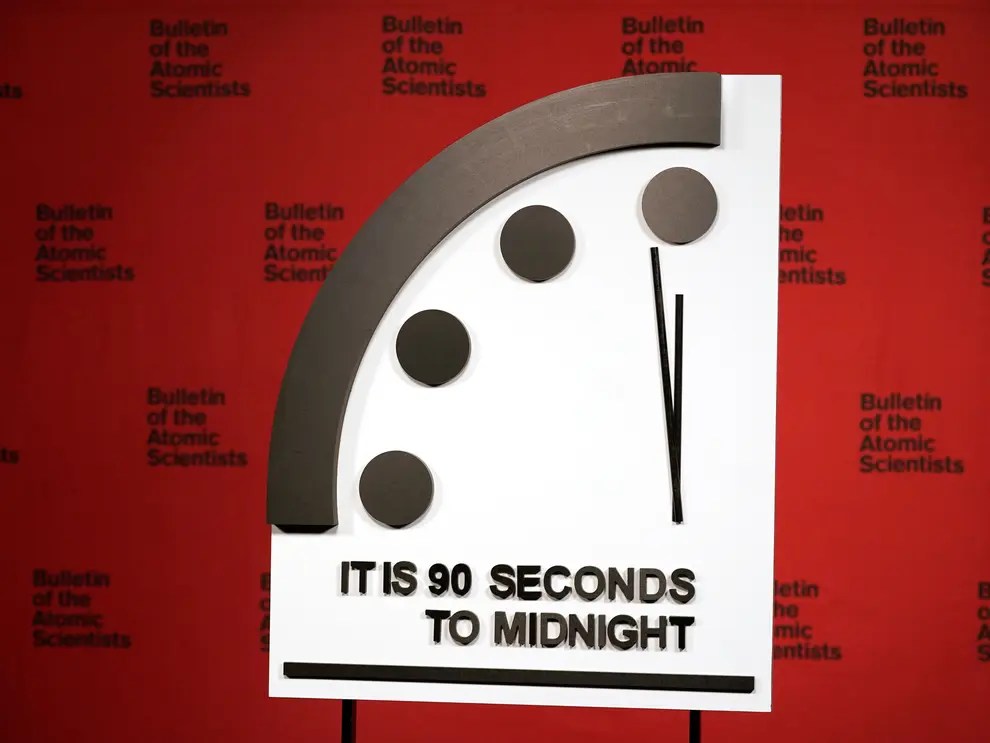
As we contemplate chronology, we might recall that it was on this date in 1947 that the Doomsday Clock appeared for the first time (as the fourth quadrant of a clock face with its hands at 7 minutes to midnight) as the background image on the cover of the June issue of the Bulletin of the Atomic Scientists. From then to the present, the Doomsday Clock image has been on the cover of the Bulletin, though the hands over the years have been shown moving forward or back to convey how close humanity is to catastrophic destruction (midnight).
The clock currently stands at 90 seconds to midnight.
[HBD, GC(S)]
“No one ever explained the octopuses”*…

We humans are forward-facing, gravity-bound plodders. David Borkenhagen wonders if the liquid motion of the octopus can radicalize our ideas about time…
… The octopus may navigate its ocean home with ease, but it can seem like a creature from another planet. It populates our popular visions of cosmic beings and extraterrestrial life, with its eight arms, three hearts, and a malleable body without bones. What’s more, its ability to camouflage itself, coupled with a propensity to hide in tight holes, make it a master of disguise. If seen, a water siphon that expels inhaled water can instantly propel the creature away from danger in any direction in three-dimensional aquatic space. Its web of radially symmetrical arms allow it to crawl in any direction with equal competence, regardless of how its head is oriented. Its soft and malleable body can move through any crevasse larger than its beak. And with its two eyes positioned on opposite sides of its head, it has a near-total field of vision with almost nothing hidden ‘behind’. These abilities give the octopus a radically different relationship to its surroundings compared with other species, human or otherwise. It is a relationship free of constraints.
And what about our bodies? Compared with the octopus, human beings appear corporeally constrained. We lack the fluid mobility and wide field of vision of our (very, very) distant cephalopod cousins. Instead, we have two eyes stuck in the front of our heads. We have a paltry two legs, hardwired for forward movement. And we are bound to our terrestrial ecological niche, where our bodies must continually counteract the downward pull of gravity.
It’s not only that our experiences of space are different. Our experiences of time are likely different, too. We think about the passage of time through our terrestrial experience of unidirectional motion through space – our metaphors of time are almost all grounded in the way our bodies move forward through the environment. Given this fact, how would an octopus, who can easily see and move in all directions, conceptualise time? Current research methods may be able to take us only part of the way toward an answer, but it’s far enough to consider a radical possibility: if we became more like an octopus, could we free time, metaphorically speaking, from its constraints? Could we experience it as multidimensional, fluid and free?…
[Borkenhagen reviews the research on octopuses and what it tells us about how their relationships with time and death]
… In many ways, the octopus represents a challenge, or a profound limit, to our conventional ways of thinking about time and death. But it’s more than a challenge. It’s also an invitation. With its unconstrained movements and semelparous lifecycle, the octopus offers a radically different perspective on the fluidity and flexibility of existence. Could we learn to move through time as an octopus moves through space? With equal access to the past, present and future – viewed wide or with sharp focus – we might better navigate the challenges of living and dying on Earth. The octopus invites us to think in a way that dissolves the boundaries between the present and the future, understanding our ‘ending’ less as a fixed point and more as a fluid process stretching across generations. As the boundary between life and death dissolves and becomes more porous, so do the boundaries between ourselves and others. The metaphors we used to inhabit our time here may seem impoverished, but there’s another way. It’s in the unconstrained movements of an octopus traveling through space – fluid, flexible and free…
“Octopus Time,” from @posts_modern in @aeonmag. Eminently worth reading in full.
Pair with The Mountain in the Sea by Ray Nayler and/or “Stories of Your Life” in the short story collection of the same title, by Ted Chiang
* Gail Garriger (@gailcarriger)
###
As we re-understand unfolding, we might recall that it was on this date in 1871 that the American Museum of Natural History opened to the public in New York City. Organized into a series of exhibits, the Museum’s collection–which had been gathered from the time of the Museum’s founding in 1869– went on view for the first time in the Central Park Arsenal, the Museum’s original home, on the eastern side of Central Park. The cornerstone of the Museum’s first building was laid in Manhattan Square (79th Street and Central Park West), the Museum’s current location, in 1874; but it is obscured from view by the many Museum buildings in the complex that today occupy most of the Square.

You must be logged in to post a comment.