Posts Tagged ‘social media’
“Why has our age surrendered so easily to the controllers, the manipulators, the conditioners of an authoritarian technics?”*…

Half a century ago, Lewis Mumford developed a concept that explains why we trade autonomy for convenience…
… Surveying the state of the high-tech life, it is tempting to ponder how it got so bad, while simultaneously forgetting what it was that initially convinced one to hastily click “I agree” on the terms of service. Before certain social media platforms became foul-smelling swamps of conspiratorial misinformation, many of us joined them for what seemed like good reasons; before sighing at the speed with which their batteries die, smartphone owners were once awed by these devices: before grumbling that there was nothing worth watching, viewers were astounded by how much streaming content was available at one’s fingertips. Overwhelmed by the way today’s tech seems to be burying us in the bad, it’s easy to forget the extent to which tech won us over by offering us a share in the good — or to be more precise, in “the goods.”
Nearly 50 years ago, long before smartphones and social media, the social critic Lewis Mumford put a name to the way that complex technological systems offer a share in their benefits in exchange for compliance. He called it a “bribe.” With this label, Mumford sought to acknowledge the genuine plentitude that technological systems make available to many people, while emphasizing that this is not an offer of a gift but of a deal. Surrender to the power of complex technological systems — allow them to oversee, track, quantify, guide, manipulate, grade, nudge, and surveil you — and the system will offer you back an appealing share in its spoils. What is good for the growth of the technological system is presented as also being good for the individual, and as proof of this, here is something new and shiny. Sure, that shiny new thing is keeping tabs on you (and feeding all of that information back to the larger technological system), but it also lets you do things you genuinely could not do before. For a bribe to be accepted it needs to promise something truly enticing, and Mumford, in his essay “Authoritarian and Democratic Technics,” acknowledged that “the bargain we are being asked to ratify takes the form of a magnificent bribe.” The danger, however, was that “once one opts for the system no further choice remains.”
For Mumford, the bribe was not primarily about getting people into the habit of buying new gadgets and machines. Rather it was about incorporating people into a world that complex technological systems were remaking in their own image. Anticipating resistance, the bribe meets people not with the boot heel, but with the gift subscription.
The bribe is a discomforting concept. It asks us to consider the ways the things we purchase wind up buying us off, it asks us to see how taking that first bribe makes it easier to take the next one, and, even as it pushes us to reflect on our own complicity, it reminds us of the ways technological systems eliminate their alternatives. Writing about the bribe decades ago, Mumford was trying to sound the alarm, as he put it: “This is not a prediction of what will happen, but a warning against what may happen.” As with all of his glum predictions, it was one that Mumford hoped to be proven wrong about. Yet as one scrolls between reviews of the latest smartphone, revelations about the latest misdeeds of some massive tech company, and commentary about the way we have become so reliant on these systems that we cannot seriously speak about simply turning them off — it seems clear that what Mumford warned “may happen” has indeed happened…
Eminently worth reading in full: “The Magnificent Bribe,” by Zachary Loeb in @_reallifemag.
As to (some of) the modern implications of that bargain, see also Shoshana Zuboff‘s: “You Are the Object of a Secret Extraction Operation.”
As we move into the third decade of the 21st century, surveillance capitalism is the dominant economic institution of our time. In the absence of countervailing law, this system successfully mediates nearly every aspect of human engagement with digital information. The promise of the surveillance dividend now draws surveillance economics into the “normal” economy, from insurance, retail, banking and finance to agriculture, automobiles, education, health care and more. Today all apps and software, no matter how benign they appear, are designed to maximize data collection.
Historically, great concentrations of corporate power were associated with economic harms. But when human data are the raw material and predictions of human behavior are the product, then the harms are social rather than economic. The difficulty is that these novel harms are typically understood as separate, even unrelated, problems, which makes them impossible to solve. Instead, each new stage of harm creates the conditions for the next stage…
And resonantly: “AI-tocracy” a working paper from NBER that links the development of artificial intelligence with the interests of autocracies: from the abstract:
Can frontier innovation be sustained under autocracy? We argue that innovation and autocracy can be mutually reinforcing when: (i) the new technology bolsters the autocrat’s power; and (ii) the autocrat’s demand for the technology stimulates further innovation in applications beyond those benefiting it directly. We test for such a mutually reinforcing relationship in the context of facial recognition AI in China. To do so, we gather comprehensive data on AI firms and government procurement contracts, as well as on social unrest across China during the last decade. We first show that autocrats benefit from AI: local unrest leads to greater government procurement of facial recognition AI, and increased AI procurement suppresses subsequent unrest. We then show that AI innovation benefits from autocrats’ suppression of unrest: the contracted AI firms innovate more both for the government and commercial markets. Taken together, these results suggest the possibility of sustained AI innovation under the Chinese regime: AI innovation entrenches the regime, and the regime’s investment in AI for political control stimulates further frontier innovation.
(And, Anne Applebaum warns, “The Bad Guys Are Winning.”)
* “Why has our age surrendered so easily to the controllers, the manipulators, the conditioners of an authoritarian technics? The answer to this question is both paradoxical and ironic. Present day technics differs from that of the overtly brutal, half-baked authoritarian systems of the past in one highly favorable particular: it has accepted the basic principle of democracy, that every member of society should have a share in its goods. By progressively fulfilling this part of the democratic promise, our system has achieved a hold over the whole community that threatens to wipe out every other vestige of democracy.
The bargain we are being asked to ratify takes the form of a magnificent bribe. Under the democratic-authoritarian social contract, each member of the community may claim every material advantage, every intellectual and emotional stimulus he may desire, in quantities hardly available hitherto even for a restricted minority: food, housing, swift transportation, instantaneous communication, medical care, entertainment, education. But on one condition: that one must not merely ask for nothing that the system does not provide, but likewise agree to take everything offered, duly processed and fabricated, homogenized and equalized, in the precise quantities that the system, rather than the person, requires. Once one opts for the system no further choice remains. In a word, if one surrenders one’s life at source, authoritarian technics will give back as much of it as can be mechanically graded, quantitatively multiplied, collectively manipulated and magnified.”
– Lewis Mumford in “Authoritarian and Democratic Technics,” via @LMSacasas
###
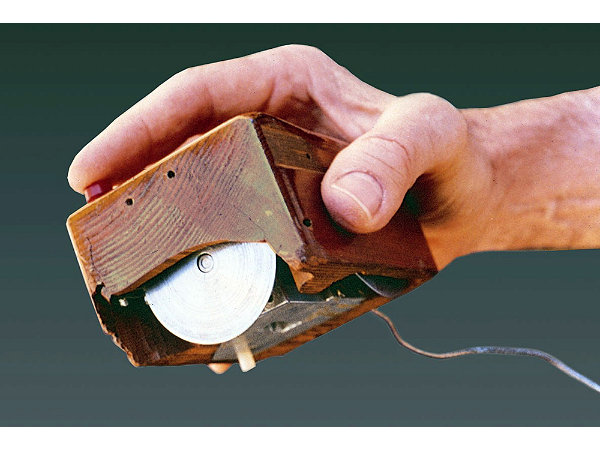
As we untangle user agreements, we might recall that it was on this date in 1970 that Douglas Engelbart (see here, here, and here) was granted a patent (US No. 3,541,541) on the “X-Y Position Indicator for a Display System,” the world’s first prototype computer mouse– a wooden block containing the tracking apparatus, with a single button attached.

“Curiosity has its own reason for existence”*…

This is, as nearly as I can tell, the 5,000th (Roughly) Daily post (4,505 blog posts, preceded by 495 email-only pieces). On this numerologically-significant occasion, my deep thanks to readers past and present. It seems appropriate to devote this post to the impulse that has powered (Roughly) Daily from the start, curiosity– free-range curiosity…
Recently I read a terrific blog post by CJ Eller where he talks about the value of paying attention to offbeat things.
Eller was joining an online conversation about how people get caught up in the “status and celebrity game” when they’re trying to grow their audience. They become overly obsessed with following — and emulating, and envying— the content of people with massive audiences. The conversation started with this poignant essay by the author Ali Montag; she concludes that rabidly chasing followers endows your writing (and thinking!) with “inescapable mediocrity.” (It also tends to make you miserable, too, she points out)…
Instead of crowding your attention with what’s already going viral on the intertubes, focus on the weird stuff. Hunt down the idiosyncratic posts and videos that people are publishing, oftentimes to tiny and niche audiences. It’s decidedly unviral culture — but it’s more likely to plant in your mind the seed of a rare, new idea.
I love the idea of “rewilding your attention”. It puts a name on something I’ve been trying to do for a while now: To stop clicking on the stuff big-tech algorithms push at me… social behavior can influence our attention: What are the high-follower-count folks talking/posting/arguing about today? This isn’t always a bad thing. We’re social animals, so we’re necessarily (and often productively) intrigued by what others are chewing over. But as these three writers note, it’s also crucial to follow your own signal — to cultivate the stuff you’re obsessed with, even if few others are.
On top of the social pressure from people online, there’s technological pressure too — from recommendation systems trying to juke our attention… Medium’s algorithm has deduced that … I’m a nerd. They are correct! I am. The other major social networks, like Twitter or YouTube, offer me the same geek-heavy recommendations when I log in. And hey, they’re not wrong either; I really do like these subjects.
But … I’m also interested in so many other things that are far outside these narrow lanes. I am, for example, a Canadian who’s deeply into Canadian art, and a musician who spends a lot of time thinking about composition and gear and lyric-writing and production and guitar pedals, and a father who thinks a lot about the culture my kids show me, and I have a super-snobby fanboy love of the 18th century poet Alexander Pope.
You’re the same way; you contain your own Whitmanian multitudes, your pockets of woolly-eyed obsession. We all do.
But our truly quirky dimensions are never really grasped by these recommendation algorithms. They have all the dullness of a Demographics 101 curriculum; they sketch our personalities with the crudity of crime-scene chalk-outlines. They’re not wrong about us; but they’re woefully incomplete. This is why I always get a slightly flattened feeling when I behold my feed, robotically unloading boxes of content from the same monotonous conveyor-belt of recommendations, catered to some imaginary marketing version of my identity. It’s like checking my reflection in the mirror and seeing stock-photo imagery.
The other problem with big-tech recommendation systems is they’re designed by people who are convinced that “popularity” and “recency” equal “valuable”. They figure that if they sample the last 15 milliseconds of the global zeitgeist and identify what’s floated to the top of that quantum foam, I’ll care about it. Hey, a thing happened and people are talking about it, here’s the #hashtag!
And again … they’re sometimes right! I am often intrigued to know the big debates of the day, like Oscar Wilde peering into his daily gazette. But I’d also like to stumble over arguments yet more arcane, and material that will never be the subject of a massive online conversation because only a small group of oddballs care about it.
You’re the same way too, I bet. We’re all weird in different ways, but we’re all weird.
Big-tech recommendation systems have been critiqued lately for their manifold sins— i.e. how their remorseless lust for “engagement” leads them to overpromote hotly emotional posts; how they rile people up; how they feed us clicktastic disinfo; how they facilitate “doomscrolling”. All true.
But they pose a subtler challenge, too, for our imaginative lives: their remarkably dull conception of what’s interesting. It’s like intellectual monocropping. You open your algorithmic feed and see rows and rows of neatly planted corn, and nothing else.
That’s why I so enjoy the concept of “rewilding”… For me, it’s meant slowly — over the last few years — building up a big, rangy collection of RSS feeds, that let me check up on hundreds of electic blogs and publications and people. (I use Feedly.) I’ve also started using Fraidycat, a niftily quixotic feed-reader that lets you sort sources into buckets by “how often should I check this source”, which is a cool heuristic; some people/sites you want to check every day, and others, twice a year.
Other times I spend an hour or two simply prospecting — I pick a subject almost at random, then check to see if there’s a hobbyist or interest-group discussion-board devoted to it. (There usually is, running on free warez like phpBB). Then I’ll just trawl through the forum, to find out what does this community care about? It’s like a psychogeographic walk of the mind.
Another awesome technology for rewilding my attention, I’ve found, is the good old-fashioned paper book. I go to a bookstore, pick up something where it’s not immediately obvious why it’d appeal to me, then flip around to see if anything catches my eye. (This works online, too, via the wonderful universe of pre-1923, freely-accessible ebooks and publications at the Internet Archive, Project Gutenberg, or even Google Books. Pre-WWI material is often super odd and thought-provoking.)…
Step away from algorithmic feeds. In praise of free-range curiosity: “Rewilding your attention,” from Clive Thompson (@pomeranian99).
See also “Before Truth: Curiosity, Negative Capability, Humility, ” from Will Wilkinson (@willwilkinson)
* “Curiosity has its own reason for existence. One cannot help but be in awe when he contemplates the mysteries of eternity, of life, of the marvelous structure of reality. It is enough if one tries merely to comprehend a little of this mystery each day.” — Albert Einstein, “Old Man’s Advice to Youth: ‘Never Lose a Holy Curiosity.'” LIFE Magazine (2 May 1955) p. 64”
###
As we revel in rabbit holes, we might send insightfully-humorous birthday greetings to William Penn Adair Rogers; he was born on this date in 1879. A stage and motion picture actor, vaudeville performer, cowboy, humorist, newspaper columnist, and social commentator, he traveled around the world three times, made 71 films (50 silent films and 21 “talkies”), and wrote more than 4,000 nationally syndicated newspaper columns. By the mid-1930s Rogers was hugely popular in the United States, its leading political wit and the highest paid Hollywood film star. He died in 1935 with aviator Wiley Post when their small airplane crashed in northern Alaska.
Known as “Oklahoma’s Favorite Son,” Rogers was a Cherokee citizen, born to a Cherokee family in Indian Territory (now part of Oklahoma).
“I am not a member of an organized political party. I am a Democrat.”- Will Rogers

“There will come a time when it isn’t ‘They’re spying on me through my phone’ anymore. Eventually, it will be ‘My phone is spying on me’.”*…

When to breathe easy– and when to worry…
When people worry about the impact of a new technology, often they worry it’ll set us on a path to ruin.
Sometimes they’re freaking out for no good reason. New technologies — particularly ones that affect communication, or give young people new abilities — unsettle people all the time, but don’t wreck the world. In the past, people worried that the telephone would destroy face-to-face conversation, that the portable camera would destroy all public privacy, and that pinball would turn kids into delinquents.
In each case, critics worried that the new technology would make people’s behavior a bit worse, and then that change would cause even more bad results, and on and on. We’d be on a “slippery slope” to ruin! (Indeed, cities like New York actually banned pinball for forty years — from the mid-30s to the mid-70s.)
This is why, in the worlds of philosophy and technology, “slippery slope” arguments are often regarded as kind of flimsy. Often, critics are just personally miffed by the new behaviors midwived by technology. But no social ruin is at hand.
Sometimes, though, a slippery slope is real. In the early days of the automobile, some critics feared cars would take over city streets — and that we’d get so addicted to car travel that we’d rebuild the whole country around cars. Those critics nailed it. That really did happen. The same thing goes with Facebook or other social media; some early critics (like the philosopher Ian Bogost) predicted they’d poison social and civic life. Again: Nailed it.
But how do you tell the difference? How do you know when you’re facing a technology that might lead us down a real slippery slope — versus a tech that you’re just annoyed by?…
Does a new technology pose serious dangers — or are we just overreacting? Clive Thompson (@pomeranian99) talks to philosopher Evan Selinger (@EvanSelinger) about how to tell: “How To Recognize When Tech Is Leading Us Down a ‘Slippery Slope’“
For a current warning from the aforementioned Ian Bogost (@ibogost), see “The Metaverse Is Bad.”
* the prescient Philip K. Dick
###
As we practice prudence, we might recall that it was on this date in 1861 that the first transcontinental telegram was sent from Stephen J. Field, the Chief Justice of California, to President Abraham Lincoln in Washington, DC.
In the temporary absence of the Governor of the State I am requested to send you the first message which will be transmitted over the wires of the telegraph Line which Connect the Pacific with the Atlantic States the People of California desire to Congratulate you upon the Completion of the great work.
They believe that it will be the means of strengthening the attachment which bind both the East & West to the Union & they desire in this the first message across the continent to express their loyalty to that Union & their determination to stand by the Government in this its day of trial They regard that Government with affection & will adhere to it under all fortunes

“Create more value than you capture”*…

As Donald Trump’s presidency careened to its ignominious end, with a mob of his supporters storming of the US Capitol, Facebook and Twitter banned the US president for inciting the violence. With that act, the scope of the political power wielded by Big Tech became impossible to ignore.
Whether these platforms have too much political power is a debate that is just beginning. Their outsize economic power, though, is unquestionable. The combined market capitalization of the five largest US tech platforms – Alphabet (Google), Amazon, Apple, Facebook, and Microsoft – rose by $2.7 trillion in 2020. Following the addition of Tesla to the S&P 500, the Big Six tech firms now represent nearly one-quarter of the index’s valuation. And with the spread of COVID-19, the leading digital platforms have become de facto essential service providers, enabling a mass transition to remote and isolated living.
And yet the political pressure on Big Tech has continued to rise. There is a growing consensus that platforms have been abusing their power, driving profits by exploiting consumer privacy, crushing the competition, and buying up potential rivals.
…
The economics of platforms is different from the economics of traditional offline and one-sided markets. Policymakers therefore need to reconsider some of their most basic assumptions, asking themselves whether they are even focusing on the right things.
A key challenge is to determine how the value of data diverges from the value created by providing a data-generating service. Platforms have the power to shape how decisions are made, which in turn can alter the value of the data being amassed. The implication, as Google co-founders Larry Page and Sergey Brin foresaw in a 1998 paper, is that advertisers or any other third-party interest can embed mixed motives into the design of a digital service. In the case of internet search, the advertising imperative can distract from efforts to improve the core service, because the focus is on the value generated for advertisers rather than for users.
As this example shows, it is necessary to ask who benefits the most from the design of a given service. If a platform’s core mission is to maximize profits from advertising, that fact will shape how it pursues innovation, engages with the public, and designs its products and services.
Moreover, it is important to understand that even if antitrust authorities were empowered to break up companies like Google and Facebook, that would not eliminate the data extraction and monetization that lie at the heart of their business models. Creating competition among a bunch of mini-Facebooks would not weed out such practices, and may even entrench them further as companies race to the bottom to extract the most value for their paying customers…
Digital markets do not have to be extractive and exploitative. They could be quite different, but only if we ourselves start to think differently. We need to recognize, as Adam Smith did, that there is a difference between profits and rents – between the wealth generated by creating value and wealth that is amassed through extraction. The first is a reward for taking risks that improve the productive capacity of an economy; the second comes from seizing an undue share of the reward without providing comparable improvements to the economy’s productive capacity.
For the past half-century, corporate governance has rested on the notion of shareholder value. The result is an economy in which it is increasingly important to differentiate firms that are actually driving innovation from those that are not. There is no shortage of firms that are engaged merely in financial engineering, share buy-backs, and rent-seeking, extracting gains from actual risk takers while under-investing in the goods and services that generate value.
The digital economy has accelerated this conflation of wealth creation and rent extraction, making it all the more difficult to differentiate between the two. The issue is not just that financial intermediaries are shaping how value is created and distributed across firms, but that these extractive mechanisms are embedded within user interfaces; they are baked into digital markets by design…
The proliferation of such practices shows why we need to focus more on the “how” of wealth creation, and less on the “bottom line.” An economy that produces wealth from privacy-respecting innovations would not function anything like one that encourages the systematic exploitation of private data.
But building a new economic foundation will require a shift from the shareholder model to a stakeholder model that embodies a deeper appreciation of public value creation. Wealth and other desirable market outcomes are collectively co-created among public, private, and civic domains, and should be understood as such. Policy analysis and corporate decision-making can no longer be guided solely by concerns about maximizing efficiency. We now also must consider whether wealth generation is actually improving society and strengthening the ability to respond to social challenges.
After all, the fact that platforms are creating wealth does not mean they are creating public value. A firm with access to massive amounts of data and network effects could, in theory, use its position to improve social well-being. But it is unlikely to do so if it is operating under a framework that prizes the generation of advertising revenue over everything else, including the performance of products and services…
Today’s digital economy has grown up around a business model of data and wealth extraction, confounding traditional antitrust paradigms and undermining the public and social value that otherwise could be derived from technological innovation. An acute diagnosis of a fundamental structural challenge, and thoughts on steps to address it– Mariana Mazzucato (@MazzucatoM), Tim O’Reilly (@timoreilly), and colleagues: “Reimagining the Platform Economy.” Do click through to read piece read the entire piece.
* Tim O’Reilly
###
As we dig deep, we might recall that it was on this date in 2005 that YouTube was founded and registered (though it didn’t launch until November of that year). The creation of three PayPal vets (Chad Hurley, Steve Chen, and Jawed Karim), it was bought by Google one year after launch (in November 2006) for $1.65 billion. Operating as one of Google’s subsidiaries, it is now (per Alexa Internet Rankings) the second most trafficked web site, after its parent’s search page.

“What is written without effort is in general read without pleasure”*…

When a man is tired of memes, he is tired of life.
Samuel Johnson’s original observation pertained to his hometown of London, the streets of which he knew better than most. As a man of letters and author of a best-selling dictionary, he wrote volumes [see here]. But nowadays, in the words of one English professor, “Samuel Johnson is one of those figures whom everyone quotes and no one reads.” (The use of “whom” is how you know an English professor wrote that.)
That’s perhaps as it should be: As the subject of the first modern biography [see here], Johnson (1709-84) was known as the best social talker who ever lived. And 228 years after his death, referencing Johnson’s portrait by Sir Joshua Reynolds became a universally recognized expression of this profane sentiment:

Resurrecting history’s most quotable man: “The memeification of Dr. Johnson“
For more on the remarkable Dr. J., see “A Word A Day, the Doctor’s Way.”
* Samuel Johnson
###
As we share the love with Shakespeare, we might recall that it was on this date in 2000 that Charles M. Schulz published the last daily Peanuts strip. (The final Sunday panel ran on on February 13 of that year.)

You must be logged in to post a comment.