Posts Tagged ‘history of ideas’
“Behind the hieroglyphic streets there would either be a transcendent meaning, or only the earth”*…

A crop of new books attempts to explain the allure of conspiracy theories and the power of belief; Trevor Quirk considers them…
For the millions who were enraged, disgusted, and shocked by the Capitol riots of January 6, the enduring object of skepticism has been not so much the lie that provoked the riots but the believers themselves. A year out, and book publishers confirmed this, releasing titles that addressed the question still addling public consciousness: How can people believe this shit? A minority of rioters at the Capitol had nefarious intentions rooted in authentic ideology, but most of them conveyed no purpose other than to announce to the world that they believed — specifically, that the 2020 election was hijacked through an international conspiracy — and that nothing could sway their confidence. This belief possessed them, not the other way around.
At first, I’d found the riots both terrifying and darkly hilarious, but those sentiments were soon overwon by a strange exasperation that has persisted ever since. It’s a feeling that has robbed me of my capacity to laugh at conspiracy theories — QAnon, chemtrails, lizardmen, whatever — and the people who espouse them. My exasperation is for lack of an explanation. I see Trump’s most devoted hellion, rampaging down the halls of power like a grade schooler after the bell, and I need to know the hidden causes of his dopey rebellion. To account for our new menagerie of conspiracy theories, I told myself, would be to reclaim the world from entropy, to snap experience neatly to the grid once again. I would use recent books as the basis for my account of conspiracy theories in the age of the internet. From their pages I would extract insights and errors like newspaper clippings, pin the marginal, bizarre, and seemingly irrelevant details to the corkboard of my mind, where I could spy eerie resonances, draw unseen connections. At last, I could reveal that our epistemic bedlam is as a Twombly canvas — messy but decipherable…
Learn with @trevorquirk: “Out There,” in @GuernicaMag.
* Thomas Pynchon, The Crying of Lot 49
###
As we tangle with truth, we might send rigorous birthday greetings to Gustav Bergmann; he was born on this date in 1906. A philosopher, he was a member of the Vienna Circle, a a group of philosophers and scientists drawn from the natural and social sciences, logic and mathematics, whose values were rooted in the ideals of the Enlightenment. Their approach, logical positivism, an attempt to use logic to make philosophy “scientific,” has had immense influence on 20th-century philosophy, especially on the philosophy of science and analytic philosophy… even if it has not, in fact, eliminated the issues explored above.

We might also send birthday greetings in the form of logical and semantic puzzles both to the precocious protagonist of Alice’s Adventures in Wonderland and to her inspiration, Alice Liddell; they were “born” on this date in 1852.

“I’ve always lived by signs”*…

Justin McElroy, Municipal Affairs Reporter for CBC Vancouver, has taken to Twitter to perform an important public service…
I’ve identified 185 communities in the province of British Columbia that have welcome signs.
And in this thread, I’m going to rank every single one.

You can follow the thread, which is underway now: Rating the Welcome Signs of British Columbia, from @j_mcelroy. Via @broderick.
* Iris Murdoch, Henry and Cato
###
As we contemplate connoisseurship, we might might send significant birthday greetings to a master of a different kind of sign, William Lilly; he was born on this date in 1602 (O.S.). Described as a genius at something “that modern mainstream opinion has since decided cannot be done at all,” he was an astrologer who was powerfully influential in his own time and hugely impactful on the future course of Western astrological tradition.
Lilly’s autobiography, published towards the end of his life in 1681, at the request of his patron Elias Ashmole, gives candid accounts of the political events of his era, and biographical details of contemporaries that are unavailable elsewhere. It was described, in the late 18th century, as “one of the most entertaining narratives in our language”, in particular for the historical portrayal it leaves of men like John Dee, Simon Forman, John Booker, Edward Kelley, including a whimsical first meeting of John Napier and Henry Briggs, respective co-inventors of the logarithm and Briggsian logarithms, and for its curious tales about the effects of crystals and the appearance of Queen Mab. In it, Lilly describes the friendly support of Oliver Cromwell during a period in which he faced prosecution for issuing political astrological predictions. He also writes about the 1666 Great Fire of London, and how he was brought before the committee investigating the cause of the fire, being suspected of involvement because of his publication of images, 15 years earlier, which depicted a city in flames surrounded by coffins… To his supporters he was an “English Merlin”; to his detractors he was a “juggling wizard and imposter.”…
Wikipedia

“The truth is rarely pure and never simple”*…

For a century, the idea of truth has been deflated, becoming terrain from which philosophers fled. Crispin Sartwell argues that they must return – urgently…
It is often said, rather casually, that truth is dissolving, that we live in the ‘post-truth era’. But truth is one of our central concepts – perhaps our most central concept – and I don’t think we can do without it. To believe that masks prevent the spread of COVID-19 is to take it to be true that they do. To assert it is to claim that it is true. Truth is, plausibly, central to thought and communication in every case. And, of course, it’s often at stake in practical political debates and policy decisions, with regard to climate change or vaccines, for example, or who really won the election, or whom we should listen to about what.
One might have hoped to turn to philosophy for a clarification of the nature of truth, and maybe even a celebration of it. But philosophy of pragmatist, analytic and continental varieties lurched into the post-truth era a century ago. If truth is a problem now for everyone, if the idea seems empty or useless in ‘the era of social media’, ‘science denialism’, ‘conspiracy theories’ and suchlike, maybe that just means that ‘everyone’ has caught up to where philosophy was in 1922…
[Sartwell sketches the last 100 years of philosophy, and it’s undermining of the very idea of truth.]
I don’t think, despite all the attacks on the notion by all sorts of philosophers for a good century, that we’re going to be able to do without truth. In a way, I don’t think all those attacks touched truth at all, which (we’re finding) is necessary, still the only possible cure…
As a first step… we might broaden the focus from the philosophical question of what makes a sentence or proposition true or false to focus on some of the rich ways the concept of truth functions in our discourse. That love is true does not mean that it is a representation that matches up to reality. It does not mean that the love hangs together with all the rest of the lover or lovee’s belief system. It doesn’t mean that the hypothesis that my love is true helps us resolve our problems (it might introduce more problems). It means that the love is intense and authentic, or, as I’d like to put it, that it is actual, real. That my aim is true does not indicate that my aim accurately pictures the external world, but that it thumps the actual world right in the centre, as it were.
Perhaps what is true or false isn’t only, or even primarily, propositions, but loves and aims, and the world itself. That is, I would like to start out by thinking of ‘true’ as a semi-synonym of ‘real’. If I were formulating in parallel to Aristotle, I might say that ‘What is, is true.’ And perhaps there’s something to be said for Heidegger’s ‘comportment’ after all: to know and speak the real requires a certain sort of commitment: a commitment to face reality. Failures of truth are, often, failures to face up. Now, I’m not sure how much that will help with mathematics, but maths needs to understand that it is only one among the many forms of human knowledge. We, or at any rate I, might hope that an account that addresses the traditional questions about propositional truth might emerge from this broader structure of understanding. That is speculative, I admit.
Truth may not be the eternal unchanging Form that Plato thought it was, but that doesn’t mean it can be destroyed by a few malevolent politicians, tech moguls or linguistic philosophers, though the tech moguls and some of the philosophers (David Chalmers, for instance) might be trying to undermine or invent reality, as well. Until they manage it, the question of truth is as urgent, or more urgent, than ever, and I would say that despite the difficulties, philosophers need to take another crack. Perhaps not at aletheia as a joy forever, but at truth as we find it, and need it, now…
On why philosophy needs to return of the question of truth: “Truth Is Real,” from @CrispinSartwell in @aeonmag.
Source of the image above, also relevant: “The difference between ‘Truth’ and ‘truth’.”
* Oscar Wilde
###
As we wrestle with reality, we might recall that it was on this date in 1986 that Geraldo Rivera opened “Al Capone’s Vault”…
Notorious and “most wanted” gangster, Al Capone, began his life of crime in Chicago in 1919 and had his headquarters set up at the Lexington Hotel until his arrest in 1931. Years later, renovations were being made at the hotel when a team of workers discovered a shooting-range and series of connected tunnels that led to taverns and brothels making for an easy escape should there be a police raid. Rumors were spread that Capone had a secret vault hidden under the hotel as well. In 1985, news reporter Geraldo Rivera had been fired from ABC after he criticized the network for canceling his report made about an alleged relationship between John F. Kennedy and Marilyn Monroe. It seemed like a good time for Rivera to scoop a new story to repair his reputation. It was on this day in 1986 that his live, two-hour, syndicated TV special, The Mystery of Al Capone’s Vault aired. After lots of backstory, the time finally came to reveal what was in that vault. It turned out to be empty. After the show, Rivera was quoted as saying “Seems like we struck out.”
source

“Our social tools are not an improvement to modern society, they are a challenge to it”*…

Jonathan Haidt ponders the poisonous impact of social media, arguing that “It’s not just a phase,” and what considers we might do about it…
… It’s been clear for quite a while now that red America and blue America are becoming like two different countries claiming the same territory, with two different versions of the Constitution, economics, and American history. But Babel is not a story about tribalism; it’s a story about the fragmentation of everything. It’s about the shattering of all that had seemed solid, the scattering of people who had been a community. It’s a metaphor for what is happening not only between red and blue, but within the left and within the right, as well as within universities, companies, professional associations, museums, and even families.
Babel is a metaphor for what some forms of social media have done to nearly all of the groups and institutions most important to the country’s future—and to us as a people. How did this happen? And what does it portend for American life?
…
The high point of techno-democratic optimism was arguably 2011, a year that began with the Arab Spring and ended with the global Occupy movement. That is also when Google Translate became available on virtually all smartphones, so you could say that 2011 was the year that humanity rebuilt the Tower of Babel. We were closer than we had ever been to being “one people,” and we had effectively overcome the curse of division by language. For techno-democratic optimists, it seemed to be only the beginning of what humanity could do.
In February 2012, as he prepared to take Facebook public, Mark Zuckerberg reflected on those extraordinary times and set forth his plans. “Today, our society has reached another tipping point,” he wrote in a letter to investors. Facebook hoped “to rewire the way people spread and consume information.” By giving them “the power to share,” it would help them to “once again transform many of our core institutions and industries.”
In the 10 years since then, Zuckerberg did exactly what he said he would do. He did rewire the way we spread and consume information; he did transform our institutions, and he pushed us past the tipping point. It has not worked out as he expected…
Social media and society: “Why the Past 10 Years of American Life Have Been Uniquely Stupid,” from @JonHaidt in @TheAtlantic. Eminently worth reading in full.
See also: “The big idea: how to win the fight against disinformation.”
* Clay Shirky
###
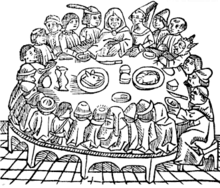
As we follow Jaron Lanier‘s advice to “go to where you are kindest,” we might recall that it was on this date 1397 that Geoffrey Chaucer “told” (read aloud) The Canterbury Tales for the first time at the court of Richard II.
“Inequality is as dear to the American heart as liberty itself”*…

And indeed, what was true a century ago seem still to hold. Everyone seems to hate/fear inflation, but it has radically different impacts on different groups within our society…
Inflation is widening America’s wealth gap.
• Prices have risen across the nation, and so have wages across all income levels.
• The lowest-earning households gained an average of $500 in earnings last year. But their expenses grew by almost $2,000.
• Meanwhile, the upper half of earners pulled further ahead as their incomes outgrew expenses significantly.
“Whom does inflation hurt the most?” from Scott Galloway (@profgalloway)
###
As we ferret out unfairness, we might cautious birthday greetings to James Mill; he was born (James Milne) on this date in 1773. A historian, economist, political theorist, and philosopher (a close ally of Utilitarian thinker Jeremy Bentham), he is counted among the founders of the Ricardian school of economics (and so, among other things, a father of monetarism, the theory that excess currency leads to inflation).
His son, John Stuart Mill, studied with both Bentham and his father, then became one of most influential thinkers in the history of classical liberalism (perhaps especially his definition of liberty as justifying the freedom of the individual in opposition to unlimited state and social control). JSM also followed his father in justifying colonialism on Utilitarian lines, and served as a colonial administrator at the East India Company.

You must be logged in to post a comment.