“The difference between screwing around and science is writing it down”*…
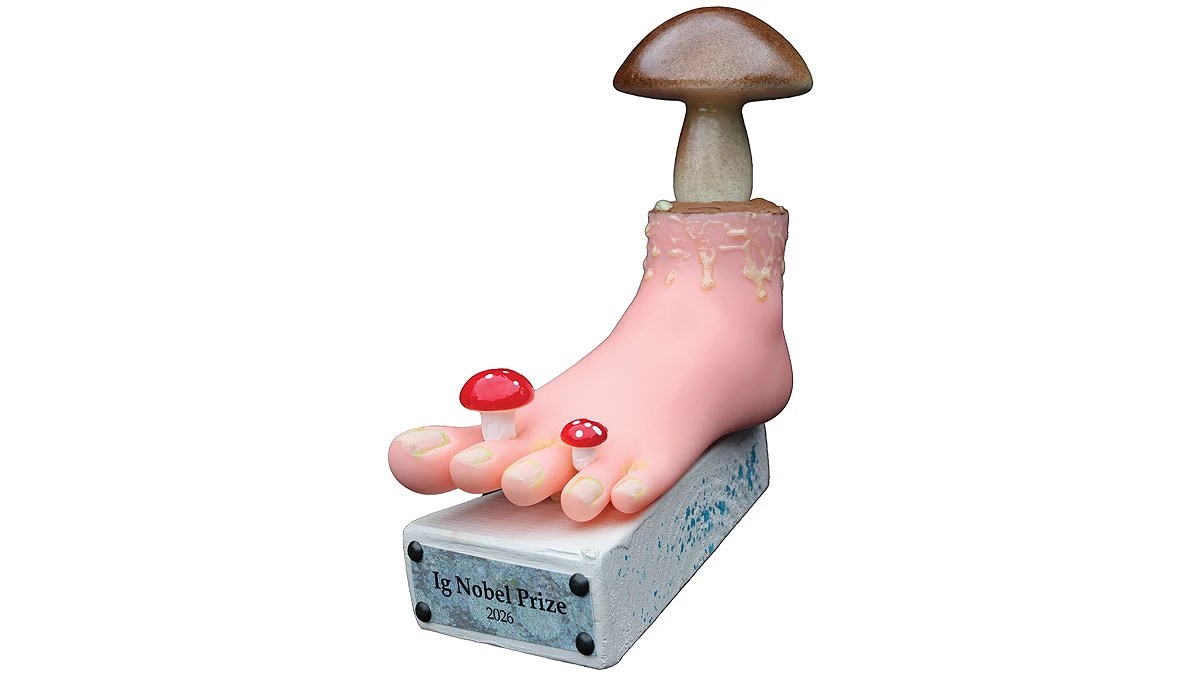
It’s that time of year again: earlier this month, the Ig Nobel Prizes were awarded…
Scientists who studied cockroach milk proteins, splash-free urinals, and buried underpants garnered top honors at the 36th Ig Nobel Prize ceremony on Thursday, Sept. 3. The humorous honors, which are given “for achievements that first make people LAUGH, and then make them THINK,” were awarded in Zurich for the first time, after 35 years of ceremonies in the US. The Ig Nobel’s organizers at the magazine Annals of Improbable Research moved the ceremony because of safety concerns for international winners and journalists traveling to the US, according to Marc Abrahams, Ig Nobel founder and the master of ceremonies…
… The Ig Nobel in Biomechanics went to the University of Oxford’s Matilda Brindle and coworkers, who have redefined kissing as “non-agonistic interactions involving directed, intraspecific, oral-oral contact with some movement of the lips/mouthparts and no food transfer” after observing the behavior in ants, birds, polar bears, and primates (Evol. Hum. Behav. 2025, DOI: 10.1016/j.evolhumbehav.2025.106788).
The discovery that milk proteins from viviparous cockroaches—insects that nourish their developing offspring within their bodies instead of in an external egg case—possess three times as much energy as cow milk proteins garnered the coveted Chemistry Prize. A team led by Leonard M. G. Chavas at Dectris Japan and Subramanian Ramaswamy at Purdue University studied the proteins from living Diploptera punctata cockroaches (IUCrJ 2016, DOI: 10.1107/S2052252516008903).
For their study “Higher Social Class Predicts Increased Unethical Behavior,” Paul K. Piff at the University of California, Irvine, and coworkers took home the Economics Ig Nobel. Among other things, they learned that drivers of expensive, late-model cars were more likely to cut off other vehicles at a busy four-way intersection (Proc. Natl. Acad. Sci. U.S.A. 2012, DOI: 10.1073/pnas.1118373109)...
“2026 Ig Nobel Prizes” from the American Chemical Society‘s Chemical and Engineering News.
The full list of this year’s Ig Nobel honorees is here; watch the (very amusing) ceremony here.
###
As we extol the eccentric, we might spare a thought for Orville Redenbacher; he died on this date in 1995. An agronomist and businessman, he was described by The New York Times as “the agricultural visionary who all but single-handedly revolutionized the American popcorn industry.” Redenbacher’s interest in popcorn blossomed early. It was the favorite snack on his family’s farm, and he grew it (and sold it from the back of his car) to earn extra spending money.
After graduating from Purdue, Redenbacher returned to agriculture, serving as a Farm Bureau extension agent, then working in fertilizer sales. In 1951, Redenbacher and partner Charles F. Bowman bought the George F. Chester and Son seed corn plant in Boone Grove, Indiana. Naming their company “Chester Hybrids,” they tried tens of thousands of hybrid strains of popcorn before settling on a hybrid they named “RedBow.” Over the next two decades, Chester became a worldwide supplier of popcorn seed while also selling its own varieties directly to consumers at its plant in Valparaiso, Indiana.
In 1970, the company introduced a new gourmet hybrid popping corn (developed by plant breeder Carl Hartman) and began distributing it to retail outlets. On the advice of an advertising agency, the product was branded under Orville Redenbacher’s name, and launched as Orville Redenbacher’s Gourmet Popping Corn (in 30-ounce jars)– with the tagline “World’s most expensive popping corn.”
While Orville Redenbacher-branded popcorn is still available, it is (a la last Wednesday’s post) no longer Orville’s passion product. In 1976, Redenbacher sold the company to Hunt-Wesson Foods, a division of Norton Simon, Inc. In 1983, Esmark purchased Norton Simon, which in turn was acquired by Beatrice Foods in 1984. In 1985 Kohlberg Kravis Robert acquired Beatrice with the goal of selling off businesses. In 1990, they sold the popcorn business and other old Hunt-Wesson businesses to agribusiness giant ConAgra.

You must be logged in to post a comment.