“But is it not already an insult to call chess anything so narrow as a game?”*…
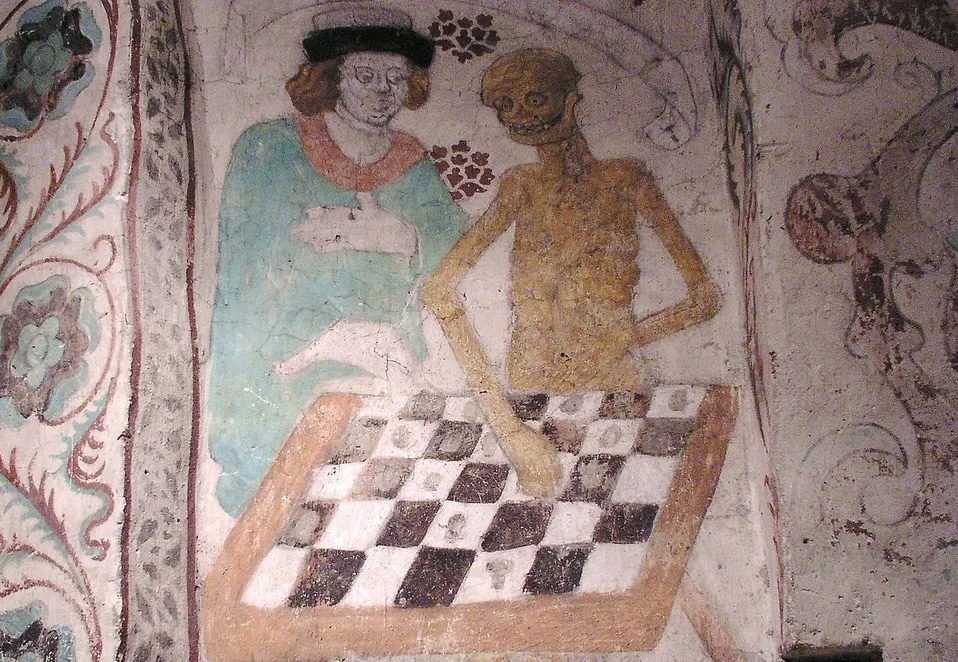
Mardean Isaac, in The Republic of Letters, on chess and what it can– and can’t– teach us. He begins by recounting his personal history with the Royal Game, culminating in an intense period of play…
… Soon after I started my spree, I could already feel subtle cognitive re-wiring beginning to take place. The shape of those changes seemed to align with the objective lessons chess imparts; as if contemplating the findings on a psychedelic drug trip, the issue then becomes whether this is really the case.
People read themselves into interpretations of the greater significance of the game. For Vladimir Nabokov, like the sentence, chess reaches its most elevated form in the perfect rendering of problems into compositions. Stanley Kubrick, who used to put in 12 hour days playing in Washington Square Park, had a stab at life lesson stuff in an old Playboy interview: “Among a great many other things that chess teaches you is to control the initial excitement you feel when you see something that looks good. It trains you to think before grabbing, and to think just as objectively when you’re in trouble.” A 1966 profile of the director in the New Yorker reveals the grubbier material underneath that prudence. At the end of the piece, Kubrick sees the reporter eyeing what he perceives as a killer move, and breaks out in agony to encourage him to make it. But it turned out to be a trap; the move opened a pathway for Kubrick to win. The game’s laws are objective, and can be understood by analysing the outcomes of actions and potential actions. But while players are necessarily guided by explicit rules, they often gain their edge from covert ones. The edge-seeking on display there, rooted in an absence of institutional cushioning, would never leave Kubrick, as he strove to reach the apex of the most logistically burdensome and patronage dependent of art forms.
Chess is primarily a strategic, not a cultural, phenomenon. That is the key to its longevity: where culture changes and evolves, strategy survives and persists—merely as itself. Chess reveals the chiselled edges of strategic veracity: the failures that ensue from not registering your adversary; the complacency that sets in when seemingly comfortably in control; not recognising that risk is a constant, meaning that a good move, coming at the expense of a great one, can also harm you.
The logic of chess exists outside of us; and yet every move feels so personal. Is there an illustration of personal limits more acutely painful than making a truly dumb move, or not spotting a killer one? Not seeing things objectively is not only a guarantor of psychic torment—it often also leads to a kind of self-defeat anyway, because it shuts off routes to our own self-advancement, even if the solipsistic voice in your head might tell us otherwise.This is where zugzwang (“move compulsion” in German) comes in. This strategic concept refers to a situation in which you have no choice but to make a move that will worsen your position. For example: you are in check, and have to protect your king by moving over a piece that will certainly be taken, reducing your pool of available pieces to the point where victory is made more difficult or impossible. (The only way out of zugzwang—resignation—is no way out at all: a fact which carries a dark metaphorical valence.) It seems to reach into the ultimate dynamic: biology set against time. The problem is: the onus is always on you—you who are always either preparing, or executing, the move you must make. The issue of needing to make a move; there being no such thing as stasis; and each one either advancing or worsening, is a kind of approximation of our biological existence. It’s a reminder that everything is advancing or hurting your cause. Whether or not you are creating the conditions for zugzwang boils down to the accumulated consequences of your own actions. It affirms that you are always responsible for advancing yourself—even, and especially, into oblivion. Worst of all, it affirms that you were responsible for creating the objective conditions that brought about your own drive towards defeat.
I can’t hang onto this moment any longer. It is up to me to decide whether I’ve played too many games for that, or too few. I can either accept that I now have to drive on into the endless forest of chess—or step back altogether, leaving this essay as the only footprint of my ramble across its periphery. As I contemplate the problems with either position, I realise I have already entered my own personal zugzwang…
Perhaps we’d do well to sort the “games” we play into those like chess worth playing, win or lose, and those that are not… Of those latter– especially of those the present themselves not so much as games, but as “the way things are”– as “Joshua / WOPR,” the computer in War Games, observes to “David Lightman” (Matthew Broderick) after thermonuclear annihilation is narrowly avoided: “A strange game. The only winning move is not to play.”
A love affair with chess: “My Personal Zugzwang.”
More on zugzwang: “Advantage! What is advantage?“
* Stefan Zweig, Chess Story
###
As we make a move, we might recall that it was on this date in 1964 that The Addams Family premiered on ABC. Based on a series of single-paneled cartoons by cartoonist Charles Addams for The New Yorker magazine that began in 1938, the series took the unnamed characters in the single-panel gag cartoons and gave them names, backstories, and a household setting. The main cast was: Gomez (John Astin), Morticia (Carolyn Jones), Lurch (Ted Cassidy), Pugsley (Ken Weatherwax), and Wednesday (Lisa Loring).
The show went off the air in 1966, but The Addams Family’s popularity never really died. Since that time, Hanna-Barbera created two different cartoon series based on the show, three feature films were released in 1991, 1993, and 1998 plus a direct-to-video movie in 1998. In 2019, MGM released a brand new full-length animated film which was pretty good followed by a sequel two years later which wasn’t. In 2022, Jenna Ortega starred in a Netflix show centering on the character of Wednesday Addams, but all of the Addams have supporting roles for the series Wednesday including Luis Guzman (Gomez), Catherine Zeta-Jones (Morticia) and Isaac Ordonez (Pugsley).

You must be logged in to post a comment.