Author Archive
“Your life has a limit, but knowledge has none”*…
Kurt Gödel’s Incompleteness Theorems put a cap on what we can “know” from within the logical and perceptual systems in which we live. While Gödel’s focus was trained on mathematics, his insight has seen much broader application (e.g., here).
Alexander V. Gheorghiu argues that it’s not so simple– and that what we claim as “true” is not a ceiling we are forever failing to reach but something that changes as we climb toward it…
On the evening of 8 September 1930, the German mathematician David Hilbert stepped up to a microphone in Königsberg and addressed his countrymen by radio. He was 68, recently retired, and at the height of his fame. The talk was a defense of pure reason, delivered in the city of Immanuel Kant, and it ended with two phrases that would later be carved on his tombstone: Wir müssen wissen. Wir werden wissen. We must know. We shall know.
Are certain questions closed to the human mind? Are there truths about the world that we can never know? Hilbert thought that, at least within mathematics, this could not be the case. For him, mathematics was a game played with symbols: one could fix the right axioms as rules of the game and every mathematical problem could be solved. He was wrong.
The day before his Königsberg address, at a small academic meeting in the same city, a 24-year-old Austrian named Kurt Gödel had quietly announced that no such system for arithmetic could exist. Whatever reasonable set of rules you fix, something true must lie beyond them and thus beyond our knowledge. We can’t know. We won’t know. Gödel’s results, known as the Incompleteness Theorems, are landmark achievements of 20th-century logic. Recent work in philosophy and mathematics has begun to illuminate the gap they opened, and with it something deeper about the foundations of knowledge itself. The story begins in the same city, but two centuries earlier…
[Gheorghiu unpacks the arguments of Kant, Hilbert, and Gödel, then traces the work done since. He concludes…]
… In 2005, Tor Sandqvist, a doctoral student at Uppsala University, submitted a thesis that took up [Michael Dummett‘s]’s challenge: to justify the ordinary practices of mathematicians without any appeal to truth. Where Dummett had given the conditions a solution must satisfy, Sandqvist gave a solution. He produced a precise mathematical justification of deduction as mathematicians actually use it, grounded entirely in practices of assertion. The boxer’s fists were untied.
It was rediscovered a decade later in the Department of Computer Science at University College London, where a group of logicians recognised what Sandqvist had actually built, and developed it into a full framework on a par with the orthodox truth-conditional view. The framework now stands equal to the truth-based account, analogous to the situation after Gödel’s PhD thesis. What about mathematics? The UCL team have recently shown that the Dummett-Sandqvist framework gives a way to understand what Gödel’s Incompleteness Theorems are about, and it is not the limits of knowledge.
If meaning comes from practices of assertion, then our concepts are settled only as far as our practices have settled them. A system of definitions is a kind of constitution that determines something. The US Constitution, for example, is meant to enshrine a form of democracy. But what a constitution defines answers to how it is amended.
Principia Mathematica is a constitution for arithmetic. To read it as a constitution is to assume it is consistent; otherwise, it would be nonsense. So, when we amend it by asserting that ‘Principia Mathematica is consistent,’ we are not changing the subject: the new axiom says aloud only what the practice already did. Gödel’s theorems apply afresh to the enlarged constitution: the amended system has its own unprovable truth, its own consistency it cannot certify. No amendment is the last; each faithful extension opens room for the next. To grasp a concept like arithmetic is not to survey a finished structure; it is to hold a principle for going on: a rule for laying the next stretch of line, not a map of where the line ends. Dummett called this openness indefinite extensibility.
Faithful is the word doing the work, because not every amendment is. Gödel claimed the US Constitution could deliver a dictatorship. That does not make dictatorship a form of democracy. Whatever loophole he had in mind, it would have contradicted the practices the Constitution already enshrined. An amendment can betray what a constitution defines. But it can also unfold it, drawing out what the founding commitments demanded all along. Only the second kind is what Dummett has in mind.
The constitution of our language is our current practice for public discourse. As it is extensible in this way, what we claim as ‘true’ is not a fixed structure with a ceiling we are forever failing to reach, but something that can change. Gödel’s verdict never applied to mathematics, but only to some edition of the constitution. Within the Sandqvist system, we can attend to the extension systematically. Hilbert’s words outlive his programme: Wir werden wissen. We shall know. Not because the answers are waiting at the end of a ladder, but because truth goes exactly as far as we have built the rungs…
Eminently worth reading in full: “The Ladder of Knowledge,” from @aeon.co.
###
As we stand on the shoulders of giants, we might note that today is National Nut Day.

“All that we see or seem is but a dream within a dream”*…
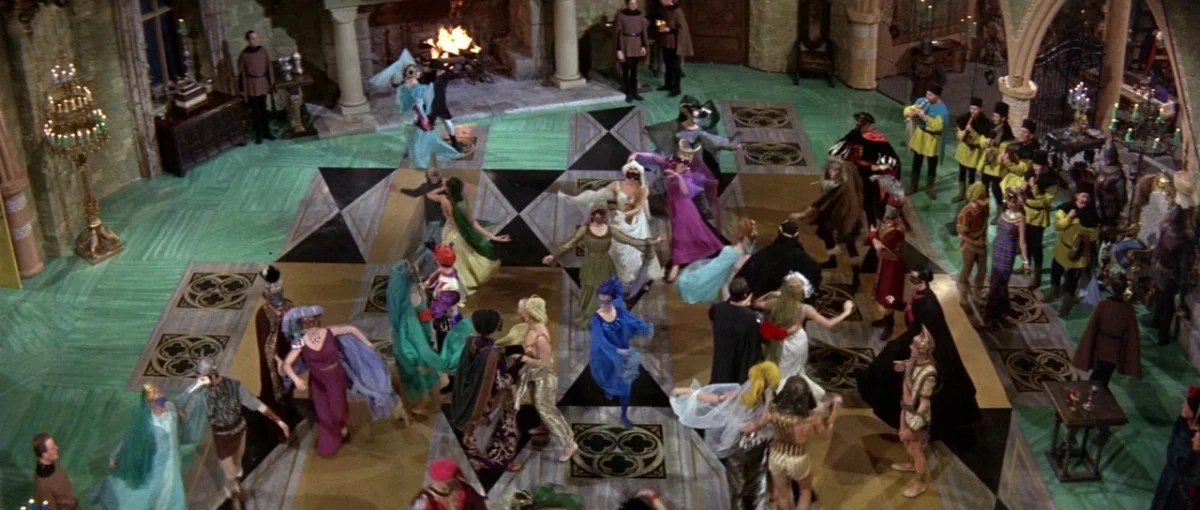
As All Saint’s Eve approaches, Karina Wilson weighs in (on her lovely blog, Horror Film History) on the remarkable series of films created by Roger Corman from the works of seasonal “hero” Edgar Allan Poe…
Corman was fond of literary adaptations, especially if the original was in the public domain. He mined Edgar Allan Poe’s short stories for some of his most memorable work between 1960 and 1964…
… In 1960 AIP execs Arkoff and Nicholson asked Roger Corman to make yet another pair of low-budget black and white horror films. He told them he had a better idea, a movie adaptation of Edgar Allan Poe’s The Fall of the House of Usher. Nicholson and Arkoff initially balked at the concept, which differed wildly from their then-staple trade in monster B-pics aimed at drive-in adolescent audiences. “Where’s the monster?” asked Arkoff.
Corman reassured them the house was the monster (“The house lives. The house breathes”). He was becoming more and more interested in Freudian theory and wanted the adaptation to reference psychoanalytic theory. To Corman, the dark corridors and gaping portals of the decaying mansion were unmistakably female spaces. He was fascinated by the concept that buildings (or at least movie sets) can reflect the ego and the id. Daily activities happen as normal in the sunlit upper rooms of a mansion while shapeless terrors ooze within the gloom of the basement .
If a yonicentric set wasn’t enough to draw the crowds (at least subconsciously), Corman insisted Poe stories had built-in teen appeal thanks to the efforts of English Literature teachers everywhere (“He’s read in every high school”). Corman wanted to tap into widespread familiarity with the tales and the ongoing love affair with gothic horror fuelled by television reruns of Universal movies from the 1930s. He also wanted to make more lavish movies instead of perpetually budgeting on a shoestring. Always mindful of the market, he believed a classic literary adaptation could give AIP productions more mainstream (and adult) appeal and compete with the technicolor horror films being produced by Hammer in the United Kingdom and as part of the nascent Giallo movement in Italy. Arkoff and Nicholson, fully aware of Corman’s proven ability to deliver low budget quality in a timely fashion, agreed to the experiment.
For House of Usher (1960), Corman teamed up with actor Vincent Price, whose sonorous cod-Shakespearean vowels became synonymous with the storybook theater narration that would become emblematic of this cycle. Price had supposedly sworn off making horror movies after The Fly (1958) because he claimed he couldn’t keep a straight face on set. Corman lured him back to the genre with the prospect of playing Roderick Usher, a meaty, actorly role – and the rest is history. Corman tapped screenwriter Richard Matheson, (who was doggedly building his reputation as a master of the genre) for the script, which stuck quite closely to the original, adding a romance between Philip and Madeline. House of Usher was Corman’s first foray into color movies and cost a luxurious $270,000 ($50,000 of which reportedly went to Price). The production schedule was still tight (15 days) and Corman made the most of his expensive star by framing him against production designer Daniel Haller’s skilfully scavenged yet sumptuous looking sets. The result was a commercial and critical hit, grossing $2 million that summer and elevating American International Pictures’ aesthetic beyond Poverty Row. Arkoff and Nicholson, naturally, wanted more of the same.
Between the House of Usher (1960) and The Tomb of Ligeia (1964), Corman made seven Poe-related movies for AIP. Premature Burial in 1962 featured Ray Milland in the lead role but all the others starred Vincent Price (who would go on to make The Oblong Box in 1969, for AIP but without Corman). Matheson supplied scripts for The Pit and the Pendulum (1961), Tales of Terror (1962), The Raven (1963), while his friend Charles Beaumont wrote The Premature Burial, The Haunted Palace (1963), and The Masque of the Red Death (1964). Future Academy Award winner Robert Towne (Chinatown) penned the final entry, Tomb of Ligeia.
While he relied heavily on tried-and-trusted AIP personnel, Corman tried to switch things around tonally with each movie. This ensured a different experience for the audience each time rather than simply replicating what had gone before. Tales of Terror is quite cynical, even humorous in tone and The Raven is outright comedy-horror [and noteworthy as a rung on Jack Nicholson’s climb to stardom]. The Haunted Palace isn’t even based on a Poe story – it’s actually an adaptation of H. P. Lovecraft’s The Case of Charles Dexter Ward. AIP wanted to market it as part of the cycle, so they gave it the title of one of Poe’s poems, and bookended the action with narrated lines…
Read on… “Roger Corman’s Poe Cycle (1960-1964)” from @karinalw.bsky.social.
* Edgar Allan Poe, “A Dream Within a Dream“
###
As we scream, we might recall that it was on this date in 1988 that Lair of the White Worm was released in the U.S. A “supernatural comedy horror film” loosely based on the 1911 Bram Stoker novel of the same name, it was written, produced, and directed by the remarkable Ken Russell, and starred Amanda Donohoe, Hugh Grant, Catherine Oxenberg, and Peter Capaldi; it follows the residents in and around a rural English manor that are tormented by an ancient priestess after the skull of a serpent that she worships is unearthed by an archaeologist.

“In the beginning there is the stem cell; it is the origin of an organism’s life”*…

C.H. Waddington’s powerful image of embryonic stem cells specializing on a rolling landscape has captivated biologists since the 1950s. As Philip Ball reports, experimental data is finally confirming– and complicating– his visionary ideas…
By the middle of the 20th century, it had begun to seem that biology was almost solved. Charles Darwin’s theory of evolution by natural selection explained how organisms change and adapt. The modern science of genetics showed how it works at the molecular scale. Genes governing the traits of organisms get passed down from parent to offspring, and random mutations create the variations from which natural selection picks the “fittest.” Natural selection and genetics fitted together in what the biologist Julian Huxley christened “the modern synthesis” in his 1942 book). Once it was shown in 1953 that the genes are encoded by DNA, the rest of biology looked like little more than piecing together details.
But not everyone was satisfied. The British biologist Conrad Hal Waddington), known to his friends and colleagues as Wad, thought this focus on genes was all very well. But it wasn’t clear to him, or anyone else, exactly how genes shape the forms and features of organisms — how they reliably generate all the different tissues of the body, in all the right places, during embryonic development. Around the same time that Huxley unveiled the modern synthesis, Waddington presented a novel picture of how this might unfold.
He visualized the developmental process as a landscape with hills and valleys that split every so often like those in a river network. At the very top of the highest hill he imagined a ball, which represented a population of cells in their earliest embryonic form — what we now call stem or pluripotent cells, which have the potential to become any cell type. The progression of the cells towards their fates — to become, say, skin cells, muscle cells, or nerve cells — is like the ball rolling downhill through the landscape.
When the ball reaches a branching point (bifurcation), the model’s “gravity” pulls it to one track or the other: In scientific terms, it must differentiate. Through a particular sequence of such branching decisions, Waddington argued, cells specialize into their mature types, or fates, each expressing a particular set of genes. The cells are restricted to a small number of well-defined states because they are “canalized,” in Waddington’s lexicon: trapped and channeled by the sides of the valley. In this way, a limited number of cell types reliably arise from the activity of an army of genes.
Waddington’s landscape has been “remarkably useful as a conceptual scaffold,” said James Briscoe, a developmental biologist at the Francis Crick Institute in London. “The core ideas — that development is progressive, that cell states are distinct, that bifurcations represent [cell] fate decisions, that canalization implies robustness — all survive.”
“There’s so much richness to some of the concepts Waddington was trying to share,” said Susanne Rafelski, a biochemist at the Institute for Stem Cell and Regenerative Medicine in Seattle.
But the concept was more of a visual metaphor than a representation of an actual biological process. Or so it seemed. In the past several years, researchers have mapped out the real topography of cell-state spaces — in effect, Waddington’s landscapes — from experimental data collected from many thousands of cells over the course of embryonic development. Those analyses are revealing that development is not a mere readout of a genetic program, but rather a dynamic process in which communities of cells build themselves, and the very landscape they navigate, by mutual negotiation and interaction, into an organism.
This cartography of development is now helping researchers understand how identical cells in the early embryo develop into the distinct tissues and cell types of a complex organism. This matters enormously for regenerative medicine and stem-cell engineering, Briscoe said: “If you understand the landscape topology and know where the bifurcations lie, you can in principle design methods that steer cell populations to desired states with precision, rather than by trial and error.”
Waddington’s metaphor, then, could be the key to understanding and reshaping possibilities for what cells, tissues, and embryos can be…
Read on: “How Does Life Unfold? A Landscape Metaphor Comes Into Its Own.” from @philipcball.bsky.social in @quantamagazine.org.
###
As we appreciate adaptability, we might send healing birthday greetings to Robert Peter Gale; he was born on this date in 1945. A physician and medical researcher, he conducted important research into leukemia and other bone marrow disorders (e.g., aplastic anemia). Gale was a a pioneer in bone marrow transplantation and co-founded the International Bone Marrow Registry. But he is perhaps most widely known for his assistance to foreign governments in treating radiation victims – to the Soviet Union (1986) after the Chernobyl disaster and to Brazil (1987) following an accident in Goiania. As a specialist in bone marrow transplants, he volunteered to treat Chernobyl victims and was invited by Mikhail Gorbachev to travel with a group to Moscow immediately after the April 1986 accident. He performed bone marrow transplants on 13 Chernobyl victims (though many of the highly exposed Chernobyl survivors have since died from latent radiation effects).

“In nature, as in work of art, the isolation of an object tends to invest it with absoluteness, to endow it with that more-than-symbolic meaning which is identical with being”*…
Does AI threaten our humanity? Nathan Gardels, the editor-in-chief of Noema Magazine, suggests that the horse has already left the barn…
From Silicon Valley to the Vatican, across kitchen tables and in the halls of power, the world is astir over the question of whether humans will be able to control the AIs we’ve created. But that begs the question: What does it mean to be “human”?
One place to start sorting this all out is what Confucian philosophy calls “rectification” — naming things for what they actually are.
To N. Katherine Hayles [here], author of Bacteria to AI: Human Futures with our Non-human Symbionts [here], we are already “post-human.”
As she explained to Claire Webb in a recent Futurology podcast, the concept of “human” is culturally and historically contingent. These days, she says, there is still the dominant view that arose with the Enlightenment of the human as an autonomous, singular entity with “rational free will.”
For Hayles, that has never been true because humans have never existed as an entity apart but have always been “woven in the web” of a surrounding environment, or “Umwelt.” It is the symbiotic interactions within that interdependence which determine the signs we sense, the meaningful interpretation of the information we process, the decisions we make, and the actions we take that define who we are.
The most obvious example of our relational interdependence with non-human life is the gut bacteria within us, the biological functions of which we’d perish without.
The false notion of self-enclosed human autonomy is even less true today, she argues, because “we are already in a deeply symbiotic relationship with computational media — chips, routers, devices, microwaves, etc. They have become the controllers, processors and disseminators of a flow of information” in which we are inextricably enmeshed — and, in advanced societies, without which we couldn’t survive. If it all crashed, we couldn’t transport food, fly airplanes or operate the stock market. We’d quite literally live in the dark.
As Hayles describes it, this condition amounts to “distributed cognition and distributed decision-making” between human and non-human participants. She calls these “cognitive assemblages” or “networked intelligence.”
In short, we are “post-human” because we are inseparably joined in an “integrated cognitive framework” with computational media.
This post-human condition would seem to place us some distance along the continuum toward Singularity, the full fusion of humans and intelligent machines. By definition, this symbiosis blurs the line of who or what is in control.
In a related Futurology podcast, Kevin Kelly [here] tells Nils Gilman that “we are already in the Singularity.” From his northern California perch, Kelly has been surfing the waves of technological innovation and cultural transformation for decades, going back to his time as co-founder of The Whole Earth Catalog with Stewart Brand and then Wired magazine.
What Kelly means by “already in” is that human/machine fusion is a presently ongoing process that doesn’t suddenly cross some rapturous threshold, but incrementally unfolds with the accelerated deepening of the “integrated cognitive framework” Hayles talks about.
We can’t clearly see the massive change taking place now in its pixelated form, but will only be able to recognize the fuller picture of what has taken place from a future retrospective standpoint. Our perspective is clouded, says Kelly, by the fact that “we are living inside the event horizon.”
For Kelly, the Singularity is not a closed process with a fixed endpoint, but perpetually open to the emergence of new creative forms and unexpected symbiotic combinations, what the complexity scientist Stuart Kauffman calls the “adjacent possible” that can’t be foretold. “The Singularity is always near,” as Kelly puts it, but forever remains on the elusive horizon.
Hayles departs from the transhumanist vision of Singularity where human consciousness one day is uploaded to an inorganic substrate other than the biological body.
She makes the point, as do many others, that artificial intelligences on their own cannot attain consciousness.
This is because they lack the “natural intelligence” that can only emerge from the extraordinary complexity of the millennia-long evolution of embodied humans adapting to their environment to survive and thrive. No matter how powerful the large language models may be, language which inherently infers that distinctly human experience, cannot be meaningfully transferred to an inorganic substrate lacking the commensurate context.
AIs cannot know the “ground truth” of embodied intelligence, which, at bottom, is the homeostatic quest for survival that neuroscientist Antonio Damasio argues is the root of emotion and self-awareness.
AIs may use chain-of-reasoning logic to achieve objectives by stringing together the language they’ve been trained on, but the meaning is not the same. Precisely the danger of AIs is that they become empowered as actors through “recursive self-improvement” ungrounded in lived experience.
As such, they lack the ingrained primal training that informs moral reasoning. In Pope Leo XIV’s words, “So-called artificial intelligences do not undergo experiences, do not possess a body, do not feel joy or pain, do not mature through relationships and do not know from within what love, work, friendship or responsibility mean.”
Though AI models may “imitate language” and “simulate empathy and understanding,” he says, “they do not understand what they produce.”
What humans invaluably bring to the table of an “integrated cognitive framework” is, in the parlance of the pontiff, the “integral” nature of the human as a “whole person” in the full set of relations with others and nature that constitute him or her. “The person,” he says, “is not a system of algorithms: he or she is a creature, relationship, mystery.”
In this sense, retaining “human control” of AIs means purposefully and insistently instantiating the integral element drawn from lived human experience into our entwinement with intelligent machines.
The challenge is not just about “disarming” the capacity of AI agents to act on their own, as the Pope has called for, but also about “arming” the integral conception of the human within the integrated cognitive framework in which we already dwell…
From an integrated to an integral cognitive framework: “We Are Already Post-Human,” from @noemamag.com.
* Aldous Huxley, The Doors of Perception
###
As we contemplate connection, we might recall that it was on this date in 1973 that a US Federal Judge signed his decision, following a lengthy trial, declaring the ENIAC patent invalid and belatedly credited physicist John Atanasoff with developing the first electronic digital computer, the Atanasoff- Berry Computer (or simply, “the ABC”). Built in 1937-42 at Iowa State University (then Iowa State College) by Atanasoff and a graduate student, Clifford Berry, it introduced the ideas of binary arithmetic, regenerative memory, and logic circuits.
As it happened, these ideas were communicated from Atanasoff to John Mauchly, who used them in the design of the better-known ENIAC built and patented several years later.

“In our world of big names, curiously, our true heroes tend to be anonymous”*…
Your correspondent is headed off-line for a few days, so (R)D will be off until Monday, October 19, when (airline performance permitting) regular service should resume…
Billions of computers and phones run on code looked after by a handful of mostly-volunteer people. On his lovely site sheets.works, Akash Wadhwani introduces us to some of those generous souls…
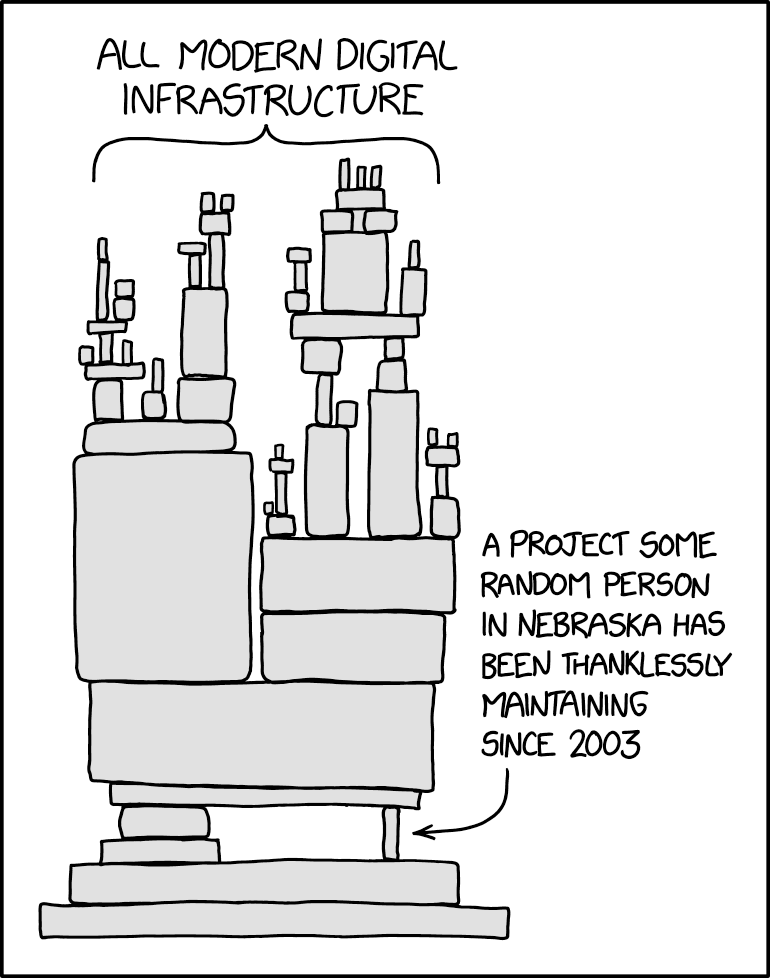
People post [the comic above] whenever something breaks. The tower is labelled “all modern digital infrastructure” and it stands on one small block, “a project some random person in Nebraska has been thanklessly maintaining since 2003”.
We wanted to know how close to true it is. We downloaded the full history of 23 pieces of software that phones, browsers and servers depend on, and counted everyone who made ten or more changes to each one between October 2025 and October 2026. Then we listed what is actually installed on an Android phone, an iPhone and a Windows PC…
Wadhwani opens with the story of Paul Eggert…
Your alarm, a boarding pass, a meeting in another country, the day your salary lands: anything on your phone that shows a time has to know where you are. Underneath sit every Android phone, every iPhone and most of the servers on the internet.
They all get local time from one text file, the time zone database, which holds every clock rule a government has ever announced. Paul Eggert, a lecturer at UCLA, keeps that file up to date in his spare time [and has since 2012].
4,000,000,000 Android phones and iPhones use his file. We didn’t count servers, Macs or laptops, which would push the number higher.
On 29 September Paul put out version 2026e of the file. The first line of its notes says that Manitoba moves to permanent -05 on 31 October, which tells phones in Winnipeg not to set their clocks back on 1 November, and it was typed in by two volunteers a month ahead…
Read on for 22 other tales of extraordinary generosity: “The people holding up the internet.”
* Daniel J. Boorstin, The Image: A Guide to Pseudo-events in America
###
As we give thanks, we might spare a thought for a man who, if not un-sung, has been at least under-sung: Walter M. Elsasser; he died on this date in 1991. A physicist, he contributed to science across several disciplines. In atomic physics, he interpreted electron scattering. In geophysics, during the 1940’s, he provided insight into radiative heat transfer in the Earth’s atmosphere, and developed the currently-accepted dynamo theory to explain the origin and properties of the Earth’s magnetic field. And he pioneered study of the magnetic orientation of minerals in rocks to reveal the Earth’s history of its magnetic field.
The last fifty years of his life were in large measure spent on biology, more particularly on Systems Biology: Elsasser worked toward a theory of organisms (an effort to establish the distinction between living and inanimate matter). His thinking is still at play in both Complex Systems Biology and Relational Biology.

You must be logged in to post a comment.