Posts Tagged ‘architecture’
“Function reforms form, perpetually”*…

Over the years I have given away many, many copies of many books in the hope that they might be of interest/use to the recipient. The book of which I’ve gifted the most copies is How Buildings Learn- What Happens After They’re Built, published in 1995 by my GBN partner and Long Now colleague Stewart Brand. While it has certainly earned its plaudits as a work of architectural criticism, I’ve handed it out because it’s the most thoughtful and evocative book on strategy I’ve come across; it’s p-o-v and principles, rooted in (often literally) concrete examples, amount to the best manifesto I’ve found for thinking and planning for the long term.
In 1997, The BBC released a six-part series based on the book (with music by GBN and Long Now colleague and friend Brian Eno). As Open Culture reports, Stewart has created a YouTube channel to make the series available to us all…
Stewart Brand came onto the cultural scene during the 1960s, helping to stage the Acid Tests made famous by Ken Kesey and the Merry Pranksters, and later launching the influential Whole Earth Catalog (something Steve Jobs described as “Google in paperback form, 35 years before Google came along”). He also vigorously campaigned in 1966 to have NASA release a photograph showing the entirety of Earth from space—something we take for granted now, but fired humanity’s imagination back then.
During the 1970s and beyond, Brand founded CoEvolution Quarterly, a successor to the Whole Earth Catalog; the WELL (“Whole Earth ‘Lectronic Link”), “a prototypical, wide-ranging online community for intelligent, informed participants the world over;” and eventually The Long Now Foundation, whose work we’ve highlighted here before. When not creating new institutions, he has poured his creative energies into books and films…
… Based on [the book, How Buildings Learn], the TV series offers a critique of modernist approaches to architecture (think Buckminster Fuller, Frank Gehry, and Le Corbusier) and instead argues for “an organic kind of building, based on four walls, which is easy to change and expand and grow as the ideal form of building.”
Brand made the series available on his YouTube channel, with these words: “Anybody is welcome to use anything from this series in any way they like… Hack away. Do credit the BBC, who put considerable time and talent into the project.” And he added the noteworthy footnote: “this was one of the first television productions made entirely in digital—shot digital, edited digital.”…
A wonderful series on architecture– and more broadly, on planning for the long term: “Watch Stewart Brand’s 6‑Part Series How Buildings Learn, With Music by Brian Eno,” from @openculture.bsky.social.
Watch the series here.
Further to yesterday’s post (and thanks to friend MK) an obituary of Don Michael, another GBN friend, and author of another book– Learning to Plan and Planning to Learn: The Social Psychology of Changing Toward Future-Responsive Societal Learning— that I’ve given away many, many times.
* Stewart Brand, How Buildings Learn: What Happens After They’re Built
###
As we take the long view, we might recall that it was on this date in 1914 that Frank Lloyd Wright’s self-designed home in Wisconsin, Taliesin, was the site of mass murder and arson. Julian Carlton, a servant of Wright, set fire to the home and brutally attacked the people there during lunch. He ultimately killed seven, including Wright’s partner, “Mamah” Borthwick.
Wright was among the architects that Brand criticized in How Buildings Learn. Brand argued that Wright designed rigid, static “magazine architecture” that prioritized photogenic style and artistic ego over practical function, durability, and the way buildings must adapt to weather and human use over time. That said, Stewart never even thought of reaching for the matches nor a hatchet.

“Bacteria represent the world’s greatest success story”*…

But as Stephen Jay Gould goes on to observe (in his 1996 book, Full House: The Spread of Excellence from Plato to Darwin), “They are today and have always been the modal organisms on earth; they cannot be nuked to oblivion and will outlive us all. This time is their time, not the ‘age of mammals’ as our textbooks chauvinistically proclaim. But their price for such success is permanent relegation to a microworld, and they cannot know the joy and pain of consciousness. We live in a universe of trade-offs; complexity and persistence do not work well as partners.”
Still, we (more complex) humans have recognized– and accommodated– bacteria for millennia. As We Make Money Not Art explains in a review of a recent book– We The Bacteria. Notes Toward Biotic Architecture by architectural historians Beatriz Colomina and Mark Wigley— that’s fascinatingly apparent in the history of architecture…
This “alternative history of architecture from the point of view of microbes” compiles the research that led to the exhibition We the Bacteria: Notes Toward Biotic Architecture at the 24th Milan Triennale last year. Curated by Colomina and Wigley, the show investigated how microbial ecosystems relate to spatial design and health inequality.
The book argues that microbes have not only built the whole planetary biosphere but they have also been the real architects of our homes and cities throughout the ages. Or rather, it’s the fear and diseases they cause that have shaped our spaces and the ways we move through them.
About ten thousand years ago, humans began retreating into spaces increasingly cut off from the exterior world. Plants, soil and insects could be left outside. But microbes, including pathogenic ones, followed humans inside their homes, where they adapted, mutated and generated new diseases. As our shelters expanded into villages, cities and sprawling empires, so too did the microbial ecosystems.
The authors narrate how buildings and bodies exist in a constant microbial exchange, co-evolving into a single, dynamic ecosystem. The microbiome of a home is highly specific to its inhabitants. Even the microbiome of a frequently cleaned hospital room resembles the microbiome of the previous patient, but starts to resemble that of a new occupant after twenty-four hours.
Architecture cannot exist without microbes, and, by extension, without disease. While scrubbing, spraying and disinfecting may eliminate most microorganisms, these practices also breed extremophiles, species so resistant that they can take over the space.
Throughout history, the book reveals, health crises have dictated architectural and urban design. From toilets to fumigation systems, from the plague hospitals, aka lazarettos, to the sanatoriums for tuberculosis patients; from sewage systems to urban parks, cities have been continually reshaped in response to the threats they sought to contain. Architecture became the first line of defence against microbes…
[More of the intertwined history of bacteria and our reponse to them, with lots of fascinating photos…]
… Given the important role that microbes play for our immune systems and the environments we inhabit, the authors call for a biotic architecture. Biotic architecture is less human-centric than traditional architecture. It learns from microbes rather than resists them. It does, of course, maintain some antimicrobial protocols against pathogens remain crucial. Water, sewage systems, toilets and food preparation areas still need to be cleansed, but cleaning routines should also embrace controlled exposure to microbial diversity. During COVID-19, for example, microbiologist Elisabetta Caselli and her colleagues replaced conventional disinfectants with probiotic-based sanitation in six Italian public hospitals. The result was a decrease in surface pathogens by up to 90% compared to conventional chemical cleaning and lower rates of healthcare-associated infections and antibiotic resistances… For once, here is a book that presents a vision where humans can actively contribute to microbial diversity, collaborate with the unseen world around us and build in ways that nurture rather than harm the environment…
More– and more fascinating images– at: “We The Bacteria. Notes Toward Biotic Architecture.”
###
As we coexist, we might recall that it was on this date in 2012 that Rebekah Speight of Dakota City, Nebraska sold a McDonald’s Chicken McNugget that resembled President George Washington for $8,100 on eBay (the third most expensive McNugget ever sold). She had kept the McNugget in her freezer for 3 years before deciding to sell it…. because bacteria.

“Where all think alike there is little danger of innovation”*…

Last week, Northwestern Professor Joel Mokyr was awarded a half-share in The Nobel Prize in Economic Sciences (AKA The Sveriges Riksbank Prize in Economic Sciences in Memory of Alfred Nobel) “for having identified the prerequisites for sustained growth through technological progress.” Anton Howes explains why this is noteworthy…
Among today’s winners of the Nobel prize in Economics is Joel Mokyr, the professor at Northwestern whose name is indelibly associated with the primacy of innovation to modern economic growth – the gradual, sustained, and unprecedented improvement in living standards that first Britain, and then country after country, have enjoyed over the past few hundred years. It was reading Mokyr’s The Enlightened Economy that first opened my eyes to the importance of studying the history of invention to explaining the causes of the Industrial Revolution, which I have since made my career.
What makes this Nobel win so remarkable, and so pleasantly surprising, is that Mokyr’s work is not the kind that is often published by economics journals, or even many economic history journals anymore. Over the past few decades, journal editors and peer-reviewers have increasingly insisted that papers must present large datasets that have been treated using complex statistical methods in order to make even the mildest claims about what caused what. Although Mokyr is a master of such methods – he was one of the early pioneers of economic history’s quantitative turn – the work for which he has won the prize is firmly and necessarily qualitative.
Mokyr’s is the economic history that gets written up in books – his classics are The Lever of Riches, The Gifts of Athena, The Enlightened Economy, and A Culture of Growth – and in readable papers shorn of unnecessary formulae. His is history accessible to the layman, though rigorously applying the insights of economics. The prize is a clear signal from the economics profession that it doesn’t just value the application of fancy statistical methods; its highest prize can go to works of history.
Whereas most of the public, and even many historians, think of the causes of modern economic growth – the beginnings of the Industrial Revolution – as being rooted in material factors, like conquest, colonialism, or coal, Mokyr tirelessly argued that it was rooted in ideas, in the intellectual entrepreneurship of figures like Francis Bacon and Isaac Newton, and in the uniquely precocious accumulation in eighteenth-century Britain of useful, often mechanically actionable knowledge. Britain, he argued, through its scientific and literary societies, and its penchant for publications and sharing ideas, was the site of a world-changing Industrial Enlightenment – the place where progress was thoughtpossible, and then became real.
One of Mokyr’s big early insights, first appearing in Lever of Riches, was that many inventions could not be predicted by economic factors. Society could enjoy remarkable productivity improvements from simply increasing the size of the market, leading to division of labour and specialization – what he labelled ‘micro-inventions’ – in the vein popularised by Adam Smith. But this could not explain an invention that appeared out of the blue, like Montgolfier’s hot air balloon in the 1780s – what he called a ‘macro-invention’, not for the magnitude of its impact, but for its novelty. Macro-inventions often required further development to make them important, but the original breakthrough could not be predicted by looking at changes in prices or the availability of resources. It ultimately came down to advances in our understanding of the world. Mokyr put the Scientific Revolution – and the factors that contributed to it – on the economist’s map.
Mokyr also looked at the relationship between different kinds of knowledge. A scientist might know, through observation, that the air has a weight. A craftsman might know, through long training and experience with glass, how to make a long glass tube. Each could not get far alone. But combining them, by creating means to ensure that scientists and craftsmen talked with one another and collaborated – through connecting their propositional and prescriptive knowledge, their heads and hands – very quickly led to the invention of thermometers, barometers, and much more besides, in an ever expanding field of knowledge. What Mokyr taught economists is that it’s not knowledge per se that makes the difference, but the way it is organized. Much of his later work has shown just how deep a pool Britain’s scientists could draw on, of skilled artisans.
In a way, Mokyr himself has practised what he preached. As editor of Princeton University Press’s book series on the Economic History of the Western World, Mokyr has for decades provided an all-important space for economists and historians to write the kinds of research that would never have been publishable in economics journals – including of explanations of the Industrial Revolution that are the polar opposite to his own. He helped keep the connection between history and economics alive.
Mokyr’s case for the primacy of knowledge and ideas was not an easy one to make to economists. They are naturally drawn to data that can be counted, and not to narrative, often no matter how well evidenced. But it appears that Mokyr’s persistence, elevated by his infectious, irrepressible sprightliness, has paid off. His prize is a long overdue recognition of the historyin economic history, and a remarkable testament to the power of ideas to persuade…
A triumph for history and the importance of ideas: “Joel Mokyr’s Nobel,” from @antonhowes.bsky.social.
See also: “Why Joel Mokyr deserves his Nobel prize,” gift article from The Economist.
* Edward Abbey, Desert Solitaire
###
As we ponder the process of progress, we might send creative birthday greetings to one of the subjects Mokyr’s study, Sir Christopher Wren; he born on this date in 1632. A mathematician and astronomer (who co-founded and later served as president of the Royal Society), he is better remembered as one of the most highly acclaimed English architects in history; he was given responsibility for rebuilding 52 churches in the City of London after the Great Fire in 1666, including what is regarded as his masterpiece, St. Paul’s Cathedral, on Ludgate Hill.
Wren, whose scientific work ranged broadly– e.g., he invented a “weather clock” similar to a modern barometer, new engraving methods, and helped develop a blood transfusion technique– was admired by Isaac Newton, as Newton noted in the Principia.

“When we build, let us think that we build forever”*…
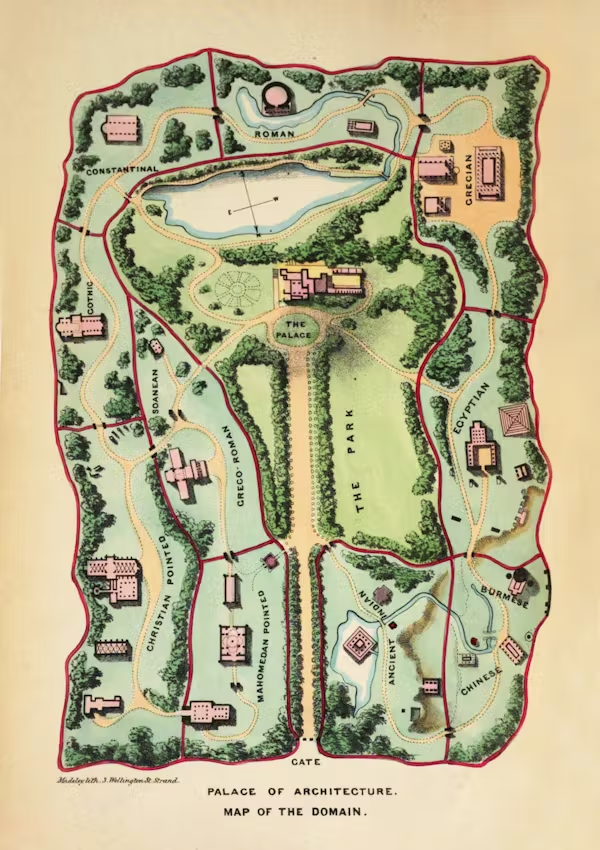
In 1840, British architect George Wightwick published a world history of architecture in the Romantic mode, inviting readers to enter a vast garden where Buddhist iconography rubs shoulders with Greek temples and Egyptian pyramids gaze upon Gothic cathedrals. His intended audience? Idle women. Matthew Mullane revisits this visionary but ultimately unpopular text and explores the legacy of attempts to gatekeep the realms of imagination and fantasy pertaining to the built environment…
The “Prince Architect” welcomes you: “You will see, within this domain, an epitome of the Architectural world. Mine is, as it were, a palace of congress, wherein you will be successively addressed by humble (but, it is hoped, characteristic) representatives of the great families of Design in ancient and Mahomedan India, China, Egypt, Greece, ancient and modern Italy, Turkey, Moorish Spain, and Christian Europe”.
This grandiose introduction is offered by the protagonist of George Wightwick’s Palace of Architecture: A Romance of Art and History (1840). The reader, an imagined visitor referred to in the second person, is quickly handed a map showing the “architectural world” not as a diagram of transmission, a “tree” of influence, or a catalogue of entries, but a picturesque garden. Flanking the central palace is a group of buildings representing the “ancient” corners of the world, including India, China, Burma, and Egypt. At the top-right corner of the map, Greek and Roman structures curl leftward to show a European panoply of styles including Gothic, Soanean, Greco-Roman, and finally, two pointed styles from the Christian and “Mahomedan” perspective. Before entering this garden, you face the palace gate, an unruly collage of world architecture history consisting of, among other things, a Gothic spire, an Islamic dome, and crude prehistoric stone. The gate represents the chasm between the Prince Architect’s overflowing storehouse of experience, and you, the new guest, with none. The well-traveled architect sourced the building’s components from his extensive travels and “crammed [it] with observation, the which it vents in mangled forms.”2 You, the reader, are homebound and observationally deficient and therefore must feel beguiled. However, after a guided journey through the grounds of the palace, “you will return, competent to read the significant details of what, now, only vaguely addresses your understanding.”
Unlike more familiar world histories of the nineteenth century that enticed readers with pages full of illustrations, simplified categorizations, and appeals to scientific rationality, Wightwick’s tour of world architecture was a poetically narrated experience. His florid language and direct reference to the reader were intended to “address the eye and ear of the general public with the eloquence of picturesque illustration and impassioned comment”. He believed that “the error of architectural authors has been that of writing technical treatises for professional readers” and approached the public with a different proposition: “[architecture] requires no critical knowledge of its beauties to admit; neither are its mathematics necessary to a certain enjoyment of the associations that may be connected with a building.”5 In other words, plans, geometry, and other artifacts of specialized knowledge are impediments to actually knowing architecture and its history, and a general audience requires none of that. What they need is a basic level of historical knowledge introduced in an evocative manner so that “the joy of being competent to appreciate” can be unlocked in order to experience “the poetic enchantment of Architecture [that] transfixes the soul of the beholder, and leaves him spell-bound under the combined influence of the phantom past, and the palpable present”. Instead of relying on the empirical evidence of professionals alone, after just one tour through the palace of architecture, you will be in command of architectural knowledge as your “own poet”.
Wightwick’s preference for “speculation and belief” over technical demonstration was directed toward a very specific readership: idle women. The seemingly neutral “you” that drew readers into the palace grounds was in fact aimed at the “fair countrywomen of England”. At a time when female readership of both popular and specialized material was growing, the book is perhaps the first world architectural history written specifically with women in mind…
…
… Critical responses to Wightwick’s entreaty to female readers spanned from bemusement to venomous reproach. The Gentleman’s Magazine recognized that the book was not for the “scientific observer” of architecture but acknowledged that it could nonetheless “afford amusement to the ‘fair’ and fashionable admirers of the art”. W. H. Leeds, writing under the penname Candidus, was not so generous. He published an excoriating review that held the book up as an example of the withering effects of Romanticism on contemporary architectural discourse. He called Wightwick the “wickedest dog in existence” for audaciously dedicating his book not to any reputable institute, but “to a woman, or a no-man” and thinking “that romance has anything to do with art—at any rate, with architecture”. Leeds argued that Wightwick’s avoidance of technical description, scarce reference to plans, and indulgence in imagination threatened to turn architecture into an unserious field of curiosity, charm, and play — all words invariably tinged with the feminine. If Wightwick’s book gained the influence its author wanted, then surely “that which has hitherto been the task of a higher order of intellect is now to become the amusement of women—perhaps the plaything of children”. Careful to not appear ungentlemanly, Leeds clarified that he is not opposed to women enjoying or appreciating architecture in a passive way, but Wightwick’s encouragement of active speculation and creative rearrangement of architecture history was dangerous. “We object to it”, he reasoned, “not because we question the capacity or the sex, but because we see no occasion for increasing the number of designing women”. Where Wightwick saw idle women as eager consumers, Leeds was concerned that an overly enticing history would shock them out of their idleness and convince them that they, too, could make architecture.
Men like Leeds feared that “designing women” would disrupt two key aspects of English architectural culture, its homosociality and its claim to truth. The first was perhaps an annoyance, but the second could be disastrous. Leeds argued that women’s flimsy associations and predilection for exclamations like “how exceedingly pretty!” could trigger the collapse of all architectural knowledge made by men before them.23 Such anxiety represents the panic of a discipline whose propulsive drive to include more and more case studies and accommodate more and more readers also brought unwelcomed actors, like women, dangerously close to the inner circle of architectural expertise. The discrediting of Wightwick’s book shows the quick hardening of professional and epistemological borders to maintain credibility…
…
… Into the twentieth century, architectural history remained stubbornly male dominated and the gendering of architectural fantasy and imagination as feminine stymied any hope that such ideas could gain professional credence. Things quickly changed in the 1960s, when young architects championed phenomenology as a critique of modernism’s universalizing assumptions about user experience. Historian Jorge Otero-Pailos argues that this phenomenological revolution allowed for a generation of so-called postmodern architects to challenge architectural history’s longstanding positivist bent. The buildings of Charles Moore, Robert Venturi, and Denise Scott Brown playfully assemble specific and invented historical references, provoking the viewer in a manner that is not so dissimilar from Wightwick’s mutant palace gate.
While postmodernists experimented with architectural history, the written output of architectural historians such as Charles Jencks ironically remained somewhat conventional and tied to the explanatory textbook. Fantasy and imagination seemingly still carried an indelible stigma. However, a few recent books suggest a return of the repressed, so to speak. Françoise Fromonot’s The House of Doctor Koolhaas (2025) tells the history of a famous house by Rem Koolhaas through the genre conventions of a detective novel. Charlotte Van den Broeck’s Bold Ventures: Thirteen Tales of Architectural Tragedy (2022) blends researched histories of architectural failure and suicide with self-reflective passages that question the authoritativeness of words like “explanation” that are so often used in history texts. Past authors are being rediscovered as well. Lin Huiyin’s mid-twentieth-century poems reflecting on a changing China are at last being translated and reframed as examples of architectural history. These texts are refreshingly strange — just as strange as walking into the Palace of Architecture — and signal that the discipline is finally shedding some of its enduring prejudices about imagination and fantasy…
More of the fascinating story, along with copious illustrations: “Imagining an Idle Countess- George Wightwick’s The Palace of Architecture,” from @publicdomainrev.bsky.social.
Apposite: “Bernard Sleigh’s Anciente Mappe of Fairyland (ca. 1920 edition),” also from @publicdomainrev.bsky.social
* John Ruskin
###
As we dwell on design, we might send connected birthday greetings to an architect of a different kind, Sir Tim Berners-Lee; he was born on this date in 1955. A computer scientist best known as the inventor of the World Wide Web, the browser, the HTML markup language, the URL system, and HTTP, he is a professorial research fellow at the University of Oxford, a professor emeritus at the MIT, and director of the World Wide Web Consortium, which oversees its continued development.

“Firmness, utility, and beauty”*…
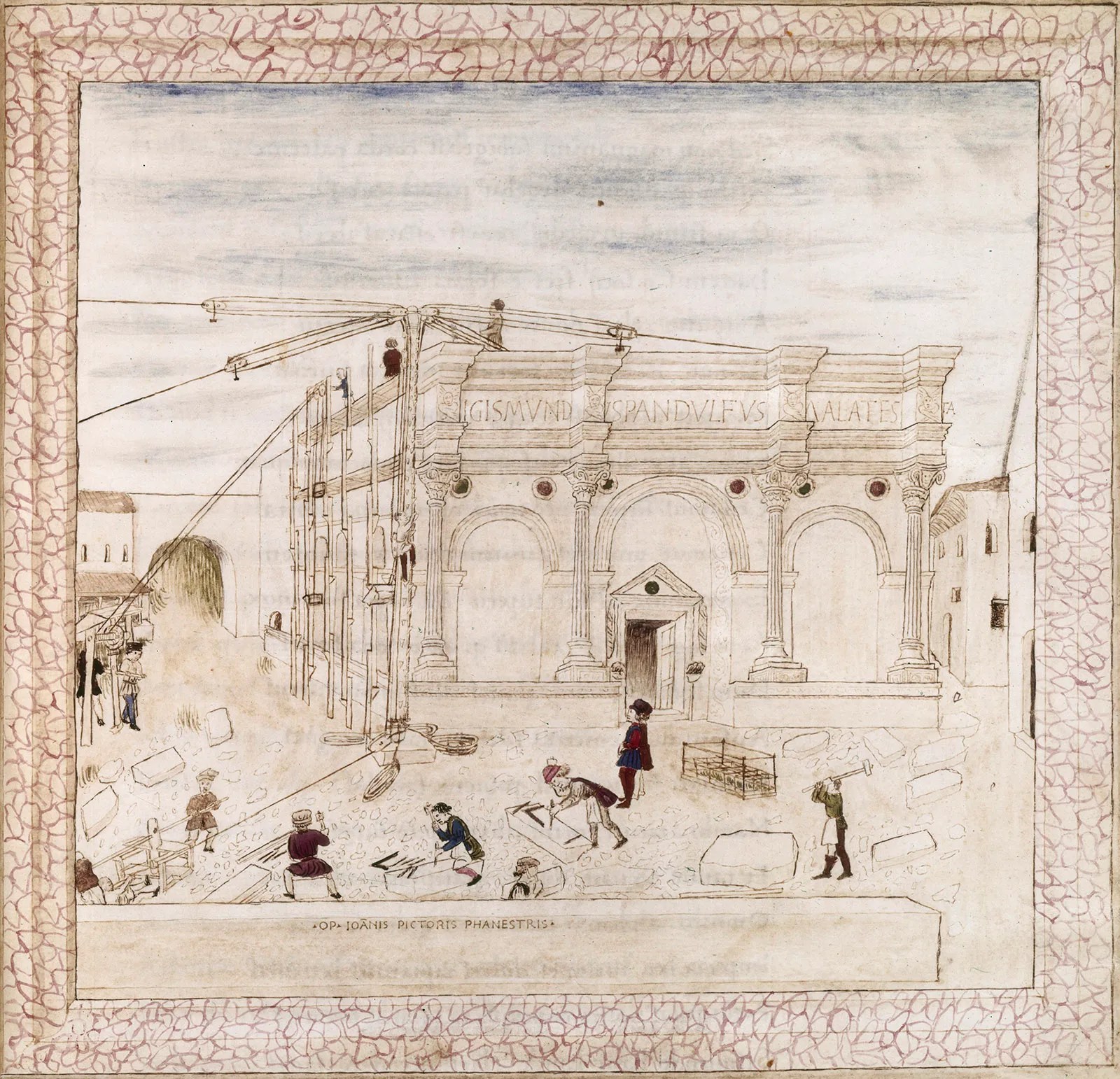
In a review of Indra Kagis McEwen‘s book All the King’s Horses- Vitruvius in an Age of Princes, Ingrid Rowland examines the ways in which Vitruvius’s Ten Books on Architecture [AKA De Architectura] was not only a manual of the building arts but a treatise on how to extend and consolidate the Roman Empire, and lent itself all too well to the autocratic ambitions of Renaissance princes…
As perennial best sellers go, the treatise known as Ten Books on Architecture by the Roman writer Vitruvius is not, perhaps, the most predictable. It includes some gripping stories, certainly, many of them military, like the the Carian queen Artemisia’s surprise naval attack on Rhodes aboard the Rhodians’ own ships or the thwarted siege of the same city by the Macedonian general Demetrius Poliorcetes, the proverbial “Sacker of Cities,” whose gigantic war machine, the “City-seizer” (Helepolis), churns to an ignominious halt in a pool of muck created overnight by the mass emptying of Rhodian chamber pots.
These vignettes, however, are little gems inserted to brighten long passages about what kind of wood to use for different parts of a building, the proportions of temples, and the marvels of waterproof concrete, as well as instructions on how to build, among many other wonders and amenities, sundials, aqueducts, water clocks, and catapults. Its storehouse of practical information helped to ensure that Vitruvius’s handbook, written around 25 BCE, was one of the few ancient Greek and Latin works to survive what the fifteenth-century pundit Leon Battista Alberti called the “shipwreck” of the Middle Ages, along with the poetry of Vergil and Ovid, the prose of Cicero, a Latin translation of Plato’s Timaeus, the Bible, and some other surprisingly durable texts. Ever since the papal printer Eucharius Silber brought out his edition in Rome in 1486, Ten Books on Architecture has never gone out of print.
One of the chief reasons for the enduring interest in On Architecture, aside from its treasury of practical instructions, is the ambitious educational program that Vitruvius puts forth in the first of his ten books (each of which originated as a single papyrus scroll, closer to the length of a modern chapter than an entire book, just as his chapters are approximately the size of a paragraph). Architects, he argues, can only complete their work properly (in his words, “perfect” it) if they are well informed about every one of the subjects that the art of building brings into play—if not as well informed as a specialist, then at least well enough to make the right decisions. A competent practitioner, therefore, must not only master drawing but also have a good grasp of literature, music, mathematics, and law…
… It seems likely that the connection between education, architecture, and empire inspired the creation of the earliest known manuscript of Vitruvius, copied on parchment in the ninth century, perhaps for Charlemagne, perhaps by the hand of his learned adviser Alcuin of York, almost certainly as part of the Frankish king’s project of resurrecting the glories of ancient Rome in a Christian spirit. It is through this same clever wedge, education, that Vitruvius has driven himself and his treatise into the very heart of the way the contemporary world still thinks about any number of things, from human scale to beauty to liberal education to the best methods of town planning. Whether you have read Vitruvius or not, his influence is still palpable in the fabric of modern urban life, and that is why he has been translated as recently as 2017 into Chinese…
… In All the King’s Horses: Vitruvius in an Age of Princes, Indra Kagis McEwen, a Canadian architect and historian, brings out a more chilling aspect of Vitruvius and his millennial tradition: his fatal attractiveness to despots. The “princes” of her title are the princes of whom Machiavelli wrote: strongmen who seized and maintained one-man rule over medieval and early modern Italian city-states by force of arms and charisma. Augustus served these princes as an inspiring model because his trajectory so closely resembled their own—except, of course, for its colossal scale. Like the Italian lords who revered him, the future Imperator rose to his august heights by doing whatever would ensure his own survival, eventually completing a process that Machiavelli attributes to Augustus’s adoptive father, Julius Caesar: supplanting the ancient Roman Republic with one-man rule…
Fascinating… and too timely: “Vitruvius & the Warlords” from @nybooks.com.
* “Firmitas, utilitas, venustas”– the three principles of good architecture, as described by Vitruvius in De Architectura
###
As we analyze the architecture of authoritarianism, we might recall that it was on thsi date in 1527, during the War of the League of Cognac (a dispute between the Holy Roman Empire and the Papacy), that Rome was captured and sacked by the mutinous troops of Charles V, Holy Roman Emperor. Charles V had intended only to threaten military action to make Pope Clement VII come to his terms. But most of Charles’ Imperial army (14,000 Germans, including Lutherans, 6,000 Spaniards, and some Italians) were unpaid, and took matters into their own hands. Despite being ordered not to storm Rome, they broke into the scarcely defended city and began looting, killing, and holding citizens for ransom. Clement VII took refuge in Castel Sant’Angelo after the Swiss Guard were annihilated in a delaying rear guard action; he remained there until a ransom was paid to the pillagers. Benvenuto Cellini witnessed the Sack and described the it in his works.
The Sack of Rome impacted the histories of Europe, Italy, and Christianity, creating lasting ripple effects throughout European culture and politics. Before the sack, Rome had been a center of Italian High Renaissance culture and patronage, and the main destination for any European artist eager for fame and wealth, thanks to the prestigious commissions of the papal court. In the sack, Rome suffered depopulation and economic collapse, sending artists and writers elsewhere.
The Sack of Rome also permanently shifted the balance of power between Church and State. Before the sack, Pope Clement VII opposed the ambitions of Emperor Charles V. Afterward, he no longer had the military or financial resources to do so. To avert more warfare, Clement adopted a conciliatory policy toward Charles. The power shift – away from the Pope, toward the Emperor – also produced lasting consequences for Catholicism.
And the Sack of Rome also contributed to making permanent the split between Catholics and Protestants. (After the sack, Clement acceded to Charles’ wishes, agreeing to call a Church Council to decide how to address the Protestant Reformation and naming the city of Trent, Italy as its site. In 1545, eleven years after Clement’s death, his successor Pope Paul III convened the Council of Trent. As Charles predicted, it reformed the corruption present in certain orders of the Catholic Church. But by 1545, the moment for reconciliation between Catholics and Protestants – arguably a possibility during the 1520s, given cooperation between the Pope and Emperor – had passed.)
The Sack of Rome is widely identified by historians as the the end of the Italian High Renaissance.

You must be logged in to post a comment.