Posts Tagged ‘George Wightwick’
“When we build, let us think that we build forever”*…
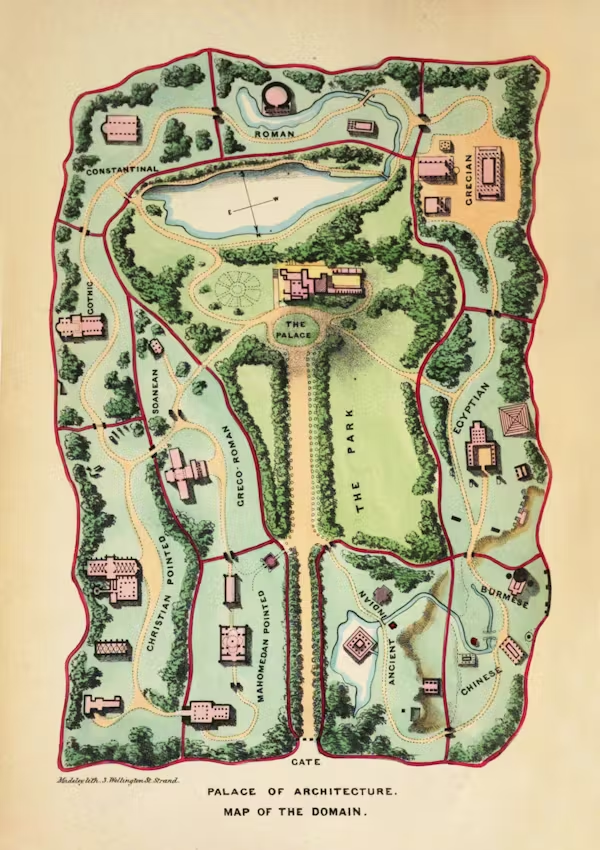
In 1840, British architect George Wightwick published a world history of architecture in the Romantic mode, inviting readers to enter a vast garden where Buddhist iconography rubs shoulders with Greek temples and Egyptian pyramids gaze upon Gothic cathedrals. His intended audience? Idle women. Matthew Mullane revisits this visionary but ultimately unpopular text and explores the legacy of attempts to gatekeep the realms of imagination and fantasy pertaining to the built environment…
The “Prince Architect” welcomes you: “You will see, within this domain, an epitome of the Architectural world. Mine is, as it were, a palace of congress, wherein you will be successively addressed by humble (but, it is hoped, characteristic) representatives of the great families of Design in ancient and Mahomedan India, China, Egypt, Greece, ancient and modern Italy, Turkey, Moorish Spain, and Christian Europe”.
This grandiose introduction is offered by the protagonist of George Wightwick’s Palace of Architecture: A Romance of Art and History (1840). The reader, an imagined visitor referred to in the second person, is quickly handed a map showing the “architectural world” not as a diagram of transmission, a “tree” of influence, or a catalogue of entries, but a picturesque garden. Flanking the central palace is a group of buildings representing the “ancient” corners of the world, including India, China, Burma, and Egypt. At the top-right corner of the map, Greek and Roman structures curl leftward to show a European panoply of styles including Gothic, Soanean, Greco-Roman, and finally, two pointed styles from the Christian and “Mahomedan” perspective. Before entering this garden, you face the palace gate, an unruly collage of world architecture history consisting of, among other things, a Gothic spire, an Islamic dome, and crude prehistoric stone. The gate represents the chasm between the Prince Architect’s overflowing storehouse of experience, and you, the new guest, with none. The well-traveled architect sourced the building’s components from his extensive travels and “crammed [it] with observation, the which it vents in mangled forms.”2 You, the reader, are homebound and observationally deficient and therefore must feel beguiled. However, after a guided journey through the grounds of the palace, “you will return, competent to read the significant details of what, now, only vaguely addresses your understanding.”
Unlike more familiar world histories of the nineteenth century that enticed readers with pages full of illustrations, simplified categorizations, and appeals to scientific rationality, Wightwick’s tour of world architecture was a poetically narrated experience. His florid language and direct reference to the reader were intended to “address the eye and ear of the general public with the eloquence of picturesque illustration and impassioned comment”. He believed that “the error of architectural authors has been that of writing technical treatises for professional readers” and approached the public with a different proposition: “[architecture] requires no critical knowledge of its beauties to admit; neither are its mathematics necessary to a certain enjoyment of the associations that may be connected with a building.”5 In other words, plans, geometry, and other artifacts of specialized knowledge are impediments to actually knowing architecture and its history, and a general audience requires none of that. What they need is a basic level of historical knowledge introduced in an evocative manner so that “the joy of being competent to appreciate” can be unlocked in order to experience “the poetic enchantment of Architecture [that] transfixes the soul of the beholder, and leaves him spell-bound under the combined influence of the phantom past, and the palpable present”. Instead of relying on the empirical evidence of professionals alone, after just one tour through the palace of architecture, you will be in command of architectural knowledge as your “own poet”.
Wightwick’s preference for “speculation and belief” over technical demonstration was directed toward a very specific readership: idle women. The seemingly neutral “you” that drew readers into the palace grounds was in fact aimed at the “fair countrywomen of England”. At a time when female readership of both popular and specialized material was growing, the book is perhaps the first world architectural history written specifically with women in mind…
…
… Critical responses to Wightwick’s entreaty to female readers spanned from bemusement to venomous reproach. The Gentleman’s Magazine recognized that the book was not for the “scientific observer” of architecture but acknowledged that it could nonetheless “afford amusement to the ‘fair’ and fashionable admirers of the art”. W. H. Leeds, writing under the penname Candidus, was not so generous. He published an excoriating review that held the book up as an example of the withering effects of Romanticism on contemporary architectural discourse. He called Wightwick the “wickedest dog in existence” for audaciously dedicating his book not to any reputable institute, but “to a woman, or a no-man” and thinking “that romance has anything to do with art—at any rate, with architecture”. Leeds argued that Wightwick’s avoidance of technical description, scarce reference to plans, and indulgence in imagination threatened to turn architecture into an unserious field of curiosity, charm, and play — all words invariably tinged with the feminine. If Wightwick’s book gained the influence its author wanted, then surely “that which has hitherto been the task of a higher order of intellect is now to become the amusement of women—perhaps the plaything of children”. Careful to not appear ungentlemanly, Leeds clarified that he is not opposed to women enjoying or appreciating architecture in a passive way, but Wightwick’s encouragement of active speculation and creative rearrangement of architecture history was dangerous. “We object to it”, he reasoned, “not because we question the capacity or the sex, but because we see no occasion for increasing the number of designing women”. Where Wightwick saw idle women as eager consumers, Leeds was concerned that an overly enticing history would shock them out of their idleness and convince them that they, too, could make architecture.
Men like Leeds feared that “designing women” would disrupt two key aspects of English architectural culture, its homosociality and its claim to truth. The first was perhaps an annoyance, but the second could be disastrous. Leeds argued that women’s flimsy associations and predilection for exclamations like “how exceedingly pretty!” could trigger the collapse of all architectural knowledge made by men before them.23 Such anxiety represents the panic of a discipline whose propulsive drive to include more and more case studies and accommodate more and more readers also brought unwelcomed actors, like women, dangerously close to the inner circle of architectural expertise. The discrediting of Wightwick’s book shows the quick hardening of professional and epistemological borders to maintain credibility…
…
… Into the twentieth century, architectural history remained stubbornly male dominated and the gendering of architectural fantasy and imagination as feminine stymied any hope that such ideas could gain professional credence. Things quickly changed in the 1960s, when young architects championed phenomenology as a critique of modernism’s universalizing assumptions about user experience. Historian Jorge Otero-Pailos argues that this phenomenological revolution allowed for a generation of so-called postmodern architects to challenge architectural history’s longstanding positivist bent. The buildings of Charles Moore, Robert Venturi, and Denise Scott Brown playfully assemble specific and invented historical references, provoking the viewer in a manner that is not so dissimilar from Wightwick’s mutant palace gate.
While postmodernists experimented with architectural history, the written output of architectural historians such as Charles Jencks ironically remained somewhat conventional and tied to the explanatory textbook. Fantasy and imagination seemingly still carried an indelible stigma. However, a few recent books suggest a return of the repressed, so to speak. Françoise Fromonot’s The House of Doctor Koolhaas (2025) tells the history of a famous house by Rem Koolhaas through the genre conventions of a detective novel. Charlotte Van den Broeck’s Bold Ventures: Thirteen Tales of Architectural Tragedy (2022) blends researched histories of architectural failure and suicide with self-reflective passages that question the authoritativeness of words like “explanation” that are so often used in history texts. Past authors are being rediscovered as well. Lin Huiyin’s mid-twentieth-century poems reflecting on a changing China are at last being translated and reframed as examples of architectural history. These texts are refreshingly strange — just as strange as walking into the Palace of Architecture — and signal that the discipline is finally shedding some of its enduring prejudices about imagination and fantasy…
More of the fascinating story, along with copious illustrations: “Imagining an Idle Countess- George Wightwick’s The Palace of Architecture,” from @publicdomainrev.bsky.social.
Apposite: “Bernard Sleigh’s Anciente Mappe of Fairyland (ca. 1920 edition),” also from @publicdomainrev.bsky.social
* John Ruskin
###
As we dwell on design, we might send connected birthday greetings to an architect of a different kind, Sir Tim Berners-Lee; he was born on this date in 1955. A computer scientist best known as the inventor of the World Wide Web, the browser, the HTML markup language, the URL system, and HTTP, he is a professorial research fellow at the University of Oxford, a professor emeritus at the MIT, and director of the World Wide Web Consortium, which oversees its continued development.

You must be logged in to post a comment.