Posts Tagged ‘women’
“The present is the past rolled up for action, and the past is the present unrolled for understanding”*…
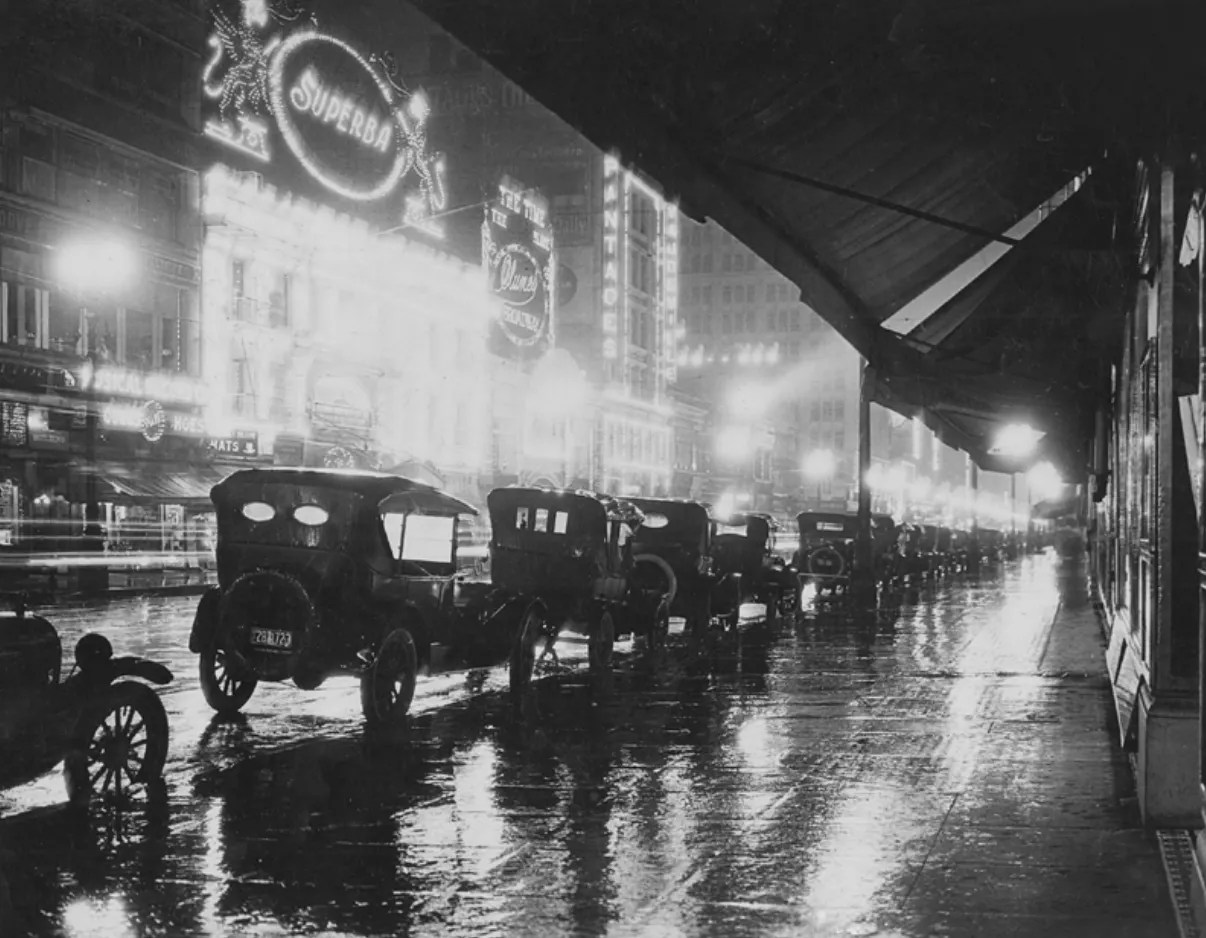
As Jean-Baptiste Alphonse Karr put it, “plus ça change, plus c’est la même chose” (“the more things change, the more they stay the same”). Case in point: Derek Thompson reminds us that about 100 years ago, America was obsessed with technology, immigration, women, work, and money. Sound familiar?
[Just over] one hundred years ago, on September 26, 1929, President Herbert Hoover gathered a group of social scientists at the White House. He asked them to begin research on the most detailed report ever produced on the state of the nation. Four years later, running more than 1,500 pages long, Recent Social Trends was published, offering an unusually granular look at life in the mid-1920s.
The document is almost entirely forgotten. But today, for America’s 250th birthday, I’m blowing the cobwebs off this sucker and taking readers inside its yellowed pages for a look back at what life was like in the U.S. exactly 100 years ago, when the U.S. was celebrating its sesquicentennial anniversary…
And what a look it is…
… Imagine that you are the typical American in 1926. You are a white 26-year-old. (In 2026, the median age is 40.) Since most immigrants have been male, we’ll say you’re a guy. Your name is John. Born in the first term of William McKinley’s presidency, you are raised on a farm without flush toilets or electric lighting. Too young to fight in World War I, you come of age alongside a generation that sees war in Europe as a “useless colossal blunder,” in the words of historian David M. Kennedy. Your life—indeed, your entire generation—is shaped by several notable developments: education, urbanization, automation, and women’s rights. You are the first person in your family to finish high school.
At 19, you move from the countryside to an urban apartment, as one small drop in the migratory flood from farm to city. Jobs in manufacturing and retail are easy to find. They’re also easy to lose. Temporary unemployment is the norm. You earn $100 a month and put some away for a rainy day, confident that the bustling city will provide another job in a few months. (Unemployment insurance does not exist; neither does Social Security.) In the evenings, you “radio”; yes, it’s a verb, too. Every weekend, you visit a cineplex, where the movies are black-and-white and silent. Sometimes, you down a few prohibited cocktails and go dancing with flappers. Several times a week, you drive around in a black Model T.
The year 1926 has been good to you. City life is a blur of high-velocity machines—cars, assembly lines, and radio broadcasts—and you sometimes miss the ancient rhythms of your farmland home. One year from now, Charles Lindbergh will shock the world by flying across the Atlantic. In two years, at 28, you’ll be married. In three years, you’ll have a baby. And in four years, in 1930, just months after the biggest stock market crash in American history, the world as you know it will be over…
Thompson goes on to unpack the details of the economy and employment, the migration from farm to city, the extraordinary centrality of the automobile, changing mores and gender roles, the primacy of literature and the rise of radio, and so much more. He concludes…
The authors of Recent Social Trends were astonishingly prescient about the direction of technology. In one paragraph, they somehow anticipated the rise of audiobooks, YouTube, Netflix, smartphone cameras, musical software, ubiquitous air conditioning, and the electric battery revolution:
It may be that the world will find much use for talking books; school and college students may listen to lectures by long-running phonographs or talking pictures; moving pictures may be transmitted by wireless into houses; seeing with that new electric eye, the photo-electric cell, and recording what is seen, appear to have almost unlimited applications; new musical instruments different from any now in use may be given to us by electricity; the production of artificial climate may become widespread; an efficient storage battery of light weight and low cost might produce changes rivaling those of the internal combustion engine. And these are only a few of the myriad possibilities from new inventions in the future!
In an equally oracular section, the authors predicted the emergence of remote work and declining geographic mobility, anticipating that “the transmission of goods, of the voice and possibly of vision may act as a retarding influence on human mobility in the future and may cause a development of more remote and impersonal direction and controls.”
But the social scientists did not see these trends as altogether good. They worried that modern life, defined in equal parts by urbanization and technology, obliterated people’s values and their sense of self. Even as they gawked at the increase in patents—which grew more than 20-fold between the 1850s and the 1920s—they worried that a growing number of discoveries would bring “problems of morals, of education, of law, of leisure time, of unemployment, of speed, of uniformity and of differentiation.”
Social scientists of the 1920s saw machines pushing workers off of farms and competing with workers in manufacturing plants. How long, they wondered, until they would replace human workers in all tasks? “A larger proportion of work by machines, and a smaller proportion of human labor, is to be expected in the future,” they wrote. “There are indeed a few cases of wholly automatic factories and automatic stores and many automatic salesmen.” It is extraordinary to read these fears and not reflect on the AI jobs panic of the present, while also marveling at the thousands of occupations that are possible today precisely because machines made old jobs obsolete.
The dawn of the age of the machine drove us mad. Physicians of the day warned that the frail human mind was no match for the car, predicting at the time that “diseases of the wheel” would afflict the youth who rode bicycles and cars without restraint. It was not entirely obvious that they were wrong. In Germany, the number of patients registered in mental hospitals grew from 40,375 in 1870 to 220,881 in 1910. Over the same period, the share of patients admitted to general hospitals for illnesses of the nervous system rose from 44 to 60 percent.
Most perceptively, social critics of the age recognized that the urban-technological revolution of the early 20th century—what we might even call “modernity”—transformed not only our minds but also our values. Machines and systems that pulled Americans off the farm, away from the family home, and into churning markets of people and products threatened to replace the Judeo-Christian values that had bound the country for centuries with a new system of values dictated by markets. In 1903, the sociologist Georg Simmel anticipated the anxieties of the Twenties—ours and theirs—when he observed that in cities “money takes the place of all the manifoldness of things” and becomes “a common denominator of all values.” Money “hollows out the core of things, their peculiarities, their specific values, and their uniqueness and incomparability in a way which is beyond repair.”
One hundred and twenty years after the publication of that essay, the Wall Street Journal asked thousands of Americans what values were still important to them. While a declining share of Americans endorsed the worthiness of patriotism, religion, community, and children, the share who said “money” was “very important to them” went up. It sometimes seems as if markets and money are the last value standing, the final common denominator beneath all human endeavor.

On its 250th birthday, the U.S. similarly defines itself through markets. Those famous words of Calvin Coolidge, America’s president in 1926, could just as well serve this American president and this American moment: “The chief business of the American people is business.”…
Eminently worth reading in full: “America, 1926: What a Forgotten 100-Year-Old Report Says About Who We Are,” from @dkthomp.bsky.social.
You can find the full text of Recent Social Trends in the United States- Report of the President’s Research Committee on Social Trends, from the collection of the remarkable Prelinger Library, at the invaluable Internet Archive: Volume 1 and Volume 2.
* Will and Ariel Durent, The Lessons of History (in which, also: “Progress is an improvement in the means that we use for achieving the same old ends. I sometimes wonder if the progress is only of means without any progress in ends.”)
###
As we hear the echo, we might recall that today marks the anniversary of a signature advance during the period covered by Recent Social Trends in the United States: on this date in 1928, sliced bread was sold for the first time, by the Chillicothe Baking Company of Chillicothe, Missouri.
For more on this seminal development, see “What was the best thing before sliced bread?“

“When we build, let us think that we build forever”*…
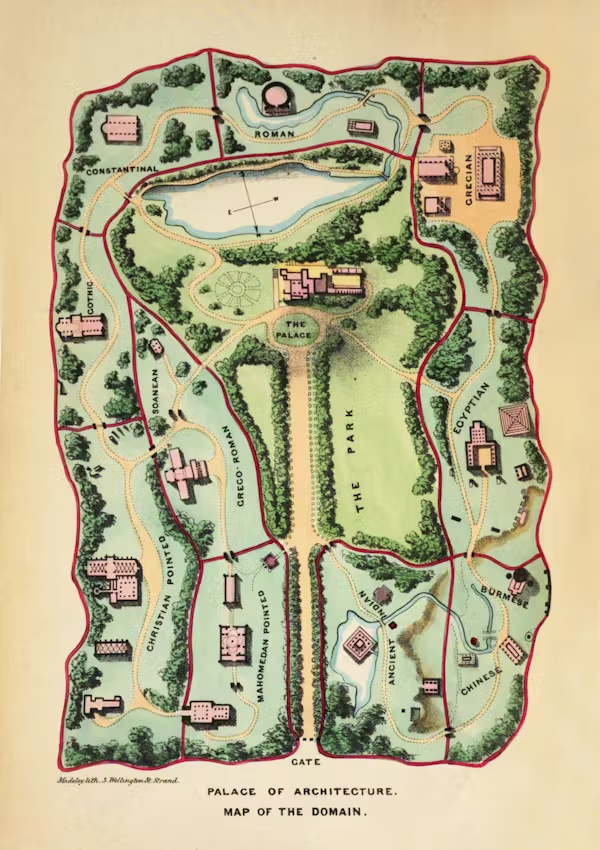
In 1840, British architect George Wightwick published a world history of architecture in the Romantic mode, inviting readers to enter a vast garden where Buddhist iconography rubs shoulders with Greek temples and Egyptian pyramids gaze upon Gothic cathedrals. His intended audience? Idle women. Matthew Mullane revisits this visionary but ultimately unpopular text and explores the legacy of attempts to gatekeep the realms of imagination and fantasy pertaining to the built environment…
The “Prince Architect” welcomes you: “You will see, within this domain, an epitome of the Architectural world. Mine is, as it were, a palace of congress, wherein you will be successively addressed by humble (but, it is hoped, characteristic) representatives of the great families of Design in ancient and Mahomedan India, China, Egypt, Greece, ancient and modern Italy, Turkey, Moorish Spain, and Christian Europe”.
This grandiose introduction is offered by the protagonist of George Wightwick’s Palace of Architecture: A Romance of Art and History (1840). The reader, an imagined visitor referred to in the second person, is quickly handed a map showing the “architectural world” not as a diagram of transmission, a “tree” of influence, or a catalogue of entries, but a picturesque garden. Flanking the central palace is a group of buildings representing the “ancient” corners of the world, including India, China, Burma, and Egypt. At the top-right corner of the map, Greek and Roman structures curl leftward to show a European panoply of styles including Gothic, Soanean, Greco-Roman, and finally, two pointed styles from the Christian and “Mahomedan” perspective. Before entering this garden, you face the palace gate, an unruly collage of world architecture history consisting of, among other things, a Gothic spire, an Islamic dome, and crude prehistoric stone. The gate represents the chasm between the Prince Architect’s overflowing storehouse of experience, and you, the new guest, with none. The well-traveled architect sourced the building’s components from his extensive travels and “crammed [it] with observation, the which it vents in mangled forms.”2 You, the reader, are homebound and observationally deficient and therefore must feel beguiled. However, after a guided journey through the grounds of the palace, “you will return, competent to read the significant details of what, now, only vaguely addresses your understanding.”
Unlike more familiar world histories of the nineteenth century that enticed readers with pages full of illustrations, simplified categorizations, and appeals to scientific rationality, Wightwick’s tour of world architecture was a poetically narrated experience. His florid language and direct reference to the reader were intended to “address the eye and ear of the general public with the eloquence of picturesque illustration and impassioned comment”. He believed that “the error of architectural authors has been that of writing technical treatises for professional readers” and approached the public with a different proposition: “[architecture] requires no critical knowledge of its beauties to admit; neither are its mathematics necessary to a certain enjoyment of the associations that may be connected with a building.”5 In other words, plans, geometry, and other artifacts of specialized knowledge are impediments to actually knowing architecture and its history, and a general audience requires none of that. What they need is a basic level of historical knowledge introduced in an evocative manner so that “the joy of being competent to appreciate” can be unlocked in order to experience “the poetic enchantment of Architecture [that] transfixes the soul of the beholder, and leaves him spell-bound under the combined influence of the phantom past, and the palpable present”. Instead of relying on the empirical evidence of professionals alone, after just one tour through the palace of architecture, you will be in command of architectural knowledge as your “own poet”.
Wightwick’s preference for “speculation and belief” over technical demonstration was directed toward a very specific readership: idle women. The seemingly neutral “you” that drew readers into the palace grounds was in fact aimed at the “fair countrywomen of England”. At a time when female readership of both popular and specialized material was growing, the book is perhaps the first world architectural history written specifically with women in mind…
…
… Critical responses to Wightwick’s entreaty to female readers spanned from bemusement to venomous reproach. The Gentleman’s Magazine recognized that the book was not for the “scientific observer” of architecture but acknowledged that it could nonetheless “afford amusement to the ‘fair’ and fashionable admirers of the art”. W. H. Leeds, writing under the penname Candidus, was not so generous. He published an excoriating review that held the book up as an example of the withering effects of Romanticism on contemporary architectural discourse. He called Wightwick the “wickedest dog in existence” for audaciously dedicating his book not to any reputable institute, but “to a woman, or a no-man” and thinking “that romance has anything to do with art—at any rate, with architecture”. Leeds argued that Wightwick’s avoidance of technical description, scarce reference to plans, and indulgence in imagination threatened to turn architecture into an unserious field of curiosity, charm, and play — all words invariably tinged with the feminine. If Wightwick’s book gained the influence its author wanted, then surely “that which has hitherto been the task of a higher order of intellect is now to become the amusement of women—perhaps the plaything of children”. Careful to not appear ungentlemanly, Leeds clarified that he is not opposed to women enjoying or appreciating architecture in a passive way, but Wightwick’s encouragement of active speculation and creative rearrangement of architecture history was dangerous. “We object to it”, he reasoned, “not because we question the capacity or the sex, but because we see no occasion for increasing the number of designing women”. Where Wightwick saw idle women as eager consumers, Leeds was concerned that an overly enticing history would shock them out of their idleness and convince them that they, too, could make architecture.
Men like Leeds feared that “designing women” would disrupt two key aspects of English architectural culture, its homosociality and its claim to truth. The first was perhaps an annoyance, but the second could be disastrous. Leeds argued that women’s flimsy associations and predilection for exclamations like “how exceedingly pretty!” could trigger the collapse of all architectural knowledge made by men before them.23 Such anxiety represents the panic of a discipline whose propulsive drive to include more and more case studies and accommodate more and more readers also brought unwelcomed actors, like women, dangerously close to the inner circle of architectural expertise. The discrediting of Wightwick’s book shows the quick hardening of professional and epistemological borders to maintain credibility…
…
… Into the twentieth century, architectural history remained stubbornly male dominated and the gendering of architectural fantasy and imagination as feminine stymied any hope that such ideas could gain professional credence. Things quickly changed in the 1960s, when young architects championed phenomenology as a critique of modernism’s universalizing assumptions about user experience. Historian Jorge Otero-Pailos argues that this phenomenological revolution allowed for a generation of so-called postmodern architects to challenge architectural history’s longstanding positivist bent. The buildings of Charles Moore, Robert Venturi, and Denise Scott Brown playfully assemble specific and invented historical references, provoking the viewer in a manner that is not so dissimilar from Wightwick’s mutant palace gate.
While postmodernists experimented with architectural history, the written output of architectural historians such as Charles Jencks ironically remained somewhat conventional and tied to the explanatory textbook. Fantasy and imagination seemingly still carried an indelible stigma. However, a few recent books suggest a return of the repressed, so to speak. Françoise Fromonot’s The House of Doctor Koolhaas (2025) tells the history of a famous house by Rem Koolhaas through the genre conventions of a detective novel. Charlotte Van den Broeck’s Bold Ventures: Thirteen Tales of Architectural Tragedy (2022) blends researched histories of architectural failure and suicide with self-reflective passages that question the authoritativeness of words like “explanation” that are so often used in history texts. Past authors are being rediscovered as well. Lin Huiyin’s mid-twentieth-century poems reflecting on a changing China are at last being translated and reframed as examples of architectural history. These texts are refreshingly strange — just as strange as walking into the Palace of Architecture — and signal that the discipline is finally shedding some of its enduring prejudices about imagination and fantasy…
More of the fascinating story, along with copious illustrations: “Imagining an Idle Countess- George Wightwick’s The Palace of Architecture,” from @publicdomainrev.bsky.social.
Apposite: “Bernard Sleigh’s Anciente Mappe of Fairyland (ca. 1920 edition),” also from @publicdomainrev.bsky.social
* John Ruskin
###
As we dwell on design, we might send connected birthday greetings to an architect of a different kind, Sir Tim Berners-Lee; he was born on this date in 1955. A computer scientist best known as the inventor of the World Wide Web, the browser, the HTML markup language, the URL system, and HTTP, he is a professorial research fellow at the University of Oxford, a professor emeritus at the MIT, and director of the World Wide Web Consortium, which oversees its continued development.

“There is nothing nicer than a kitchen really made for a cook. Things that are designed to be used always have an innate beauty.”*…

In an earlier (R)D, we looked at Lillian Gilbreth‘s hugely influential design for “The Kitchen Practical.” At roughly the same time, a similar, but interestingly different design was debuted in Frankfurt. 99% Invisible has the story…
After World War I, in Frankfurt, Germany, the city government was taking on a big project. A lot of residents were in dire straits, and in the second half of the 1920s, the city built over 10,000 public housing units. It was some of the earliest modern architecture — simple, clean, and uniform. The massive housing effort was, in many ways, eye-poppingly impressive, with all new construction and sleek, cutting edge architecture. But one room in these new housing units was far and away the most lauded and influential: and that was the kitchen.
Many consider the Frankfurt Kitchen to be nothing less than the first modern kitchen. [It did pre-date Gilbreth’s creation by a couple of years, though it’s unclear whether Gilbreth knew of it.] A few of these kitchens still exist, some in museums. And it’s strange to see one there, because to modern eyes, it doesn’t appear to be high art. It just looks like a kitchen.
But so many things that we totally take for granted now as standard kitchen features were pretty unheard of before they showed up in the Frankfurt Kitchen. Things like a cookstove that wasn’t also your house’s heat source; well-planned storage to stash your plates and glasses; a way to wash dishes that didn’t involve hauling a heavy tub of water into the house; and slatted racks for drying dishes over the countertops.
Standardization ruled this design. Before, for example, there weren’t long surfaces that were uniform in height. Most kitchens just had whatever random assortment of tables you could throw in them. The Frankfurt Kitchen, countertops and all, was mass-produced off-site — which was a totally new phenomenon. It was designed to fit in relatively small apartments. So, here is perhaps the most visibly striking thing about the kitchen: it is super compact.
To the woman who designed it, Margarete Schütte-Lihotzky, the Frankfurt Kitchen was a revolution. Not just because it was part of a huge effort to get people housed, but because of its wildly efficient layout. It was designed to fit, and to bring modern appliances and architecture to the masses — but it was also designed to conserve the user’s energy. To make cooking as fast and easy as possible. And to Schütte-Lihotzky, that ease was political…

Schutte-Lihotzky was methodical and scientific in her planning. She studied how women used their kitchens, and mapped out their movements like football plays or complex dance steps, with little lines across the floor, and streamlined accordingly, until she came up with this very design – a kitchen in which no single step or reach of the arm was unnecessary.
From the 1920s into the present, many architects and home cooks celebrated, even revered the Frankfurt Kitchen. And the echoes of her design are still everywhere. But Schütte-Lihotzky’s feminist legacy is a bit more complicated. She was revolutionary in that she paid attention to the kitchen, a space that had historically been neglected by architects and designers. She laid everything out with the goal of lessening the burden of housework for women. But by the time Schütte-Lihotzky designed this revolutionary kitchen, many feminists had already been questioning whether private kitchens could ever be designed to liberate women. Or whether they were irredeemable, and needed to be abolished. And their stories show just how much design can accomplish… and how much it can’t…
The instructive story of “The Frankfurt Kitchen,” from @99piorg.
* Julia Child
###
As we save steps, we might spare a thought for M. F. K. (Mary Frances Kennedy) Fisher; she died on this date in 1992. A food writer and founder of the Napa Valley Wine Library, she published 27 books (including a translation of The Physiology of Taste by Brillat-Savarin) and hundreds of essays and reviews. Of her work, W. H. Auden once remarked, “I do not know of anyone in the United States who writes better prose.”

“Good design’s not about what medium you’re working in. It’s about thinking hard about what you want to do and what you have to work with before you start.”*…

From the team at Readymag, a project exploring the impact of women in design (and calling attention to the ongoing gender imbalance in the design industry). For example…
Susan Kare [pictured above] is famous for designing Apple’s Macintosh interface elements, icons and typefaces in the 1980s, as well as a number of other pixel-based graphics for early computers. She was one of the key figures in the PC usability revolution initiated by Steve Jobs at Apple. Kare is often referred to as “the woman who gave the Macintosh a smile,” for designing the original Happy Mac icon…
19 others at “Designing women,” from @readymag.
More on @SusanKare here.
###
As we give credit where credit is due, we might recall that it was on this date in 1985 that the Advanced Research Projects Agency (ARPA, later DARPA) opened internet domains for registration. Symbolics Computer Corporation was the first out of the gate with Symbolics.com. The company used the website to sell specialized computers running the programming language Lisp. (Symbolics initially meant these machines to develop artificial intelligence but were a little ahead of their time; they later adapted them for other uses.)

“For most of history, Anonymous was a woman”*…
… and in the relatively few instances in which they weren’t anonymous, they were often rarefied into the stuff of legend…
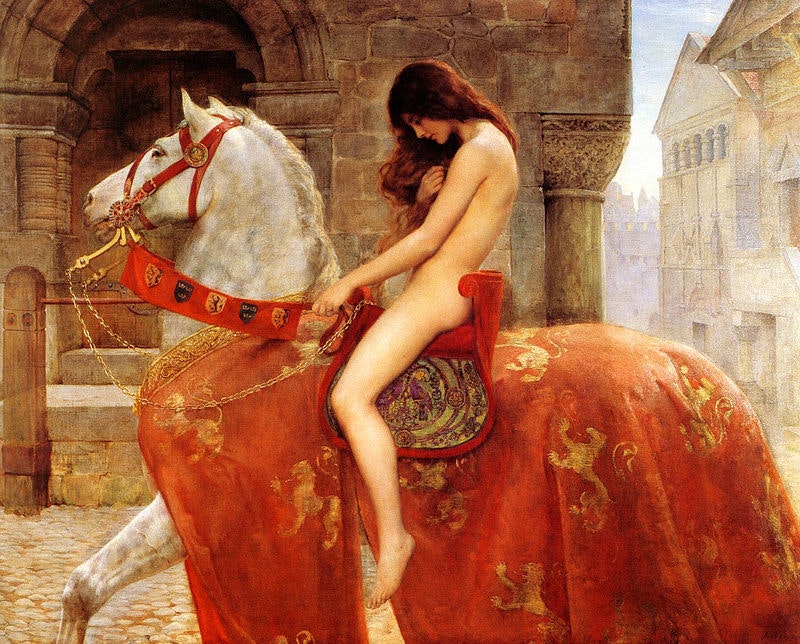
Many of us are familiar with the legend of Lady Godiva, who rode through the streets of Coventry naked, covered only by her long hair, so her husband would reduce taxes. This legendary story actually originates with a real early medieval English woman. Godgifu (who flourished from c.990-1067) was the wife of Earl Leofric of Mercia, and she was a major landholder in England before the Norman Conquest.
…
As powerful members of the nobility, Leofric and Godgifu were generous benefactors. As ‘the earl’s wife’, Godgifu is associated with her husband in the endowment and rebuilding of Stow St Mary, Lincolnshire in the 1050s, which was said to have been in ruins since it was burned down by Vikings. Leofric also endowed Coventry Abbey, an act with which Godgifu was associated in later accounts. Orderic Vitalis says that Godgifu gave ‘her whole store of gold and silver’, and this is said to include a necklace which was worth 100 silver marks. The Evesham Chronicle also names Leofric and Godgifu as founders both of Coventry, but also of the church of Holy Trinity, Evesham, to which they apparently gave a crucifix with figures of the Virgin Mary and St John the Evangelist.
In the centuries after her death tales of her beauty, piety and devotion to the Virgin Mary are known, though it is not until the early thirteenth century that we see the story of Godgifu’s naked horse ride through Coventry appear in sources. Roger of Wendover in his Flores Historiarum, writes that:
The countess Godiva, who was a great lover of God’s mother, longing to free the town of Coventry from the oppression of a heavy toll, often with urgent prayers besought her husband, that from regard to Jesus Christ and his mother, he would free the town from that service, and from all other heavy burdens; when the earl sharply rebuked her for foolishly asking what was so much to his damage, and always forbade her ever more to speak to him on the subject; and while she on the other hand, with a woman’s pertinacity, never ceased to exasperate her husband on that matter, he at last made her this answer, ‘Mount your horse, and ride naked, before all the people, through the market of the town, from one end to the other, and on your return you shall have your request.’ On which Godiva replied, ‘But will you give me permission, if I am willing to do it?’ ‘I will,’ said he. Whereupon the countess, beloved of God, loosed her hair and let down her tresses, which covered the whole of her body like a veil, and then mounting her horse and attended by two knights, she rode through the market-place, without being seen, except her fair legs; and having completed the journey, she returned with gladness to her astonished husband, and obtained of him what she had asked; for earl Leofric freed the town of Coventry and its inhabitants from the aforesaid service, and confirmed what he had done by a charter.
Roger of Wendover is known for his exaggerations. This story is not corroborated by earlier sources and cannot be verified; thus historians must treat it simply as a colourful anecdote. Over the years, elements have been added to the legend, such as the fourteenth century miraculous version where Godiva is invisible, a sixteenth century modest version in ballad form, in which she requests that all the townsfolk stay indoors so as not to see her nakedness, or the late eighteenth century moralistic addition of Peeping Tom, who is struck blind after trying to glimpse her naked body.
It might seem as if the later legend of Godiva has very little to do with the real evidence we have about the eleventh-century noblewoman and landowner Godgifu. However, some links can be made between the two figures. Godiva’s lack of adornment in her nudity would have seemed shocking to a medieval audience, not necessarily because nudity was an indication of sexual promiscuity, but because nobility was indicated by outer wear, like clothing and jewellery. By removing these, Godiva was not only removing her clothes, but also her status. Her nudity in this story does not function as a moral failure, but the converse, as an act of piety, in which she lowers herself in order to help those less fortunate, and her hair covers her ‘like a veil’ to protect her modesty. This piety is also present in the act of the real Godgifu giving away her precious necklace, an important symbol of status for elite women, to Coventry Abbey, as well as great quantities of gold and silver. Within the legend of Godiva and the real life of Godgifu there is a common thread of unadornment as a way of elite and wealthy women expressing religious piety.
“Godgifu: The Bare Truth Behind the Lady Godiva Legend,” just one of the portraits of early medieval English women published every two weeks by Florence H R Scott.
* Virginia Woolf
###
As we get to know the players, we might spare a thought for Æthelthryth (aka Etheldreda and Audrey); she died on this date in 679. An East Anglian princess, a Fenland and Northumbrian queen, and ultimately Abbess of Ely, she is an Anglo-Saxon saint. Indeed, according to Jocelyn Wogan-Browne, “more medieval vernacular lives [about Æthelthryth] were composed in England than any other native female saint”– including an account contained in the Venerable Bede‘s Ecclesiastical History of the English People.

You must be logged in to post a comment.