Posts Tagged ‘architecture’
“Fast gets all our attention, slow has all the power”*…

Coleman McCormick on a framework that can help us understand change in systems– and build resiliance…
A forest is a complex ecosystem made up of thousands of organisms living, evolving, interacting with each other, and changing over time.
At the top of the hierarchy are the leaves, changing annually, growing, dying, and shedding in a year-long seasonal cycle. Next there are branches, fewer in number and slower in growth. Then the whole tree itself, changing over decades. The tree sits in a stand of dozens, and the stand in a forest of thousands of individual trees. The forest within a biome, the biome in a region with a particular climate.
You get the idea.
All natural ecosystems evolve in layers like this that connect to each other, but move at different speeds. You can imagine other systems with similar structures: your body is made up of proteins, DNA strands, organelles, cells, membranes, organs, a skeleton, and eventually, your whole body. Cells are being generated but also dying off at almost the same rate. Slower layers like the nervous system take a long time to heal (if ever) when subjected to injury.
Seeing complex systems this way — as layered collections of variable-speed elements — is a useful framework for understanding why we have a hard time changing them.
Stewart Brand [and here and here] noticed this recurring pattern in the anatomy of systems, which he called pace layering.
The concept builds on an observation made by architect Frank Duffy, who noticed a hierarchy in the components of buildings. In his book How Buildings Learn, Brand expanded this observation into a model he termed “shearing layers,” which describes how different parts of a structure change at varying speeds. Site → Structure → Skin → Services → Space plan → Stuff. Each must survive or adapt on different timelines. When architecture fails to account for the different rates at which users need to modify these layers, it results in rigid, non-functional design. Buildings where Services or the Space Plan are overly inflexible are difficult to adapt to users’ changing needs.

In his later book The Clock of the Long Now, Brand expanded the concept of shearing layers to a civilizational scale:

At the bottom, nature moves along on its own eons-level time scale. In the middle, governance and culture shift with generations. Infrastructure and commerce in the range of years. And on the surface, fashionable trends flare up and die out with sometimes daily regularity, like the turbulent wave tops in a stormy ocean. Each layer serves a function:
Fast learns, slow remembers. Fast proposes, slow disposes. Fast is discontinuous, slow is continuous. Fast and small instructs slow and big by accrued innovation and by occasional revolution. Slow and big controls small and fast by constraint and constancy. Fast gets all our attention, slow has all the power...
… Seeing the world through this lens — not only of scale, but also of time — has distant reach to so many other domains. It’s a fundamental characteristic of how systems work and adapt to change.
The fast flurry of activity at the top of a pace layered system creates a testbed for new ideas. In the forest, each individual tree can try out different evolutionary adaptations. New survival strategies are tested in numbers not possible if entire ecosystems had to move together. If one tree tests a new trait that turns out not to work, only a single organism is at risk, not the whole forest.
Because upper layers move faster they can also rebound faster. A forest fire or a passing herd of elk causes some damage, but only at the surface level upper crust of our strata. The bark and branches and leaves may get eaten or burn off, but in a few weeks they bounce back.
Pace layering builds resiliency into complex systems. The fast layers shield the slower ones from shocks, while selectively transmitting changes down through the layers, allowing slower ones to incorporate those adaptations. But some changes propagate too fast.
Some of the worst cases of system shock happen when change shakes to lower levels too rapidly. Look at the collapse of the Soviet Union. A rapid change in the governance layer caused wreaked havoc in the layers above: massive instability on a national scale, rippling through the whole system for decades. In this case, a totalitarian government imposed rigidity on commerce, infrastructure, and even fashion, and didn’t allow for the necessary shifting and experimentation required for the system to maintain resilience.
Drawing sharp lines between layers actually draws an inaccurate picture of how a thriving system works. A more accurate diagram would show smoother gradients across the transitions between layers.
Resilience comes from allowing this gradient — this slippage — at the junctions between layers. Each layer, above and below, must allow for give and take from its neighbors. Slow layers must permit some influence at the edges, and fast layers must slow down to maintain a workable interface with the slower. The layers need to be able to negotiate with one another. If the fast ignores the constraints of the slow, you get discontinuous instability. If the slow never bends to the fast, you get stifling stagnation…
[McCormick explores the applicability of this framework to governance and to corporate activity…]
… With age, my mind seems to sink to lower levels in the hierarchy. “Current things” are more likely to hit me and bounce off. We come around to new ideas more slowly. Above us are the teenagers, trying new technologies, listening to new music, pushing new memes, on a weekly or daily basis. We parents underneath can’t keep up.
But “keeping up” isn’t our role! Fast learns, slow remembers. Fast tries things, slow preserves what works. Resilient, sustainable systems balance this learning and remembering.
Not every meme or new song or fashion trend has staying power, but some do. The ones with notable resonance absorb and influence the culture below. Youth play the role of experimenters, continuously throwing new ideas at the wall — some good, many terrible. The elders carry the torch of tradition, and provide the stable platform of time-tested solutions on top of which the innovators can explore.
Pace layering is one of those ideas with such broad reach that once you learn about it, you see it everywhere…
The hidden architecture of resilient systems: “Pace Layers,” from @colemanm.
For Stewart’s own essay on Pace Layers, see here; and for more, here.
* Stewart Brand
###
As we take the long view, we might send connective birthday greetings to Alexander MacMillan; he was born on this date in 1818. MacMillan was cofounder (in 1843) with his brother Daniel, of Macmillan Publishers, one of the “Big Five” English language publishers.
Though not himself a professional scientist, MacMillan did much to promote science in the Victorian times– especially when he established the journal Nature (in 1869), enabling communication between men of science. The journal had the support of many influential contributors, including Thomas Huxley. Yet, it remained a financial challenge for Macmillan. Other scientific quarterlies had short lives, but Macmillan tolerated losses for three decades, committed to the journal’s mission “to place before the general public the grand results of scientific work and scientific discovery; and to urge the claims of science to move to a more general recognition in education and in daily life.” That mission continues to the present day.

“We say the cows laid out Boston. Well, there are worse surveyors.”*…

On plotting the relationships of things in space…
Written by Leonhard Zubler, a Swiss goldsmith and instrument maker who is credited with popularizing the use of the plane table as a tool for surveying, Novum instrumentum geometricum illuminates the shared history of land-surveying and militaristic range-finding technologies. The text is intercut with elaborate copperplate engravings that showcase the might of trigonometry and triangulation in the immediacy of conflict. Bombardiers pack canons that are aimed with advanced precision at distant towers; the construction of ornate fortifications are planned with ease thanks to geometric instruments; and seemingly insurmountable crags are brought down to earth through the surveyor’s sightline. Readers are promised that they will learn how to measure the width of a moat or the height of wall in order to breach them more efficiently.
Novum instrumentum geometricum mainly features images related to an early modern instrument known as the triquetrum or Dreistab, a three-armed ruler, with two pivot points, used for charting angles in the heavens and on earth. Zubler most often showcases a two-armed variation known as the Zweistab, which includes a “finely divided scale and micrometer slide for exact settings”, writes Uta Lindgren. As if to show the versatility of this technology, the instrument is wielded on the masts of ships, balconies, and by a man perched atop the stump of a felled tree — even comically enlarged to depict its arms stretching out to touch the objects of their reconnaissance. Frequently two instruments are employed in parallel, by a pair of figures a fixed distance apart, which would allow the surveyors to estimate the distance to a faraway point using trigonometry.
Little is known about Leonhard Zubler (b. 1565), aside from his divorce in 1604, and probable death by plague circa 1611. He once created an extensive plan for modernizing the cityscape of Zurich, which was subsequently lost. During his lifetime, Zubler’s instruments were so desired that he was able to open a commercial outlet in Frankfurt am Main in 1608…


More mesmerizing illustrations: “Angles of Reconnaissance: Novum Instrumentum Geometricum (1607)” from @PublicDomainRev.
* Ralph Waldo Emerson
###
As we triangulate, we might recall that it was on this date in 1667, about a year after the Great Fire of London, that Robert Hooke, a physicist (“natural philosopher”), astronomer, geologist, meteorologist, and architect was sub-contracted by friend and fellow architect Christopher Wren to conduct a survey of the fire-damaged area to establish ownership and facilitate reconstruction. As Lisa Jardine observed, “in the four weeks from the 4th of October, [Hooke] helped map the fire-damaged area, began compiling a Land Information System for London, and drew up building regulations for an Act of Parliament to govern the rebuilding.” Hooke also designed some of the buildings that made up the “new” London, among them: the Monument to the Great Fire of London (1672), Montagu House in Bloomsbury )1674 and Bethlem Royal Hospital (1674), which became known as “Bedlam.”
In 1670, Hooke was appointed Surveyor of the Royal Works. Together with Scottish cartographer and printer John Ogilby, he made precise and detailed surveys that led to the production in 1677 of a large-scale map of London, the first-known to be of a specific scale (1:1200).

“A doctor can bury his mistakes, but an architect can only advise his clients to plant vines.”*…

Actually, sometimes architecture is buried– or at least demolished. And occasionally, as in the “refurbishing” of the Sainsbury Wing of London’s National Gallery, that unearths a surprise. Martin Bailey reports…
A “time capsule” has been discovered at London’s National Gallery, buried deep in a column in the foyer of the Sainsbury Wing. It is a letter recording that one of the wing’s funders, John Sainsbury (Lord Sainsbury of Preston Candover), believed the architects had committed a serious “mistake”. The 1990 letter, typed on Sainsbury’s supermarket notepaper, has recently been deposited in the gallery’s archive as an historic document.
John Sainsbury is critical in the letter of the American post-Modernist architect Robert Venturi and his professional partner and wife Denise Scott Brown for inserting two large false columns in the gallery’s foyer that served no structural purpose. Other than the false columns, John Sainsbury was happy with the Venturi and Scott Brown design.
While building work was under way, Sainsbury gained access to the site and dropped his letter into a concrete column that was under construction. The letter, protected in a plastic folder, was discovered last year, when the foyer was being reconfigured.
The Sainsbury letter of 26 July 1990 was addressed “To those who find this note”—who turned out to be the 2023 demolition workers.
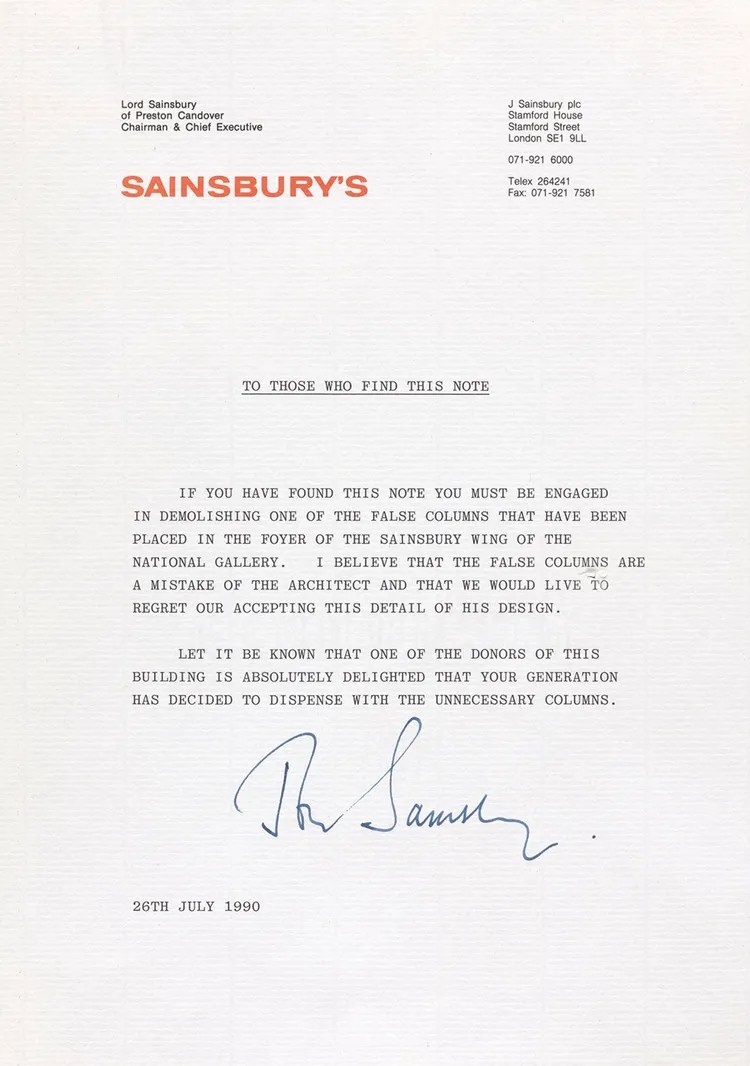
John and his wife Anya presumably never imagined that the demolition of the Sainsbury Wing foyer might take place during their lifetimes. John, one of the most generous UK donors to the arts, died in 2022, aged 94. His widow Anya, a former ballerina, was present when her husband’s note was removed. “I was so happy for John’s letter to be rediscovered after all these years,” she says, “and I feel he would be relieved and delighted for the gallery’s new plans and the extra space they are creating.”…
From the annals of architecture– a dissenting voice from the past: “Sainsbury Wing contractors find 1990 letter from donor anticipating their demolition of false columns,” from @TheArtNewspaper.
But lest we forget that when one critic is assuaged, others are appalled: “Eight Prestigious Architects Blast Annabelle Selldorf’s Proposed $40 Million Redesign of London’s National Gallery, Likening It to an ‘Airport Lounge’,” from @artnet.
(Image above: source)
* Frank Lloyd Wright
###
As we deconstruct design, we might send peaceful birthday greetings to Stephen Geary; he was born on this date in 1797. An architect who designed everything from gin palaces to the (short-lived) monument to King George IV that gave King’s Cross its name, he is best remembered for Highgate Cemetery, opened in 1839, and later to be his resting place, where he designed the Egyptian Avenue and the Terrace Catacombs. He also designed Gravesend, Nunhead, and Brompton Cemeteries, and founded the London Cemetery Company, established by Act of Parliament in 1836, which owned Highgate Cemetery and Nunhead Cemetery.

“Lack of ornamentation is a sign of spiritual strength”*…

Why are buildings today drab and simple, while buildings of the past were ornate and elaborately ornamented? Samuel Hughes proposes an answer…
One of the unifying features of architectural styles before the twentieth century is the presence of ornament. We speak of architectural elements as ornamental inasmuch as they are shaped by aesthetic considerations rather than structural or functional ones. Pilasters, column capitals, sculptural reliefs, finials, brickwork patterns, and window tracery are straightforward examples. Other elements like columns, cornices, brackets, and pinnacles often do have practical functions, but their form is so heavily determined by aesthetic considerations that it generally makes sense to count them as ornament too.
Ornament is amazingly pervasive across time and space. To the best of my knowledge, every premodern architectural culture normally applied ornament to high-status structures like temples, palaces, and public buildings. Although vernacular buildings like barns and cottages were sometimes unornamented, what is striking is how far down the prestige spectrum ornament reached: our ancestors ornamented bridges, power stations, factories, warehouses, sewage works, fortresses, and office blocks. From Chichen Itza to Bradford, from Kyiv to Lalibela, from Toronto to Tiruvannamalai, ornament was everywhere.
Since the Second World War, this has changed profoundly. For the first time in history, many high-status buildings have little or no ornament. Although a trained eye will recognize more ornamental features in modern architecture than laypeople do, as a broad generalization it is obviously true that we ornament major buildings far less than most architectural cultures did historically. This has been celebrated by some and lamented by others. But it is inarguable that it has greatly changed the face of all modern settlements. To the extent that we care about how our towns and cities look, it is of enormous importance.
The naive explanation for the decline of ornament is that the people commissioning and designing buildings stopped wanting it, influenced by modernist ideas in art and design. In the language of economists, this is a demand-side explanation: it has to do with how buyers and designers want buildings to be. The demand-side explanation comes in many variants and with many different emotional overlays. But some version of it is what most people, both pro-ornament and anti-ornament, naturally assume.
However, there is also a sophisticated explanation. The sophisticated explanation says that ornament declined because of the rising cost of labor. Ornament, it is said, is labor-intensive: it is made up of small, fiddly things that require far more bespoke attention than other architectural elements do. Until the nineteenth century, this was not a problem, because labor was cheap. But in the twentieth century, technology transformed this situation. Technology did not make us worse at, say, hand-carving stone ornament, but it made us much better at other things, including virtually all kinds of manufacturing and many kinds of services. So the opportunity cost of hand-carving ornament rose. This effect was famously described by the economist William J Baumol in the 1960s, and in economics it is known as Baumol’s cost disease [see here].
To put this another way: since the labor of stone carvers was now far more productive if it was redirected to other activities, stone carvers could get higher wages by switching to other occupations, and could only be retained as stone carvers by raising their wages so much that stone carving became prohibitively expensive for most buyers. So although we didn’t get worse at stone carving, that wasn’t enough: we had to get better at it if it was to survive against stiffer competition from other productive activities. And so the labor-intensive ornament-rich styles faded away, to be replaced by sparser modern styles that could easily be produced with the help of modern technology. Styles suited to the age of handicrafts were superseded by the styles suited to the age of the machine. So, at least, goes the story.
This is what economists might call a supply-side explanation: it says that desire for ornament may have remained constant, but that output fell anyway because it became costlier to supply. One of the attractive features of the supply-side explanation is that it makes the stylistic transformation of the twentieth century seem much less mysterious. We do not have to claim that – somehow, astonishingly – a young Swiss trained as a clockmaker and a small group of radical German artists managed to convince every government and every corporation on Earth to adopt a radically novel and often unpopular architectural style through sheer force of ideas. In fact, the theory goes, cultural change was downstream of fairly obvious technical and economic forces. Something more or less like modern architecture was the inevitable result of the development of modern technology.
I like the supply-side theory, and I think it is elegant and clever. But my argument here will be that it is largely wrong. It is just not true that twentieth-century technology made ornament more expensive: in fact, new methods of production made many kinds of ornament much cheaper than they had ever been. Absent changes in demand, technology would have changed the dominant methods and materials for producing ornament, and it would have had some effect on ornament’s design. But it would not have resulted in an overall decline. In fact, it would almost certainly have continued the nineteenth-century tendency toward the democratization of ornament, as it became affordable to a progressively wider market. Like furniture, clothes, pictures, shoes, holidays, carpets, and exotic fruit, ornament would have become abundantly available to ordinary people for the first time in history.
In other words, something like the naive demand-side theory has been true all along: to exaggerate a little, it really did happen that every government and every corporation on Earth was persuaded by the wild architectural theory of a Swiss clockmaker and a clique of German socialists, so that they started wanting something different from what they had wanted in all previous ages. It may well be said that this is mysterious. But the mystery is real, and if we want to understand reality, it is what we must face…
And face it Hughes does: “The beauty of concrete,” from @SCP_Hughes in @WorksInProgMag.
* Adolf Loos (architect and polemicist of modern architecture)
###
As we ponder plainness, we might send ornate birthday greetings to Sir Bertram Clough Williams-Ellis; he was born on this date in 1883. An architect who resisted the modernist trends of his time, he is best remembered as the creator of the Italianate village of Portmeirion in North Wales– the setting of the wonderful televisions series The Prisoner (and the Doctor Who arc The Masque of Mandragora).

“God has no religion”*…

For the last 15 years, the Public Religion Research Institute (PRRI) has done quantitative and qualitative research on religious values in the U.S. A recent study has generated a number of headlines, most focusing on a single issue– a good example: “People say they’re leaving religion due to anti-LGBTQ teachings and sexual abuse“… which is in fact a significant finding, but only one finding in a wide range of other interesting– and important– observations that emerge…
America encompasses a rich diversity of faith traditions, and “religious churning” is very common. In 2023, PRRI surveyed more than 5,600 adults across the United States about their experiences with religion. This report examines how well major faith traditions retain their members, the reasons people disaffiliate, and the reasons people attend religious services. Additionally, this report considers how atheists and agnostics differ from those who say they are “nothing in particular.” Finally, it analyzes the prevalence of charismatic elements as well as prophecy and prosperity theology in American churches and the role of charismatic Christianity in today’s Republican Party…
[Among the major areas explored…]
- “Unaffiliated” is the only major religious category experiencing growth…
- Catholic loss continues to be highest among major religious groups; white Evangelical retention rate has improved since 2016…
- While most disaffiliate because they stop believing, religious teachings on the LGBTQ community and clergy sexual abuse now play a more prominent role…
- The religiously unaffiliated are not a monolith…
- Most unaffiliated Americans are not looking for a religious or spiritual home…
- Church attendance among Americans is down and fewer Americans say religion is important; most Americans who attend religious services do so to feel closer to God…
- Exploring the prevalence of charismatic elements in American churches…
- Prophetic and Prosperity theological beliefs are more common among Republicans and African Americans…
- Religion and the MAGA Movement: The Role of Charismatic Christianity and Prophecy/Prophetic Beliefs in the Republican Party…
The state of faith in the U. S. and what it can tell us about our society: “Religious Change in America” from @PRRIpoll.
Apposite: “Ufologists, Unite!“– Nathaniel Rich‘s review of two books by D.W. Pasulka, a professor of religious studies at the University of North Carolina Wilmington who (to oversimplify only slightly) sees the growing devotion to UFOs/UAPs as a new religious movement… one not considered in the PRRI study.
* Gandhi
###
As we contemplate celestial conviction, we might recall that it was on this date in 1506 that the cornerstone of the current St. Peter’s Basilica was laid. (It was completed in 1626.) Located in Vatican City, an independent microstate enclaved within the city of Rome, it was initially planned in the 15th century by Pope Nicholas V and then Pope Julius II to replace the ageing Old St. Peter’s Basilica, which was built in the fourth century by Roman emperor Constantine the Great.
Designed principally by Donato Bramante, Michelangelo, and Carlo Maderno, with piazza and fittings by Gian Lorenzo Bernini, St. Peter’s is one of the most renowned works of the Italian High Renaissance. It is the largest church in the world (by interior measure). And while it is neither the mother church of the Catholic Church nor the cathedral of the Diocese of Rome (these equivalent titles being held by the Archbasilica of Saint John Lateran in Rome), St. Peter’s is regarded as one of the holiest Catholic shrines. The pope presides at a number of liturgies throughout the year both within the basilica or the adjoining St. Peter’s Square, liturgies that draw audiences numbering from 15,000 to over 80,000 people.

You must be logged in to post a comment.