Posts Tagged ‘problems’
“The hours of folly are measur’d by the clock, / But of wisdom: no clock can measure.”*…
Our problems are so vast, our distance from them so great. Benjamin Cohen asks how we navigate our “derangement of scale”?
… Parents say the days are long but the years are short. Sophocles says time eases all things. Thoreau says time is but the stream we go a-fishing in. Einstein tells us time is an illusion. I don’t know what I’m supposed to do with that. All of them are right.
A human life can be 70, 80, maybe 90 years. The tuataras, a New Zealand reptile, can live to be 100, as can a crocodile. A Seychelles giant tortoise can live close to 200 years. Sea animals have us all beat. Bowhead whales can live past 200 years. For some sea urchin species, it’s 300. The ocean quahog clam can live past 500. On the other end are insects. An adult dragonfly might live a week. Shadflies, also called mayflies or fishflies, live just a day or two.
Geological time has an entirely different range of long and short. My friend studies ice cores from millions of years ago, examining glacial variation to better understand how climates change. The Pleistocene, Pliocene, Miocene. These are epochs, an official scientific term for a measure of time—less than a period, more than an age. Epochs span millions of years. They put our biological lifespans to shame. We are shadflies to the sandstone sediment of the Miocene.
Our current epoch, scientists argue, is called the Anthropocene. It’s new. The term comes from Paul J. Crutzen, a Nobel Prize-winning chemist who wrote that “human activities are exerting increasing impacts on the environment on all scales”—impacts so profound that we created an entirely new stamp on the timeline. The Anthropocene is a commentary on our scales of time as well as space. It isn’t just how old things are or how long they take, but how big they are and how vast their dimensions are.
I’ll admit a little hesitancy for the concept. It’s an audacious move, to declare the dawn of a new epoch from within; I’m not sure if there’s a bit too much modern exceptionalism at work. But I also can’t say the full scientific validity matters for me. Say what you will about the Anthropocene, but I nod to it for trying to gauge what’s so strange and difficult about our moment. It is the relationship between biological generations and geological epochs, between the scope of mortal activity and that of global planetary activity. It is all scales everywhere all at once.
Understanding the significance of our own lives requires some understanding of scale. “Just as the microscope and telescope extended our vision into spatial realms once too minuscule or too immense for us to see, geology provides a lens through which we can witness time in a way that transcends the limits of our human experiences,” Marcia Bjornerud, a geologist, writes. The Anthropocene, she suggests, is a fine time to “adopt a geologic respect for time and its capacity to transfigure, destroy, renew, amplify, erode, propagate, entwine, innovate, and exterminate.” We need to know how to navigate our epoch: to recognize our profusion of scales and strive to understand, amidst their collisions, not just how to care for the world beyond us but how a person can be, what it means to stand as a morally vested individual.
And yet we humans are still not particularly good at seeing ourselves in time or space. I’m certainly not. So here we are. Not only has our age come face to face with an emergency of scalar challenges—brashly called a global climate crisis—but we have produced a daunting sense of distance from addressing it. The problems are physically too far away, too large, too vast; the psychological distance we feel from addressing them is too great. It’s a double-distancing. Hopelessness comes from the scalar mismatch between we individuals, who are wee individuals, and the problems of an 8,000-mile-diameter earth.
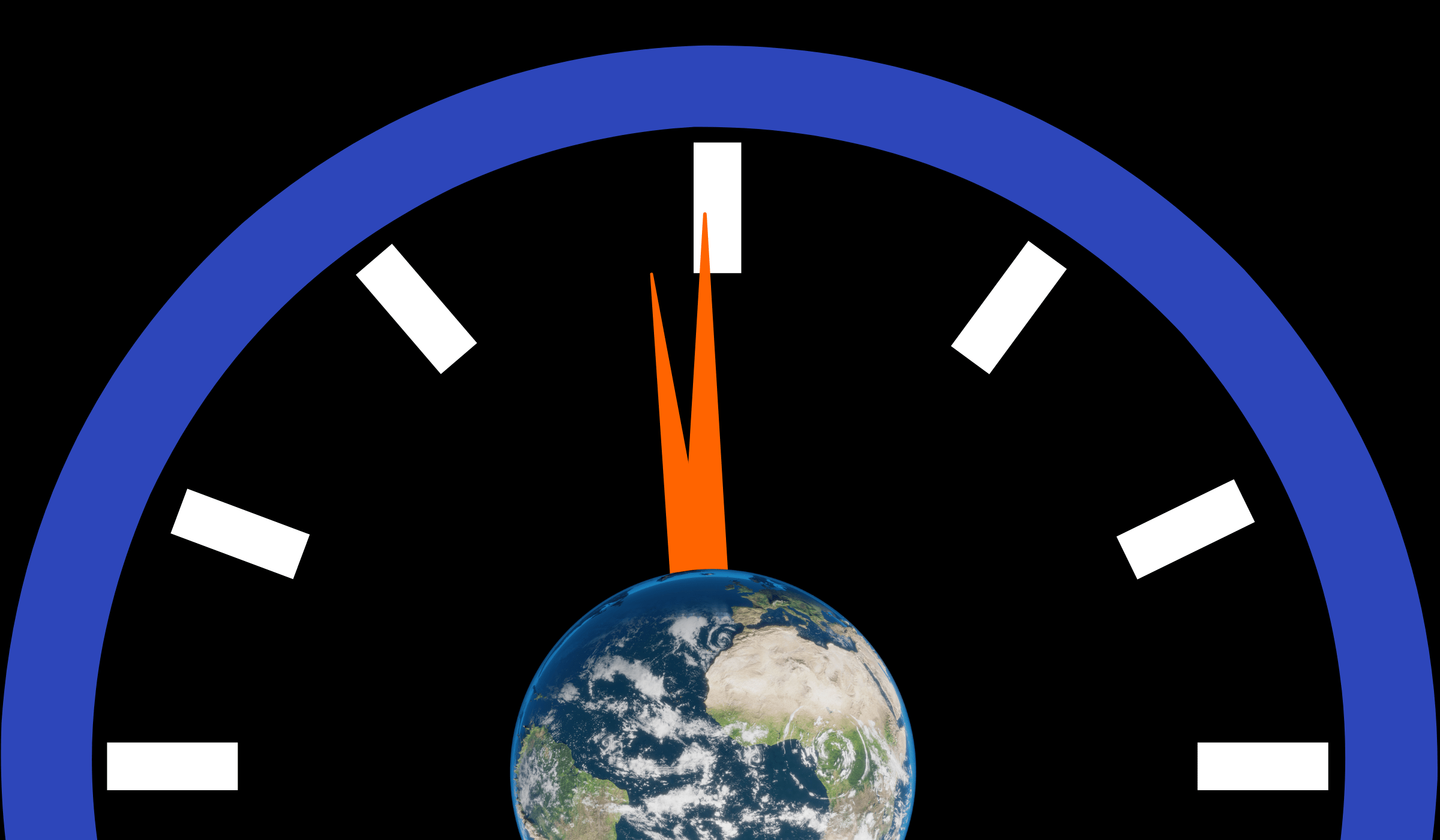
All of this was on my mind when I first met Robert Socolow [here], an 88-year-old physicist who, over the course of his life, turned to environmental science and technology to help humanity respond to our most complex challenges of scale. One of those efforts has been with the Bulletin of the Atomic Scientists, where Socolow helps with their Doomsday Clock. That’s the device that, since 1947, tracks humanity’s proximity to self-destruction. The clock is a metaphor, presuming to measure Blake’s hours of folly by minute and second hand; the hands are set by “nuclear risk, climate change, disruptive technologies, and biosecurity,” among other concerns. They’ve changed positions 26 times in the decades since they began metaphorically ticking. Since 2010, the clock’s hands have only moved closer to midnight.
In 2025, Socolow himself revealed the face of the clock at a press conference in Washington, DC. It was January and he was at the US Institute of Peace in Foggy Bottom. With a crowd of reporters looking on, cameras flashing and shutters digitally clicking, Socolow stood by a modernist wooden stand and spun a turntable to reveal the clock hands at a small, acute angle against midnight. A world of scalar challenges fell into an urgent sort of order. The end was 89 seconds away.
Most of us are daunted, every day, by the vastness of planetary activity and the proximity of our personal choices. We look at the clock, unsure how to balance clashing scopes of time and space. But if I’m unsettled, I want proximity to settle me. I want to be close, I want to feel part of the world I inhabit and see and feel, I want to hold those I love near to me. So what should we do?…
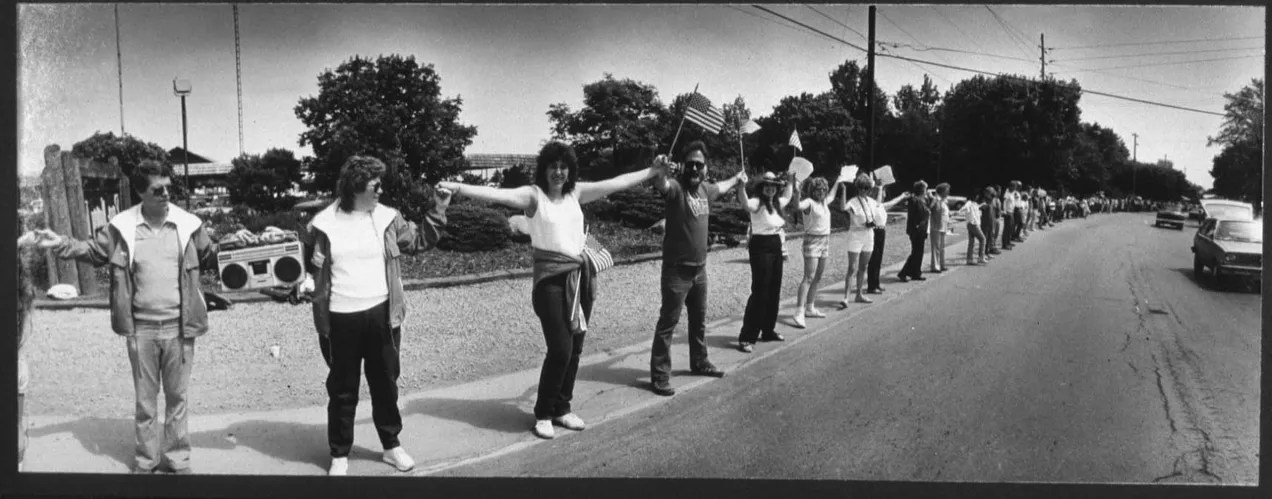
… The confusion may come from what the writer Timothy Clark calls “derangements of scale.” Our experiences as modern global humans, Clark writes, are like being “lost in a small town” and then handed a map of the entire earth for locating yourself and finding your way. In the Anthropocene, he writes, “we have a map, [and] its scale includes the whole earth, but when it comes to relating the threat to daily questions of politics, ethics, or specific interpretations of history, culture, literature, etc., the map is often almost mockingly useless.” Our scales are too imbalanced; we are unable to think the unthinkable. It goes without saying that it can be paralyzing, demoralizing, to be an individual acting as part of the collective, globe-sized world…
[Cohen shares his conversations with Socolow, with call-outs to Tolstoy, Camus, Augustine, and Solnit…]
… The attempt to capture our smallness inside the grandness of the universe is a timeless human quest, I get that. Tolstoy’s theological view is a typical one; God is that which is without scale. Even if I’m not so theological about it, I share the modern anxiety. And that anxiety is currently a dominant emotion.
Clark writes that “deranged jumps in scale and fantasies of agency may recall rhetoric associated with the atomic bomb in the 1950s and after.” After talking to Socolow a number of times, I don’t think it recalls so much as continues that rhetoric. The new atomic age was a test case for the coming collisions of scale that derange us now. The Doomsday Clock was about sounding the alarm. It was meant to shake people, to grab them by the shoulders and yell that they pay attention to human-made catastrophe.
We’ve flipped in the past 50 years, nearly the exact span of my own life. A half century later, and so many people have gone from urgency to hopelessness. They feel bombarded by all scales, not just the next one.
There’s room to reconsider that bombardment. There’s time to think to the next scale. Socolow has been doing it his entire adult life. So were Augustine and Tolstoy and Camus and so is Solnit. It isn’t new, we aren’t alone.
And so Socolow and I stand in his home office, trying to measure. It’s misty outside and calm inside. He is thinking in linear feet of books, where the spatial scale of distance is a proxy for the temporal scale of his life’s work. I’m thinking in years, measuring my sense of contribution and belonging against the shadfly-like limitations of a mere biological lifespan. I’m cautious, excited, gratified that the two of us can talk and compare across the scales of our current lives. That Blake couplet in the epigraph above [title quote] runs through my head. Socolow’s keenly aware of his own place in our epoch. Nearly a hundred linear feet of a life’s work at an archive, and still, as we consider our various measures, he tells me, “I am searching for ways to be constructive, and there are small opportunities here and there so far.” There is wisdom here, even if no clock can measure it…
Eminently worth reading in full: “By All Measures,” from @longreads.com.
* William Blake, “Proverbs of Hell”
###
As we take the long view, we might we might rejoice in the naively and nobly inventive: it was on this date in 1605 that El Ingenioso Hidalgo Don Quijote de la Mancha (or The Ingenious Hidalgo Don Quixote of La Mancha— aka Don Quixote), the masterwork of Miguel de Cervantes (and of the Spanish Golden Age) and a founding work of Western literature, was first published. Widely considered the first modern novel (published in the Western world), it is also considered by many (still) to be the best; it is in any case the second most translated work in the world (after the Bible).

“The pursuit of science is a grand adventure, driven by curiosity, fueled by passion, and guided by reason”*…
Adam Mastroianni on how science advances (and how it’s held back), with a provocative set of suggestions for how it might be accelerated…
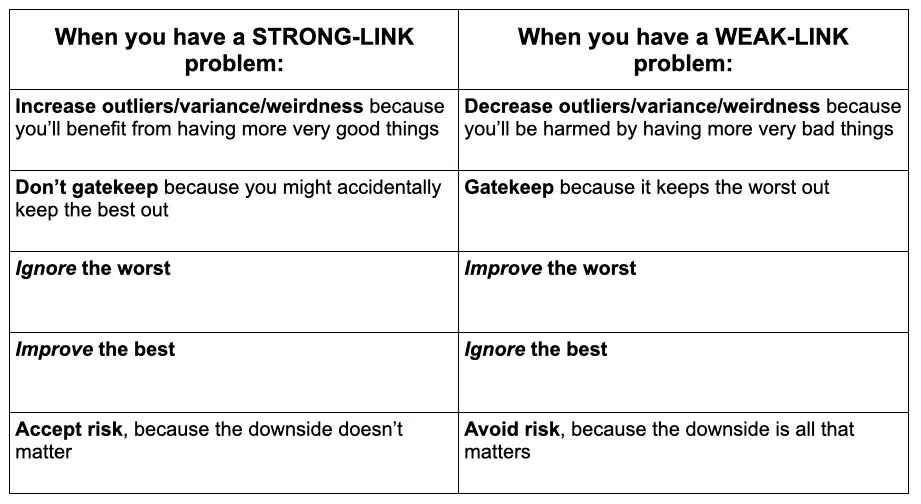
There are two kinds of problems in the world: strong-link problems and weak-link problems.
Weak-link problems are problems where the overall quality depends on how good the worst stuff is. You fix weak-link problems by making the weakest links stronger, or by eliminating them entirely.
Food safety, for example, is a weak-link problem. You don’t want to eat anything that will kill you. That’s why it makes sense for the Food and Drug Administration to inspect processing plants, to set standards, and to ban dangerous foods…
…
Weak-link problems are everywhere. A car engine is a weak-link problem: it doesn’t matter how great your spark plugs are if your transmission is busted. Nuclear proliferation is a weak-link problem: it would be great if, say, France locked up their nukes even tighter, but the real danger is some rogue nation blowing up the world. Putting on too-tight pants is a weak-link problem: they’re gonna split at the seams.
It’s easy to assume that all problems are like this, but they’re not. Some problems are strong-link problems: overall quality depends on how good the best stuff is, and the bad stuff barely matters. Like music, for instance. You listen to the stuff you like the most and ignore the rest. When your favorite band releases a new album, you go “yippee!” When a band you’ve never heard of and wouldn’t like anyway releases a new album, you go…nothing at all, you don’t even know it’s happened. At worst, bad music makes it a little harder for you to find good music, or it annoys you by being played on the radio in the grocery store while you’re trying to buy your beetle-free asparagus…
Strong-link problems are everywhere; they’re just harder to spot. Winning the Olympics is a strong-link problem: all that matters is how good your country’s best athletes are. Friendships are a strong-link problem: you wouldn’t trade your ride-or-dies for better acquaintances. Venture capital is a strong-link problem: it’s fine to invest in a bunch of startups that go bust as long as one of them goes to a billion…
In the long run, the best stuff is basically all that matters, and the bad stuff doesn’t matter at all. The history of science is littered with the skulls of dead theories. No more phlogiston nor phlegm, no more luminiferous ether, no more geocentrism, no more measuring someone’s character by the bumps on their head, no more barnacles magically turning into geese, no more invisible rays shooting out of people’s eyes, no more plum pudding…
Our current scientific beliefs are not a random mix of the dumbest and smartest ideas from all of human history, and that’s because the smarter ideas stuck around while the dumber ones kind of went nowhere, on average—the hallmark of a strong-link problem. That doesn’t mean better ideas win immediately. Worse ideas can soak up resources and waste our time, and frauds can mislead us temporarily. It can take longer than a human lifetime to figure out which ideas are better, and sometimes progress only happens when old scientists die. But when a theory does a better job of explaining the world, it tends to stick around.
(Science being a strong-link problem doesn’t mean that science is currently strong. I think we’re still living in the Dark Ages, just less dark than before.)
Here’s the crazy thing: most people treat science like it’s a weak-link problem.
Peer reviewing publications and grant proposals, for example, is a massive weak-link intervention. We spend ~15,000 collective years of effort every year trying to prevent bad research from being published. We force scientists to spend huge chunks of time filling out grant applications—most of which will be unsuccessful—because we want to make sure we aren’t wasting our money…
…
I think there are two reasons why scientists act like science is a weak-link problem.
The first reason is fear. Competition for academic jobs, grants, and space in prestigious journals is more cutthroat than ever. When a single member of a grant panel, hiring committee, or editorial board can tank your career, you better stick to low-risk ideas. That’s fine when we’re trying to keep beetles out of asparagus, but it’s not fine when we’re trying to discover fundamental truths about the world…
The second reason is status. I’ve talked to a lot of folks since I published The rise and fall of peer review and got a lot of comments, and I’ve realized that when scientists tell me, “We need to prevent bad research from being published!” they often mean, “We need to prevent people from gaining academic status that they don’t deserve!” That is, to them, the problem with bad research isn’t really that it distorts the scientific record. The problem with bad research is that it’s cheating.
I get that. It’s maddening to watch someone get ahead using shady tactics, and it might seem like the solution is to tighten the rules so we catch more of the cheaters. But that’s weak-link thinking. The real solution is to care less about the hierarchy…
Here’s our reward for a generation of weak-link thinking.
The US government spends ~10x more on science today than it did in 1956, adjusted for inflation. We’ve got loads more scientists, and they publish way more papers. And yet science is less disruptive than ever, scientific productivity has been falling for decades, and scientists rate the discoveries of decades ago as worthier than the discoveries of today. (Reminder, if you want to blame this on ideas getting harder to find, I will fight you.)…
…
Whether we realize it or not, we’re always making calls like this. Whenever we demand certificates, credentials, inspections, professionalism, standards, and regulations, we are saying: “this is a weak-link problem; we must prevent the bad!”
Whenever we demand laissez-faire, the cutting of red tape, the letting of a thousand flowers bloom, we are saying: “this is a strong-link problem; we must promote the good!”
When we get this right, we fill the world with good things and rid the world of bad things. When we don’t, we end up stunting science for a generation. Or we end up eating a lot of asparagus beetles…
“Science is a strong-link problem,” from @a_m_mastroianni in @science_seeds.
* James Clerk Maxwell
###
As we ponder the process of progress, we might spare a thought for Sir Christopher Wren; he died on this date in 1723. A mathematician and astronomer (who co-founded and later served as president of the Royal Society), he is better remembered as one of the most highly acclaimed English architects in history; he was given responsibility for rebuilding 52 churches in the City of London after the Great Fire in 1666, including what is regarded as his masterpiece, St. Paul’s Cathedral, on Ludgate Hill.
Wren, whose scientific work ranged broadly– e.g., he invented a “weather clock” similar to a modern barometer, new engraving methods, and helped develop a blood transfusion technique– was admired by Isaac Newton, as Newton noted in the Principia.

“You fix what you can fix and you let the rest go”*…

Humans are natural problem solvers; still, sometimes no amount of thoughtfulness, hard work, or understanding will transform an intractable problem into a resolvable one. But, as Alex Berezow argues, we must accept this harsh reality to have peace in our lives…
Though our species name is Homo sapiens (Latin for “wise man”), perhaps a better one would be Homo problematis solvendis (“problem solving man”). If there’s a mountain, we’ll climb it; if there’s a moon, we’ll fly to it; if there’s a disease, we’ll cure it. Our species’ success in science and technology has even given rise to scientism, the naïve and arrogant belief that science alone is the only legitimate source of knowledge and that any problem — no matter how great — will one day be solved by science.
It is easy to see why many people believe that. We are taught from a young age that the trickiest homework can be solved through diligent study; the toughest sporting competitions can be dominated through training; and the complexities of interpersonal relationships can be settled through understanding and compromise. All of this conspires to create in each of us a false sense that no problem is too big to tackle. Yet, the unfortunate reality is that, sometimes, no amount of thoughtfulness, hard work, or understanding will transform an intractable problem into a resolvable one. Indeed, some problems really have no solution…
Berezow goes on to unpack three examples: the Riemann hypothesis, the problem of aging and cancer, and willful ignorance. Then he urges us to understand them as a metaphor…
As we grow older, we slowly come to the realization that there is very little in our lives that we actually can control. We didn’t control who our parents were, where we were born, our genetic gifts (or lack thereof), or the sort of upbringing we received. We can’t control our spouses or our children, let alone politicians. And if we’re honest with ourselves, we’ll admit that we can barely control our own thoughts and feelings. It should not surprise us, therefore, that the world contains unsolvable problems. I would go so far as to posit that there may be more unsolvable problems than solvable ones.
So, if there’s any moral lesson to learn from the aforementioned “unsolvable problems,” let it be that they serve as a metaphor for the greater truth that we control far less than we think we do, and that we must become comfortable with that discomforting fact. How? Perhaps the Serenity Prayer by Reinhold Niebuhr could help:
God, grant me the serenity to accept the things I cannot change,
Courage to change the things I can,
And wisdom to know the difference.Or perhaps this cheekier version will suffice:
Give me coffee to change the things I can
And wine to accept the things I cannot.
The very concept of a “problem with no solution” goes against human nature, but they’re everywhere– and we need to find ways to relate to them: “Problems with no solution: From math to politics, some things humans cannot solve,” from @AlexBerezow @bigthink.
* Cormac McCarthy, No Country for Old Men
###
As we ruminate on resolution, we might we might send bright birthday greetings to Robert Wilhelm Eberhard Bunsen; he was born on this date in 1811. A chemist, he observed– with a prototype spectroscope that he created– that each element emits a light of characteristic wavelength (thus founding the field of spectrum analysis) and used his insight to discover two new elements, caesium and rubidium.
But Bunsen is probably best remembered for his creation of the Bunsen burner, a gas burner with a non-luminous flame that does not interfere with the colored flame given off by the test material–ubiquitous in labs around the world. Indeed, today is (Inter)National Bunsen Burner Day.

Poor, poor pitiful me…
Long-time readers will recall Jessica Hagy, and her wonderful site Indexed, from pre-blog days. Your correspondent, who’s checked in regularly in the meantime, is happy to report that her index card diagrams are as sharp as ever:

As we count our blessings, we might recall that it was on this date in 1934 that the MC at Amateur Night at Harlem’s Apollo Theater drew the name of an aspiring 15-year-old dancer from his hat. Shocked to be called on stage, Ella Fitzgerald chose to sing– and won… The rest is blissfully harmonious history.

You must be logged in to post a comment.