Posts Tagged ‘architecture’
“The pursuit of science is a grand adventure, driven by curiosity, fueled by passion, and guided by reason”*…
Adam Mastroianni on how science advances (and how it’s held back), with a provocative set of suggestions for how it might be accelerated…
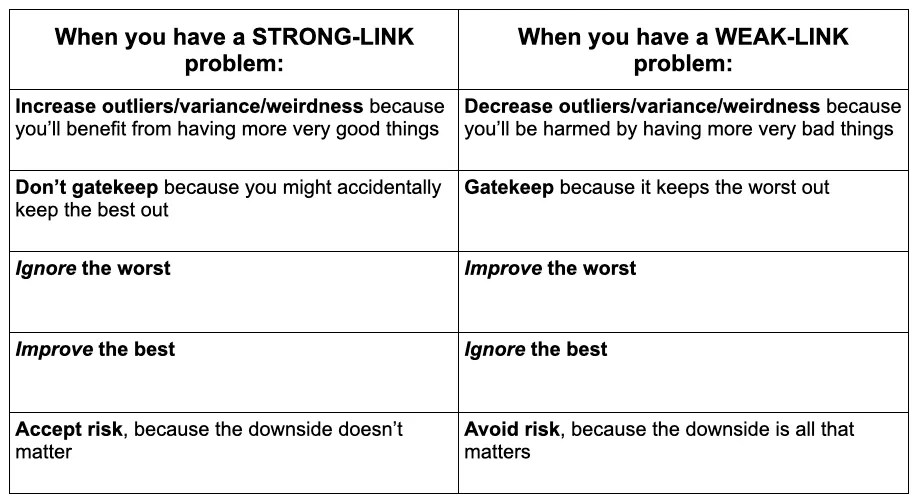
There are two kinds of problems in the world: strong-link problems and weak-link problems.
Weak-link problems are problems where the overall quality depends on how good the worst stuff is. You fix weak-link problems by making the weakest links stronger, or by eliminating them entirely.
Food safety, for example, is a weak-link problem. You don’t want to eat anything that will kill you. That’s why it makes sense for the Food and Drug Administration to inspect processing plants, to set standards, and to ban dangerous foods…
…
Weak-link problems are everywhere. A car engine is a weak-link problem: it doesn’t matter how great your spark plugs are if your transmission is busted. Nuclear proliferation is a weak-link problem: it would be great if, say, France locked up their nukes even tighter, but the real danger is some rogue nation blowing up the world. Putting on too-tight pants is a weak-link problem: they’re gonna split at the seams.
It’s easy to assume that all problems are like this, but they’re not. Some problems are strong-link problems: overall quality depends on how good the best stuff is, and the bad stuff barely matters. Like music, for instance. You listen to the stuff you like the most and ignore the rest. When your favorite band releases a new album, you go “yippee!” When a band you’ve never heard of and wouldn’t like anyway releases a new album, you go…nothing at all, you don’t even know it’s happened. At worst, bad music makes it a little harder for you to find good music, or it annoys you by being played on the radio in the grocery store while you’re trying to buy your beetle-free asparagus…
Strong-link problems are everywhere; they’re just harder to spot. Winning the Olympics is a strong-link problem: all that matters is how good your country’s best athletes are. Friendships are a strong-link problem: you wouldn’t trade your ride-or-dies for better acquaintances. Venture capital is a strong-link problem: it’s fine to invest in a bunch of startups that go bust as long as one of them goes to a billion…
In the long run, the best stuff is basically all that matters, and the bad stuff doesn’t matter at all. The history of science is littered with the skulls of dead theories. No more phlogiston nor phlegm, no more luminiferous ether, no more geocentrism, no more measuring someone’s character by the bumps on their head, no more barnacles magically turning into geese, no more invisible rays shooting out of people’s eyes, no more plum pudding…
Our current scientific beliefs are not a random mix of the dumbest and smartest ideas from all of human history, and that’s because the smarter ideas stuck around while the dumber ones kind of went nowhere, on average—the hallmark of a strong-link problem. That doesn’t mean better ideas win immediately. Worse ideas can soak up resources and waste our time, and frauds can mislead us temporarily. It can take longer than a human lifetime to figure out which ideas are better, and sometimes progress only happens when old scientists die. But when a theory does a better job of explaining the world, it tends to stick around.
(Science being a strong-link problem doesn’t mean that science is currently strong. I think we’re still living in the Dark Ages, just less dark than before.)
Here’s the crazy thing: most people treat science like it’s a weak-link problem.
Peer reviewing publications and grant proposals, for example, is a massive weak-link intervention. We spend ~15,000 collective years of effort every year trying to prevent bad research from being published. We force scientists to spend huge chunks of time filling out grant applications—most of which will be unsuccessful—because we want to make sure we aren’t wasting our money…
…
I think there are two reasons why scientists act like science is a weak-link problem.
The first reason is fear. Competition for academic jobs, grants, and space in prestigious journals is more cutthroat than ever. When a single member of a grant panel, hiring committee, or editorial board can tank your career, you better stick to low-risk ideas. That’s fine when we’re trying to keep beetles out of asparagus, but it’s not fine when we’re trying to discover fundamental truths about the world…
The second reason is status. I’ve talked to a lot of folks since I published The rise and fall of peer review and got a lot of comments, and I’ve realized that when scientists tell me, “We need to prevent bad research from being published!” they often mean, “We need to prevent people from gaining academic status that they don’t deserve!” That is, to them, the problem with bad research isn’t really that it distorts the scientific record. The problem with bad research is that it’s cheating.
I get that. It’s maddening to watch someone get ahead using shady tactics, and it might seem like the solution is to tighten the rules so we catch more of the cheaters. But that’s weak-link thinking. The real solution is to care less about the hierarchy…
Here’s our reward for a generation of weak-link thinking.
The US government spends ~10x more on science today than it did in 1956, adjusted for inflation. We’ve got loads more scientists, and they publish way more papers. And yet science is less disruptive than ever, scientific productivity has been falling for decades, and scientists rate the discoveries of decades ago as worthier than the discoveries of today. (Reminder, if you want to blame this on ideas getting harder to find, I will fight you.)…
…
Whether we realize it or not, we’re always making calls like this. Whenever we demand certificates, credentials, inspections, professionalism, standards, and regulations, we are saying: “this is a weak-link problem; we must prevent the bad!”
Whenever we demand laissez-faire, the cutting of red tape, the letting of a thousand flowers bloom, we are saying: “this is a strong-link problem; we must promote the good!”
When we get this right, we fill the world with good things and rid the world of bad things. When we don’t, we end up stunting science for a generation. Or we end up eating a lot of asparagus beetles…
“Science is a strong-link problem,” from @a_m_mastroianni in @science_seeds.
* James Clerk Maxwell
###
As we ponder the process of progress, we might spare a thought for Sir Christopher Wren; he died on this date in 1723. A mathematician and astronomer (who co-founded and later served as president of the Royal Society), he is better remembered as one of the most highly acclaimed English architects in history; he was given responsibility for rebuilding 52 churches in the City of London after the Great Fire in 1666, including what is regarded as his masterpiece, St. Paul’s Cathedral, on Ludgate Hill.
Wren, whose scientific work ranged broadly– e.g., he invented a “weather clock” similar to a modern barometer, new engraving methods, and helped develop a blood transfusion technique– was admired by Isaac Newton, as Newton noted in the Principia.

“Everything in the physical environment—everything—either raises our spirits or dampens them”*…

The venerable Witold Rybczynski on how, starting with Adolf Loos and the Vienna Secession, ornament was “banished” from modernist architecture– and on what that’s cost us…
… The abandonment of ornament has levied a heavy toll on the practice of architecture, tantamount to misplacing a crucial instrument of one’s toolbox. With ornament, an architect could give meaning to a building not only by incorporating specific references to what went on inside… but also by simply dialing the intensity up or down. Thus the main entrance of the Philadelphia Board of Education Building is not merely larger than the service entrance, it is more elaborately decorated, topped by two winged female figures and a medallion containing what looks like a coat of arms. Without subjunctive ornament, a building risks being less nuanced, but without meaningful ornament, it risks becoming, well, meaningless.
The banishment of ornament means an end to the close collaboration between architects and artists. It is difficult to imagine an architect today saying, “I should like to do the plan and the massing of the building; then … turn the ornament over to a perfectly qualified sculptor, and the color and surface direction to an equally qualified painter.” Today, the art in public buildings tends to be divorced from the architecture. A large travertine sculpture, Henry Moore’s Reclining Figure, stands outside Marcel Breuer’s UNESCO Building in Paris. Inside is a Picasso mural, The Fall of Icarus. The sculpture and the mural are beautiful works of art, but they have nothing to do with the architecture. They are simply “a Henry Moore” and “a Picasso.” The days when architects and artists worked closely together are long gone, and the results are not necessarily architecture that is worse, but architecture that is more one-dimensional: a long solo unenlivened by the occasional duet.
Take away ornament, and what are you left with? When we get close to a building today, we are confronted by gaskets, caulking, nuts and bolts—the minutiae of building construction. Or worse: exit signs, ventilation grills, and fire-hose cabinets. There is an architectural consequence to this. Traditionally, buildings were built as relatively straightforward boxes, their distinctive quality provided by ornament. Lacking the latter, architects feel obliged to provide dramatic cantilevers, unusual shapes, vertiginous space, and soaring roofs. But these big moves are not balanced by the finer-grained experience of small moves—that is, by ornament…
Why ornament matters in architecture: “Give Us Something to Look At,” from @witoldr in @TheAmScho. Eminently worth reading in full.
* Christopher Alexander, in conversation with Rybczynski
###
As we make with meaning, we might spare a thought for Pier Luigi Nervi; he died on this date in 1979. An exemplar of the trend against which Rybczynski argues, Nervi was an architect who drew on his deep engineering expertise– especially in reinforced concrete– to create notable “thin shell” structures worldwide.


“It is the same in love as in war; a fortress that parleys is half taken”*…

Further to yesterday’s post on historic battlements, Zach Mortice on a modern fortress that’s become a go-to location for film and television thrillers…
When it was completed in Lower Manhattan in 1974, 33 Thomas Street, formerly known as the AT&T Long Lines Building, was intended as the world’s largest facility for connecting long-distance telephone calls. Standing 532 feet — roughly equivalent to a 45-story building — it’s a mugshot for Brutalism, windowless and nearly featureless. Its only apertures are a series of ventilation hoods meant to hide microwave-satellite arrays, which communicate with ground-based relay stations and satellites in space. One of several long lines buildings designed by John Carl Warnecke for the New York Telephone Company, a subsidiary of AT&T, 33 Thomas Street is perhaps the most visually striking project in the architect’s long and influential career. Embodying postwar American economic and military hegemony, the tower broadcasts inscrutability and imperviousness. It was conceived, according to the architect, to be a “skyscraper inhabited by machines.”
“No windows or unprotected openings in its radiation-proof skin can be permitted,” reads a project brief prepared by Warnecke’s office; the building’s form and dimensions were shaped not by human needs for light and air, but by the logics of ventilation, cooling, and (not least) protection from atomic blast. “As such, the design project becomes the search for a 20th-century fortress, with spears and arrows replaced by protons and neutrons laying quiet siege to an army of machines within.” The purple prose of the project brief was perhaps inspired by the client. AT&T in the 1970s still held its telecom monopoly, and was an exuberant player in the Cold War military-industrial complex. Until 2009, 33 Thomas Street was a Verizon data center. And in 2016, The Intercept revealed that the building was functioning as a hub for the National Security Administration, which has bestowed upon it the Bond-film-esque moniker Titanpointe.
Computers at Titanpointe have monitored international phone calls, faxes and voice calls routed over the internet, and more, hoovering up data from the International Monetary Fund, the World Bank, and U.S. allies including France, Germany, and Japan. 33 Thomas Street, it turns out, is exactly what it looks like: an apocalypse-proof above-ground bunker intended not only to symbolize but to guarantee national security. For those overseeing fortress operations at the time of construction, objects of fear were nuclear-armed Communists abroad and a restive youth population at home, who couldn’t be trusted to obey the diktats of a culture that had raised up some in previously inconceivable affluence; an affluence built on the exploitation and disenfranchisement of people near and far.
By the time the NSA took over, targets were likely to be insurgents rejecting liberal democracy and American hegemony, from Islamic fundamentalists to world-market competitors in China, alongside a smattering of Black Lives Matter activists. For those outside the fortress, in the Nixon era as in the present, the fearful issue was an entrenched and unaccountable fusion of corporate and governmental capability, a power that flipped the switches connecting the world. At the same time, popular culture had begun, in the 1970s, to register a paranoia that has only intensified — the fear that people no longer call the shots. In its monumental implacability, Titanpointe seems to herald a posthuman regime, run by algorithm for the sole purpose of perpetuating its own system.
It is, in other words, a building tailor made for spy movies.
John Carl Warnecke did not realize, of course, that he was storyboarding a movie set…

How (and why) a windowless telecommunications hub in New York City embodying an architecture of surveillance and paranoia became an ideal location for conspiracy thrillers: “Apocalypse-Proof,” from @zachmortice in @PlacesJournal. Fascinating.
###
As we ponder impenetrability, we might recall that it was on this date in 1780, during the American Revolutionary War, that Benedict Arnold, commander of the American fort at West Point, passed plans of the bastion to the British.

“It is often our mightiest projects that most obviously betray the degree of our insecurity– the construction of fortifications, for instance”*…

From Public Domain Review, a look at a 17th century book that collects (beautiful) plans for forts and fortifications…
What is the peculiar appeal of military architecture? Whether Norman castle or Cold War concrete, there is a kind of sublimity that belongs to defensive design. It stems obviously from the massive scale of construction, and from the luxury of uncompromised execution that generous defence budgets afford. But there is also pleasure to be taken in the unornamented purity of style of structures that have been built solely for practical ends.
These qualities are abundant in the work of the seventeenth-century French military engineer Allain Manesson Mallet. Born in Paris in 1630, Manesson studied mathematics before becoming a soldier (he added the name Mallet in tribute to his teacher). In 1663, he was posted to Alentejo as an army engineer in the service of the Portuguese king Alfonso VI, where he fortified chateaux, until the Treaty of Lisbon in 1668. He returned to France with an appointment as mathematics instructor at the court of Louis XIV.
He recorded his military ideas in a highly successful manual, The Works of Mars (i.e. “the art of war”) in 1671. A year later came German and Dutch editions (the source of the images above), even though France was by then at war with the Netherlands.
Manesson’s book encompassed theories of fortifications from their origins in designs developed in the sixteenth century by Michelangelo and the architect Vincenzo Scamozzi, including more recent innovations of French and Dutch engineers….
More– and many more renderings of ramparts: “The Works of Mars” from @PublicDomainRev.
* W. G. Sebald, Austerlitz
###
As we build bastions, we might understand the Dutch interest in Manesson’s manual as we recall that it was on this date in 1602 that the Spanish-held city of Grave in the Netherlands was taken, at the end of a two-month siege, by a Dutch and English army led by Maurice of Orange and Francis Vere respectively.
Part of the Eighty Years’ War and the Anglo–Spanish War, the Siege of Grave and its ultimate fall were severe enough to cause a major mutiny in the Spanish army.

“A suburb is an attempt to get out of reach of the city without having the city be out of reach”*…

In mid-twentieth century, in contrast to the noisy and diverse city, the suburbs were seen as spacious, segregated, and quiet— a much more promising state of affairs to corporations bent on expansion. American cities had been spreading out into metropolitan areas since the 19th century; but for most of that time city centers remained the hub of economic and social life. As Luise A. Mozingo explains, that began to change after World War II; residents and businesses alike began to leave…
… As a number of scholars have emphasized, the iconic suburbs of white, middle-class, nuclear families were a well-known part of this story but by no means all of it. Added to prewar suburban expansion, the rapid restructuring of postwar metropolitan areas formed a complexity of patches, spokes, and swaths of separated, specialized, and low-density land uses in the peripheral zones around older city centers, including industry, retail centers, ethnic enclaves, and working-class neighborhoods. This rapid decentralization created the conditions that were conducive to the invention of specialized suburban management facilities by large corporations.
To many privileged Americans of the 1950s and 1960s, the center city appeared to be in a state of inexorable decline. The proliferating automobile inundated the center city’s gridded 19th-century street pattern, and “congestion” seemed intractable and highly detrimental to economic activity. Increasing numbers of people of color walked the streets. Vacancies and abandoned properties were on the rise as tenants relocated to the suburbs and owners could find no replacements. New construction in the city center required homage to an ensconced and layered system of political patronage. Even then, wedging in new skyscrapers that could accommodate large corporate staffs in a single building proved difficult in blocks divided into multiple parcels of land and built out with varied buildings, including many used for industry. To redress these perceived shortcomings, the urban renewal process acquired property, removed tenants, destroyed buildings, and reparceled land in order to insert freeways, offer large lots for corporate offices, supply parking, and confine the poor to mass public housing. In the process, it took apart what remained of the vitality of the old urban core and added to the inventory of open urban lots and dysfunctional neighborhoods. The center city was noisy, diverse, crowded, unpredictable, inflexible, expensive, old, and messy — a dubious state of affairs for postwar capitalists bent on expansion.
In contrast, the suburbs seemed to warrant a sense of forward-looking optimism. At the city’s edge, an effective alliance of well-financed real estate investors, large property owners, local governments, federal loan guarantors, and utopian planners opened property for speedy development. Building along federal- and state-funded road systems that brought these large tracts of land into the economy of metropolitan regions, this alliance conceived of low-density, auto-accessed landscapes of highly specified uses with plenty of parking, and wrote these forms into stringent zoning and building regulations. Once built, these suburban expansion zones were deliberately resistant to change, with the end of producing both social stasis and secure real estate values.
The suburbs as a whole may have been diverse, but the process of building their component parts created insidious racial and class divisions. While the separation of different classes and races of home dwellers is the best-understood part of this spatial process, all kinds of workers were categorically set apart in discrete landscapes as well — corporate executives from factory labor, retail clerks from typists, electronics researchers from accountants. Hence the suburbs were predictable, spacious, segregated, specialized, quiet, new, and easily traversed — a much more promising state of affairs to corporations bent on expansion.
…
My book “Pastoral Capitalism” describes how pioneering projects established the essential landscape patterns of the corporate campus, corporate estate, and office park and how, from those few early projects, other corporations followed suit in great numbers. These landscape types became embedded in the expectations of the corporate class and could, at a glance, embody both the reality and prospect of capitalist power. Hence, the development forms have remained remarkably consistent for six decades. By the end of the 20th century, the suburbs, not the central business district, contained the majority of office space in the United States. This was a new and potent force in the process of suburban expansion…
More at “The Birth of the Pastoral Corporation.”
###
As we ponder the prominence of the periphery, we might send altitudinous birthday greetings to Louis Sullivan; he was born on this date in 1856. An architect, he was hugely influential in the Chicago School, a mentor to Frank Lloyd Wright, and an inspiration to the Chicago group of architects who have come to be known as the Prairie School. He is considered by many to have been the “father of modernism” in architecture (the phrase “form follows function” is attributed to him) and (as he pioneered the steel high-rise) “the father of the skyscraper.”
Indeed, in Sullivan’s honor, this date is National Skyscraper Day.


You must be logged in to post a comment.