Posts Tagged ‘NSA’
“It is the same in love as in war; a fortress that parleys is half taken”*…

Further to yesterday’s post on historic battlements, Zach Mortice on a modern fortress that’s become a go-to location for film and television thrillers…
When it was completed in Lower Manhattan in 1974, 33 Thomas Street, formerly known as the AT&T Long Lines Building, was intended as the world’s largest facility for connecting long-distance telephone calls. Standing 532 feet — roughly equivalent to a 45-story building — it’s a mugshot for Brutalism, windowless and nearly featureless. Its only apertures are a series of ventilation hoods meant to hide microwave-satellite arrays, which communicate with ground-based relay stations and satellites in space. One of several long lines buildings designed by John Carl Warnecke for the New York Telephone Company, a subsidiary of AT&T, 33 Thomas Street is perhaps the most visually striking project in the architect’s long and influential career. Embodying postwar American economic and military hegemony, the tower broadcasts inscrutability and imperviousness. It was conceived, according to the architect, to be a “skyscraper inhabited by machines.”
“No windows or unprotected openings in its radiation-proof skin can be permitted,” reads a project brief prepared by Warnecke’s office; the building’s form and dimensions were shaped not by human needs for light and air, but by the logics of ventilation, cooling, and (not least) protection from atomic blast. “As such, the design project becomes the search for a 20th-century fortress, with spears and arrows replaced by protons and neutrons laying quiet siege to an army of machines within.” The purple prose of the project brief was perhaps inspired by the client. AT&T in the 1970s still held its telecom monopoly, and was an exuberant player in the Cold War military-industrial complex. Until 2009, 33 Thomas Street was a Verizon data center. And in 2016, The Intercept revealed that the building was functioning as a hub for the National Security Administration, which has bestowed upon it the Bond-film-esque moniker Titanpointe.
Computers at Titanpointe have monitored international phone calls, faxes and voice calls routed over the internet, and more, hoovering up data from the International Monetary Fund, the World Bank, and U.S. allies including France, Germany, and Japan. 33 Thomas Street, it turns out, is exactly what it looks like: an apocalypse-proof above-ground bunker intended not only to symbolize but to guarantee national security. For those overseeing fortress operations at the time of construction, objects of fear were nuclear-armed Communists abroad and a restive youth population at home, who couldn’t be trusted to obey the diktats of a culture that had raised up some in previously inconceivable affluence; an affluence built on the exploitation and disenfranchisement of people near and far.
By the time the NSA took over, targets were likely to be insurgents rejecting liberal democracy and American hegemony, from Islamic fundamentalists to world-market competitors in China, alongside a smattering of Black Lives Matter activists. For those outside the fortress, in the Nixon era as in the present, the fearful issue was an entrenched and unaccountable fusion of corporate and governmental capability, a power that flipped the switches connecting the world. At the same time, popular culture had begun, in the 1970s, to register a paranoia that has only intensified — the fear that people no longer call the shots. In its monumental implacability, Titanpointe seems to herald a posthuman regime, run by algorithm for the sole purpose of perpetuating its own system.
It is, in other words, a building tailor made for spy movies.
John Carl Warnecke did not realize, of course, that he was storyboarding a movie set…

How (and why) a windowless telecommunications hub in New York City embodying an architecture of surveillance and paranoia became an ideal location for conspiracy thrillers: “Apocalypse-Proof,” from @zachmortice in @PlacesJournal. Fascinating.
###
As we ponder impenetrability, we might recall that it was on this date in 1780, during the American Revolutionary War, that Benedict Arnold, commander of the American fort at West Point, passed plans of the bastion to the British.

“It may be roundly asserted that human ingenuity cannot concoct a cipher which human ingenuity cannot resolve”*…
But sometimes it takes lots of ingenuity… and often, a great deal of time…
The United States National Security Agency—the country’s premier signals intelligence organization—recently declassified a Cold War-era document about code-breaking.
The 1977 book, written by cryptologist Lambros Callimahos, is the last in a trilogy called Military Cryptanalytics. It’s significant in the history of cryptography, as it explains how to break all types of codes, including military codes, or puzzles—which are created solely for the purpose of a challenge.
The first two parts of the trilogy were published publicly in the 1980s and covered solving well-known types of classical cipher. But in 1992, the US Justice Department claimed releasing the third book could harm national security by revealing the NSA’s “code-breaking prowess“. It was finally released in December last year.
A key part of Callimahos’s book is a chapter titled Principles of Cryptodiagnosis, which describes a systematic three-step approach to solving a message encrypted using an unknown method…
See how those three steps work at “Declassified Cold War code-breaking manual has lessons for solving ‘impossible’ puzzles.”
* Edgar Allan Poe
###
As we ponder puzzles, we might send intelligent birthday greetings to Alfred Binet; he was born on this date in 1857. A psychologist, he invented the first practical IQ test, the Binet–Simon test (in response to a request from the French Ministry of Education to devise a method to identify students needing remedial help).

“Certainly it constitutes bad news when the people who agree with you are buggier than batshit”*…
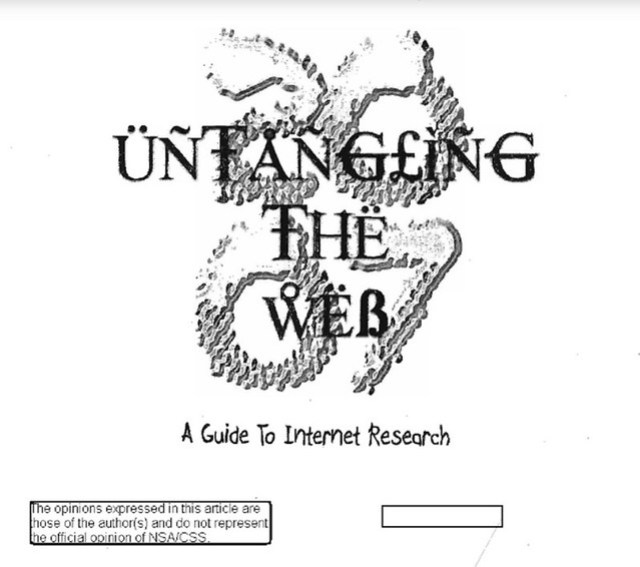
The NSA’s 2007 internal manual for research on the Internet is, well… mesmerizingly odd. On it’s way to a Dungeons-and-Dragons-as-reported-by-an-undergraduate-Classics-major-like depiction of life online, it cites Borges, Freud, and Ovid – and that’s just the preface…
The NSA has a well-earned reputation for being one of the tougher agencies to get records out of, making those rare FOIA wins all the sweeter. In the case of Untangling the Web, the agency’s 2007 guide to internet research, the fact that the records in question just so happen to be absolutely insane are just icing on the cake – or as the guide would put it, “the nectar on the ambrosia.”…
More of the backstory at “The NSA’s guide to the internet is the weirdest thing you’ll read today“; browse through the text in its extraordinary entirety here.
Quis custodiet ipsos custodes? (Who will guard the guards themselves?, or more familiarly, who will watch the watchers?)
– Juvenal
* Philip K. Dick
###
As we limber up our gaming fingers, we might recall this is an important anniversary in the pre-history of the Internet: on this date in 1837, Charles Wheatstone and William Fothergill Cooke patented the electric “Five Needle Telegraph” in London (U.K. No. 7390). They were subsequently granted a patent in the U.S. 10 days before Samuel Morse received his, but Morse was given priority by the U.S. PTO as the first inventor. Nonetheless, Wheatstone and Cooke had priority in the U.K.; their system served British railways, press, and law enforcement for decades, first as the service of an independent company, then as a nationalized part of the General Post Office.

Wheatstone (left) and Cooke
You must be logged in to post a comment.