Posts Tagged ‘Highgate Cemetery’
“Death is not easily escaped, try it who will; but every living soul among the children of men dwelling upon the earth goeth of necessity unto his destined place, where the body, fast in its narrow bed, sleepeth after feast.”*…
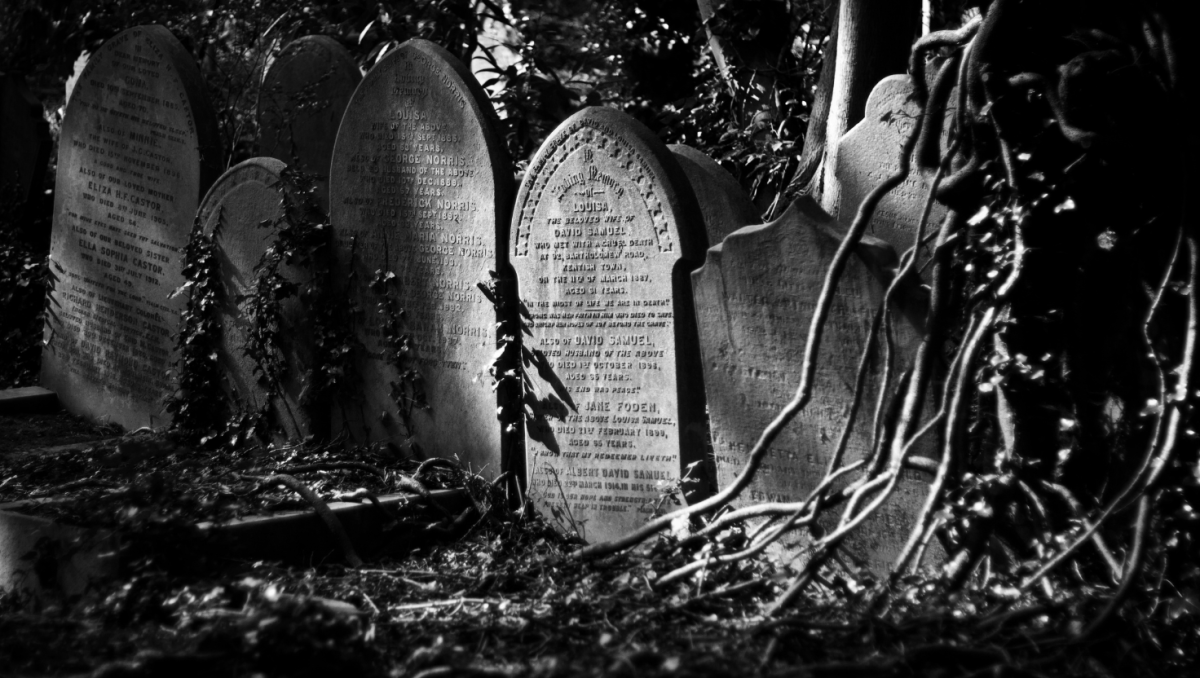
London’s Highgate Cemetery (and here)– the resting place of Karl Marx, George Eliot, Michael Faraday, Henry Moore, George Michael and many other notables– shows us just how hard it is to keep the dead buried. Ralph Jones explains…
“A cemetery’s a really bad idea,” said Ian Dungavell. It’s not a sentence I expected from someone paid to run one. But Dungavell, chief executive of the Friends of Highgate Cemetery Trust, is just as idiosyncratic as the site he presides over. The pair of us were walking around North London’s Highgate Cemetery in late February, as the snowdrops were beginning to flower and rain threatened overhead. As we walked, visitors approached to ask Dungavell, who knows more about the cemetery than perhaps anyone else alive, about specific graves. One woman wanted to know exactly where 19th-century artist Lizzie Siddal was buried. Dungavell tried to explain the route. “It’s slightly tricky if you turn left too soon,” he said. “Then if you turn left too late, we might not see you till tomorrow.”
Dungavell, who is 58 and speaks with the calm precision of an English head teacher, wasn’t speaking ill of his beloved Highgate when he said that a cemetery is a bad idea. He meant that the business of running one has become almost unsustainable. Highgate is the only cemetery in the United Kingdom to charge the public for entry, yet upkeep remains a struggle, costing at least $1.9 million a year. Highgate Cemetery is particularly fascinating because its fortunes have run the gamut—from high to rock bottom, back to high again. It isn’t as easy as it looks, keeping people in the ground.
I was visiting Highgate at a crucial juncture in its history. More change is afoot for this most famous of cemeteries; this “Disneyland of the dead,” in the words of Kenneth Greenway, the cemetery park manager at nearby Tower Hamlets Cemetery Park. To put it bluntly: Highgate, which hosts the bodies and ashes of around 173,000 people, is running out of space. What do you do when you can’t create new graves? You reuse the old ones. In March 2022, the UK Parliament granted the cemetery the right to “disturb human remains”—dig up graves to make space for new bodies—in its mission to combat this problem…
The fascinating (if mildly macabre) details: “Disneyland of the Dead,” from @ohhiralphjones.bsky.social in @longreads.com.
* Beowulf
###
As we ponder posterity, we might recall that it was on this date in 1968 that Gram Parsons quit the Byrds, allegedly over concerns about a planned tour of South Africa, citing his opposition to the country’s apartheid policies. Parsons headed to France, became acquainted with Mick Jagger and Keith Richards of the Rolling Stones (during the recording of Exiles On Main Street) and reintroduced Richards to country music. On returning to Los Angeles, Parsons formed The Flying Burrito Brothers.
Germanely to the piece featured above, Parsons died in 1973 of an overdose…
Although Parsons had said he wanted his body cremated at Joshua Tree and his ashes spread over the formation Cap Rock, Parsons’ stepfather organized a private ceremony in New Orleans and left the body in the care of a funeral home. But, to fulfill Parsons’ wishes, [Parson’s friend Phil] Kaufman and a friend stole both a hearse and his body and drove it to Joshua Tree. At Cap Rock Parking Lot, they poured gasoline into the open coffin and lit it, creating an enormous fireball. They were arrested and eventually fined $750.00, for stealing the coffin. What remained of Parsons’ body was buried in Garden of Memories Cemetery in Metairie, Louisiana.
The story brings Parsons fans out to a large rock flake known to rock climbers as ‘The Gram Parsons Memorial Hand Traverse’. At some point, someone added a slab that marked Parsons’ cremation to the memorial rock; that slab was removed by the U.S. National Park Service and is now at the Joshua Tree Inn. Joshua Tree park guides are given the option to tell the story of Parsons’ cremation during tours, but there is no mention of the act in official maps or brochures…
– source

“A doctor can bury his mistakes, but an architect can only advise his clients to plant vines.”*…

Actually, sometimes architecture is buried– or at least demolished. And occasionally, as in the “refurbishing” of the Sainsbury Wing of London’s National Gallery, that unearths a surprise. Martin Bailey reports…
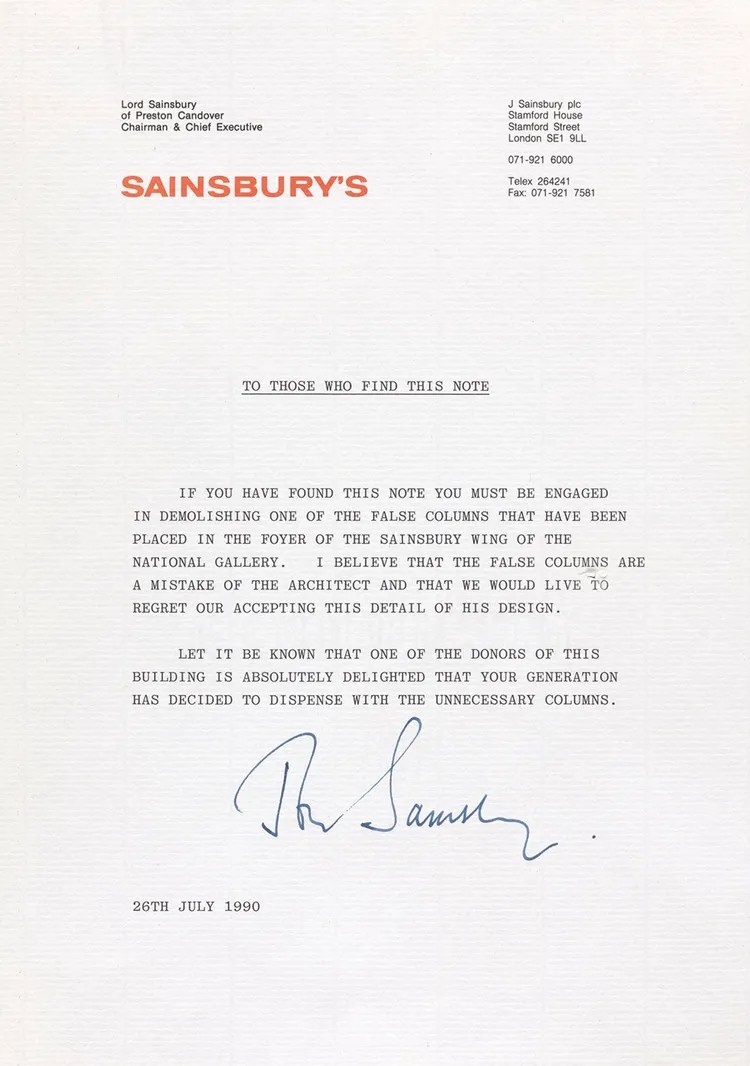
A “time capsule” has been discovered at London’s National Gallery, buried deep in a column in the foyer of the Sainsbury Wing. It is a letter recording that one of the wing’s funders, John Sainsbury (Lord Sainsbury of Preston Candover), believed the architects had committed a serious “mistake”. The 1990 letter, typed on Sainsbury’s supermarket notepaper, has recently been deposited in the gallery’s archive as an historic document.
John Sainsbury is critical in the letter of the American post-Modernist architect Robert Venturi and his professional partner and wife Denise Scott Brown for inserting two large false columns in the gallery’s foyer that served no structural purpose. Other than the false columns, John Sainsbury was happy with the Venturi and Scott Brown design.
While building work was under way, Sainsbury gained access to the site and dropped his letter into a concrete column that was under construction. The letter, protected in a plastic folder, was discovered last year, when the foyer was being reconfigured.
The Sainsbury letter of 26 July 1990 was addressed “To those who find this note”—who turned out to be the 2023 demolition workers.
John and his wife Anya presumably never imagined that the demolition of the Sainsbury Wing foyer might take place during their lifetimes. John, one of the most generous UK donors to the arts, died in 2022, aged 94. His widow Anya, a former ballerina, was present when her husband’s note was removed. “I was so happy for John’s letter to be rediscovered after all these years,” she says, “and I feel he would be relieved and delighted for the gallery’s new plans and the extra space they are creating.”…
From the annals of architecture– a dissenting voice from the past: “Sainsbury Wing contractors find 1990 letter from donor anticipating their demolition of false columns,” from @TheArtNewspaper.
But lest we forget that when one critic is assuaged, others are appalled: “Eight Prestigious Architects Blast Annabelle Selldorf’s Proposed $40 Million Redesign of London’s National Gallery, Likening It to an ‘Airport Lounge’,” from @artnet.
(Image above: source)
* Frank Lloyd Wright
###
As we deconstruct design, we might send peaceful birthday greetings to Stephen Geary; he was born on this date in 1797. An architect who designed everything from gin palaces to the (short-lived) monument to King George IV that gave King’s Cross its name, he is best remembered for Highgate Cemetery, opened in 1839, and later to be his resting place, where he designed the Egyptian Avenue and the Terrace Catacombs. He also designed Gravesend, Nunhead, and Brompton Cemeteries, and founded the London Cemetery Company, established by Act of Parliament in 1836, which owned Highgate Cemetery and Nunhead Cemetery.

You must be logged in to post a comment.