Posts Tagged ‘burial’
“Death is not easily escaped, try it who will; but every living soul among the children of men dwelling upon the earth goeth of necessity unto his destined place, where the body, fast in its narrow bed, sleepeth after feast.”*…
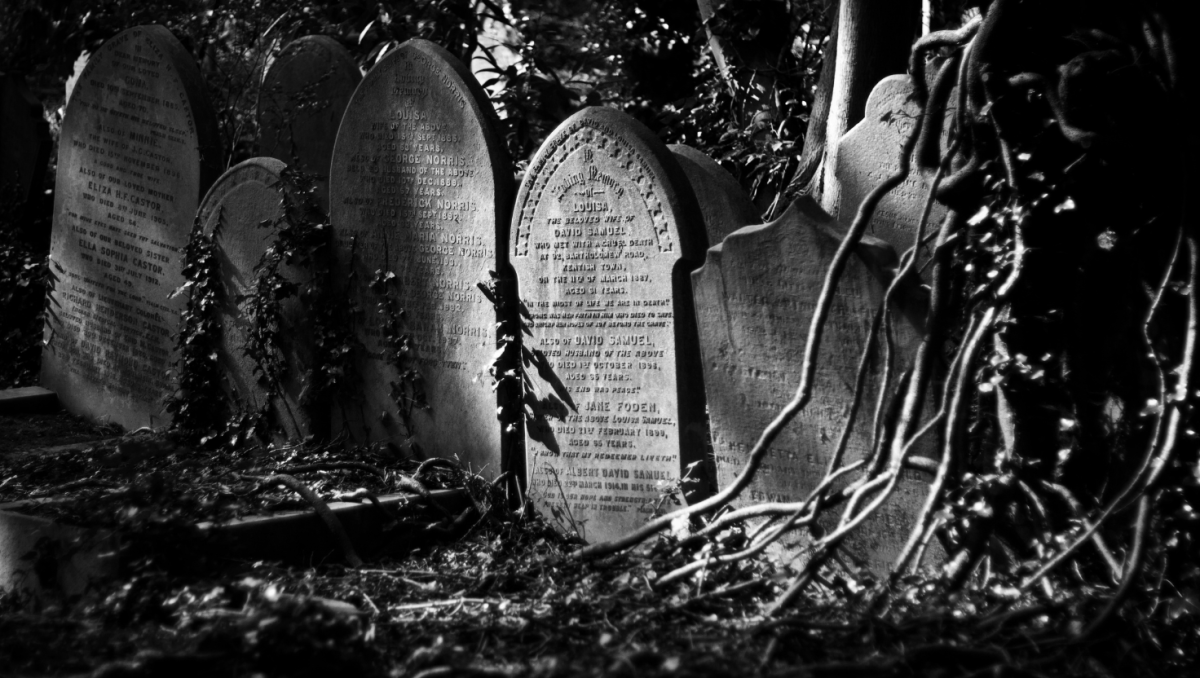
London’s Highgate Cemetery (and here)– the resting place of Karl Marx, George Eliot, Michael Faraday, Henry Moore, George Michael and many other notables– shows us just how hard it is to keep the dead buried. Ralph Jones explains…
“A cemetery’s a really bad idea,” said Ian Dungavell. It’s not a sentence I expected from someone paid to run one. But Dungavell, chief executive of the Friends of Highgate Cemetery Trust, is just as idiosyncratic as the site he presides over. The pair of us were walking around North London’s Highgate Cemetery in late February, as the snowdrops were beginning to flower and rain threatened overhead. As we walked, visitors approached to ask Dungavell, who knows more about the cemetery than perhaps anyone else alive, about specific graves. One woman wanted to know exactly where 19th-century artist Lizzie Siddal was buried. Dungavell tried to explain the route. “It’s slightly tricky if you turn left too soon,” he said. “Then if you turn left too late, we might not see you till tomorrow.”
Dungavell, who is 58 and speaks with the calm precision of an English head teacher, wasn’t speaking ill of his beloved Highgate when he said that a cemetery is a bad idea. He meant that the business of running one has become almost unsustainable. Highgate is the only cemetery in the United Kingdom to charge the public for entry, yet upkeep remains a struggle, costing at least $1.9 million a year. Highgate Cemetery is particularly fascinating because its fortunes have run the gamut—from high to rock bottom, back to high again. It isn’t as easy as it looks, keeping people in the ground.
I was visiting Highgate at a crucial juncture in its history. More change is afoot for this most famous of cemeteries; this “Disneyland of the dead,” in the words of Kenneth Greenway, the cemetery park manager at nearby Tower Hamlets Cemetery Park. To put it bluntly: Highgate, which hosts the bodies and ashes of around 173,000 people, is running out of space. What do you do when you can’t create new graves? You reuse the old ones. In March 2022, the UK Parliament granted the cemetery the right to “disturb human remains”—dig up graves to make space for new bodies—in its mission to combat this problem…
The fascinating (if mildly macabre) details: “Disneyland of the Dead,” from @ohhiralphjones.bsky.social in @longreads.com.
* Beowulf
###
As we ponder posterity, we might recall that it was on this date in 1968 that Gram Parsons quit the Byrds, allegedly over concerns about a planned tour of South Africa, citing his opposition to the country’s apartheid policies. Parsons headed to France, became acquainted with Mick Jagger and Keith Richards of the Rolling Stones (during the recording of Exiles On Main Street) and reintroduced Richards to country music. On returning to Los Angeles, Parsons formed The Flying Burrito Brothers.
Germanely to the piece featured above, Parsons died in 1973 of an overdose…
Although Parsons had said he wanted his body cremated at Joshua Tree and his ashes spread over the formation Cap Rock, Parsons’ stepfather organized a private ceremony in New Orleans and left the body in the care of a funeral home. But, to fulfill Parsons’ wishes, [Parson’s friend Phil] Kaufman and a friend stole both a hearse and his body and drove it to Joshua Tree. At Cap Rock Parking Lot, they poured gasoline into the open coffin and lit it, creating an enormous fireball. They were arrested and eventually fined $750.00, for stealing the coffin. What remained of Parsons’ body was buried in Garden of Memories Cemetery in Metairie, Louisiana.
The story brings Parsons fans out to a large rock flake known to rock climbers as ‘The Gram Parsons Memorial Hand Traverse’. At some point, someone added a slab that marked Parsons’ cremation to the memorial rock; that slab was removed by the U.S. National Park Service and is now at the Joshua Tree Inn. Joshua Tree park guides are given the option to tell the story of Parsons’ cremation during tours, but there is no mention of the act in official maps or brochures…
– source

“History cannot give us a program for the future, but it can give us a fuller understanding of ourselves, and of our common humanity, so that we can better face the future”*…

Wrapped in a cotton shroud, Joseph Fitzgerald is laid to rest in 2013 at the Prairie Creek Conservation Cemetery in Gainesville, Florida. “Green” burials like this are becoming increasingly popular.
Death has always been a fact of life. But somehow, even after endless repetitions of the cycle, we still haven’t figured out how we feel about dead bodies. Are they vessels of loved ones that should be preserved for as long as possible? Bundles of organic material that should be reunited with the earth? Harsh reminders of our own mortality that should be disposed of quickly and thoroughly?
Ellen Stroud, an environmental historian at Penn State University, explored the macabre history and legal ambiguities of American bodies in the Annual Review of Law and Social Science. From the one-footed 87-year-old man sold to a medical school for $10 in 1902 to the plasticized people put on display in traveling exhibits today, bodies continue to challenge our ideas of justice and humanity…
An environmental historian looks at how Americans treat corpses and what it means: “She Sees Dead Bodies.”
Pair with this (unsentimental, illuminating) account of the last words of the dying: “What People Actually Say Before They Die.”
* Robert Penn Warren
###
As we muse on on the morals of mortality, we might spare a thought for Sir Charles Leonard Woolley; he died on this date in 1960. Recognized as one of the first “modern” archaeologists– which is to say, one who excavated in a methodical way, kept careful records, and used them to reconstruct ancient life and history– his excavation (1922-34) of the ancient Sumerian city of Ur (in modern Iraq), the royal burial site of many Mesopotamian royals, greatly advanced knowledge of ancient Mesopotamian civilization, enabling scholars to trace the history of the city from its final days during the 4th century BC back to its prehistoric beginnings (c. 4000 BC).
His finds revealed much about everyday life, art, architecture, literature, government, and religion in this “cradle of civilization. ” In royal tombs dating from about 2700 BC, he uncovered the practice of the sacrificial burial of a deceased king’s personal retinue. He discovered tombs of great material wealth, gold and silver jewelry, large paintings of ancient Mesopotamian culture at its zenith, and other furnishings. His widely read Ur of the Chaldees: A record of seven years of excavation (1929), described his findings in a manner both informative to specialists and accessible by lay-people.

Woolley holding the excavated Sumerian Queen’s Lyre in 1922
“I did not attend his funeral, but I sent a nice letter saying I approved of it”*…

The cost of burying a loved one in America has risen faster than virtually everything else over the last 30 years.
The Bureau of Labor Statistics just published a fascinating look at the cost of dying in the US… The chart below shows that the price index for funerals has risen almost twice as fast as consumer prices for all other items.
Producer prices for caskets rose 230% from December 1986 through September 2017, while prices for all commodities increased 95.1%. The data is not seasonally adjusted.
As casket costs surged, the rate of cremations surpassed burials in 2015 for a second straight year, according to the National Funeral Directors Association. Its data showed that the median cost of a funeral with viewing and burial in 2014 was $7,181, and $6078 for a funeral with viewing and cremation.
Dig in at: “It’s gotten a whole lot more expensive to die in America.”
See also: “The 10 Companies That Control the Death Industry.”
* Mark Twain
###
As we memento mori, we might spare a thought for Sir Samuel Wilks; he died on this date in 1911. Wilks, who served as President of the Royal College of Physicians in the UK., made his mark with the publication on his Lectures on Pathological Anatomy (1863)– for which he is remembered as a founding father of clinical science and modern pathology. He identified the visceral lesions of syphilis and improved the understanding of Addison’s, Bright’s and Hodgkin’s diseases. As Sir Thomas Barlow observed, “ [Wilks] started the systematic and practical teaching of morbid anatomy, and for nearly thirty years Wilks represented and embodied at Guy’s Hospital the important combination of a great morbid anatomist, and a great clinical physician and teacher.”

“I said to a bartender, ‘Make me a zombie.’ He said ‘God beat me to it.'”*…

Wharram Percy, aerial view
Archaeologists investigating human bones excavated from the deserted mediaeval village of Wharram Percy in North Yorkshire have suggested that the villagers burned and mutilated corpses to prevent the dead from rising from their graves to terrorise the living.
Although starvation cannibalism often accounts for the mutilation of corpses during the Middle Ages, when famines were common, researchers from Historic England and the University of Southampton have found that the ways in which the Wharram Perry remains had been dismembered suggested actions more significant of folk beliefs about preventing the dead from going walkabout.
Their paper, titled “A multidisciplinary study of a burnt and mutilated assemblage of human remains from a deserted mediaeval village in England,” is published in the Journal of Archaeological Science…
Dig in at “Mediaeval Yorkshirefolk mutilated, burned t’dead to prevent reanimation.”
* Rodney Dangerfield
###
As we anticipate the apocalypse, we might recall that it was on this date (as tradition would have it) in 1387 that 30 pilgrims gathered at the Tabard Inn in Southwark to embark together the next day on a pilgrimage to the shrine of Saint Thomas Becket at Canterbury Cathedral. They agreed to a story-telling contest to be held along the way on their journey, the prize being a free meal on their return.
The pilgrims were, of course, fictional, the product of the glorious imagination of Geoffrey Chaucer. But their stores– The Canterbury Tales— delight to this day.

A woodcut from William Caxton‘s second edition of The Canterbury Tales printed in 1483
“Going up”*…

In special situations from ancient Egypt to modern New Orleans, the departed have been “buried” above ground. But this seemingly minority practice may become mainstream…
A skyscraper filled with corpses may sound morbid, but soon, such things may become a necessity. The earth is already packed with dead housed in oversized caskets that have been designed to outlive us all – so what are we going to do with the never-ending stream of human bodies as we face life’s greatest inevitability?…
More at “Cemeteries in the Sky: 7 Compact Vertical Burial Designs.”
* what Charon never had the occasion to say
###
As we reconsider that investment in air rights, we might spare a rugged thought for Louis Dearborn L’Amour; he died on this date in 1988. While L’Amour wrote mysteries, science fiction, historical fiction, and non-fiction, he is surely best remembered as the author of westerns (or as he preferred, “frontier stories”) like Hondo and Sackett.. At the time of his death he was one of the world’s most popular writers; dozens of his stories had been made into films, and 105 of his works were in print (89 novels, 14 short-story collections, and two full-length works of nonfiction); as of 2010, over 320 million copies of his work had been sold.
L’Amour was interred in the Forest Lawn Memorial Park Cemetery near Los Angeles. His grave is marked in a way that acknowledges that death was able to contain him in a way that he successfully resisted throughout his life: while his body is underground, his site is fenced in.

You must be logged in to post a comment.