Posts Tagged ‘The Byrds’
“Nature alone is antique; and the oldest art, a mushroom”*…

Every August, Telluride hosts the Telluride Mushroom Festival—an event that brings fungal science, conservation, foraging, cultivation, psychedelic research, art, and community together in the Colorado mountains. Tamara MC reports…
… Nestled in the Colorado mountains, Telluride has long been a town of festivals: Bluegrass, Film, Mountainfilm, and Jazz. But for more than four decades, the Telluride Mushroom Festival has carved out its own niche as the largest gathering of its kind in North America.
The festival began as the Aspen Mushroom Conference before moving to Telluride in 1981. Its early circle included Dr. Emanuel “Manny” Salzman, a Denver radiologist and one of its founders, and his wife, Joanne Salzman, along with Gary Lincoff, author of The Audubon Society Field Guide to North American Mushrooms; Dr. Andrew Weil, the integrative medicine pioneer; Paul Stamets, the mycologist and entrepreneur who founded Fungi Perfecti; and Goodtimes himself. Furci credits Goodtimes with helping bring the gathering from Aspen to Telluride. Today, the festival operates as a program of the Telluride Institute.
What began as a relatively intimate gathering focused on psychedelics and fungal science has grown considerably. More than 700 people attended in 2019; by 2025, [Guiliana] Furci [here] says, attendance had reached about 1,500. The growth accelerated in the pandemic years, when mushroom foraging and other outdoor pursuits drew new interest, part of what Furci calls “the mushroom hype.” Roughly 70 percent of recent attendees, she says, were experiencing the festival for the first time. Yet despite the influx of newcomers, the gathering retains what Furci describes as a “tribe or family feeling,” with regulars returning year after year and considering one another family…
…
… Without fungi, everyday life would look radically different: no beer, wine, chocolate, coffee, or bread. No penicillin. Fungi decompose organic matter and return nutrients to ecosystems, while fungal partnerships with plants helped make life on land possible and remain essential to much of terrestrial plant life.
“They are a life form that is different than plants and animals,” Furci explains. “They are neither plant nor animal nor bacteria. They can live on land, in the air, in water, both oceans and fresh waters.”
The fungal kingdom is astonishingly diverse, encompassing yeasts, molds, and mushroom-forming fungi, including everything from morels and chanterelles to conks and puffballs. Fungi also form the structural basis of lichens. When Furci mentions that morels and chanterelles are both fungi, she quickly puts the distance between them in perspective: “They are as closely related as a whale and a flea.”
Both whales and fleas belong to the animal kingdom, she notes, yet occupy profoundly different branches of it. The same is true within the fungal kingdom. “There are more ways to be a fungus than there are ways to be an animal,” Furci says.
Some of those differences challenge familiar ideas about reproduction. Schizophyllum commune, a widespread wood-decaying fungus, has more than 23,000 mating types—a genetic system far removed from a simple male-female binary.
Are fungi gendered? “No,” Furci says flatly. But she cannot bring herself to call them “it,” either. “They’re definitely not things, so I can’t talk about them as things. And they definitely don’t have a he vibe.”
For Furci, the problem is partly one of language. Calling a living organism “it” can reduce it to an object, while “he” or “she” imposes a gender fungi do not have. That attention to words extends well beyond pronouns.
Furci is one of the driving forces behind the “3F proposal”: Fauna, Flora, and Funga. For generations, “flora and fauna” has served as shorthand for the living world while leaving fungi linguistically—and often institutionally—out of the picture. In 2018, Furci and mycologists Francisco Kuhar, Elisandro Ricardo Drechsler-Santos, and Donald Pfister published a paper formally delimiting “funga” as the fungal equivalent of fauna and flora: the diversity of fungi within a particular place or region.
The idea has traveled far beyond the original paper. The Fauna Flora Funga Initiative now counts more than 2,500 signatories across 77 countries and documents adoption or use of mycologically inclusive language by conservation groups, universities, museums, and government agencies around the world. In 2021, the IUCN Species Survival Commission and Re:wild formally embraced the three-F framework, calling for fungi to be recognized alongside fauna and flora in conservation language…
Much more: “The Telluride Mushroom Festival: Where Fungal Love Runs Wild,” from @tamaramc.bsky.social
Still, we’d do well to remember (Sir) Terry Pratchett‘s wise reminder: “All Fungi are edible. Some fungi are only edible once.”
###
As we celebrate shrooms, we might recall that it was on this date in 1965, on their second day off during their tour of North America, that The Beatles rented a house owned by Zsa Zsa Gabor in Beverly Hills. There, they were visited by Roger McGuinn and David Crosby of the Byrds as well as English actress Eleanor Bron, who’d appeared in their film, Help. While young girls stood outside the gates, John Lennon and George Harrison had their second experience with LSD, and Ringo his first. (Paul did not partake.) It was here that McGuinn introduced Harrison to Indian music, particularly that of Ravi Shankar.
Actor Peter Fonda was also present, and helped comfort Harrison as he grew unsettled after taking LSD and thought he was dying. According to Fonda, Lennon overheard him saying to George, “I know what it’s like to be dead,” recalling a childhood incident in which his heart stopped beating several times due to blood loss after accidentally shooting himself in the stomach. Lennon then told Fonda “You’re making me feel like I’ve never been born,” words that were later included in the Revolver track “She Said She Said.”

“Death is not easily escaped, try it who will; but every living soul among the children of men dwelling upon the earth goeth of necessity unto his destined place, where the body, fast in its narrow bed, sleepeth after feast.”*…
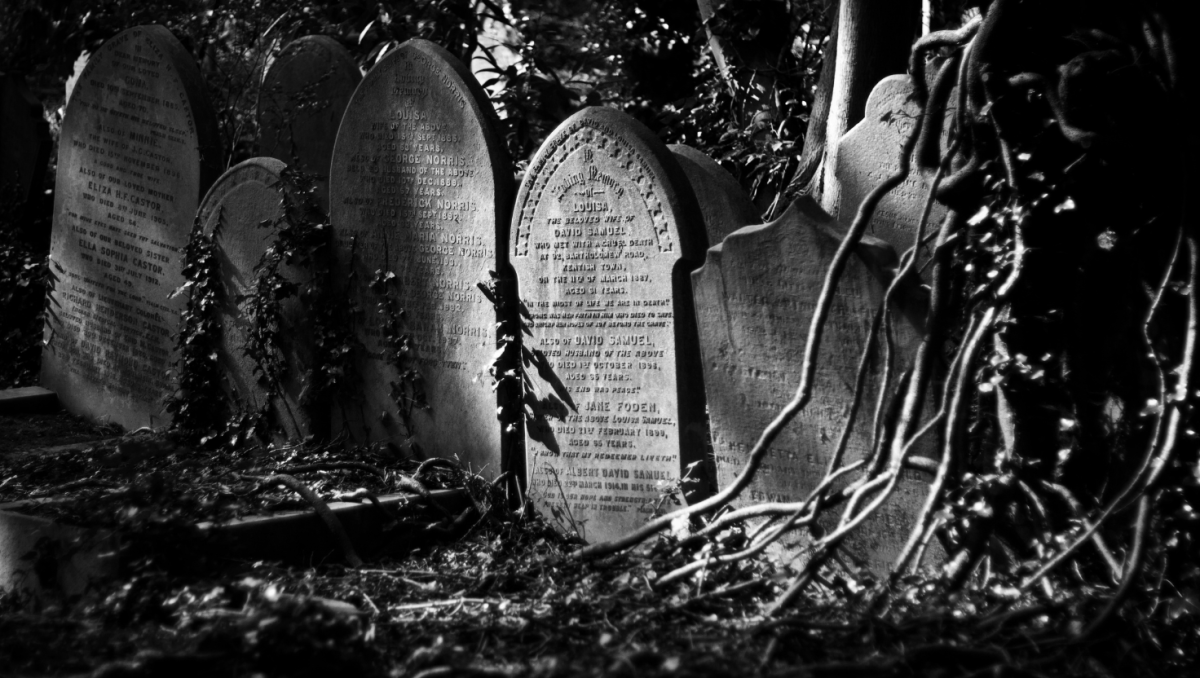
London’s Highgate Cemetery (and here)– the resting place of Karl Marx, George Eliot, Michael Faraday, Henry Moore, George Michael and many other notables– shows us just how hard it is to keep the dead buried. Ralph Jones explains…
“A cemetery’s a really bad idea,” said Ian Dungavell. It’s not a sentence I expected from someone paid to run one. But Dungavell, chief executive of the Friends of Highgate Cemetery Trust, is just as idiosyncratic as the site he presides over. The pair of us were walking around North London’s Highgate Cemetery in late February, as the snowdrops were beginning to flower and rain threatened overhead. As we walked, visitors approached to ask Dungavell, who knows more about the cemetery than perhaps anyone else alive, about specific graves. One woman wanted to know exactly where 19th-century artist Lizzie Siddal was buried. Dungavell tried to explain the route. “It’s slightly tricky if you turn left too soon,” he said. “Then if you turn left too late, we might not see you till tomorrow.”
Dungavell, who is 58 and speaks with the calm precision of an English head teacher, wasn’t speaking ill of his beloved Highgate when he said that a cemetery is a bad idea. He meant that the business of running one has become almost unsustainable. Highgate is the only cemetery in the United Kingdom to charge the public for entry, yet upkeep remains a struggle, costing at least $1.9 million a year. Highgate Cemetery is particularly fascinating because its fortunes have run the gamut—from high to rock bottom, back to high again. It isn’t as easy as it looks, keeping people in the ground.
I was visiting Highgate at a crucial juncture in its history. More change is afoot for this most famous of cemeteries; this “Disneyland of the dead,” in the words of Kenneth Greenway, the cemetery park manager at nearby Tower Hamlets Cemetery Park. To put it bluntly: Highgate, which hosts the bodies and ashes of around 173,000 people, is running out of space. What do you do when you can’t create new graves? You reuse the old ones. In March 2022, the UK Parliament granted the cemetery the right to “disturb human remains”—dig up graves to make space for new bodies—in its mission to combat this problem…
The fascinating (if mildly macabre) details: “Disneyland of the Dead,” from @ohhiralphjones.bsky.social in @longreads.com.
* Beowulf
###
As we ponder posterity, we might recall that it was on this date in 1968 that Gram Parsons quit the Byrds, allegedly over concerns about a planned tour of South Africa, citing his opposition to the country’s apartheid policies. Parsons headed to France, became acquainted with Mick Jagger and Keith Richards of the Rolling Stones (during the recording of Exiles On Main Street) and reintroduced Richards to country music. On returning to Los Angeles, Parsons formed The Flying Burrito Brothers.
Germanely to the piece featured above, Parsons died in 1973 of an overdose…
Although Parsons had said he wanted his body cremated at Joshua Tree and his ashes spread over the formation Cap Rock, Parsons’ stepfather organized a private ceremony in New Orleans and left the body in the care of a funeral home. But, to fulfill Parsons’ wishes, [Parson’s friend Phil] Kaufman and a friend stole both a hearse and his body and drove it to Joshua Tree. At Cap Rock Parking Lot, they poured gasoline into the open coffin and lit it, creating an enormous fireball. They were arrested and eventually fined $750.00, for stealing the coffin. What remained of Parsons’ body was buried in Garden of Memories Cemetery in Metairie, Louisiana.
The story brings Parsons fans out to a large rock flake known to rock climbers as ‘The Gram Parsons Memorial Hand Traverse’. At some point, someone added a slab that marked Parsons’ cremation to the memorial rock; that slab was removed by the U.S. National Park Service and is now at the Joshua Tree Inn. Joshua Tree park guides are given the option to tell the story of Parsons’ cremation during tours, but there is no mention of the act in official maps or brochures…
– source

You must be logged in to post a comment.