Posts Tagged ‘Napoleon’
“Romanticism is precisely situated neither in choice of subject, nor exact truth, but in the way of feeling”*…

The estimable Ted Gioia is exploring the possibility that we are at the cusp of a major change in the zeitgeist– the beginning of a new age of Romanticism…
I made a flippant remark a few months ago. It was almost a joke.
But then I started taking it seriously.
I said that technocracy had grown so oppressive and manipulative it would spur a backlash. And that our rebellion might resemble the Romanticist movement of the early 1800s.
We need a new Romanticism, I quipped. And we will probably get one.
A new Romanticism? Could that really happen? That seems so unlikely.
Even I didn’t take this seriously (at first). I was just joking. But during the subsequent weeks and months, I kept thinking about my half-serious claim.
I realized that, the more I looked at what happened circa 1800, the more it reminded me of our current malaise.
- Rationalist and algorithmic models were dominating every sphere of life at that midpoint in the Industrial Revolution—and people started resisting the forces of progress.
- Companies grew more powerful, promising productivity and prosperity. But Blake called them “dark Satanic mills” and Luddites started burning down factories—a drastic and futile step, almost the equivalent of throwing away your smartphone.
- Even as science and technology produced amazing results, dysfunctional behaviors sprang up everywhere. The pathbreaking literary works from the late 1700s reveal the dark side of the pervasive techno-optimism—Goethe’s novel about Werther’s suicide, the Marquis de Sade’s nasty stories, and all those gloomy Gothic novels. What happened to the Enlightenment?
- As the new century dawned, the creative class (as we would call it today) increasingly attacked rationalist currents that had somehow morphed into violent, intrusive forces in their lives—an 180 degree shift in the culture. For Blake and others, the name Newton became a term of abuse.
- Artists, especially poets and musicians, took the lead in this revolt. They celebrated human feeling and emotional attachments—embracing them as more trustworthy, more flexible, more desirable than technology, profits, and cold calculation.
That’s the world, circa 1800.
The new paradigm shocked Europe when it started to spread. Cultural elites had just assumed that science and reason would control everything in the future. But that wasn’t how it played out.
Resemblances with the current moment are not hard to see.
These considerations led me, about nine months ago, to conduct a deep dive into the history of the Romanticist movement. I wanted to see what the historical evidence told me.
…
I’m now structuring my research in chronological order—that’s a method I often use in addressing big topics.
I make no great promises for what I share below. These are just notes on what happened in Western culture from 1800 to 1804—listed year-by-year.
Sharing these is part of my process. I expect this will generate useful feedback, and guide me on the next phase of this project…
Because music is always my entry point into cultural changes, it plays a key role here in how I analyze past (and present) events. I firmly believe that music is an early indicator of social change. The notes below are offered as evidence in support of that view…
[There follows a fascinating– and compelling– account of those five years, featuring Napoleon, Haydn, Beethoven, Woodsworth, Coleridge, Herder, Schelling, the Marquis de Sade, Novalis, Ann Radcliffe, and others]
… Beethoven turns against Napoleon—and this is emblematic of the aesthetic reversal sweeping through Europe. Not long ago, Beethoven and other artists looked to French rationalism as a harbinger of a new age of freedom and individual flourishing. But this entire progress-obsessed ideology is unraveling.
It’s somehow fitting that music takes the lead role in deconstructing a tyrannical rationalism, and proposing a more human alternative.
Could that happen again?
- Imagine a growing sense that algorithmic and mechanistic thinking has become too oppressive.
- Imagine if people started resisting technology as a malicious form of control, and not a pathway to liberation, empowerment, and human flourishing—soul-nurturing riches that must come from someplace deeper.
- Imagine a revolt against STEM’s dominance and dictatorship over all other fields?
- Imagine people deciding that the good life starts with NOT learning how to code.
If that happened now, wouldn’t music stand out as the pathway? What could possibly be more opposed to brutal rationalism running out of control than a song?
But what does that kind of music sound like? In 1800, it was Beethoven. And today?…
Why it may be 1800 all over again: “Notes Toward a New Romanticism,” from @tedgioia in his terrific newsletter, The Honest Broker.
* Charles Baudelaire
###
As we review vibes on the verge, we might send rational birthday greetings to an avatar of the Enlightenment against which the Romantics rebelled, Francois-Marie Arouet, better known as Voltaire; he was born on this date in 1694. The Father of the Age of Reason, he produced works in almost every literary form: plays, poems, novels, essays, and historical and scientific works– more than 2,000 books and pamphlets (and more than 20,000 letters). He popularized Isaac Newton’s work in France by arranging a translation of Principia Mathematica to which he added his own commentary.
A social reformer, Voltaire used satire to criticize the intolerance, religious dogma, and oligopolistic privilege of his day, perhaps nowhere more sardonically than in Candide.

“Her Majesty’s government should do nothing to place in peril our opium revenues. As for preventing the manufacturing of opium, and the sale of it in China, that is far beyond your power.”*

An excerpt from Linda Jaivin‘s The Shortest History of China…
European traders had been trying to get a foothold in China for centuries. As eager as the Europeans were for Chinese tea, silk, and porcelain, the Chinese remained indifferent to European goods. The Qing restricted access to ports, confining foreign merchants to Guangzhou (Canton), from October to March. Foreign traders resented this, as well as having to work with licensed Chinese intermediaries and abide by local law. In 1793, the British sent an experienced diplomat, Lord George Macartney, to Qianlong’s court carrying a letter arguing for greater access to the empire’s markets, including a reduction in tariffs, the ability of merchants to live in China year-round, and the stationing of an ambassador in Beijing.
The eighty-year-old Qianlong agreed to receive the Englishman at his imperial hunting lodge at Chéngdé, northeast of Beijing. The protocol of an imperial audience demanded a kowtow. Macartney refused, instead bowing on one knee before Qianlong, just as he did with his own sovereign, King George III. Qianlong received him courteously anyway, but once Macartney left and his letter was translated, Qianlong instructed his ministers to bolster the Qing’s coastal defenses, predicting that England, ‘fiercer and stronger than other countries in the Western Ocean,’ might ‘stir up trouble.’ To Macartney he prefaced his reply by saying that the Qing had everything it needed in abundance: ‘I set no value on objects strange or ingenious, and have no use for your country’s manufactures.’
The British East India Company, which enjoyed a British monopoly on East Asian trade, had something for which at least some Chinese had use: opium, grown in British-controlled India. Opium was already cultivated in China, but in small quantities — soldiers and manual laborers relied on it for pain relief, and some of the idle rich smoked it for pleasure. In 1729, the British sold two hundred chests of opium into China, each containing almost sixty kilograms of the drug. In 1790, three years before Macartney’s visit, they sold 4,054 chests. That number increased steadily.
Qianlong retired in 1796 in a gesture of filial piety, not wanting his reign to outlast that of his revered grandfather, Kangxi. This left the problem of opium to his successor, Jiāqìng (r. 1796-1820).
In 1815, the British sent another envoy, Lord Amherst, to Beijing. Jiāqìng expelled him after another tussle over the kowtow.
Opium addiction began to damage the fabric of Chinese society. The illegal trade fostered corruption, and silver drained from the imperial coffers. Debate raged in the court of Jiāqìng and his successor, Dàoguāng (r. 1821-1850), over whether to legalize opium — encouraging domestic production and limiting trade-related corruption — or ban it. In 1838, Daoguang decided on prohibition. In March 1839, the emperor sent the official Lín Zéxú (1785-1850) to Guangzhou, the hub of the opium trade, to implement the ban. By July, Lin had arrested thousands of addicts and confiscated almost twenty-three thousand kilos of opium, as well as seventy thousand pipes.
Lín Zéxú demanded that the 350 or so foreign traders in Guangzhou surrender their opium. As tensions rose, he locked them in their warehouses. Chinese soldiers blew horns and banged gongs to increase the pressure on them. It took six weeks, but the foreigners handed over twenty thousand chests. Now in possession of almost 1.4 million kilos of opium, Lín Zéxú had it mixed with water, salt, and lime and flushed out to sea.
In response, British warships blockaded the entrance to Guangzhou’s harbor, smashed through Chinese defenses, and captured ports including Shanghai and Ningbo, blocking maritime traffic on the Grand Canal and lower Yangtze. This became known as the First Opium War.
Under duress, the Qing signed the Treaty of Nanjing in 1842, which granted the British access to Guangzhou, Shanghai, and three other ‘treaty ports.’ It also ceded the island of Hong Kong — ‘fragrant port,’ named for the spice trade — to the British in perpetuity. (The British foreign secretary at the time, Lord Palmerston, questioned the wisdom of acquiring ‘a barren island with hardly a House upon it’ that would never become a great ‘Mart of Trade.’) It imposed indemnities on the Qing totaling twenty-one million silver dollars. The United States, France, and other nations piled on with their own demands, including ‘extraterritoriality’ exemption from local justice for foreigners who committed crimes in China. Chinese law would not apply within ‘concessions’ those parts of the treaty ports controlled by foreign powers. These agreements were the first of what are called the Unequal Treaties, beginning a century of China’s humiliation at the hands of various imperialist powers. They heralded the beginning of the end, not just of the Qing, but of the dynastic system by which China had been ruled for thousands of years…
Via the invaluable Delancyplace (@delanceyplace): “The Opium Wars.”
* Lord Ellenborough, 1843
###
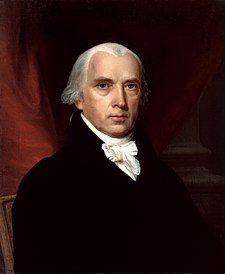
As we contemplate colonialism, we might recall that it was on this date in 1812 that President James Madison signed the declaration of war against Great Britain that formally launched the War of 1812.
Three U.S. incursions into Canada launched in 1812 and 1813 had been handily turned back by the British despite the fact that the bulk of British force was tied up in an unpleasantness with the Emperor of France and his troops. But the decline of Napoleon’s strength freed the English to devote more resources to the West… leading to the 1814 burning of the White House, the Capital, and much of the rest of official Washington by British soldiers (retaliating for the U.S. burning of some official buildings in Canada). Still, by the end of 1814 a combination of naval and ground victories by the Americans had driven the British back to Canada, and on December 14, 1814 the Treaty of Ghent, ending the war, was signed… sadly for the British, word of the accord did not reach troops on the Gulf Coast in time to head off an attack (on January 8, 1815) on New Orleans– which was turned back by American forces led by Andrew Jackson. Jackson became a national hero, who rode his fame to the (rebuilt) White House; Johnny Horton got a Number One record out of it (Billboard Hot 100, 1959)… and the English had to console themselves with their victory at Waterloo later that year– on this date in 1815…
“Mathematics has not a foot to stand on which is not purely metaphysical”*…

Lest we forget…
A forgotten episode in French-occupied Naples in the years around 1800—just after the French Revolution—illustrates why it makes sense to see mathematics and politics as entangled. The protagonists of this story were gravely concerned about how mainstream mathematical methods were transforming their world—somewhat akin to our current-day concerns about how digital algorithms are transforming ours. But a key difference was their straightforward moral and political reading of those mathematical methods. By contrast, in our own era we seem to think that mathematics offers entirely neutral tools for ordering and reordering the world—we have, in other words, forgotten something that was obvious to them.
In this essay, I’ll use the case of revolutionary Naples to argue that the rise of a new and allegedly neutral mathematics—characterized by rigor and voluntary restriction—was a mathematical response to pressing political problems. Specifically, it was a response to the question of how to stabilize social order after the turbulence of the French Revolution. Mathematics, I argue, provided the logical infrastructure for the return to order. This episode, then, shows how and why mathematical concepts and methods are anything but timeless or neutral; they define what “reason” is, and what it is not, and thus the concrete possibilities of political action. The technical and political are two sides of the same coin—and changes in notions like mathematical rigor, provability, and necessity simultaneously constitute changes in our political imagination…
Massimo Mazzotti with an adaptation from his new book, Reactionary Mathematics: A Genealogy of Purity: “Foundational Anxieties, Modern Mathematics, and the Political Imagination,” @maxmazzotti in @LAReviewofBooks.
* Thomas De Quincey
###
As we count on it, we might send carefully-calculated birthday greetings to Regiomontanus (or Johannes Müller von Königsberg, as he was christened); he was born on this date in 1436. A mathematician, astrologer, and astronomer of the German Renaissance, he and his work were instrumental in the development of Copernican heliocentrism during his lifetime and in the decades following his death.

“Those who cannot remember the past are condemned to repeat it”*…

The number of American university students selecting history as their chosen four year degree has been on the decline since the 1970s…

Tanner Greer (@Scholars_Stage) considers four possible reasons– and what they portend: “The Fall of History as a Major–and as a Part of the Humanities.”
(Image at top: source)
* George Santayana, The Life of Reason, 1905
###
As we ponder the practicality of the past, we might we might celebrate a major contribution to the study of history; it was on this date in 1799 (or close; scholars agree that it was “mid-July” but disagree on the precise day) that a French soldier in Napoleon’s Egyptian Campaign discovered a black basalt slab inscribed with ancient writing near the town of Rosetta, about 35 miles north of Alexandria.
The stone contained fragments of passages written in three different scripts inscribed by priests of Ptolemy V in the second century B.C.– Greek, Egyptian hieroglyphics, and Egyptian demotic. The Greek passage proclaimed that the three scripts were all of identical meaning– so allowed French Egyptologist Jean Francois Champollion to decipher the hieroglyphics… and opened the language of ancient Egypt, a written language that had been “dead” for nearly two millennia.

“Those who can make you believe absurdities, can make you commit atrocities”…

Richard Whately’s 1843 book on whether Napoleon actually existed deserves to be turned into a documentary. It is either (1) an extreme example of skepticism, or (2) satire, or (3) satire of an extreme example of skepticism, or (4) a straightforward debunking of Napoleon’s existence, or—and my preferred interpretation—(5) the first example of French deconstruction…
Faulkner argued that “The past is never dead. It’s not even past.” Ted Gioia (@tedgioia) offers a timely historical example: “Historic Doubts Relative to Napoleon Buonaparte.” Via his wonderful newsletter.
* Voltaire
###
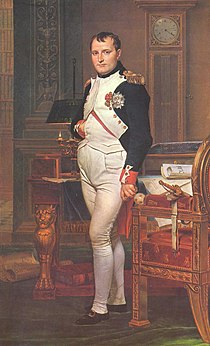
As we contend with conspiracists, we might we might recall that it was on this date in 1804 that Napoleon Bonaparte was in fact proclaimed Emperor of France by the French Senate– at least in part an unintended consequence of Britain’s declaration of war against France (again), exactly one year before, in response to Napoleon’s “activities” in Italy and Switzerland… (Napoleon formally crowned himself “Emperor Napoleon I” on December 2, 1804 at Notre Dame de Paris.)
You must be logged in to post a comment.