Posts Tagged ‘skepticism’
“A cynic is a man who knows the price of everything, and the value of nothing”*…

In times like these, it’s all too easy to resort to (or indeed, to relapse into) cynicism. In an excerpt from his recent book Hope for Cynics, the director of the Stanford Social Neuroscience Lab, Jamil Zaki, offers an alternative…
… Over the last few years, I’ve met dozens of self-proclaimed cynics. Besides the obvious contempt for people, most have something else in common: a harsh pride. It may feel better to believe in people than to be cynical, they say. But we can’t go around thinking whatever we want, just like we can’t pretend tiramisu is a health food. Cynics might live hard lives, but that’s just the price of being right.
If cynicism is a sign of intelligence, then someone who wants to appear smart might put it on, like wearing a suit to a job interview. And indeed, when researchers ask people to appear as competent as possible, they respond by picking fights, criticizing people, and removing friendly language from emails—performing the gloomiest version of themselves to impress others.
Most of us valorize people who don’t like people. But it turns out cynicism is not a sign of wisdom, and more often it’s the opposite. In studies of over 200,000 individuals across thirty nations, cynics scored less well on tasks that measure cognitive ability, problem-solving, and mathematical skill. Cynics aren’t socially sharp, either, performing worse than non-cynics at identifying liars. This means 85 percent of us are also terrible at picking lie detectors. We choose Colleens to get to the bottom of things when we should join team Sue.
In other words, cynicism looks smart, but isn’t. Yet the stereotype of the happy, gullible simpleton and the wise, bitter misanthrope lives on, stubborn enough that scientists have named it “the cynical genius illusion.”
If cynicism is a pathogen, we can create resistance to it with skepticism: a reluctance to believe claims without evidence. Cynicism and skepticism are often confused for each other, but they couldn’t be more different. Cynicism is a lack of faith in people; skepticism is a lack of faith in our assumptions. Cynics imagine humanity is awful; skeptics gather information about who they can trust. They hold on to beliefs lightly and learn quickly…
Timely advice: “Instead of Being Cynical, Try Becoming Skeptical,” from @zakijam in @behscientist.
* Oscar Wilde
###
As we reframe, we might recall that it was on this date (which is, by the way, Fibonacci Day) in 1644 that John Milton, best remembered, of course, for his epic poem Paradise Lost, published Areopagitica; A speech of Mr. John Milton for the Liberty of Unlicenc’d Printing, to the Parlament of England. A prose polemic opposing licensing and censorship, it is among history’s most influential and impassioned philosophical defenses of the principle of a right to freedom of speech and expression. The full text is here.

“Those who can make you believe absurdities, can make you commit atrocities”…

Richard Whately’s 1843 book on whether Napoleon actually existed deserves to be turned into a documentary. It is either (1) an extreme example of skepticism, or (2) satire, or (3) satire of an extreme example of skepticism, or (4) a straightforward debunking of Napoleon’s existence, or—and my preferred interpretation—(5) the first example of French deconstruction…
Faulkner argued that “The past is never dead. It’s not even past.” Ted Gioia (@tedgioia) offers a timely historical example: “Historic Doubts Relative to Napoleon Buonaparte.” Via his wonderful newsletter.
* Voltaire
###
As we contend with conspiracists, we might we might recall that it was on this date in 1804 that Napoleon Bonaparte was in fact proclaimed Emperor of France by the French Senate– at least in part an unintended consequence of Britain’s declaration of war against France (again), exactly one year before, in response to Napoleon’s “activities” in Italy and Switzerland… (Napoleon formally crowned himself “Emperor Napoleon I” on December 2, 1804 at Notre Dame de Paris.)
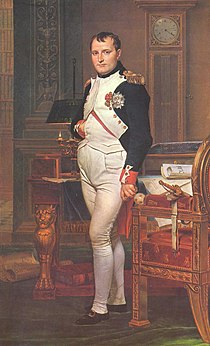
Oh yeah?…
It’s tough to assess the dueling explanations of the fix(es) that we’re in , and to judge the completing claims for remedies. Happily, a professional skeptic– founding publisher of Skeptic magazine, Scientific American columnist, and economics professor)– Michael Shermer has ridden to the rescue with his Baloney Detection Kit— “ten questions we should ask when encountering a claim.”
1. How reliable is the source of the claim?
2. Does the source make similar claims?
3. Have the claims been verified by somebody else?
4. Does this fit with the way the world works?
5. Has anyone tried to disprove the claim?
6. Where does the preponderance of evidence point?
7. Is the claimant playing by the rules of science?
8. Is the claimant providing positive evidence?
9. Does the new theory account for as many phenomena as the old theory?
10. Are personal beliefs driving the claim?
(Presented by The Richard Dawkins Foundation for Reason and Science. C.F. also, the ever-insightful Howard Reingold’s “Crap Detection 101,” with it’s allusion to John McManus’ terrific Detecting Bull: How to Identify Bias and Junk Journalism in Print, Broadcast and on the Wild Web.”)
As we get to the bottom of things, we might note that, while this is the day that folks in the U.S. celebrate the Declaration of Independence in 1776 of the US from Great Britain, it is also a day to spare a memorial thought for two of the drafters and signers of that document, John Adams and Thomas Jefferson (respectively, of course, the second and third Presidents of the United States), as both died on this date 1826.

You must be logged in to post a comment.