Posts Tagged ‘French history’
“Justice is the first virtue of social institutions, as truth is of systems of thought… Each person possesses an inviolability founded on justice that even the welfare of society as a whole cannot override.”*…

Stephen Colbert once observed that “reality has a well-known liberal bias.” And indeed, liberalism— the political/moral philosophy rooted in individual liberty, consent of the governed, and equality before the law– has been a major ideology through modern times… and, of course, the major ideology animating the founding of the United States.
But as Easten European states turn to authoritarians, Western European nations wrestle with the rise of nationalist far-right parties, and the U.S. is “steered” by MAGA using Project 2025‘s “map,” there’s a concern that liberalism’s days may be past.
Persuasion is running a series of essays on “Liberal Virtues and Values.”
The series, made possible with the generous support of the John Templeton Foundation, will make the case that liberalism has its own distinctive set of virtues and values that are capable not only of responding to the dissatisfaction that drives authoritarianism, but also of restoring faith in liberalism as an ideology worth believing in—and defending—on its own terms.
The latest installment is from Martin Gurri, who argues that Liberalism needs a new foundation (and that how we handle AI will matter fundamentally)…
That liberal democracy is in a state of terminal decline I take to be beyond dispute. Like Alice in the rabbit hole, those of us who dwell in democratic societies suffer from a nauseating sense of falling without ever landing on solid ground. The usual suspects blamed for this tumble—populism, inequality, the economy—are mere surface symptoms of an internal breakdown. We have arrived at the conclusion of a world-historical cycle. Liberal democracy is the procedural embodiment of Enlightenment ideology—and after two centuries of dominance, that ideology has lost all purchase and stands utterly exhausted.
Radical alternatives confront us. Either we reorient our system to post-Enlightenment principles or we risk staggering into the nihilist’s paradise I have called the Endarkenment.
Enlightenment philosophers placed their faith in reason and science. These are purely critical disciplines: liberal propagandists wielded criticism like a scalpel to dissect conservative laggards and utopian revolutionaries alike. Once triumphant at the “end of history,” liberal democracy turned the knife on itself—a process of self-criticism and self-doubt that has shredded its own ideals to ribbons.
The positive values inherited from the Enlightenment—equality, individualism, compassion—were always parasitic on Christianity. But Christianity, like all religions, has no place in a universe ruled by reason and science. Nietzsche long ago brought us the troubling news: the Christian God is dead. Oblivious to the implications of this calamity, liberal democracy kept marching like a cartoon character over the edge of the abyss, until the laws of moral gravity asserted themselves. So began the Great Fall.
Criticism is a force for progress so long as there are blatant irrationalities, like slavery or Jim Crow discrimination, to overcome. But under the hammer of Enlightenment ideals, modern society has been flattened, centralized, and rationalized. Deprived of obvious superstitions to debunk and totalitarian rivals to defeat, liberal democracy has been revealed in all its internal contradictions.
One such contradiction, I contend, pits the cherished principle of equality against the chosen few who actually practice reason and science: let’s call this the problem of the elites.
A second contradiction finds freedom of the press and of opinion arrayed against the need to protect objective truth: call it the problem of information.
Finally, freedom of worship and the life of the spirit collide head-on with the materialist criticism favored by Enlightenment ideology: the problem of meaning.
Each of these contradictions could prove fatal to the democratic project, but none is insoluble, and the search for solutions offers an opportunity for renewal. While there are no guarantees, we could emerge from the crisis with a better understanding of the reach and limits of equality, a more transparent information sphere, and even, it may be, a rich infusion of the transcendental into everyday life…
[Gurri unpacks each of those contradictions…]
… So what is to be done?
The first, obvious step is to move the question to the center of our shared conversations. The most capacious thinkers of the age should contemplate first principles and ultimate goals with at least as much intensity as they invest in Donald Trump or the latest economic report. There’s nothing artificial about this. Science and reason are necessary for modernity. Meaning and moral aspiration are necessary for humanity. A balance must be struck that preserves the one and gives full weight to the other.
Materialism, we must understand, is a valuable perspective for science but not a realistic appraisal of the human condition. Scientists work as if on a geometric point, abstracted from nature and indifferent to its dispositions. In reality, however, we come from nature, we are of nature, and we are far from indifferent to our place in it. Our intuitions are internal to the system: humanity’s spiritual quest is, in every sense, nature reflecting on itself. One such intuition is agency—the belief that, at the crossroads, I am free to go right or left, and I alone make the choice. Another is faith in causation. These stances are irrational, or rather pre-rational, but without them liberal democracy as well as science itself would be impossible.
In the end, materialism is self-defeating. To say, “I choose to be a materialist” is to fall into an absurd fallacy. Either our bodies, which consist of matter, obey unchanging laws, or the mind, transcending matter, is capable of choice. There can be no middle ground.
Politics, in a metaphysical age, will resume its traditional place as a secondary activity—a means to an end. This will leave liberal democracy vulnerable to false prophets who are willing to trample on individual rights in pursuit of some apocalyptic scheme. The interesting question is whether the post-truth condition will make the peril greater or lesser. On the one hand, the lack of universal firewalls might make it easier for a fanatic to flood the system. Yet post-truth itself, I believe, is the strongest kind of firewall. In our fractured, eternally contested environment, the progress of any totalizing doctrine will be painfully slow. The quest for meaning and the struggle over frames of reference are, in the end, really one and the same.
We have inherited a rich and evocative spiritual vocabulary, but it belongs to a worldview thousands of years old. “King of kings,” to cite just one example, should sound archaic in a democratic age. Can we awaken the scientific world to the spirit? Is it possible to sanctify our largely instrumental relations? This shouldn’t entail a belief in fairies and goblins, or even necessarily in religion. Any good empiricist will admit that the richest human lives are lived symbolically. Can we climb the symbolic ladder to the mountaintop, where meaning and modern humanity come harmoniously together—anchoring, it may be, a loftier understanding of equality and social life, and of the sanctity of truth?
We won’t know until we try. Pessimism, let me suggest, is unwarranted. History moves in mysterious ways. We may be due for a second coming of historian Karl Jaspers’ “Axial Age”: preachers and philosophers who conceived a drastically updated transcendental vision, with the rational and the sacred, truth and meaning, reconciled with political freedom.
For 200 years, we placed society under the sway of universal principles. That’s gone with the wind. We have entered an era of radical contingency, in which even truth is indeterminate. The natural tendency is to retreat to the certainties of the past—but there’s no going back. If we hope to preserve the gains from Enlightenment society, and resolve its many contradictions, we’ll have to do so within a new and wildly unstable conceptual framework.
With the spell of the Enlightenment broken, liberal democracy will have to redefine what “created equal” means. This process could end in a rigid caste system, with the institutions in the hands of self-selected mandarins who wield the power of the state to impose their “solutions.” Preferably, and more likely given the thrust of the new technology, we’ll see a flattening of the institutions and the continued trampling by the public into the sacred spaces of politics and communication.
Equality, however understood, will be forged in the will of the citizenry rather than granted by a benevolent God. That will make it contingent like everything else, and so liable to variation and in constant need of defense. And if perfect equality is an impossible dream, eternal inequality requires impossible discipline. The current elite class, already under enormous pressure, may lose its cohesion and melt into the impermanence of the age, divided among the various schools and sects and frames of reference.
The structure of information will follow the definition of equality. The commanding heights will be control over AI. If AI development and deployment is a closed game, the elites could set themselves up as intermediaries in the oracle of an omniscient divinity. If AI is a competitive product, the public will gain the upper hand. In that case, we can expect a flowering of eccentric applications, the individualization of commerce and industry, and the final overthrow of the expert class. The information sphere will remain the mirror to our passions, divisions, and metaphysical longings. Freedom of speech, no longer “endowed by our Creator,” will become the battleground on which the question of equality is ultimately settled.
Here I finally reveal myself in my true colors. I’m an analyst. My task is to describe reality, and that’s what this essay is about. But I also lead an active life inside the world that I’m describing—and I have preferences. I see equality as a factor of opportunity, law, and human dignity, not of perfect outcomes. I think truth emerges from examining a subject from a large number of perspectives, even those that may seem disturbing or false. I hope that my story—as a person, a father, a grandfather—connects to other stories in the past and will connect to more in the future, in a pattern that is not entirely devoid of meaning. And I believe fervently in liberal democracy, because—born in Cuba—I have tasted the alternative.
The breakdown of Enlightenment ideology is only the latest challenge liberal democracy has faced in my lifetime. I’m not entitled, as an analyst, to downplay the perils ahead, but I’m allowed, as an American, to have faith that they will once again be overcome…
Eminently worth reading in full: “The Search for a Post-Enlightenment Democracy”
###
As we renew, we might send free-thinking birthday greetings to Henri-Benjamin Constant de Rebecque (or as he’s usually called, Benjamin Constant); he was born on this date in 1767. A French political thinker, activist, and writer on political theory and religion (whose work influenced, among many others, Sir Isaiah Berlin), Constant was a committed republican from 1795, backing the coup d’état of 18 Fructidor in1797, and the following one on 18 Brumaire, in 1799. He became the leader of the Liberal opposition in 1800, during the Consulate. Constant fell out with Napoleon, and had to flee (first to Switzerland, then to Saxony). Nonetheless, after his return to France, Constant sided with the Emperor during the Hundred Days, drafting the Charter of 1815. He became politically active again during the Bourbon Restoration and was elected to the Chamber of Deputies in 1818 (where he remained until his death in 1830). As the head of the Liberal opposition, known as Indépendants, Constant was one of the most notable orators in the Chamber, especially in his role as a proponent of the parliamentary system.

“Those who can make you believe absurdities, can make you commit atrocities”…

Richard Whately’s 1843 book on whether Napoleon actually existed deserves to be turned into a documentary. It is either (1) an extreme example of skepticism, or (2) satire, or (3) satire of an extreme example of skepticism, or (4) a straightforward debunking of Napoleon’s existence, or—and my preferred interpretation—(5) the first example of French deconstruction…
Faulkner argued that “The past is never dead. It’s not even past.” Ted Gioia (@tedgioia) offers a timely historical example: “Historic Doubts Relative to Napoleon Buonaparte.” Via his wonderful newsletter.
* Voltaire
###
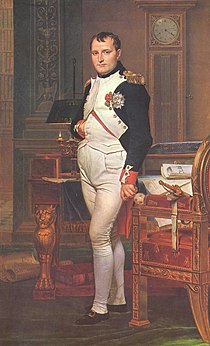
As we contend with conspiracists, we might we might recall that it was on this date in 1804 that Napoleon Bonaparte was in fact proclaimed Emperor of France by the French Senate– at least in part an unintended consequence of Britain’s declaration of war against France (again), exactly one year before, in response to Napoleon’s “activities” in Italy and Switzerland… (Napoleon formally crowned himself “Emperor Napoleon I” on December 2, 1804 at Notre Dame de Paris.)
“When the legend becomes fact, print the legend”*…

Chateaubriand’s tomb, Saint-Malo, France
Because history “belongs to the victors”– is shaped, both consciously and preter-consciously by writers looking back through the lens of their often very different presents– memoir can be an especially valuable as a vehicle for understanding a time in its own terms. François-René (Auguste), vicomte de Chateaubriand’s Memoirs from Beyond the Grave are especially precious. His autobiography helps us as readers locate ourselves in a time of tumultuous transition– from the ancien régime to the modern era: the Revolution of 1789, the downfall of the monarchy and the execution of the king, the advent of Napoleon Bonaparte and the empire, the restoration of the Bourbon dynasty after the definite defeat of Napoleon by the powers that joined in the Holy Alliance, its overthrow by the Revolution of July 1830, the inauguration of Louis-Philippe and the establishment of the July monarchy, and finally the birth of the short-lived Second Republic.
But more, Memoirs helps us understand the psychological reality of living through– and in Chateaubriand’s case, playing a series of engaged roles in– that social and political sea change.
Chateaubriand was attached to the past and its centuries-old traditions, but he was also a liberal, open to modernity: this is one thing that sets him apart in the history of ideas. He had been repulsed by the discourse and the violence of the French revolutionaries and was deeply impressed by the powerful composure of George Washington, “the representative of the needs, ideas, intelligence, and opinions of his epoch.” He had a vision of social transformation that did not entail the obliteration of the past, and was proud to declare himself “Bourboniste by honor, royalist by reason, and republican by inclination.”…
Anka Muhlstein on the significance of the Memoirs: “A Passionate Witness“; get the book here.
(Literature can play a similar role: consider the Prince in Lampedusa’s The Leopard and Tom Doniphon (John Wayne) in John Ford’s The Man Who Shot Liberty Valence.)
* newspaper reporter Maxwell Scott (Carleton Young), in The Man Who Shot Liberty Valence
###
As we struggle to understand, we might send tasty birthday greetings to the culinary genius behind green eggs and ham, Theodor Seuss Geisel, AKA “Dr. Seuss”; he was born on this date in 1904. After a fascinating series of early-career explorations, Geisel settled on a style that created what turned out to be the perfect “gateway drug” to book addiction for generations of young readers.
The more that you read,
The more things you will know.
The more that you learn,
The more places you’ll go.
– I Can Read With My Eyes Shut! (1978)

“Happiness is not something ready made”*…

Hedonometer reading for The Adventures of Huckleberry Finn
A collaboration of data scientists at the University of Vermont and the Mitre Corporation, the Hedonometer was created to gauge happiness by assessing word use. It was first applied to Twitter, as readers can see here. More lately, it has been turned on the repository at Project Gutenberg, so that users can test the “happiness” of thousands of classic books… as above. The chart in the top left shows happiness metrics through the whole of the book; the chart on the right shows a comparison of book sections, which one can select in the first chart.
As our friends at Flowing Data observe, “I wish I could say this meant something to me…” Still, it makes one happy to know that they’re on the case.
* Dalai Lama
###
As we search for word replacements codes, we might recall that it was on this date in 1977 that Hamida Djandoubi became the last person to be legally executed in France by guillotine.

“In the beginning was the Word”*…

Pope Francis has been widely lauded in the media for his focus on serving as an example of Christian humility and engaging the marginalized and poor. His decision to live in the the Vatican guesthouse rather than in the Apostolic Palace, his handling of extreme opulence within the Catholic Church, and his priority for frequent, visible acts of charity all point to the direction Pope Francis wishes to guide the Church… Since the beginning of his papacy both the pope’s actions and his words have suggested a shift in focus as compared to his predecessor Pope Benedict XVI…
In order to glean more clues about Pope Francis’ philosophy and how he will communicate it, I analyzed word frequencies in the first 104 official speeches given by Pope Francis, from March 2013 to November 2013. For comparison, I did the same analysis for the first 102 official speeches of Pope Benedict XVI, given between April 2005 and November 2005. For both popes I used only speeches that had English translations. To visualize the results I created word clouds below, where the sizes of words are proportional to their usage (the differences in color are meaningless and intended to help the reader focus on specific words). Finally, I removed the top five words used by both popes, to better discern differences in word usage. These top five words were: God, Jesus, Lord, Christ, and Church…
Read more of Chris Walker‘s analysis on his site, Vizynary.
*John 1:1
###
As we ponder pontiffs, we might spare a thought for a saint; it was on this day in 1431 that investigations began for the trial of Joan of Arc. Joan had entered history in spectacular fashion during the spring of 1429: following what she maintained was the command of God, Joan led the French Dauphin’s armies in a series of stunning military victories over the English, effectively reversing the course of the Hundred Years’ War. But she was captured in 1430 by the Burgundians, a faction (led by the Duke of Burgundy) allied with the English. The French King, Charles VII, declined to ransom her from the Burgundians who then “sold” her to the English. In December of that year, she was transferred to Rouen, the military headquarters and administrative capital in France of King Henry VI of England, and placed on trial for heresy before a Church court headed by a Bishop loyal to the English.
Joan was convicted and executed in May of 1431. She was exonerated in 1456 when the verdict was reversed on appeal by the Inquisitor-General. She became a French national heroine, and in 1920 was canonized a saint of the Roman Catholic Church.

Joan of Arc interrogated by The Cardinal of Winchester in her prison 1431. Painting by Paul Delaroche (1797-1856).
You must be logged in to post a comment.