Posts Tagged ‘France’
“Anyone who has ever struggled with poverty knows how extremely expensive it is to be poor”*…

We’ve become a nation of credit and debit card users. As of this year, Pew reports, 42% of Americans don’t use cash for purchases in a typical week (up from 24% in 2015); another 46% use a mix of cash and plastic; only 12% use mostly (or entirely) cash. The Federal Reserve reports, unsuprisingly, that cash remains the dominant mode for the elderly and the poor; debit cards, for lower-to-middle-income households.
NBER unpacks one little-understood consequence of this shift…
Every time a consumer swipes a credit card, the merchant pays an interchange fee—typically around 1.9 percent of the transaction value—most of which funds the rewards that cardholders receive. Because merchants generally charge the same prices regardless of how customers pay, consumers who use cash or debit cards effectively help finance the rewards enjoyed by credit card users. In Who Pays for Payments? (NBER Working Paper 35067), Mark L. Egan, Gregor Matvos, Amit Seru, Lulu Wang, and Vincent Yao use novel merchant-level data from Fiserv—one of the largest US merchant acquirers—to measure how the payment system redistributes resources.
The primary dataset contains establishment-level payment data from 2006 to 2022, including total payment values, transaction counts, and interchange fees paid for different card types…
… The researchers’ analysis using these datasets suggests that interchange fees transfer approximately $30 billion annually from cash and debit card users to credit card users. Cash users lose about 96 basis points of purchasing power, and regulated debit card users lose roughly 47 basis points, while basic and premium credit card users gain approximately 48 and 59 basis points, respectively. Because credit card use rises with income, the system generates an estimated $9.2 billion annual transfer from households earning less than $150,000 to those earning more.
Two forces moderate this redistribution. First, the tendency for cash, debit, and credit card users to shop at different merchants limits the overlap necessary for cross-subsidization. Second, where overlap does occur, such as at large grocery stores and gas stations, interchange fees tend to be lower due to sector discounts and negotiated rates. Together, these forces reduce the transfer by approximately 25 percent relative to the transfer that would occur with homogeneous consumers and merchants.
The researchers also examine the redistributive consequences of two specific developments in the payment system. The first is the Durbin Amendment, which capped interchange fees on debit cards issued by large banks. The authors show that one perhaps unintended consequence of the amendment was that it primarily benefited credit card users through lower retail prices at the expense of regulated debit card users, who lost approximately $9.6 billion in rewards and free checking benefits. This was a net transfer from middle-income to higher-income households. The second development is the rise of premium credit cards, which grew from 15 percent of credit card volume in 2006 to 60 percent by 2022. This has also been a regressive development. While premium cardholders gained about $7.9 billion, debit card users—not cash users—bore the largest dollar losses because they shop most frequently alongside premium card users…

The rich getting richer: “Who Ultimately Pays Credit Card Interchange Fees?” from @nber.org.
Pair with Annie Lowrey on another burden– a “time tax”– that falls disportionately on the neediest: “How American Bureaucracy (Literally) Steals Years From Your Life“:
Washington currently estimates that Americans spend 12 billion hours a year filling out government forms, meaning the average person spends six 8-hour workdays filing their taxes, signing up for Medicaid, renewing their driver’s licenses, and applying for government loans. At prevailing wages, this uncompensated labor is worth $430 billion a year. If Washington were to create a Department of Bureaucracy to take on the paperwork it shunts to citizens, the agency would require 5.9 million employees, making it four times the size of the active-duty military. The DOB’s payroll would be larger than that of every other federal department combined.
The nation’s paperwork regime frustrates every resident, and particularly lower-income residents who use more government programs and interact more frequently with public officials. The political scientist Elizabeth Cohen has done seminal work exploring time as a potent, if obscure, form of political currency. “The devaluation of a person or group’s political time is a structural obstacle to equality,” she writes. Yet we can’t measure time and effort as easily as we measure dollars, and we don’t even try. The 12-billion-hour estimate is an undercount, and an egregious one…
* James Baldwin (see also Terry Pratchett’s “Boots theory“)
###
As we second-guess secreted subventions, we might spare a thought for Jean-Baptiste Colbert; he died on this date in 1683. A French statesman who served as First Minister of State under the rule of King Louis XIV from 1661 until his death. His lasting impact on the organization of the country’s politics and markets, known as Colbertism, a form of the mercantilism so popular in the Trump Administration today. Colbert also helped craft the Code Noir, a legal instrument that sanctioned an intentionally brutal system of torture and repression to enforce institutional slavery in the French colonial empire and restrict the enterprise of free Black people.
Though Colbert was more competent and less crony-ish than the crew at “work” in D.C. over the last couple of years, his goal of a healthy economy was frustrated by a King whose spending out-ran (and whose favoritism undermined) Colbert’s efforts. In the longer run, many economists suggest that “Colbertism” has contributed to contributed to a lack of adaptability in French industry and a hostility to technological innovation.

“Leadership of a world-economy is an experience of power which may blind the victor to the march of history”*…

Benjamin Braun and Cédric Durand on the citical tension between “factions of capital” in the second Trump administration…
Hegemonic decline, according to the historian Fernand Braudel [see here and here], has historically come with financialization. Amid declining profitability in production and trade, capital owners increasingly shift their assets into finance. This, according to Braudel, is a “sign of autumn,” when empires “transform into a society of rentier-investors on the look-out for anything that would guarantee a quiet and privileged life.”
This specter of Braudelian decline haunts key figures in the second Trump administration. “Tell me what all the former reserve currencies have in common,” Scott Bessent, now Treasury Secretary, mused during the campaign. “Portugal, Spain, Holland, France, UK … How did they lose reserve currency status?” The answer: “They got highly leveraged and could no longer support their military.” While Bessent, a former hedge fund manager, officially denies a program of dollar depreciation, speculators have been driving down the US exchange rate since Trump took office in January. Secretary of State Marco Rubio is the author of a 2019 report on “American investment in the 21st century,” in which he lambasts Wall Street for its shareholder value regime that “tilts business decision-making towards returning money quickly and predictably to investors rather than building long-term corporate capabilities.” His views on finance are shared by self-styled Republican “populists” such as Josh Hawley.
This residual hostility toward Wall Street has marked an ideological rupture in the first months of Trump’s second administration; on the one hand, the President’s “Liberation Day” tariffs have roiled financial markets; on the other, Wall Street has retaliated with financial panics, working to discipline the White House. Whether a coalition of self-styled MAGA populists and Trump’s electoral base—which expects rising living standards and secure jobs delivered via a tariff-led revival of US manufacturing and a deportation-led tightening of the labor market—is sustainable remains a central question of the second Trump administration. Fossil fuel firms and defense-oriented tech companies such as Palantir and Anduril find much to like in militarized nativism. But Trump’s trade policy clearly harms private finance and big tech, two sectors that have consistently supported Trump and expect to be rewarded. Attacking those sectors threatens to alienate the very factions of US capital that have heaved him back into office.
For these capital factions, US decline is relative and can—cue Japan—be managed in a gracious manner. As Giovanni Arrighi observed in 1994, finance has always intermediated, and thus benefited from, hegemonic transitions. Today, asset management titans profit both from re-balancing US portfolios away from the declining hegemon and from offering fast-growing capital pools from China and other rising Asian economies access to US assets. Big tech, meanwhile, aims at general control over knowledge and economic coordination. It has much to lose from geoeconomic fragmentation that could cut it off from access to data, reduce its network effects, increase the cost of its material infrastructure, and push non-aligned polities to pursue digital sovereignty.
In its efforts to revive the American Empire, the Trump administration will thus have to delicately balance the interests of both manufacturing-oriented nativists and capital factions whose interests span the globe. Navigating these competing agendas will pose an enormous challenge to the longevity of the Trumpian coalition—and the stability of the global financial system as a whole…
Eminently worth reading in full: “America’s Braudelian Autumn,” from @phenomenalworld.bsky.social.
* Fernand Braudel
###
As we debate development, we might recall that it was on this day in 1940 that Government of Vichy France, the collaborationist ruling regime/government in Nazi-occupied France during World War II, was established.
Of contested legitimacy, it took shape in Bordeaux under Marshal Philippe Pétain as the successor to the French Third Republic and was finally settled in the town of Vichy. The government remained in Vichy for four years, but was escorted to Germany in September, 1944 after the Allied invasion of France. I t then operated as a government-in-exile until April 1945, when the Sigmaringen enclave was taken by Free French forces. Pétain was permitted to travel back to France (through Switzerland), by then under control of the Provisional French Republic, and subsequently put on trial for treason.

“The art of giving the same name to different things”*…

If we hear someone mention “Philadelphia,” how are we to know to which city of that name they refer? The Pudding has a handy, data-driven (though, as they confess, still a bit subjective) guide that covers every duplicated place name in the U.S.: “We calculated what place someone is most likely referring to, depending on where they are”…

Use their interactive tool yourself: “A Map of Places in the US with the Same Name,” from @puddingviz.
* Henri Poincare (on mathematics)
###
As we disambiguate, we might recall that it was on this date in 1718 that a city with no competition for its name (per The Pudding) was born: New Orleans was founded by Jean-Baptiste Le Moyne, Sieur de Bienville, on behalf of the French Mississippi Company. Le Moyne named it for Philippe II, Duke of Orléans, the regent of the Kingdom of France at the time (and by extension for the French city of Orléans, the seat of Philippe’s title).
In fact, the land was already occupied by the Chitimacha, who had been in the the Mississippi River Delta area for thousands of years. Prior to European expeditions to North America, they had numbered roughly 20,000. Although the Chitimacha had virtually no direct contact with Europeans for two more centuries, they suffered Eurasian infectious diseases (main among them: measles, smallpox, and typhoid fever) contracted from other natives who had traded with them. Like other Native Americans, the Chitimacha had no immunity to these new diseases and suffered high fatalities in epidemics. By 1700, when the French began to colonize the Mississippi River Valley, the number of Chitimacha had been dramatically reduced– to about 700 people.

“Monetary policy is one of the most difficult topics in economics. But also, I believe, a topic of absolutely crucial importance for our prosperity.”*…

What can we learn from a twentieth century economist who was a critic of Keynes and a staunch advocate of the Gold Standard? Samuel Gregg considers the career of Jacques Rueff…
Money, it is often said, makes the world go round. The inverse of that axiom is that monetary disorder brings chaos in its wake. As we learned from the hyperinflation that wreaked havoc in 1920s Germany and the stagflation which hobbled Western economies throughout the 1970s, the effects of such disorder go far beyond the economy. Further complicating the problem is that restoring monetary stability is invariably a painful exercise, often bringing unemployment, recession and lasting social damage in its wake.
As a rule, monetary theory and monetary policy are dry affairs, dominated by highly technical discussions concerning topics such as the nature of capital or the likely impact of interest-rates set by central banks. One thinker who did not conform to this mould was the French monetary theorist Jacques Rueff (1896-1978). Arguably France’s most important twentieth-century economist, Rueff played a major role in shaping the Third Republic’s response to the Great Depression in the 1930s, designed the market liberalisation programme that saved France from economic collapse in 1958, and emerged in the 1960s as the leading critic of the US dollar’s role in the global economy and a prominent advocate of a return to the classic gold standard.
Rueff was, however, much more than an economist. A graduate of the École Polytechnique, he was among that small elite of civil servants trained in administration, engineering, mathematics, the natural sciences, foreign languages, and political economy whose role was to inject stability into the perpetual political pandemonium of the Third Republic. But even among that highly-educated cohort, Rueff stood out for the breadth and depth of his knowledge and his willingness to integrate it into his economic reflections. For Rueff, the significance of monetary order went beyond issues such as economic growth or employment, as important as they were. Ultimately, it was about whether Western civilisation flourished or embraced self-delusion…
Gregg recounts Rueff’s career, his championing of “real rights” (e.g., property rights) vs. “false rights” (which involve the state declaring something such as unemployment benefits to be a right and then trying to realize it through means that destroy real rights), and his advocacy of a return to the Gold Standard (part of his critique of the use of the U.S. dollar as a unit of reserve)… all positions with which reasonable people (including your correspondent) might disagree. But Gregg reminds us that Rueff’s most fundamental goal– a healthy society– surely remains desirable, and that his fear of the chaos that monetary meltdowns can cause is only too justified…
Monetary order wasn’t everything for Rueff. His writings reflect deep awareness of the ways in which culture, religion, philosophy, music and literature influenced civilisational development. Nonetheless Rueff insisted the threats posed by monetary disorder were more than economic. For him, civilisational growth was impossible without monetary order…
Let us not allow means with which we disagree to obscure important ends.
After examining the economic chaos of the early twentieth century, monetary theorist Jacques Rueff argued that without monetary order, civilizational growth is impossible: “Jacques Rueff’s quest for monetary order,” from @DrSamuelGregg in @EngelsbergIdeas.
* Maxime Bernier
###
As we remember that neither should we allow ends with which we disagree to obscure important means, we might spare a thought for Leonid Kantorovich; he died on this date in 1986. An economist and mathematician best known for his theory and development of techniques for the optimal allocation of resources, he is regarded as the founder of linear programming— for which he received the Nobel Memorial Prize in Economic Sciences in 1975.

“Those who can make you believe absurdities, can make you commit atrocities”…

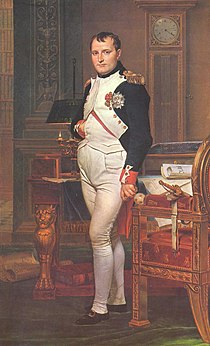
Richard Whately’s 1843 book on whether Napoleon actually existed deserves to be turned into a documentary. It is either (1) an extreme example of skepticism, or (2) satire, or (3) satire of an extreme example of skepticism, or (4) a straightforward debunking of Napoleon’s existence, or—and my preferred interpretation—(5) the first example of French deconstruction…
Faulkner argued that “The past is never dead. It’s not even past.” Ted Gioia (@tedgioia) offers a timely historical example: “Historic Doubts Relative to Napoleon Buonaparte.” Via his wonderful newsletter.
* Voltaire
###
As we contend with conspiracists, we might we might recall that it was on this date in 1804 that Napoleon Bonaparte was in fact proclaimed Emperor of France by the French Senate– at least in part an unintended consequence of Britain’s declaration of war against France (again), exactly one year before, in response to Napoleon’s “activities” in Italy and Switzerland… (Napoleon formally crowned himself “Emperor Napoleon I” on December 2, 1804 at Notre Dame de Paris.)
You must be logged in to post a comment.