Posts Tagged ‘capital’
“Risk comes from not knowing what you’re doing”*…
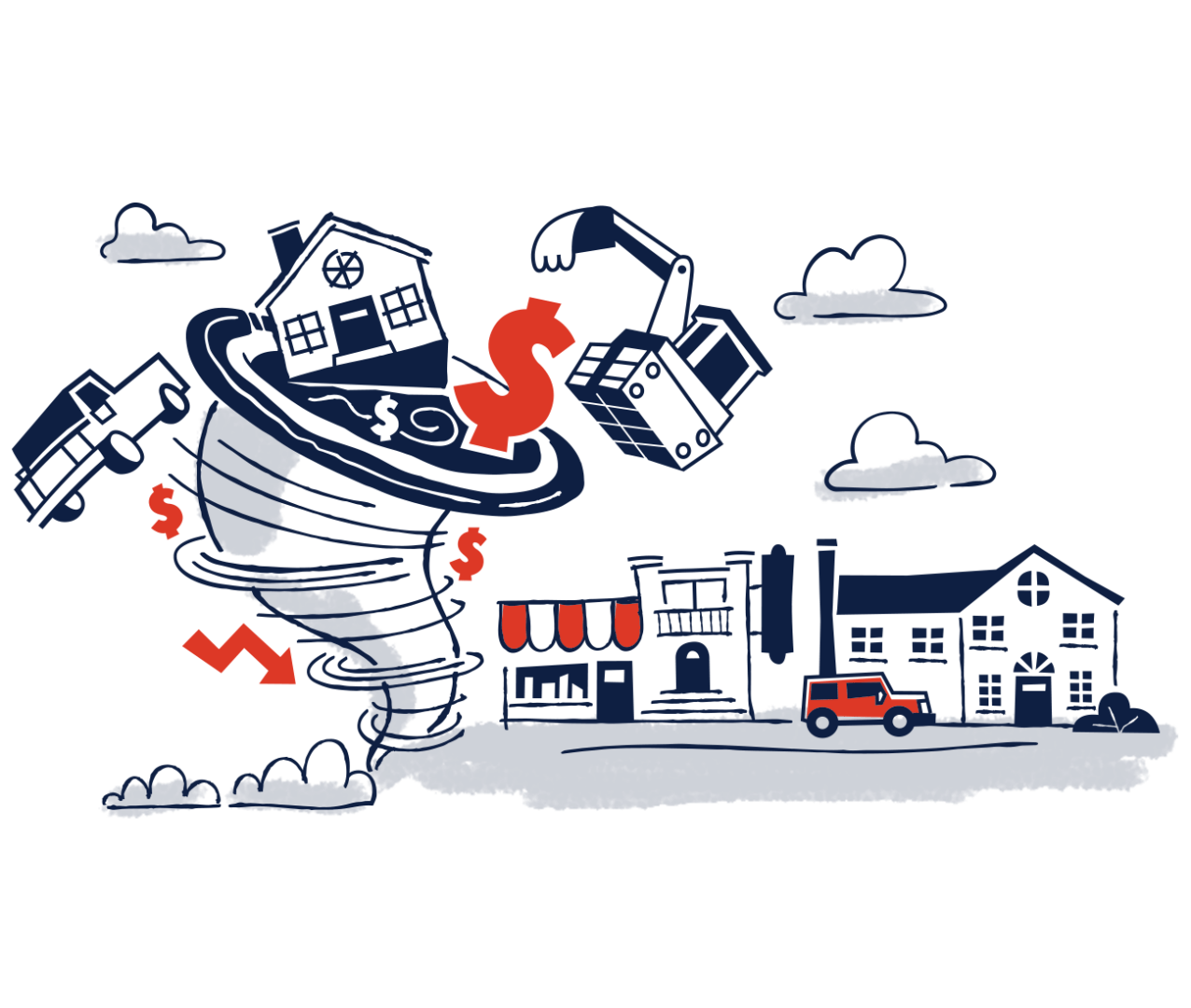
In a follow-on (in a fashion) to an (R)D earlier this month on financialization and gambling, Liz Hoffman on the striking changes underway in the financial sector…
Wall Street is starting to look a bit like a stage drama where nobody is playing the part that casting assigned.
To build a giant Louisiana data center, Meta raised $29 billion in equity from Blue Owl (a firm known for private credit) and private credit from PIMCO (a firm known for public bonds). Google has piles of cash and a red-hot stock, but is instead bringing its pristine credit rating to the deal table, backstopping crypto miners. The $7 billion that KKR and Apollo are putting into Keurig Dr Pepper is “equity” in the sense that it will help KDP reduce its debt load. But it isn’t coming from their traditional PE funds.
You think companies are built with equity and debt? That’s cute, today’s masters of the universe will chuckle while patting your head.
What used to be called simply “investing” or “lending” has been replaced by “capital solutions” — hybrid equity, kickers, and cash flows tailored to match the returns promised to investors on the other side. Growing pots of money now resemble liquid sand, moldable into whatever shape will fit the money hole in front of it. This shift has been obscured by narratives, overcooked in my view, about a battle between private credit and banks: “There’s one system,” Goldman Sachs President John Waldron told me a few weeks ago, and it’s changing quickly.
Goldman reorganized itself along these lines earlier this year… Apollo, one of the original private-equity firms, is now 80% credit… and firms from Chicago buyout shops to Middle Eastern sovereign wealth funds have launched “capital solutions” arms. Lawyers are jumping in downstream.
Prioritizing what companies actually need over whatever widgets Wall Street happens to sell is good customer service. Personal wealth management got a lot better when firms started asking “how much do you need to retire?” instead of “would you like to buy this structured note?”
And the rise of insurance money in investing has created patient capital that in many cases fits those money holes better than blunter instruments. Much of KKR and Apollo’s Keurig investment will end up in their insurance arms, backed by long-term contracts with the coffee-pod maker, people familiar with the matter said.
But flexible capital will almost certainly overflex, and not everyone with “go-anywhere” money should go anywhere. I suspect that before this cycle is over, we’ll see a few instances that leave everyone asking, “why did they own that?”… Sometimes “capital solutions” just code for investing in distressed companies, which is nothing if not a capital problem in search of a solution, trade publication Private Debt Investor wrote…
“What Wall Street’s obsession with ‘capital solutions’ tells us,” from @semafor.com.
[Image above: source]
* Warren Buffett
###
As we go back to basics, we might note that it’s International Accounting Day– a celebration of the field on this date each year that commemorates the publication of Luca Pacioli’s seminal work, Summa de Arithmetica, Geometria, Proportioni et Proportionalita, in 1494, which introduced the double-entry bookkeeping system—a foundational element of modern accounting.

“Leadership of a world-economy is an experience of power which may blind the victor to the march of history”*…

Benjamin Braun and Cédric Durand on the citical tension between “factions of capital” in the second Trump administration…
Hegemonic decline, according to the historian Fernand Braudel [see here and here], has historically come with financialization. Amid declining profitability in production and trade, capital owners increasingly shift their assets into finance. This, according to Braudel, is a “sign of autumn,” when empires “transform into a society of rentier-investors on the look-out for anything that would guarantee a quiet and privileged life.”
This specter of Braudelian decline haunts key figures in the second Trump administration. “Tell me what all the former reserve currencies have in common,” Scott Bessent, now Treasury Secretary, mused during the campaign. “Portugal, Spain, Holland, France, UK … How did they lose reserve currency status?” The answer: “They got highly leveraged and could no longer support their military.” While Bessent, a former hedge fund manager, officially denies a program of dollar depreciation, speculators have been driving down the US exchange rate since Trump took office in January. Secretary of State Marco Rubio is the author of a 2019 report on “American investment in the 21st century,” in which he lambasts Wall Street for its shareholder value regime that “tilts business decision-making towards returning money quickly and predictably to investors rather than building long-term corporate capabilities.” His views on finance are shared by self-styled Republican “populists” such as Josh Hawley.
This residual hostility toward Wall Street has marked an ideological rupture in the first months of Trump’s second administration; on the one hand, the President’s “Liberation Day” tariffs have roiled financial markets; on the other, Wall Street has retaliated with financial panics, working to discipline the White House. Whether a coalition of self-styled MAGA populists and Trump’s electoral base—which expects rising living standards and secure jobs delivered via a tariff-led revival of US manufacturing and a deportation-led tightening of the labor market—is sustainable remains a central question of the second Trump administration. Fossil fuel firms and defense-oriented tech companies such as Palantir and Anduril find much to like in militarized nativism. But Trump’s trade policy clearly harms private finance and big tech, two sectors that have consistently supported Trump and expect to be rewarded. Attacking those sectors threatens to alienate the very factions of US capital that have heaved him back into office.
For these capital factions, US decline is relative and can—cue Japan—be managed in a gracious manner. As Giovanni Arrighi observed in 1994, finance has always intermediated, and thus benefited from, hegemonic transitions. Today, asset management titans profit both from re-balancing US portfolios away from the declining hegemon and from offering fast-growing capital pools from China and other rising Asian economies access to US assets. Big tech, meanwhile, aims at general control over knowledge and economic coordination. It has much to lose from geoeconomic fragmentation that could cut it off from access to data, reduce its network effects, increase the cost of its material infrastructure, and push non-aligned polities to pursue digital sovereignty.
In its efforts to revive the American Empire, the Trump administration will thus have to delicately balance the interests of both manufacturing-oriented nativists and capital factions whose interests span the globe. Navigating these competing agendas will pose an enormous challenge to the longevity of the Trumpian coalition—and the stability of the global financial system as a whole…
Eminently worth reading in full: “America’s Braudelian Autumn,” from @phenomenalworld.bsky.social.
* Fernand Braudel
###
As we debate development, we might recall that it was on this day in 1940 that Government of Vichy France, the collaborationist ruling regime/government in Nazi-occupied France during World War II, was established.
Of contested legitimacy, it took shape in Bordeaux under Marshal Philippe Pétain as the successor to the French Third Republic and was finally settled in the town of Vichy. The government remained in Vichy for four years, but was escorted to Germany in September, 1944 after the Allied invasion of France. I t then operated as a government-in-exile until April 1945, when the Sigmaringen enclave was taken by Free French forces. Pétain was permitted to travel back to France (through Switzerland), by then under control of the Provisional French Republic, and subsequently put on trial for treason.

“The combination of economic inequality and economic segregation is deadly”*…

When we think of a social safety net, we tend to think about things like health care and environmental protection, social security, child care; lately here’s been lots of talk of Universal Basic Income. All of them are surely part of an answer. But if we want a social infrastructure that not only protects against personal and family challenges, but also creates personal and family opportunities, we need to look further– we need to look to something we might call Universal Basic Assets. The always-illuminating Rana Foroohar explains…
If American states are, as former US Supreme Court Justice Louis Brandeis once put it, the “laboratories of democracy,” then it’s worth watching closely what’s happening in California right now.
The threat of rising taxes and a “soak the rich” political atmosphere has led some wealthy Golden State residents, including a number of technology entrepreneurs, to leave for cheaper pastures such as Austin or Miami. This has, in turn, prompted worries of a larger migration that would have an impact not only on the state’s tax base, but on the growth and innovation that have made California the world’s fifth-largest economy.
It is an exceptionally fraught situation. While nobody these days has much sympathy for wealthy individuals or companies (witness the recent justified fury about the ProPublica leaks showing how little tax the wealthiest Americans pay), or really believes in trickle-down economics, the threat of tax and regulatory arbitrage by other states is real.
The good news is that California is applying some typically creative thinking to the problem. What if there was another way to harness company and citizen wealth for the benefit of all?
One such idea gaining popularity is what has been called “pre-distribution.” Unlike traditional methods of redistribution, in which the state taxes existing wealth and then uses it to bolster various projects and constituents, pre-distribution is all about harnessing capital the same way investors do, and then using the proceeds of the capital growth (which as we know far outpaces income growth) to fund the public sector…
It could help better align public and private incentives and rewards. The massive wealth accrued by leading companies is in part down to the strength of the public commons — good schools, decent infrastructure, basic research, and so on. As economists like Mariana Mazzucato frequently note, why should taxpayers pick up the bill for, say, laying high speed fibre without getting any of the commercial upside?
California Senate majority leader Robert Hertzberg, a Democrat… along with some very rich Californians like former Google chief executive Eric Schmidt and Snap founder Evan Spiegel, have proposed… something called “universal basic capital”. The idea is that seed contributions of equity from companies or philanthropists could be invested into a fund that would then be used by individual Californians for things like retirement security, healthcare and so on…
If pre-distribution works in the laboratory of California, I expect it will be adopted in some way at the federal level. The Obama administration actually tried to implement its own version of the CalSavers programme for the country as a whole, called myRA, but it failed in part because the funds were invested only in super safe low yielding Treasury bills at a time when the market as a whole was rising far faster. Even at this politically polarised moment, it’s an idea whose time may have come. Pre-distribution is supported by such unlikely bedfellows as hedge funder Ray Dalio and leftwing economist Joseph Stiglitz. Perhaps that’s because while it doesn’t fundamentally alter the market system, it does broaden share ownership: a mix of capitalism and socialism that is right for our time…
“Capital for the people — an idea whose time has come“: @RanaForoohar explains how California’s nascent experiments in Universal Basic Assets could be a model for the nation.
In thinking about national possibilities, your correspondent’s favorite rationale/approach is Cornell economic historian Louis Hyman‘s formulation (toward the end of) this post.
* “The combination of economic inequality and economic segregation is deadly. It reinforces the advantages of those at the top while exacerbating and perpetuating the disadvantages of those at the bottom. Taken together, they shape not just inequality of economic resources, but also a more permanent and dysfunctional inequality of opportunity.” – Richard Florida
###
As we share and share alike, we might send grateful birthday greetings to the Electronic Frontier Foundation; it was founded by John Gilmore, John Perry Barlow, and Mitch Kapor on this date in 1990. Over the last 30 years, EFF has become the leading nonprofit defending digital privacy, free speech, and innovation.
Happy Birthday– and many more!

You must be logged in to post a comment.