Posts Tagged ‘financialization’
“Risk comes from not knowing what you’re doing”*…
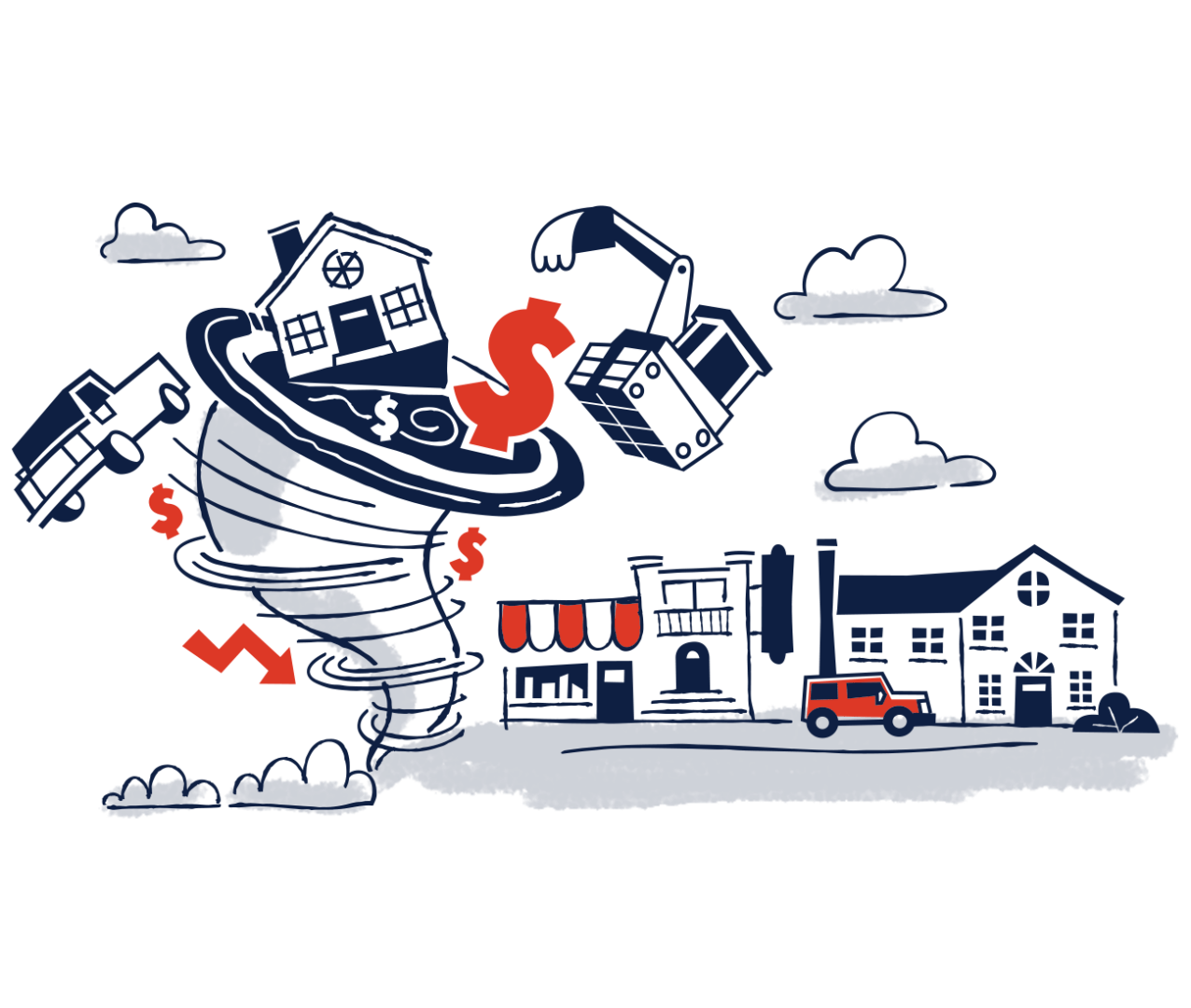
In a follow-on (in a fashion) to an (R)D earlier this month on financialization and gambling, Liz Hoffman on the striking changes underway in the financial sector…
Wall Street is starting to look a bit like a stage drama where nobody is playing the part that casting assigned.
To build a giant Louisiana data center, Meta raised $29 billion in equity from Blue Owl (a firm known for private credit) and private credit from PIMCO (a firm known for public bonds). Google has piles of cash and a red-hot stock, but is instead bringing its pristine credit rating to the deal table, backstopping crypto miners. The $7 billion that KKR and Apollo are putting into Keurig Dr Pepper is “equity” in the sense that it will help KDP reduce its debt load. But it isn’t coming from their traditional PE funds.
You think companies are built with equity and debt? That’s cute, today’s masters of the universe will chuckle while patting your head.
What used to be called simply “investing” or “lending” has been replaced by “capital solutions” — hybrid equity, kickers, and cash flows tailored to match the returns promised to investors on the other side. Growing pots of money now resemble liquid sand, moldable into whatever shape will fit the money hole in front of it. This shift has been obscured by narratives, overcooked in my view, about a battle between private credit and banks: “There’s one system,” Goldman Sachs President John Waldron told me a few weeks ago, and it’s changing quickly.
Goldman reorganized itself along these lines earlier this year… Apollo, one of the original private-equity firms, is now 80% credit… and firms from Chicago buyout shops to Middle Eastern sovereign wealth funds have launched “capital solutions” arms. Lawyers are jumping in downstream.
Prioritizing what companies actually need over whatever widgets Wall Street happens to sell is good customer service. Personal wealth management got a lot better when firms started asking “how much do you need to retire?” instead of “would you like to buy this structured note?”
And the rise of insurance money in investing has created patient capital that in many cases fits those money holes better than blunter instruments. Much of KKR and Apollo’s Keurig investment will end up in their insurance arms, backed by long-term contracts with the coffee-pod maker, people familiar with the matter said.
But flexible capital will almost certainly overflex, and not everyone with “go-anywhere” money should go anywhere. I suspect that before this cycle is over, we’ll see a few instances that leave everyone asking, “why did they own that?”… Sometimes “capital solutions” just code for investing in distressed companies, which is nothing if not a capital problem in search of a solution, trade publication Private Debt Investor wrote…
“What Wall Street’s obsession with ‘capital solutions’ tells us,” from @semafor.com.
[Image above: source]
* Warren Buffett
###
As we go back to basics, we might note that it’s International Accounting Day– a celebration of the field on this date each year that commemorates the publication of Luca Pacioli’s seminal work, Summa de Arithmetica, Geometria, Proportioni et Proportionalita, in 1494, which introduced the double-entry bookkeeping system—a foundational element of modern accounting.

“Financialization is neither finance-nor enterprise-driven”…

The estimable Brad DeLong has observed that Marx was right: “all that is solid melts into air”…
Since 1870, worldwide, on average, according to our flawed standard measures, every thirty years about 4/5 of the economy have improved in technology and productivity by roughly 25%, at a rate of roughly 0.8% per year. And 1/5 of the economy has quintupled in technology and productivity, at a rate of about 5.4% per year. That leaves average productivity, worldwide, roughly twice what it was a generation before. And it is a different, although overlapping, share of the economy that undergoes this massive leading-sector push every generation.
And so, since 1870, we have seen successive Steampower, Applied-Science, Mass Production, Globalized Value-Chain, and now Attention Info-Bio Tech modes, with these transformations occurring faster and more completely in today’s rich countries and slower and incompletely in today’s poor countries, but with life even in poor countries being substantially transformed vis-à-vis life 150 years ago…
… For most people, a generation sees (i) some change in their roles as producers in the organization and productivity of their jobs and the pieces of the societal division of labor that they do, some change in their roles as consumers and utilizers of most of the products of the human division of labor, but about one-fifth or so of their life as consumers and utilizers of the products of the human division of labor completely upended, largely in a good way. And then there are the 1/5 of people whose jobs and whose roles as producers were caught up in the Schumpeterian creative-destruction leading-sector technology tsunami, for whom little is the same as it was thirty years before. That change is to their substantial detriment if they tried to do the old thing in the old way: their real incomes then would be only 1/4 or so of what they would have expected. But that change would have been to their substantial benefit had they found a way to successfully surf the wave.
To summarize: Since 1770, the modern economy changes by puncture, not glide. Every thirty years these days, a sector explodes—lifting productivity, reorganizing firms, and scrambling career ladders. Roughly four-fifths inch forward, while one-fifth quintuples and redefines the frontier. Those leading sectors—steam, mass production, information—rebuild institutions and stress politics as they march. Most people experience partial gains in consumption and workflow; the unlucky fifth face brutal displacement unless they pivot fast. Past waves forged industry, mass production, suburbia, microelectronics; each remapped the social order, often painfully. Average living standards rise, but the distribution is jagged, and the politics volatile. Today’s leading edge runs through data centers and cognitive work: prompts, context engineering, evaluation, and synthesis. The liberal arts—long buffered—now sit at ground zero. Survival means translation: turn judgment, clarity, and taste into leverage over machines and markets, while rebuilding public capacity to manage the turbulence…
– “All That Is Solid Melts into Air”: Since 1870, Roughly One-Fifth of the Economy Is Transformed Every Thirty Years,” from @delong.social
And how’s that going? Two dispatches from the front, on separate but fundamentally-related phenomena emerging in our current “puncture.” First, Luke Goldstein on the way in which a great many major corporations — from airlines to social media platforms — now aspire to become unregulated banks. As he explains, “bankification” today accounts for the highest profit margins in the US economy, crippling productive capacity and setting the stage for the next crash…
The US economy is turning into one giant bank.
Starbucks holds nearly $2 billion of customers’ money in its rewards program. That’s more than the total deposits managed by 85 percent of chartered banks, making the coffee chain one of the biggest financial institutions in the country.
Conversely, Capital One, one of the world’s top banks, now operates its own cafes on city street corners.
Airlines are now little more than flying banks, given that they make more money from selling frequent-flyer points to credit card companies than they do flying passengers.
More Americans than ever are in debt to their nearby grocery store due to predatory “buy now, pay later” loans offered during checkout.
As you’re wheeled into an emergency medical procedure, the nurse may ask if you’d prefer to pay on a deferred-payment loan plan, an increasingly common way to finance health care expenses.
And if you can’t pay your rent on time, it could soon become common for your apartment building owner to lend you the money, putting you in debt to your landlord.
These are snapshots of the new wave of financialization sweeping across the country, where the lines between finance and commerce are being blurred.
Upward of 40 percent of Americans now pay for basic items like groceries and health care using borrowed money — and this excludes credit cards. A third of younger Americans hold their savings on nonbank tech platforms like Venmo, and industries from retail to transportation derive anywhere from 14 percent to half of their profits from partnerships with credit card companies.
While this new type of financialization takes many different forms, the endgame is the same: Most major corporations now aspire to become unregulated banks, opening up new avenues to make even more money hand over fist. Banks operating credit cards are the highest-profit-margin enterprises in the economy. Every company wants a share of the loot, amassed from high fees and low overhead costs.
This development has been supercharged by the Silicon Valley investor class, under the Orwellian term “embedded finance.” Others call it “bankification.”
The peddlers of embedded finance promise a world of “frictionless transactions,” providing consumers efficiency and convenience by integrating financial and nonfinancial services.
But these new profit streams come with a range of potential harms….
– “Everything Is Becoming a Bank” from @jacobinmagazin.bsky.social
Next, Ted Gioia on the rise of our gambling culture. He begins by recounting the grimy details of the recent gambling bust that rocked professional basketball (includsing the roles of ESPN and the NBA itself… though…)..
… It’s not just sports. Two weeks before the FBI arrests, the New York Stock Exchange invested $2 billion in the Polymarket betting operation. As Gordan Gekko says in the movie Wall Street: “It’s all about bucks, kid.”
Does the NYSE now count as the sixth family running gambling in New York?
No, it’s not that simple. There are lots of gambling businesses in New York, starting with the government. The NY State Lottery brings in more cash than all the Mafia families combined. So the NYSE is a johnny-come-lately to the gaming tables, like country rubes visiting the Statue of Liberty…
[Gioia unpacks the “ideas”seven rules of casino design and management” of casino design expert Bill Friedman (“a former gambling addict who wrote a very influential (and expensive) book on casino design”]
… Of course, the real insidious process is happening online, where every big web platform is imitating a gambling casino. And they rake in gangsta profits bigger than any gangsta has ever made.
How bad is it? Consider this fact: Among the eight largest companies in the world, at least half of them promote addiction with screen interfaces that mimic slot machines…
– “Why Is Everything Turning into a Casino?” from @tedgioia.bsky.social
The last word, which applies to both pieces, from Gioia:
Of course, none of this demands your participation. You can leave the casino at any moment—or never enter in the first place. Even if gambling is addictive, most people refuse the bait.
That’s especially true right now. Las Vegas tourism has fallen dramatically. And when you interview consumers, they will tell you why—they are upset at the casinos. The gambling business has become too exploitative and manipulative.
So people just walk away.
The exact same thing is starting to happen with social media. And for the same reason—folks are fed up with the apps. Many stop using them, and brag about it to their friends. So the trend of walking away feeds on itself…
… Maybe businesses need to find a different role model than a casino. It’s not hard to think of a few examples.
So let me close with a wild idea.
Perhaps they can design web apps to serve people—instead of controlling, manipulating, and surveilling them. After all, many businesses once thrived with that simple formula. It’s not too late to return to that practice…
By way of understanding “casino design and management” techniques at work online, see also “Catalog of Dark Patterns, “a variety of dark pattern examples, sorted by category, to better understand deceptive [consumer experience] design practices,” from Dark Patterns.
And by way of context: “The Invisible Economic Crisis,” (Louis Hyman interviewed in TNR), “It Is Trump’s Casino Economy Now. You’ll Probably Lose,” from Kyla Scanlon. and Scanlon’s follow-up piece in her newsletter: “How Bible Sales and Chipotle Explain the Economy.”
###
As we just say no, we might recall that it was on this date in 1834 that the first mention of the card game poker was published, a reference to an account by English actor Joseph Cowell, who reported that the game was played in New Orleans and on Mississippi River boats (as recounted in Jonathan H. Green‘s book, An Exposure of the Arts and Miseries of Gambling.
Poker itself originated in the late 18th century, and had probably spread throughout the Mississippi River region by 1800. It was played in a variety of forms, with 52 cards, and included both straight poker and stud. 20 card poker (the variety referenced by Cowell) was a variant for two players. (It is a common English practice to reduce the deck in card games when there are fewer players).

“Leadership of a world-economy is an experience of power which may blind the victor to the march of history”*…

Benjamin Braun and Cédric Durand on the citical tension between “factions of capital” in the second Trump administration…
Hegemonic decline, according to the historian Fernand Braudel [see here and here], has historically come with financialization. Amid declining profitability in production and trade, capital owners increasingly shift their assets into finance. This, according to Braudel, is a “sign of autumn,” when empires “transform into a society of rentier-investors on the look-out for anything that would guarantee a quiet and privileged life.”
This specter of Braudelian decline haunts key figures in the second Trump administration. “Tell me what all the former reserve currencies have in common,” Scott Bessent, now Treasury Secretary, mused during the campaign. “Portugal, Spain, Holland, France, UK … How did they lose reserve currency status?” The answer: “They got highly leveraged and could no longer support their military.” While Bessent, a former hedge fund manager, officially denies a program of dollar depreciation, speculators have been driving down the US exchange rate since Trump took office in January. Secretary of State Marco Rubio is the author of a 2019 report on “American investment in the 21st century,” in which he lambasts Wall Street for its shareholder value regime that “tilts business decision-making towards returning money quickly and predictably to investors rather than building long-term corporate capabilities.” His views on finance are shared by self-styled Republican “populists” such as Josh Hawley.
This residual hostility toward Wall Street has marked an ideological rupture in the first months of Trump’s second administration; on the one hand, the President’s “Liberation Day” tariffs have roiled financial markets; on the other, Wall Street has retaliated with financial panics, working to discipline the White House. Whether a coalition of self-styled MAGA populists and Trump’s electoral base—which expects rising living standards and secure jobs delivered via a tariff-led revival of US manufacturing and a deportation-led tightening of the labor market—is sustainable remains a central question of the second Trump administration. Fossil fuel firms and defense-oriented tech companies such as Palantir and Anduril find much to like in militarized nativism. But Trump’s trade policy clearly harms private finance and big tech, two sectors that have consistently supported Trump and expect to be rewarded. Attacking those sectors threatens to alienate the very factions of US capital that have heaved him back into office.
For these capital factions, US decline is relative and can—cue Japan—be managed in a gracious manner. As Giovanni Arrighi observed in 1994, finance has always intermediated, and thus benefited from, hegemonic transitions. Today, asset management titans profit both from re-balancing US portfolios away from the declining hegemon and from offering fast-growing capital pools from China and other rising Asian economies access to US assets. Big tech, meanwhile, aims at general control over knowledge and economic coordination. It has much to lose from geoeconomic fragmentation that could cut it off from access to data, reduce its network effects, increase the cost of its material infrastructure, and push non-aligned polities to pursue digital sovereignty.
In its efforts to revive the American Empire, the Trump administration will thus have to delicately balance the interests of both manufacturing-oriented nativists and capital factions whose interests span the globe. Navigating these competing agendas will pose an enormous challenge to the longevity of the Trumpian coalition—and the stability of the global financial system as a whole…
Eminently worth reading in full: “America’s Braudelian Autumn,” from @phenomenalworld.bsky.social.
* Fernand Braudel
###
As we debate development, we might recall that it was on this day in 1940 that Government of Vichy France, the collaborationist ruling regime/government in Nazi-occupied France during World War II, was established.
Of contested legitimacy, it took shape in Bordeaux under Marshal Philippe Pétain as the successor to the French Third Republic and was finally settled in the town of Vichy. The government remained in Vichy for four years, but was escorted to Germany in September, 1944 after the Allied invasion of France. I t then operated as a government-in-exile until April 1945, when the Sigmaringen enclave was taken by Free French forces. Pétain was permitted to travel back to France (through Switzerland), by then under control of the Provisional French Republic, and subsequently put on trial for treason.

“I analogize it to sex. You realize there were certain things you shouldn’t do, but the urge is there and you can’t resist.”*…

The estimable Cory Doctorow on the incursion of private equity into health care…
As someone who writes a lot of fiction about corporate crime, I naturally end up spending a lot of time being angry about corporate crime. It’s pretty goddamned enraging. But the fiction writer in me is especially upset at how cartoonishly evil the perps are – routinely doing things that I couldn’t ever get away with putting in a novel.
Beyond a doubt, the most cartoonishly evil characters are the private equity looters. And the most cartoonishly evil private equity looters are the ones who get involved in health care.
Writing for The American Prospect, Maureen Tcacik details a national scandal: the collapse of PE-backed hospital chain Steward Health, a company that bought and looted hospitals up and down the country, starving them of everything from heart valves to prescription paper, ripping off suppliers, doctors and nurses, and callously exposing patients to deadly risk…
[There follows an illuminating– and truly terrifying (backed up sewage in the wards; bats colonizing hospital floors; stiffed employees and vendors)– an unpacking of Steward’s deeds and a location of them in the larger landscape of private equity.]
… But despite Steward’s increasingly furious creditors and its decaying facilities, the company remains bullish on its ability to continue operations. Medical Properties Trust – the real estate investment trust that is nominally a separate company from Steward – recently hosted a conference call to reassure Wall Street investors that it would be a going concern. When a Bank of America analyst asked MPT’s CFO how this could possibly be, given the facility’s dire condition and Steward’s degraded state, the CFO blithely assured him that the company would get bailouts: “We own hospitals no one wants to see closed.”
That’s the thing about PE and health-care. The looters who buy out every health-care facility in a region understand that this makes them too big to fail: no matter how dangerous the companies they drain become, local governments will continue to prop them up. Look at dialysis, a market that’s been cornered by private equity rollups. Today, if you need this lifesaving therapy, there’s a good chance that every accessible facility is owned by a private equity fund that has fired all its qualified staff and ceased sterilizing its needles. Otherwise healthy people who visit these clinics sometimes die due to operator error. But they chug along, because no dialysis clinics is worse that “dialysis clinics where unqualified sadists sometimes kill you with dirty needles“
…
The PE sector spent more than a trillion dollars over the past decade buying up healthcare companies, and it has trillions more in “dry powder” allocated for further medical acquisitions. Why not? As the CFO of Medical Properties Trust told that Bank of America analyst last week, when you “own hospitals no one wants to see closed.” you literally can’t fail, no matter how many people you murder.
The PE sector is a reminder that the crimes people commit for money far outstrip the crimes they commit for ideology. Even the most ideological killers are horrified by the murders their profit-motivated colleagues commit.
Last year, Tkacic wrote about the history of IG Farben, the German company that built Monowitz, a private slave-labor camp up the road from Auschwitz to make the materiel it was gouging Hitler’s Wehrmacht on…
Farben bought the cheapest possible slaves from Auschwitz, preferentially sourcing women and children. These slaves were worked to death at a rate that put Auschwitz’s wholesale murder in the shade. Farben’s slaves died an average of just three months after starting work at Monowitz. The situation was so abominable, so unconscionable, that the SS officers who provided outsource guard-labor to Monowitz actually wrote to Berlin to complain about the cruelty.
The Nuremberg trials are famous for the Nazi officers who insisted that they were “just following order” but were nonetheless executed for their crimes. 24 Farben executives were also tried at Nuremberg, where they offered a very different defense: “We had a fiduciary duty to our shareholders to maximize our profits.” 19 of the 24 were acquitted on that basis.
PE is committed to an ideology that is far worse than any form of racial animus or other bias. As a sector, it is committed to profit above all other values. As a result, its brutality knows no bounds, no decency, no compassion. Even the worst crimes we commit for hate are nothing compared to the crimes we commit for greed…
“When private equity destroys your hospital,” from @doctorow. Eminently worth reading in full– and following his newsletter (from whence this comes).
* David Rubenstein, co-founder and co-chairman of the private equity giant The Carlyle Group, at a Harvard Business School Conference
###
As we rethink returns, we might recall that it was on this date in 1944 that Louis Buchalter (AKA Lepke Buchalter, AKA Louis Lepke) was executed in the electric Chair at Sing Sing. One of the premier labor racketeers in New York City in the 1930s, he is better remembered as the creator (in 1929) and overseer (thereafter) of an efficient system for performing mob hits; while Buchalter never named it, it became known in the press as “Murder, Inc.“
The Cosa Nostra mobsters wanted to insulate themselves from any connection to these murders. Buchalter’s partner, mobster Albert Anastasia, would relay a contract request from the Cosa Nostra to Buchalter. In turn, Buchalter would assign the job to Jewish and Italian street gang members from Brooklyn.
None of these contract killers had any connections with the major crime families. If they were caught, they could not implicate their Cosa Nostra employers in the crimes. Buchalter used the same killers for his own murder contracts. The Murder, Inc., killers were soon completing jobs all over the country for their mobster bosses…
source
Murder, Inc. was believed to be responsible for as many as 1,000 contract killings before it was exposed in 1941, and Buchalter was finally charged and convicted of murder that same year.

You must be logged in to post a comment.