Posts Tagged ‘greed’
“I analogize it to sex. You realize there were certain things you shouldn’t do, but the urge is there and you can’t resist.”*…
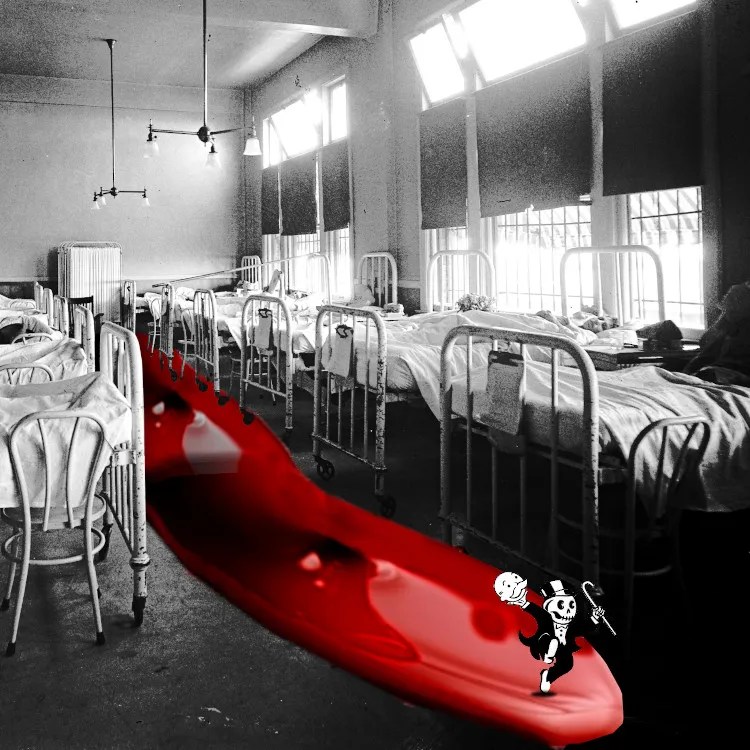
The estimable Cory Doctorow on the incursion of private equity into health care…
As someone who writes a lot of fiction about corporate crime, I naturally end up spending a lot of time being angry about corporate crime. It’s pretty goddamned enraging. But the fiction writer in me is especially upset at how cartoonishly evil the perps are – routinely doing things that I couldn’t ever get away with putting in a novel.
Beyond a doubt, the most cartoonishly evil characters are the private equity looters. And the most cartoonishly evil private equity looters are the ones who get involved in health care.
Writing for The American Prospect, Maureen Tcacik details a national scandal: the collapse of PE-backed hospital chain Steward Health, a company that bought and looted hospitals up and down the country, starving them of everything from heart valves to prescription paper, ripping off suppliers, doctors and nurses, and callously exposing patients to deadly risk…
[There follows an illuminating– and truly terrifying (backed up sewage in the wards; bats colonizing hospital floors; stiffed employees and vendors)– an unpacking of Steward’s deeds and a location of them in the larger landscape of private equity.]
… But despite Steward’s increasingly furious creditors and its decaying facilities, the company remains bullish on its ability to continue operations. Medical Properties Trust – the real estate investment trust that is nominally a separate company from Steward – recently hosted a conference call to reassure Wall Street investors that it would be a going concern. When a Bank of America analyst asked MPT’s CFO how this could possibly be, given the facility’s dire condition and Steward’s degraded state, the CFO blithely assured him that the company would get bailouts: “We own hospitals no one wants to see closed.”
That’s the thing about PE and health-care. The looters who buy out every health-care facility in a region understand that this makes them too big to fail: no matter how dangerous the companies they drain become, local governments will continue to prop them up. Look at dialysis, a market that’s been cornered by private equity rollups. Today, if you need this lifesaving therapy, there’s a good chance that every accessible facility is owned by a private equity fund that has fired all its qualified staff and ceased sterilizing its needles. Otherwise healthy people who visit these clinics sometimes die due to operator error. But they chug along, because no dialysis clinics is worse that “dialysis clinics where unqualified sadists sometimes kill you with dirty needles“
…
The PE sector spent more than a trillion dollars over the past decade buying up healthcare companies, and it has trillions more in “dry powder” allocated for further medical acquisitions. Why not? As the CFO of Medical Properties Trust told that Bank of America analyst last week, when you “own hospitals no one wants to see closed.” you literally can’t fail, no matter how many people you murder.
The PE sector is a reminder that the crimes people commit for money far outstrip the crimes they commit for ideology. Even the most ideological killers are horrified by the murders their profit-motivated colleagues commit.
Last year, Tkacic wrote about the history of IG Farben, the German company that built Monowitz, a private slave-labor camp up the road from Auschwitz to make the materiel it was gouging Hitler’s Wehrmacht on…
Farben bought the cheapest possible slaves from Auschwitz, preferentially sourcing women and children. These slaves were worked to death at a rate that put Auschwitz’s wholesale murder in the shade. Farben’s slaves died an average of just three months after starting work at Monowitz. The situation was so abominable, so unconscionable, that the SS officers who provided outsource guard-labor to Monowitz actually wrote to Berlin to complain about the cruelty.
The Nuremberg trials are famous for the Nazi officers who insisted that they were “just following order” but were nonetheless executed for their crimes. 24 Farben executives were also tried at Nuremberg, where they offered a very different defense: “We had a fiduciary duty to our shareholders to maximize our profits.” 19 of the 24 were acquitted on that basis.
PE is committed to an ideology that is far worse than any form of racial animus or other bias. As a sector, it is committed to profit above all other values. As a result, its brutality knows no bounds, no decency, no compassion. Even the worst crimes we commit for hate are nothing compared to the crimes we commit for greed…
“When private equity destroys your hospital,” from @doctorow. Eminently worth reading in full– and following his newsletter (from whence this comes).
* David Rubenstein, co-founder and co-chairman of the private equity giant The Carlyle Group, at a Harvard Business School Conference
###
As we rethink returns, we might recall that it was on this date in 1944 that Louis Buchalter (AKA Lepke Buchalter, AKA Louis Lepke) was executed in the electric Chair at Sing Sing. One of the premier labor racketeers in New York City in the 1930s, he is better remembered as the creator (in 1929) and overseer (thereafter) of an efficient system for performing mob hits; while Buchalter never named it, it became known in the press as “Murder, Inc.“
The Cosa Nostra mobsters wanted to insulate themselves from any connection to these murders. Buchalter’s partner, mobster Albert Anastasia, would relay a contract request from the Cosa Nostra to Buchalter. In turn, Buchalter would assign the job to Jewish and Italian street gang members from Brooklyn.
None of these contract killers had any connections with the major crime families. If they were caught, they could not implicate their Cosa Nostra employers in the crimes. Buchalter used the same killers for his own murder contracts. The Murder, Inc., killers were soon completing jobs all over the country for their mobster bosses…
source
Murder, Inc. was believed to be responsible for as many as 1,000 contract killings before it was exposed in 1941, and Buchalter was finally charged and convicted of murder that same year.

One-upping Gordon Gekko…

“The injunction of Jesus to love others as ourselves is an endorsement of self-interest,” Goldman’s Griffiths said Oct. 20, his voice echoing around the gold-mosaic walls of St. Paul’s Cathedral, whose 365-feet-high dome towers over the City, London’s financial district. “We have to tolerate the inequality as a way to achieving greater prosperity and opportunity for all.”
-via Profit `Not Satanic,’ Barclays Says, After Goldman Invokes Jesus – Bloomberg.com.
The ever-incisive Matt Taibbi ponders this pontification: “I didn’t believe this story was true at first — thought it had to be a spoof. But it turns out to be true. The great banks of the world have gone on a p.r. counteroffensive in Europe, and are sending spokescrooks in shiny suits into churches to persuade the masses that Christ would have approved of the latest round of obscene bonuses.”
Taibbi’s piece, which explores how it is that someone could reach this kind of conclusion (spoiler alert: it’s to do with a self-interested understanding of “free market” ideology) is well worth reading in full. Here, let me just reprise his all-too-apt conclusion:
There are lots of different varieties of evil in the world. On the extreme end of the spectrum you’ve probably got your Ted Bundy-at-Lake-Sammamish brand of evil, torturers and such, people who actually take pleasure in the suffering of others. You look at people like that and they defy rational explanation; you have to just chalk that up to the universe basically being a horrifying place where there’s either no God at at all or a God who’s just incompetent and/or explaining himself really, really badly.
On the other end of the spectrum, not nearly as evil comparably but still pretty bad, are people like this clown from Goldman. They lie to themselves and think up elaborate reasons to do the bad acts they were already hoping to do anyway. Some day, when historians finish peeling back all the different onion-layers of this financial disaster we’re living out right now, they’re going to find at the heart of it all this social Darwinist mantra wherein a very small group of overeducated twerps agreed to believe that stealing every last dime they could get their hands on was something other than what it looks and sounds like to the rest of us. That protective delusion was the first of the many luxuries they bought with all the money they stole, and see if it isn’t the last they agree to give up. What a bunch of assholes!
By way of context, research company TNS reports that “around half of American, British and German respondents reported that they would not be able to come up with $2,000 in 30 days from savings, borrowing, friends or family” if faced with an emergency… and then there’s the real poverty in the world that we can and must more aggressively address.
As we recover our composure, we might recall that it was on this date in 1789 that Benjamin Franklin remarked, in a letter to Jean-Baptiste Leroy, that “in this world nothing can be said to be certain, except death and taxes.” (In fact the first recorded utterance of that sentiment in English was by Daniel Defoe in The Political History of the Devil, 1726: “Things as certain as death and taxes, can be more firmly believed”… before that [pace Goldman] there was Jesus: “render unto Caesar…” One wonders what the front-runners and mortgage pushers at the top of the financial heap will make of that…)

You must be logged in to post a comment.