Posts Tagged ‘Mob’
“I analogize it to sex. You realize there were certain things you shouldn’t do, but the urge is there and you can’t resist.”*…
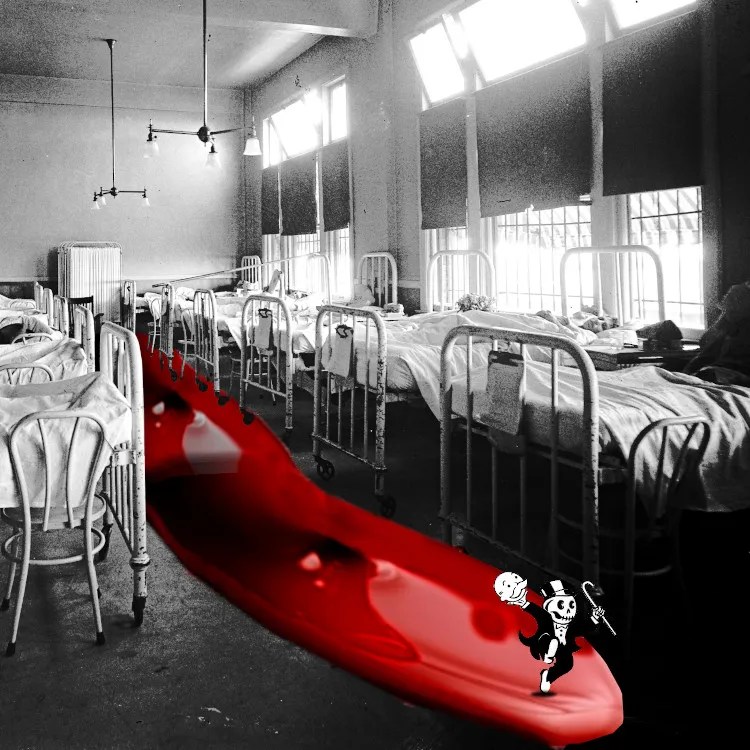
The estimable Cory Doctorow on the incursion of private equity into health care…
As someone who writes a lot of fiction about corporate crime, I naturally end up spending a lot of time being angry about corporate crime. It’s pretty goddamned enraging. But the fiction writer in me is especially upset at how cartoonishly evil the perps are – routinely doing things that I couldn’t ever get away with putting in a novel.
Beyond a doubt, the most cartoonishly evil characters are the private equity looters. And the most cartoonishly evil private equity looters are the ones who get involved in health care.
Writing for The American Prospect, Maureen Tcacik details a national scandal: the collapse of PE-backed hospital chain Steward Health, a company that bought and looted hospitals up and down the country, starving them of everything from heart valves to prescription paper, ripping off suppliers, doctors and nurses, and callously exposing patients to deadly risk…
[There follows an illuminating– and truly terrifying (backed up sewage in the wards; bats colonizing hospital floors; stiffed employees and vendors)– an unpacking of Steward’s deeds and a location of them in the larger landscape of private equity.]
… But despite Steward’s increasingly furious creditors and its decaying facilities, the company remains bullish on its ability to continue operations. Medical Properties Trust – the real estate investment trust that is nominally a separate company from Steward – recently hosted a conference call to reassure Wall Street investors that it would be a going concern. When a Bank of America analyst asked MPT’s CFO how this could possibly be, given the facility’s dire condition and Steward’s degraded state, the CFO blithely assured him that the company would get bailouts: “We own hospitals no one wants to see closed.”
That’s the thing about PE and health-care. The looters who buy out every health-care facility in a region understand that this makes them too big to fail: no matter how dangerous the companies they drain become, local governments will continue to prop them up. Look at dialysis, a market that’s been cornered by private equity rollups. Today, if you need this lifesaving therapy, there’s a good chance that every accessible facility is owned by a private equity fund that has fired all its qualified staff and ceased sterilizing its needles. Otherwise healthy people who visit these clinics sometimes die due to operator error. But they chug along, because no dialysis clinics is worse that “dialysis clinics where unqualified sadists sometimes kill you with dirty needles“
…
The PE sector spent more than a trillion dollars over the past decade buying up healthcare companies, and it has trillions more in “dry powder” allocated for further medical acquisitions. Why not? As the CFO of Medical Properties Trust told that Bank of America analyst last week, when you “own hospitals no one wants to see closed.” you literally can’t fail, no matter how many people you murder.
The PE sector is a reminder that the crimes people commit for money far outstrip the crimes they commit for ideology. Even the most ideological killers are horrified by the murders their profit-motivated colleagues commit.
Last year, Tkacic wrote about the history of IG Farben, the German company that built Monowitz, a private slave-labor camp up the road from Auschwitz to make the materiel it was gouging Hitler’s Wehrmacht on…
Farben bought the cheapest possible slaves from Auschwitz, preferentially sourcing women and children. These slaves were worked to death at a rate that put Auschwitz’s wholesale murder in the shade. Farben’s slaves died an average of just three months after starting work at Monowitz. The situation was so abominable, so unconscionable, that the SS officers who provided outsource guard-labor to Monowitz actually wrote to Berlin to complain about the cruelty.
The Nuremberg trials are famous for the Nazi officers who insisted that they were “just following order” but were nonetheless executed for their crimes. 24 Farben executives were also tried at Nuremberg, where they offered a very different defense: “We had a fiduciary duty to our shareholders to maximize our profits.” 19 of the 24 were acquitted on that basis.
PE is committed to an ideology that is far worse than any form of racial animus or other bias. As a sector, it is committed to profit above all other values. As a result, its brutality knows no bounds, no decency, no compassion. Even the worst crimes we commit for hate are nothing compared to the crimes we commit for greed…
“When private equity destroys your hospital,” from @doctorow. Eminently worth reading in full– and following his newsletter (from whence this comes).
* David Rubenstein, co-founder and co-chairman of the private equity giant The Carlyle Group, at a Harvard Business School Conference
###
As we rethink returns, we might recall that it was on this date in 1944 that Louis Buchalter (AKA Lepke Buchalter, AKA Louis Lepke) was executed in the electric Chair at Sing Sing. One of the premier labor racketeers in New York City in the 1930s, he is better remembered as the creator (in 1929) and overseer (thereafter) of an efficient system for performing mob hits; while Buchalter never named it, it became known in the press as “Murder, Inc.“
The Cosa Nostra mobsters wanted to insulate themselves from any connection to these murders. Buchalter’s partner, mobster Albert Anastasia, would relay a contract request from the Cosa Nostra to Buchalter. In turn, Buchalter would assign the job to Jewish and Italian street gang members from Brooklyn.
None of these contract killers had any connections with the major crime families. If they were caught, they could not implicate their Cosa Nostra employers in the crimes. Buchalter used the same killers for his own murder contracts. The Murder, Inc., killers were soon completing jobs all over the country for their mobster bosses…
source
Murder, Inc. was believed to be responsible for as many as 1,000 contract killings before it was exposed in 1941, and Buchalter was finally charged and convicted of murder that same year.

“It’s morally wrong to allow a sucker to keep his money”*…

Rachel Browne with the telling story of how a Montreal copywriter swindled victims out of $200 million by pretending to be a legendary psychic…
Patrice Runner was sixteen years old, in Montreal in the 1980s, when he came across a series of advertisements in magazines and newspapers that enchanted him. It was the language of the ads, the spare use of words and the emotionality of simple phrases, that drew him in. Some ads offered new products and gadgets, like microscopes and wristwatches; some offered services or guides on weight loss, memory improvement, and speed reading. Others advertised something less tangible and more alluring—the promise of great riches or a future foretold.
“The wisest man I ever knew,” one particularly memorable ad read, “told me something I never forgot: ‘Most people are too busy earning a living to make any money.’” The ad, which began appearing in newspapers across North America in 1973, was written by self-help author Joe Karbo, who vowed to share his secret—no education, capital, luck, talent, youth, or experience required—to fabulous wealth. All he asked was for people to mail in $10 and they’d receive his book and his secret. “What does it require? Belief.” The ad was titled “The Lazy Man’s Way to Riches,” and it helped sell nearly 3 million copies of Karbo’s book.
This power of provocative copywriting enthralled Runner, who, in time, turned an adolescent fascination into a career and a multi-million-dollar business. Now fifty-seven, Runner spent most of his life at the helm of several prolific mail-order businesses primarily based out of Montreal. Through ads in print media and unsolicited direct mail, he sold self-help guides, weight-loss schemes, and, most infamously, the services of a world-famous psychic named Maria Duval. “If you’ve got a special bottle of bubbly that you’ve been saving for celebrating great news, then now’s the time to open it,” read one nine-page letter that his business mailed to thousands of people. Under a headshot of Duval, it noted she had “more than 40 years of accurate and verifiable predictions.” The letter promised “sweeping changes and improvements in your life” in “exactly 27 days.” The recipients were urged to reply and enclose a cheque or money order for $50 to receive a “mysterious talisman with the power to attract LUCK and MONEY” as well as a “Guide to My New Life” that included winning lottery numbers.
More than a million people in Canada and the United States were captivated enough to mail money in exchange for various psychic services. Some people, though, eventually began to question whether they were truly corresponding with a legendary psychic and felt they had been cheated. In 2020, after being pursued by law enforcement for years, Runner was arrested in Spain and extradited to the US on eighteen counts, including mail fraud, wire fraud, and conspiracy to commit money laundering, for orchestrating one of the biggest mail-order scams in North American history…
Read on: “The Greatest Scam Ever Written,” from @rp_browne in @thewalrus.
* W. C. Fields
###
As we tread carefully, we might spare a thought for Meyer Harris “Mickey” Cohen; he died on this date in 1976. After a career as a boxer, Cohen joined the mob, moving around the country and rising through the ranks until he was a close associate of Benjamin “Bugsy” Siegel in Los Angeles. In 1950, Cohen was investigated along with many other underworld figures by a U.S. Senate committee known as the Kefauver Commission. As a result, Cohen was convicted of tax evasion in June 1951, and sentenced four years in prison.
On his release in 1955, Cohen became an international celebrity. He ran floral shops, paint stores, nightclubs, casinos, gas stations, a men’s haberdashery– he even drove an ice cream van on San Vicente Boulevard in the Brentwood section of Los Angeles. In 1957, TIME magazine wrote a brief article about Cohen’s meeting with Christian evangelist Billy Graham. Cohen said: “I am very high on the Christian way of life. Billy came up, and before we had food he said—What do you call it, that thing they say before food? Grace? Yeah, grace. Then we talked a lot about Christianity and stuff.” Allegedly when Cohen did not change his lifestyle, he was confronted by Christian acquaintances. His response: “Christian football players, Christian cowboys, Christian politicians; why not a Christian gangster?”
In 1961, Cohen was again convicted of tax evasion and sent to Alcatraz. He was the only prisoner ever bailed out of Alcatraz– his bond signed by U.S. Supreme Court Chief Justice Earl Warren. After his appeals failed, Cohen was sent to a federal prison in Atlanta, Georgia. In 1972, Cohen was released from the Atlanta Federal Penitentiary, where he had spoken out against prison abuse. He had been misdiagnosed with an ulcer, which turned out to be stomach cancer. After undergoing surgery, he continued touring the United States and made television appearances, once with Ramsey Clark.

“Whoever said crime doesn’t pay is an idiot. It pays great, which is why there is so much of it.”*…

Low-level criminals in the US make an average of $900 per week, according to an estimate published in the academic journal Criminology.
So, people who commit small crimes, like robberies, forge checks, and deal drugs, are making more money per week than the average US worker ($885).
Low-level criminals are also making more money per week than high school dropouts ($504) and college dropouts ($756).
That might be in part because wage growth (in the formal economy) is so sluggish in the US, even though unemployment is low, at 4.4%. Wages grew only 2.5% between mid-2016 and mid-2017. While some analysts would expect it to be growing at 3.5%…
More at Quartz Index.
* Jay Crownover
###
As we sigh from the straight and narrow, we might send well-organized birthday greetings to Joseph Michael “Joe Cargo” Valachi; he was born on this date in 1904. A member of Lucky Luciano’s mob family from the 1930s through the 1950s, Valachi was primarily involved in rackets and gambling– until his racketeering conviction in 1959, for which he was sentenced to 15 years in a federal prison.
Valachi attained his notoriety– and historical significance in 1963, when he was the star witness in a government inquiry into the Mob (the McClelland Committee). He provided the Committee with graphic details of Mob life, and named six New York are Crime families. The first member of the Italian-American Mafia to publicly acknowledge its existence, he is credited with popularization of the term “Cosa Nostra.”
After returning to prison, Valachi teamed with appointed writer Peter Maas to craft his memoirs, The Valachi Papers, which were published in 1968.

Valachi testifying
You must be logged in to post a comment.