Posts Tagged ‘profit’
“I analogize it to sex. You realize there were certain things you shouldn’t do, but the urge is there and you can’t resist.”*…
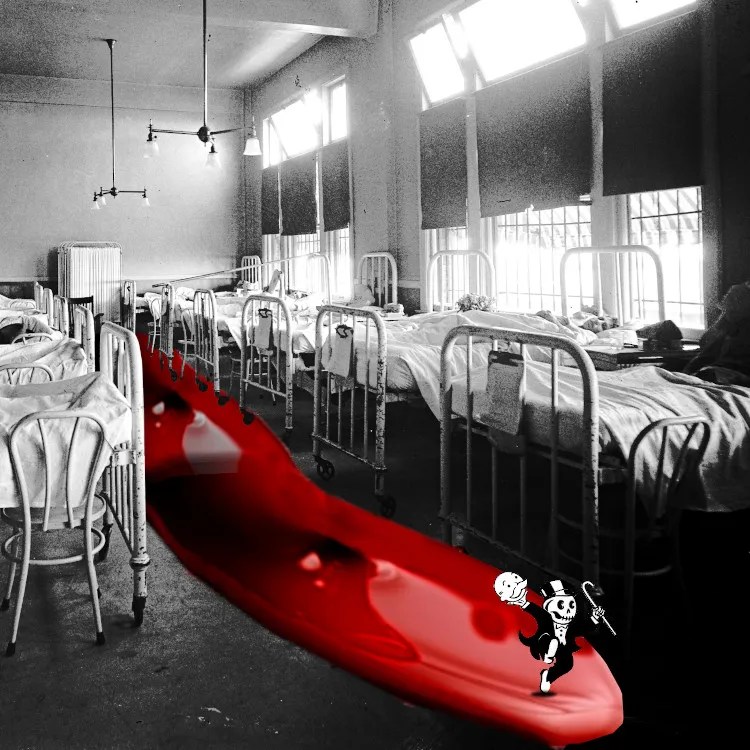
The estimable Cory Doctorow on the incursion of private equity into health care…
As someone who writes a lot of fiction about corporate crime, I naturally end up spending a lot of time being angry about corporate crime. It’s pretty goddamned enraging. But the fiction writer in me is especially upset at how cartoonishly evil the perps are – routinely doing things that I couldn’t ever get away with putting in a novel.
Beyond a doubt, the most cartoonishly evil characters are the private equity looters. And the most cartoonishly evil private equity looters are the ones who get involved in health care.
Writing for The American Prospect, Maureen Tcacik details a national scandal: the collapse of PE-backed hospital chain Steward Health, a company that bought and looted hospitals up and down the country, starving them of everything from heart valves to prescription paper, ripping off suppliers, doctors and nurses, and callously exposing patients to deadly risk…
[There follows an illuminating– and truly terrifying (backed up sewage in the wards; bats colonizing hospital floors; stiffed employees and vendors)– an unpacking of Steward’s deeds and a location of them in the larger landscape of private equity.]
… But despite Steward’s increasingly furious creditors and its decaying facilities, the company remains bullish on its ability to continue operations. Medical Properties Trust – the real estate investment trust that is nominally a separate company from Steward – recently hosted a conference call to reassure Wall Street investors that it would be a going concern. When a Bank of America analyst asked MPT’s CFO how this could possibly be, given the facility’s dire condition and Steward’s degraded state, the CFO blithely assured him that the company would get bailouts: “We own hospitals no one wants to see closed.”
That’s the thing about PE and health-care. The looters who buy out every health-care facility in a region understand that this makes them too big to fail: no matter how dangerous the companies they drain become, local governments will continue to prop them up. Look at dialysis, a market that’s been cornered by private equity rollups. Today, if you need this lifesaving therapy, there’s a good chance that every accessible facility is owned by a private equity fund that has fired all its qualified staff and ceased sterilizing its needles. Otherwise healthy people who visit these clinics sometimes die due to operator error. But they chug along, because no dialysis clinics is worse that “dialysis clinics where unqualified sadists sometimes kill you with dirty needles“
…
The PE sector spent more than a trillion dollars over the past decade buying up healthcare companies, and it has trillions more in “dry powder” allocated for further medical acquisitions. Why not? As the CFO of Medical Properties Trust told that Bank of America analyst last week, when you “own hospitals no one wants to see closed.” you literally can’t fail, no matter how many people you murder.
The PE sector is a reminder that the crimes people commit for money far outstrip the crimes they commit for ideology. Even the most ideological killers are horrified by the murders their profit-motivated colleagues commit.
Last year, Tkacic wrote about the history of IG Farben, the German company that built Monowitz, a private slave-labor camp up the road from Auschwitz to make the materiel it was gouging Hitler’s Wehrmacht on…
Farben bought the cheapest possible slaves from Auschwitz, preferentially sourcing women and children. These slaves were worked to death at a rate that put Auschwitz’s wholesale murder in the shade. Farben’s slaves died an average of just three months after starting work at Monowitz. The situation was so abominable, so unconscionable, that the SS officers who provided outsource guard-labor to Monowitz actually wrote to Berlin to complain about the cruelty.
The Nuremberg trials are famous for the Nazi officers who insisted that they were “just following order” but were nonetheless executed for their crimes. 24 Farben executives were also tried at Nuremberg, where they offered a very different defense: “We had a fiduciary duty to our shareholders to maximize our profits.” 19 of the 24 were acquitted on that basis.
PE is committed to an ideology that is far worse than any form of racial animus or other bias. As a sector, it is committed to profit above all other values. As a result, its brutality knows no bounds, no decency, no compassion. Even the worst crimes we commit for hate are nothing compared to the crimes we commit for greed…
“When private equity destroys your hospital,” from @doctorow. Eminently worth reading in full– and following his newsletter (from whence this comes).
* David Rubenstein, co-founder and co-chairman of the private equity giant The Carlyle Group, at a Harvard Business School Conference
###
As we rethink returns, we might recall that it was on this date in 1944 that Louis Buchalter (AKA Lepke Buchalter, AKA Louis Lepke) was executed in the electric Chair at Sing Sing. One of the premier labor racketeers in New York City in the 1930s, he is better remembered as the creator (in 1929) and overseer (thereafter) of an efficient system for performing mob hits; while Buchalter never named it, it became known in the press as “Murder, Inc.“
The Cosa Nostra mobsters wanted to insulate themselves from any connection to these murders. Buchalter’s partner, mobster Albert Anastasia, would relay a contract request from the Cosa Nostra to Buchalter. In turn, Buchalter would assign the job to Jewish and Italian street gang members from Brooklyn.
None of these contract killers had any connections with the major crime families. If they were caught, they could not implicate their Cosa Nostra employers in the crimes. Buchalter used the same killers for his own murder contracts. The Murder, Inc., killers were soon completing jobs all over the country for their mobster bosses…
source
Murder, Inc. was believed to be responsible for as many as 1,000 contract killings before it was exposed in 1941, and Buchalter was finally charged and convicted of murder that same year.

“Follow the money”*…

Professor and author Dave Karpf is re-reading the entire WIRED back catalog chronologically (for the second time) for a book project on the “history of the digital future.” A consideration of a 2000 issue devoted to the future has led him to a fascinating insight…
The January 2000 issue is themed around predictions. The magazine did the same thing in January 1999. They ask a ton of experts and celebrities to talk about what the future is going to be like. Some take it seriously, others make jokes. Some are prescient, others notsomuch. It’s a window into what the future looked like back then.
[Karpf reviews a number of the predictions, concluding with…]
…And then there’s this perfect Nathan Myrvhold quote “There won’t be TV per se in three decades. There will be video service over the Internet, but it will be as different from TV today as, say, MTV from the Milton Berle show of the 1950s or from radio plays of the 1940s.”
This is art. I want to frame Myrvhold’s quote and put it in a museum of lopsided tech futurist predictions.
The part that he gets right is the technological development curve. There he is, at the turn of the millennium, five years before the inception of YouTube, telling us that the future of television is going to be video service over the Internet. Yes, absolutely right!
But the part he gets wrong is the industrial, social, and economic impacts of this technological development. We’re seeing this right now, in 2023, as the various streaming services add advertising and strike content-sharing partnership deals with each other. We have these revolutionary new technological developments, and, for about a decade, they were supported by a stock market bonanza. But now that the stocks are no longer ridiculously overvalued, the companies driving these technological developments have settled on a vision of replacing old cable tv with new cable tv. (I wrote about this in July 2022, btw, back when this Substack had a much smaller readership. I think the piece holds up well.)
Technologically, it didn’t have to be this way. But, given all the existing incentive structures established by 21st century capitalism, it was all-but-certain that we would end up here.
I see this time and time again when reading predictions of social transformation from 90s- and 00s-era technologists [cough NicholasNegropontewasconstantlywrong cough]. And I see the same thing today, every time an artificial general intelligence true believer starts opining on the glorious future of education/entertainment/science/manufacturing/art.
I wrote about this phenomenon last year in The Atlantic, where I argued that we won’t be able to tell what the future of AI looks like until we have a sense of where the revenue streams come from. The trajectory of any emerging technology bends towards money.
…
I’m writing a whole book about the lopsided ways in which tech futurists always get their predictions wrong. And one major reason why is that they focus on what the technology could do, given time and mass adoption, rather than considering what capitalism will surely do to those technologies, unless we alter the incentives through regulations.
The trajectory of every emerging technology bends toward revenue streams. If you want to build a better future, you cannot ignore the shaping force of money…
A peek back at some tech predictions from January 2000: “From the WIRED archives: The trajectory of any emerging technology bends toward money,” by @davekarpf (referral account)
See also “The frantic battle over OpenAI shows that money triumphs in the end” (in which Robert Reich argues that, though the revenue streams aren’t yet obvious, protecting their emergence was at the core of the recent battle for control of what was, ostensibly, a not-for-profit) and the oddly apposite “Nerd culture is murdering intellectuals.”
And for more on Karpf’s march through WIRED’s history and what it can tell us about the ways that tech and our culture have changed, see “Notes from #WIRED30.”
* Deep Throat (as portrayed the film adaptation of All the President’s Men)
###
As we pay attention to the profit motive, we might recall that this is an important date in broadcast history. On this date in 1896, Guglielmo Marconi introduced “radio”: he amazed a group at Toynbee Hall in East London with a demonstration of wireless communication across a room. Every time Marconi hit a key beside him at the podium, a bell would ring from a box being carried around the room by William Henry Preece.
Then exactly five years later, on this date in 1901, Marconi confounded those who believed that the curvature of the earth would limit the effective range of radio waves when he broadcast a signal from Cornwall, England to Newfoundland, Canada– over 2,100 miles– and in so doing, demonstrated the viability of worldwide wireless communication.
In the earliest days of radio, when it was essentially a wireless telegraph, there were myriad predictions of what the technology might become– from an internet-like decentralized community of communicators to a provider of education, telemedicine, and other special services… in the event, of course, it followed the money.
“The ideas of economists and political philosophers, both when they are right and when they are wrong, are more powerful than is commonly understood”*…

… so the quality of those thoughts matters– as does their diversity. Ha-Joon Chang surveys the monoculture of current economic thinking, explains why that’s problematic, and proposes a remedy…
… Up to the 1970s, economics was populated by a diverse range of ‘schools’ containing different visions and research methods – classical, Marxist, neoclassical, Keynesian, developmentalist, Austrian, Schumpeterian, institutionalist, and behaviouralist, to name only the most significant. These schools of economics – or different approaches to economics – had (and still have) distinct visions in the sense that they had conflicting moral values and political positions, while understanding the way the economy works in divergent ways. I explain the competing methods of economists in my book Economics: The User’s Guide (2014), in a chapter called ‘Let a Hundred Flowers Bloom – How to “Do” Economics’.
Not only did the different methods coexist but they interacted with each other. Sometimes, the competing schools of economics clashed in a ‘death match’ – the Austrians vs the Marxists in the 1920s and ’30s, or the Keynesians vs the neoclassicals in the 1960s and ’70s. At other times, the interactions were more benign. Through debates and policy experiments tried by different governments around the world, each school was forced to hone its arguments. Different schools borrowed ideas from each other (often without proper acknowledgement). Some economists even tried the fusion of different theories – for example, some economists fused the Keynesian and the Marxist theories and created ‘post-Keynesian’ economics.
Economics until the 1970s was, then, rather like the British food scene today: many different cuisines, each with different strengths and weaknesses, competing for attention; all of them proud of their traditions but obliged to learn from each other; with lots of deliberate and unintentional fusion happening.
Since the 1980s, however, economics has become the British food scene before the 1990s. One tradition – neoclassical economics – is the only item on the menu. Like all other schools, it has its strengths; it also has serious limitations… neoclassical economics is today so dominant in most countries (Japan and Brazil, and, to a lesser extent, Italy and Turkey are exceptions) that the term ‘economics’ has – for many – become synonymous with ‘neoclassical economics’. This intellectual ‘monocropping’ has narrowed the intellectual gene pool of the subject. Few neoclassical economists (that is, the vast majority of economists today) even acknowledge the existence, never mind the intellectual merits, of other schools. Those who do, assert the other varieties to be inferior. Some ideas, like those of the Marxist school, they will argue, are ‘not even economics’. It’s claimed that the few useful insights these other schools once possessed – say, for instance, the Schumpeterian school’s idea of innovation, or the idea of limited human rationality from the behaviouralist school – have already been incorporated into the ‘mainstream’ of economics, that is, neoclassical economics. They fail to see that these incorporations are mere ‘bolt-ons’, like the baked potato beside a Pizzaland pizza, rather than genuine fusions – like Peruvian cuisine, with Inca, Spanish, Chinese and Japanese influences, or the dishes by the Korean American chef David Chang (no relation), with American, Korean, Japanese, Chinese and Mexican influences…
The problem… is the almost total dominance of one school, which has limited the scope of economics and created theoretical biases and blindspots. In the same way in which the country’s refusal to accept diverse culinary traditions made Britain before the 1990s a place with a boring and unhealthy diet, the dominance of economics by one school has made economics limited in its coverage and narrow in its ethical foundation…
Economics… influences who we are by affecting the way the economy develops and thus the way we live and work, which in turn shapes us… economics influences the kind of society we have. First, by shaping individuals differently, varying economic theories make societies of contrasting types. Thus, an economic theory that encourages industrialisation will lead to a society with more forces pushing for more egalitarian policies, as explained above. For another example, an economic theory that believes humans to be (almost) exclusively driven by self-interest will create a society where cooperation is more difficult. Second, different economic theories have different views on where the boundary of the ‘economic sphere’ should lie. So, if an economic theory recommends privatisation of what many consider to be essential services – healthcare, education, water, public transport, electricity and housing, for example – it is recommending that the market logic of ‘one-dollar-one-vote’ should be expanded against the democratic logic of ‘one-person-one-vote.’ Finally, economic theories represent contrasting impacts on economic variables, such as inequality (of income or wealth) or economic rights (labour vs capital, consumer vs producer). Differences in these variables, in turn, influence how much conflict exists in society: greater income inequality or fewer labour rights generate not just more clashes between the powerful and those under them but also more conflicts among the less privileged, as they fight over the dwindling piece of pie available to them.
Understood like this, economics affects us in many more fundamental ways than when it is narrowly defined – income, jobs and pensions. That is why it is vital that every citizen needs to learn at least some economics. If we are to reform the economy for the benefit of the majority, make our democracy more effective, and make the world a better place to live for us and for the coming generations, we must ensure some basic economic literacy…
Economics is the language of power and affects us all. What can we do to improve its impoverished menu of ideas? The case for economic literacy: “The Empty Basket,” in @aeonmag. Eminently worth reading in full.
* John Maynard Keynes
###
As we go to school, we might spare a thought for a candidate for study, David Ricardo; he died on this date in 1823. A political economist, he developed a labor theory of value in his seminal Principles of Political Economy and Taxation, published in 1817; he was instrumental in the development of theories of rent, wages, and profits; and at a time of mercantilist sentiment, he introduced the theory of competitive advance and advocated free trade. Indeed, most economists rank Ricardo as the second most influential economic thinker working before the 20th century, after Adam Smith.

You must be logged in to post a comment.