Posts Tagged ‘predictions’
“Follow the money”*…
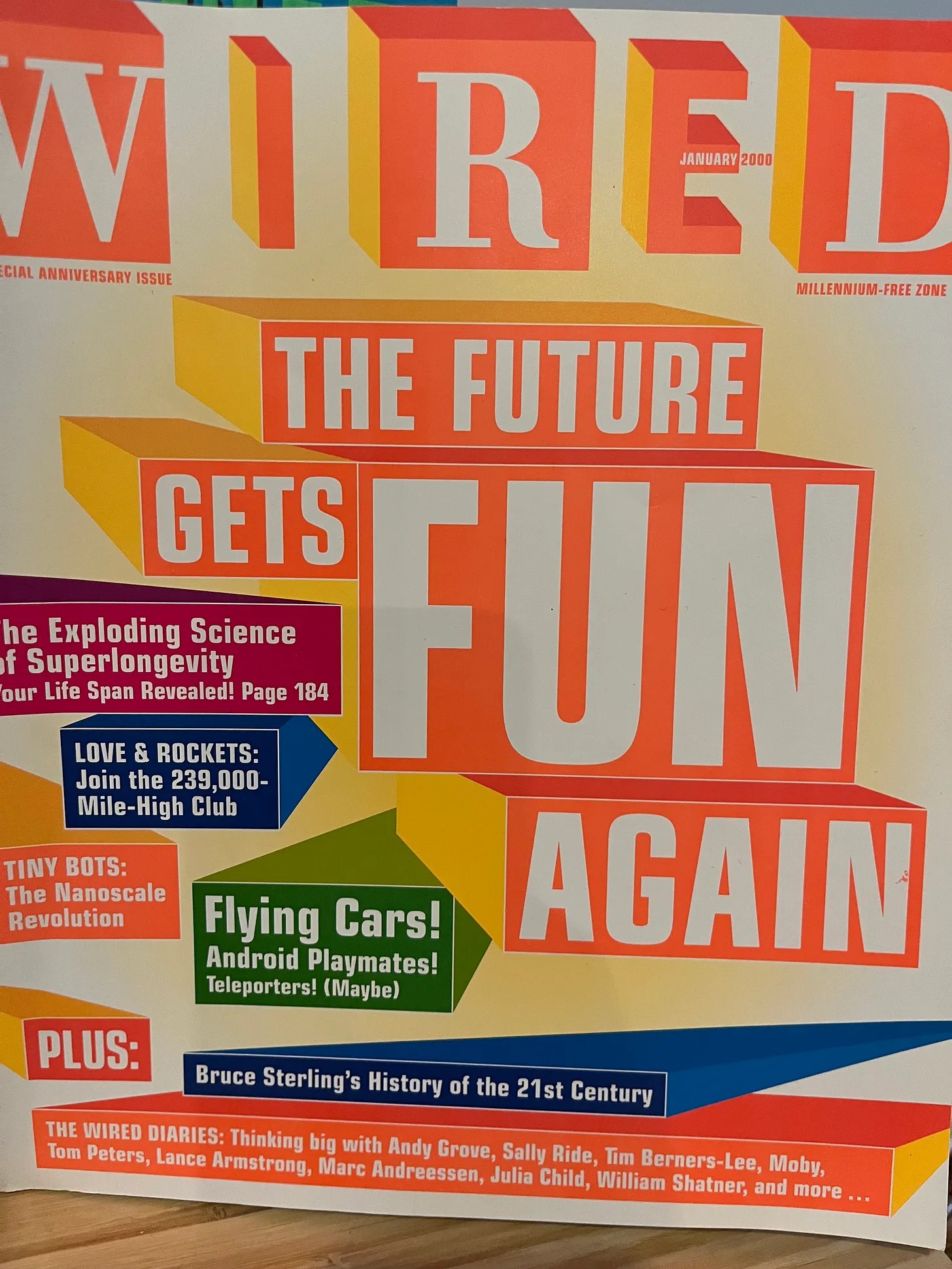
Professor and author Dave Karpf is re-reading the entire WIRED back catalog chronologically (for the second time) for a book project on the “history of the digital future.” A consideration of a 2000 issue devoted to the future has led him to a fascinating insight…
The January 2000 issue is themed around predictions. The magazine did the same thing in January 1999. They ask a ton of experts and celebrities to talk about what the future is going to be like. Some take it seriously, others make jokes. Some are prescient, others notsomuch. It’s a window into what the future looked like back then.
[Karpf reviews a number of the predictions, concluding with…]
…And then there’s this perfect Nathan Myrvhold quote “There won’t be TV per se in three decades. There will be video service over the Internet, but it will be as different from TV today as, say, MTV from the Milton Berle show of the 1950s or from radio plays of the 1940s.”
This is art. I want to frame Myrvhold’s quote and put it in a museum of lopsided tech futurist predictions.
The part that he gets right is the technological development curve. There he is, at the turn of the millennium, five years before the inception of YouTube, telling us that the future of television is going to be video service over the Internet. Yes, absolutely right!
But the part he gets wrong is the industrial, social, and economic impacts of this technological development. We’re seeing this right now, in 2023, as the various streaming services add advertising and strike content-sharing partnership deals with each other. We have these revolutionary new technological developments, and, for about a decade, they were supported by a stock market bonanza. But now that the stocks are no longer ridiculously overvalued, the companies driving these technological developments have settled on a vision of replacing old cable tv with new cable tv. (I wrote about this in July 2022, btw, back when this Substack had a much smaller readership. I think the piece holds up well.)
Technologically, it didn’t have to be this way. But, given all the existing incentive structures established by 21st century capitalism, it was all-but-certain that we would end up here.
I see this time and time again when reading predictions of social transformation from 90s- and 00s-era technologists [cough NicholasNegropontewasconstantlywrong cough]. And I see the same thing today, every time an artificial general intelligence true believer starts opining on the glorious future of education/entertainment/science/manufacturing/art.
I wrote about this phenomenon last year in The Atlantic, where I argued that we won’t be able to tell what the future of AI looks like until we have a sense of where the revenue streams come from. The trajectory of any emerging technology bends towards money.
…
I’m writing a whole book about the lopsided ways in which tech futurists always get their predictions wrong. And one major reason why is that they focus on what the technology could do, given time and mass adoption, rather than considering what capitalism will surely do to those technologies, unless we alter the incentives through regulations.
The trajectory of every emerging technology bends toward revenue streams. If you want to build a better future, you cannot ignore the shaping force of money…
A peek back at some tech predictions from January 2000: “From the WIRED archives: The trajectory of any emerging technology bends toward money,” by @davekarpf (referral account)
See also “The frantic battle over OpenAI shows that money triumphs in the end” (in which Robert Reich argues that, though the revenue streams aren’t yet obvious, protecting their emergence was at the core of the recent battle for control of what was, ostensibly, a not-for-profit) and the oddly apposite “Nerd culture is murdering intellectuals.”
And for more on Karpf’s march through WIRED’s history and what it can tell us about the ways that tech and our culture have changed, see “Notes from #WIRED30.”
* Deep Throat (as portrayed the film adaptation of All the President’s Men)
###
As we pay attention to the profit motive, we might recall that this is an important date in broadcast history. On this date in 1896, Guglielmo Marconi introduced “radio”: he amazed a group at Toynbee Hall in East London with a demonstration of wireless communication across a room. Every time Marconi hit a key beside him at the podium, a bell would ring from a box being carried around the room by William Henry Preece.
Then exactly five years later, on this date in 1901, Marconi confounded those who believed that the curvature of the earth would limit the effective range of radio waves when he broadcast a signal from Cornwall, England to Newfoundland, Canada– over 2,100 miles– and in so doing, demonstrated the viability of worldwide wireless communication.
In the earliest days of radio, when it was essentially a wireless telegraph, there were myriad predictions of what the technology might become– from an internet-like decentralized community of communicators to a provider of education, telemedicine, and other special services… in the event, of course, it followed the money.
“Sure, everything is ending… but not yet.”*…

From 365 CE to 10100 years from now, apocalyptic predictions and who made them: the interactive “Timeline of When the World Ended.” (Lots of notice for our old friend Harold Camping.)
* Jennifer Egan, A Visit from the Goon Squad
###
As we sharpen a Sense of the The Ending, we might recall that it was on this date in 1942 that a team of scientists led by Enrico Fermi, working inside an enormous tent on a squash court under the stands of the University of Chicago’s Stagg Field, achieved the first controlled nuclear fission chain reaction… laying the foundation for the atomic bomb and later, nuclear power generation.
“…the Italian Navigator has just landed in the New World…”
– Coded telephone message confirming first self-sustaining nuclear chain reaction, December 2, 1942.

Illustration depicting the scene on Dec. 2, 1942 (Photo copyright of Chicago Historical Society)
Indeed, exactly 15 years later, on this date in 1957, the world’s first full-scale atomic electric power plant devoted exclusively to peacetime uses, the Shippingport Atomic Power Station, reached criticality; the first power was produced 16 days later, after engineers integrated the generator into the distribution grid of Duquesne Light Company.

“The future ain’t what it used to be….”*

Just over a hundred years ago, in 1910, the Cedar Rapids Evening Gazette in Iowa published a list of advances and innovations that they believed would appear during the century, a fascinating list of things scientific/technical and social/political:
- Cure for cancer.
- Discovery south pole.
- Prevent or cure insanity.
- Influence sex by parental treatment.
- Create living organisms by artificial means.
- Phonograph records substitute for letter.
- Rationing clothing reform, health, comfort, durability only considerations
- Settle question of communication with Mars. Wonderful astronomical discoveries.
- Power of mind over matter a practical science devoid of superstitious elements.
- United States constitution rewritten, providing improved means for conservation of original democratic principles.
- Marvelous progress in transportation, largely aerial; airships and dirigible balloons crossing oceans and continents in remarkable time. Racing planes make five miles per minute. Inland waterways carry slow freight by improved methods. Monorail supplants two tracks. Electricity replaces steam. Convenient, economical city traffic system broadens city areas, opening suburban lands to householders. Pneumatic tubes for mails and express. Horses curiosities. Automobiles relegated to short distance burden bearing. Ocean steamers for freight, improvement toward speed rather than size.
- Produce rainfall at will.
- Temper gold and copper.
- Roads of nation paved.
- Conservation of sun’s heat and power.
- Cure for and elimination of tuberculosis.
- Development psychic research with fraud eliminated.
- Movements for universal language, universal religion, universal money.
- Non-existence of blindness by eliminating causes except accidents.
- Construction largely of concrete and metal or newly discovered materials.
- Electricity will move world’s wheels. Later radio-activity may substitute.
- Terrors of war so multiplied by death dealing inventions, chances of war minimized.
- Utilization of all energy, reducing consumption of wood and coal. Many fuel substitutes.
- Population of United States based on present ratio of increased, 1,317,547,000 at opening of twenty-first century.
- Rational diet with greatly reduced consumption of matter with increased nourishment from proper mastication and choices of foods.
- Machinery largely substituting manual energy, will promote pursuit of finer arts and sciences; give ample opportunity for relaxation and amusement; emancipate wage slaves. Three-hour work day predicted.
- Sea water for irrigation.
- Photographs in natural colors.
- Women’s political equality.
- Government control of corporations.
- Animated pictures in natural colors, transmitted by wireless.
- Substitution of heavier metals with aluminum, etc.
- Natural colors reproduced in newspaper pictures.
- Reduction of elimination all forms of gambling, including stocks.
- General acceptance of public ownership or control of public utilities.
- Government operation banking system, elimination of private banks. Postal savings banks.
- Moral, intellectual and economical awakening in dark sections of Africa, China a world power.
- Beautiful and healthful cities, offering with homes and work places all forms of free amusement, culture and recreation.
- Greater premium on brains with corresponding decreased in respect for position not gained by individual achievement.
- Revision judicial system, deciding causes on improved scientific plan, insuring equal justice. Pathological and psychological treatment for criminals. Crime reduced.
- Due to universal education, with special reference to hygiene, doctors and drugs be largely eliminated; average age to be near 60 years; men taller, stronger, higher intelligence and morals.
Some of their predictions were spot on (“Natural colors reproduced in newspaper pictures”); some, sadly as yet unrealized (“Cure for cancer”); and some, ironically backwards (“Government control of corporations”). But overall, it’s consoling to be reminded that things that seem wild, even radical at one moment in time– in this case, things like women’s rights and child labor laws– can, with the passage of time, become so obvious as to become human rights that we take for granted.
[TotH to Paleofuture, from whence the illustration above; via the always-excellent Next Draft]
* Yogi Berra
###
As we live in the past, we might send twisted birthday greetings to August Ferdinand Möbius; he was born on this date in 1790. A mathematician and theoretical astronomer, Möbius was so important to the fields of analytic geometry, topology, and number theory that several mathematical concepts are named after him, including the Möbius configuration, the Möbius transformations, the Möbius transform, the Möbius function μ(n), and the Möbius inversion formula…
But he is best remembered, of course, as the creator of the Möbius Strip— a two-dimensional surface with only one side…. more specifically: a non-orientable two-dimensional surface with only one side when embedded in three-dimensional Euclidean space… It can be constructed in three dimensions: Take a rectangular strip of paper and join the two ends of the strip together so that it has a 180 degree twist. It is now possible to start at a point A on the surface and trace out a path that passes through the point which is apparently on the other side of the surface from A.

You must be logged in to post a comment.