Posts Tagged ‘equity’
“Let’s go to the numbers”*…

From the McKinsey Global Institute, the executive summary of their snapshot– a “balance sheet”– of the global economy…
• The global balance sheet takes stock of all assets, liabilities, and wealth, providing a lens into economic health. This annual update estimates that it reached nearly $1.8 quadrillion ($1,800 trillion) in 2025, up from $1.7 quadrillion in 2024. Several asset classes grew further out of balance with the underlying economy, raising the possibility of corrections through inflation, asset valuation losses, or, optimally, productivity growth.
• The balance sheet’s mounting detachment from the global economy was driven by the world’s two biggest economies in 2025. US equity values soared to 2.4 times corporate net assets as profits were double their share of GDP since 2000. China’s corporate debt grew to 80 percent of real assets, versus 50 percent globally. Government debt remains near all-time highs in the United States and has grown most rapidly in China.
• Globally, most corporate and household debt and real estate moved closer to 25-year averages relative to GDP. Inflation helped with this normalization, although values remain well above pre-2000 levels. The ratio of productive assets to GDP held steady amid flat investment.
• Global household wealth growth rose to a new high of $570 trillion, driven by “paper” gains. Only 20 percent came from real capital formation, while valuations of existing assets grew four percentage points faster than already-high consumer price inflation. In the United States and Canada, equity values drove wealth growth. China, France, and Germany saw a drop in paper wealth as real estate prices declined. In the United Kingdom and Japan, inflation pushed up asset values.
• Major economies were on different pathways entering 2026. The United States has been in a “productivity acceleration” scenario, but high public debt and equities add the possibility of “sustained inflation” or “balance sheet reset.” Europe has gravitated toward “secular stagnation” as sluggish demand depresses growth and interest rates. China has experienced a partial balance sheet reset amid declining property values, although government spending and corporate investment have continued to propel balance sheet growth.
In this report, we provide an update on the global balance sheet in 2025, exploring to what extent its recent expansion, and by extension wealth growth, has been “in balance.” The analysis finds that wealth was, to an even greater extent than previously, rooted in asset values rising faster than real economy investment and growth, creating record levels of global wealth “on paper.”
Although many economies that were studied experienced wealth and balance sheet swings, the global picture was largely driven by its two biggest: the United States and China. Higher US equity values and the accumulation of China’s public and private debt brought some near-term economic benefits but left their economies more vulnerable to potential corrections.
Businesses use both income statements and balance sheets to develop a complete picture of their financial health. Analysts of the global economy tend to focus on the former. Since 2021, MGI has developed a “global balance sheet” to fill this gap, representing a clearer view into the world economy’s wealth and health.
Our previous reports found that from the mid-1990s to the COVID-19 pandemic, household wealth expanded faster than gross domestic product. Asset prices for real estate, equities, and bonds grew, as did debt and deposits. This occurred amid declining (and eventually rock-bottom) interest rates, rapidly expanding US profits, and a property boom in China. Productivity did not keep pace across advanced economies, nor did real wealth formation through net new investment.
When the balance sheet outruns the underlying economy, weaknesses can be exposed. When real estate and equity values rise faster than GDP, capital may disproportionately go to asset repurchases, sometimes with a lot of leverage. This may push up valuations but leave the economy deprived of the type of investment that generates long-run growth. For households, wealth rises but merely on paper, with heightened risks of eventual corrections. Growing asset values also tend to exacerbate wealth inequality, as existing owners of wealth see large gains while entering asset markets becomes harder for others (for example, young households trying to buy a home).
Elevated balance sheets may correct in one of three ways. A productivity acceleration scenario involves higher income supporting high asset values and debt; this is the most preferred outcome. A sustained inflation scenario brings down the real values of assets and debt, recalibrating the balance sheet with higher nominal GDP. But it can erode inflation-adjusted wealth along with other undesirable side effects. A balance sheet reset scenario, entailing a drop in asset values, deleveraging, and defaults, would shrink the balance sheet in absolute terms, with severe wealth losses and, often, lengthy periods of lost economic growth. Or the balance sheet may just stay high, particularly under secular-stagnation-like conditions of low investment and interest rates, as seen in the United States and Europe in the 2010s. That’s seemingly good for wealth, but at the cost of low growth and rising leverage.
Historically, most balance sheet corrections have taken place through higher inflation. Indeed, the inflation coming out of the COVID-19 pandemic in the United States and Europe brought a correction in the balance sheet (and wealth) ratio to GDP. In China, a drop in property values drove a decline in wealth to GDP.
In 2025, global wealth reached a higher dollar value than ever before. But how “healthy” was this new growth? After postpandemic corrections, some balance sheet items have resumed expansion and reached new heights. This was particularly the case for US equity as AI fueled market optimism and corporate earnings continued to climb. Rising government debt relative to GDP remains a challenge in many economies amid higher interest rates. Stocks of currency and deposits remain high compared to longer-term historical norms. Altogether, this has culminated in even more wealth on paper than in the past several decades and raises the stakes for US corporate earnings to deliver.
Balance sheets, and macroeconomic factors like productivity and inflation, point to diverging trends across major economies. Recognizing the swing factors that can shift an economy to productivity acceleration is more urgent than ever: for the United States, corporate earnings and greater government saving (in other words, less borrowing); for Europe, greater investment; for China, higher domestic consumption.
Future global wealth and stability may depend on it…
[The report unpacks 0with lots of charts/data) the contents– the constituent elements– of the balance sheet, examines whether or not it is “in balance,” and considers whether the growth that it reflects has been “healthy.” (McKinsey worries that it has not been.) It concludes, addressing the executives who are McKinsey’s primary clients…]
… A balance sheet that is out of kilter with the economy—in other words, with high paper wealth fueled by debt and liquidity levels significantly above historical norms—can unwind via higher productivity, higher inflation, or asset price corrections. Balance sheets may also remain large, typically under secular-stagnation-like conditions, effectively kicking the can down the road for potential correction.
Each of these four scenarios shapes the long-term economic outlook. Only productivity acceleration delivers real economic growth justifying valuations, thus protecting wealth. The others sacrifice wealth, growth, or both. Sustained inflation reduces real values of wealth, secular stagnation sees low growth, and a balance sheet reset signals a loss of wealth and growth. Importantly for business leaders, two scenarios would likely mean structurally higher interest rates: Productivity acceleration would entail greater demand for capital amid higher business investment, while sustained inflation would likely involve central banks tightening policy rates and, ultimately, higher long-term yields.
All scenarios are possible for all major economies. However, they appear to be on different pathways, with different swing factors that could move them from one trajectory to another.
For executives, this means both preparing for an unusually broad array of economic pathways and carefully watching the swing factors, which rise above the noise of daily indicators (see sidebar “Business planning for all scenarios”). Leaders across sectors and industries could also explore ways to encourage the optimal outcome, the productivity acceleration scenario.
Major economies show significant divergence in trends across macro drivers of productivity, inflation, and interest rates, along with fundamental balance sheet components including real estate, equity, and debt.
The United States has seen a structural uptick in both productivity growth and interest rates relative to the prepandemic period. Productive investment, particularly driven by the tech sector, has recently grown. High equity values also signal market confidence, although they may pose some downside risks. Meanwhile, inflation remains above the Federal Reserve’s 2 percent target and government debt remains near all-time highs, adding further inflation risk.
The eurozone has experienced a return to secular-stagnation-like conditions, akin to the prepandemic period, amid flat productivity and higher saving. Europe’s balance sheets overall appear more in balance compared to the US balance sheet (with a few exceptions, such as Italy’s government debt). Productivity growth rates, however, are down across the region’s three largest economies (Germany, France, and Italy). Until recently, inflation was mostly trending toward the European Central Bank’s 2 percent target, although Europe is more exposed to energy price changes. Personal savings rates remain high amid a drop in aggregate demand and per capita household wealth has declined in PPP terms in Germany and France.3 Productive investment remains below prepandemic and global averages.
China continues to work through a partial balance sheet reset in the face of a continued decline in real estate, with questions about future growth drivers amid low household demand and a boom in corporate investment. Productivity growth has receded in recent years, although it remains above the rate in advanced economies. Inflation and, in tandem, nominal interest rates have dropped, and concerns have shifted to dealing with deflation risks. At a macro level, lower household property investment has been offset by higher corporate investment, especially among state-owned enterprises, and by government spending. This has coincided with a substantial rise in corporate and government debt, both reaching all-time highs.
While the United States is the only major economy showing signs of productivity acceleration, it is not guaranteed long term, and other economies have a potential path to it. Focusing on “swing factors” could help filter signal from noise in the daily flow of indicators, market fluctuations, and political headlines. These factors differ by economy.
In the United States, swing factors that could knock the economy out of productivity acceleration include the “fiscal tightrope” and corporate earnings.
- Government debt stands at about 120 percent of GDP. Combined with higher interest rates, this means more public spending will need to be directed toward debt repayment. Public spending could come under pressure, especially from bond investors, in the form of higher market interest rates. These translate into higher business costs of capital. If fiscal policy tightens too little, a public debt crisis or sustained inflation becomes more likely. Too much, and secular stagnation is a potential outcome. To bring budgets back into balance, greater fiscal saving (or lower borrowing) on the order of three percentage points of GDP would be needed.
- On the corporate-earnings side, an equity or wealth reset could be triggered by a large structural shift in the longer-term outlook—for example, from AI disappointment or large geopolitical disruption. Equities are at all-time highs, at 3.7 times GDP and 2.4 times net assets, and constitute nearly 40 percent of household wealth. A price correction could result in a sharp pullback in demand, ushering in an extended period of low growth. It is thus imperative that corporate earnings deliver on high expectations…
Eminently worth reading in full: “The global balance sheet 2026: Imbalance and divergence.”
See also: “World Economic Situation and Prospects 2026” from UNCTAD (the UN Trade and Development Organization), whose review of the global finacial situation resonates with McKinsey’s, but whose recommendations are targeted to global policy makers and development champions:
• Strengthen coordination across macroeconomic policies. Monetary policy alone cannot manage persistent price pressures. Better alignment between monetary, fiscal and industrial policies is essential to stabilise inflation, support investment and protect vulnerable groups.
• Use fiscal policy strategically and credibly. Targeted and temporary measures can help protect households from high prices and support social cohesion, while credible medium-term fiscal plans and prudent debt management are essential to rebuild fiscal space.
• Scale up multilateral cooperation and development finance. Implementing commitments under the Sevilla Commitment, including debt reform and expanded concessional and climate finance, is vital to closing investment gaps and reducing systemic risks.
• Reinforce an open, rules-based trading system. Strengthening transparency, predictability and cooperation in global trade remains central to sustaining growth and limiting fragmentation in an increasingly uncertain global economy.
And for a differently-flavored kind of accounting: “What the Big Mac index reveals about a global currency beef.”
* Catchphrase often used by financial and sports journalists to transition to statistics or financial data, e.g., on public radio’s wonderful Marketplace.
###
As we ponder the political economy, we might recall (hoping that history doesn’t repeat itself) that on this date in 1929, while the U.S. economy was already showing signs of strain (agricultural strains and a sagging consumer market), the U.S., its businesses, and its financial markets were still in the “Roaring Twenties.” Roughly three months later (on October 24, 1929, “Black Thursday,” and October 29, 1929, “Black Tuesday”) America– and the world– suffered the Wall Street crash of 1929 and began the slide into the Great Depression.
By this date in 1932, stocks had lost roughly 90% of the value they had had three years earlier. GDP in the U.S. had fallen 30%; GDP around the world was down 15%. International trade fell by more than 50%, and unemployment in some countries rose as high as 33% (peaking in 1933 at 25% in the U.S.).

“It’s easy to meet expenses – everywhere we go, there they are.”*…

… And those expenses seem to keep rising. Ben Brubaker weighs in on one ever-more-timely culprit…
Imagine a town with two widget merchants. Customers prefer cheaper widgets, so the merchants must compete to set the lowest price. Unhappy with their meager profits, they meet one night in a smoke-filled tavern to discuss a secret plan: If they raise prices together instead of competing, they can both make more money. But that kind of intentional price-fixing, called collusion, has long been illegal. The widget merchants decide not to risk it, and everyone else gets to enjoy cheap widgets.
For well over a century, U.S. law has followed this basic template: Ban those backroom deals, and fair prices should be maintained. These days, it’s not so simple. Across broad swaths of the economy, sellers increasingly rely on computer programs called learning algorithms, which repeatedly adjust prices in response to new data about the state of the market. These are often much simpler than the “deep learning” algorithms that power modern artificial intelligence, but they can still be prone to unexpected behavior.
So how can regulators ensure that algorithms set fair prices? Their traditional approach won’t work, as it relies on finding explicit collusion. “The algorithms definitely are not having drinks with each other,” said Aaron Roth, a computer scientist at the University of Pennsylvania.
Yet a widely cited 2019 paper showed that algorithms could learn to collude tacitly, even when they weren’t programmed to do so. A team of researchers pitted two copies of a simple learning algorithm against each other in a simulated market, then let them explore different strategies for increasing their profits. Over time, each algorithm learned through trial and error to retaliate when the other cut prices — dropping its own price by some huge, disproportionate amount. The end result was high prices, backed up by mutual threat of a price war.
Implicit threats like this also underpin many cases of human collusion. So if you want to guarantee fair prices, why not just require sellers to use algorithms that are inherently incapable of expressing threats?
In a recent paper, Roth and four other computer scientists showed why this may not be enough. They proved that even seemingly benign algorithms that optimize for their own profit can sometimes yield bad outcomes for buyers. “You can still get high prices in ways that kind of look reasonable from the outside,” said Natalie Collina, a graduate student working with Roth who co-authored the new study…
Read on for more on recent findings that reveal that even simple pricing algorithms can make things more expensive: “The Game Theory of How Algorithms Can Drive Up Prices,” from @benbenbrubaker.bsky.social in @quantamagazine.bsky.social.
See also the charmingly-understatedly-titled “AI-Driven Personalized Pricing May Not Help Consumers.“
* anonymous
###
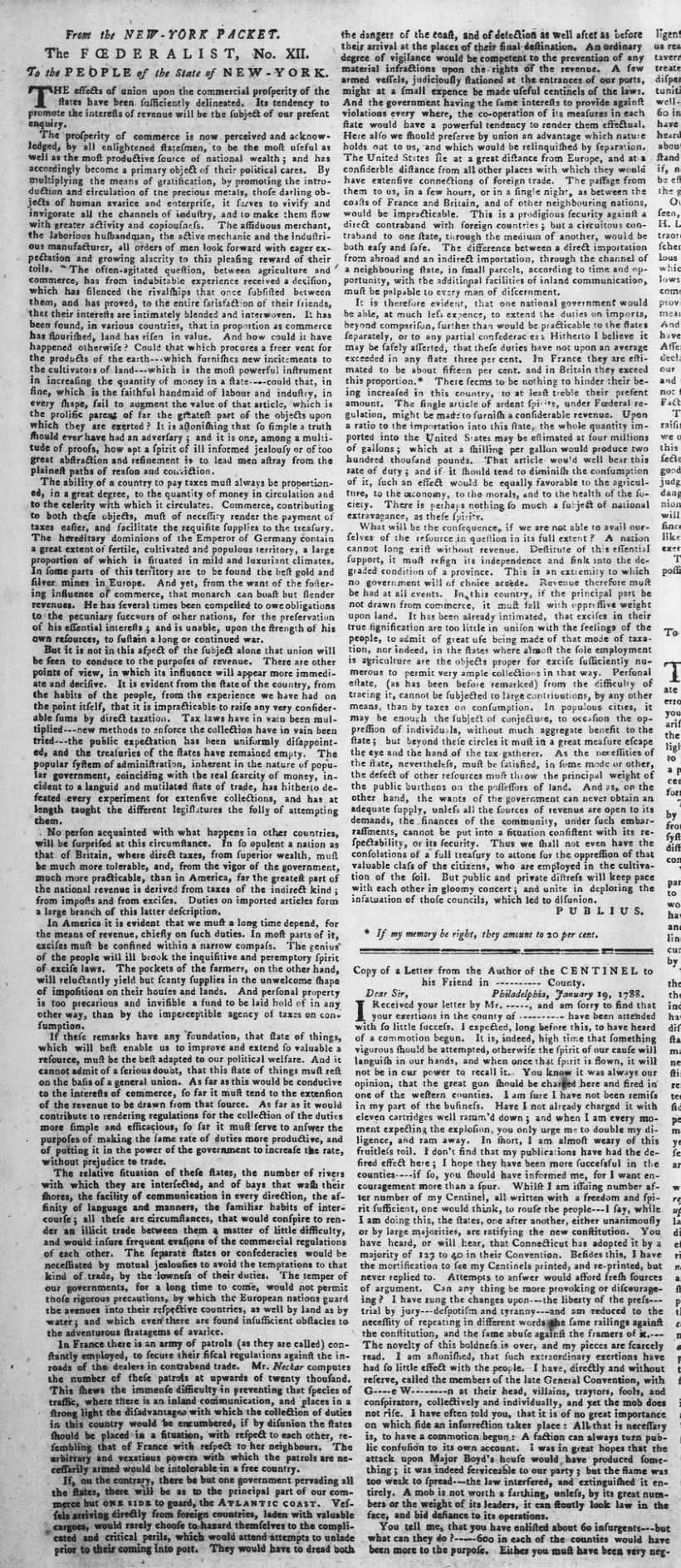
As we muse on malign mechanisms, we might recall that it was on this date in 1787 that the first in a series of eighty-five essays by “Publius,” the shared pen name of Alexander Hamilton, James Madison, and John Jay, appeared in the Independent Journal, a New York newspaper. Known collectively as The Federalist Papers, they were an effort to urge New Yorkers to support ratification of the Constitution approved by the Constitutional Convention on September 17, 1787. While aimed at New Yorkers, the essays were reprinted in newspapers (and pamphlets) across the fledgling nation.
In Federalist Paper #12, Alexander Hamilton (later the first Secretary of the Treasury) articulated an argument for the economic advantages of a united government under the proposed Constitution– and sketched the outline of the financial and commercial regime we’ve built since.
Your correspondent is heading into a series of meeting sufficiently intense that (R)D will be on brief hiatus. Regular service should resume on October 30.
“Enough is abundance to the wise”*…

The “new” idea of Abundance is having a moment. The estimable David Karpf worries that the folks behind it are blowing their opportunity…
I guess I would call myself “Abundance-curious.”
There is a version of the Abundance agenda that I quite vocally agree with. My interpretation of Ezra Klein and Derek Thompson’s central argument was something along these lines:
- Government should have a strong hand in establishing, directing, and funding social priorities.
- In the course of setting these priorities, government should endeavor to get out of its own way.
Klein and Thompson are pretty firmly in favor of government intervention and industrial policy. They aren’t just saying “growth is good and we should all cheer for developers!” They are instead saying something more along the lines of, if the government thinks something – housing, clean energy, etc – is a priority, then the government should proactively support that goal. Put money behind it. Don’t leave everything to the “will of the markets.” And, oh yeah, if the government wants to build high-speed rail or housing (etc etc) then the government should get out of its own damn way and make it can actually fulfill those promises.
I pretty enthusiastically agree with all of these points. We ought to rebuild administrative capacity and get back into having government make governance decisions. Government ought to be both proactive and responsive. And often the best way to make a better future possible is to devote public money towards promoting public goods.
I also quite like several of the people operating under that banner, and quite like some of their ideas as well. (Specifically: government should fund more things, we should have more administrative capacity, and the accretion of procedural checks-with-no-balance has had plenty of regrettable consequences.)
And hey, they’re having a moment. Good for them.The term is rapidly becoming an empty signifier, though. Tesla’s new master plan boasts of “sustainable abundance.” The Silicon Valley variant of the abundance agenda is just warmed-over techno-optimism — less “let’s rebuild the administrative state and make government work again!” and more “the government should hand big sacks of money to tech startups and exempt them from taxes and regulations. Let our genius builders build!”
The Abundance 2025 conference [happened] in DC [last] week, and the speakers range from pro-housing YIMBYs to a guy arguing for “deportation abundance.”
Yikes.
Steve Teles has taken a good-faith shot at sorting through the mess:
It would not be hard to conclude that the emergence of these various flavors of abundance betrays the inherent squishiness and incoherence of the concept. And it is true that abundance is not a systematic ideology attached to a specific political coalition, as are conservatism or democratic socialism. But that doesn’t mean that it is ideological vaporware. As someone who has been working on many of these ideas for a decade or more, I think it is time to nail down just what sort of idea abundance is.
Abundance stirs confusion in part because, unlike contemporary conservatism and progressivism, it is not an idea that emerged to justify a specific party-political, coalitional, material, or cultural project. Given that abundance has been embraced by post-colonial socialists, techno-futurist capitalists, and Democratic centrists, it is best conceptualized as an alternative dimension that cuts across existing ideologies without entirely superseding them, defined by a new set of problems and tools for addressing them.
Abundance is fundamentally “syncretic,” spreading by attaching itself to a variety of different cultural practices and political projects, rather than by preserving its doctrinal purity.
He goes on to define the central unifying idea:
At its base, Abundance is best understood as having one central aspiration that requires tackling two interlocking challenges. The aspiration is to escape from a political economy defined by artificial scarcity, to create a world in which we solve problems primarily by unlocking supply.
That’s it. That’s the whole thing. Abundance says “we should solve problems by creating more,” and invites the competing political coalitions to draw their own conclusions on what constitutes a problem. (And, also, more of what, exactly?)
Syncretic terms like this run the risk of falling apart though. If DOGE is part of the Abundance movement, and the people DOGE is illegally firing is also part of the Abundance movement… If the Green New Deal is Abundance but oh hey also the Claremont Institute is Abundance too, then Abundance ceases to mean anything at all. The term is already washed.
(Q: Are Curtis Yarvin, Balaji Srinivasan, and the other Network State neomonarchists part of the Abundance movement? A: yes, that’s “dark abundance.”)
I can empathize with the instinct to try to build the broadest possible coalition. I can see why making your new “movement” seem like the one big cross-partisan idea right now feels like a win. But it is a temporary, pyrrhic victory.
Strategy is a verb. The act of strategizing involves making choices that help you accomplish goals and wield power. The Abundance movement does not appear to be making any choices whatsoever. That’s the fast track to irrelevance.
Just saying, if *I* was part of the Abundance movement, I would be cautioning people that it sure would be nice to accomplish something, anything at all, before the idea gets entirely co-opted and loses all meaning. If the Abundance folks insist on advancing a syncretic proposal so broad that it pointedly has nothing to say about what problems ought to be solved, then they are quickly going to find that their clever-new-phrase means nothing at all.
The fate of every successful political movement is that they eventually face co-optation and counteraction. But usually you want to rack up some actual victories before it happens…
“What *Isn’t* Abundance?” from @davekarpf.bsky.social (in his valuable newsletter, The Future, Now and Then).
See also: “Varieties of Abundance” from @niskanencenter.bsky.social, and “How to Blow Up a Planet” from @nybooks.com.
[Edit: late add of a piece from the ever-insightful Rusty Foster that dropped just after this was first posted: “Abundance of What.”]
* Euripides
###
As we muse on more, we might send abundant bountiful greetings to William Bligh; he was born on this date in 1754. A British naval officer, over a 50 year career, he rose to the rank of Vice-Admiral and served as colonial governor of New South Wales. But he is remembered for his role in the most famous mutiny in history: in 1879, the first officer and crew “removed” Bligh from his command of (and set him and his few supporters adrift from) HMAV Bounty.

“Humanity is actually much more cooperative and empathic than given credit for”*…

We looked earlier at the shrinking away of public companies in the U.S., both as a product of consolidation (of operations and of ownership) and of the (potentially dangerous) growth, in their stead, of private equity. University of Michigan professor Jerry Davis has a more optimistic take…
Public corporations have been dominant institutions in the American economy since the dawn of the 20th century. Whether due to their greater efficiency or power, listed corporations spread across nearly all industries. “Capitalism” in America was synonymous with “corporate capitalism,” and the number of exchange-listed companies grew with the size of the economy.
Yet since the late 1990s, the number of listed corporations has dropped by half in the US, underwritten by new technologies that lower the cost of assembling an enterprise. Meanwhile, neglected alternatives to the public corporation both old (e.g., mutuals, cooperatives) and new (e.g., open source, platform coops) have proven surprisingly durable. Given the manifest pathologies of shareholder capitalism, the combination of these two trends may suggest pathways out of our current dilemma…
[David explains how both consolidation among listed companies and the rise of private equity have contributed to this drop, but then raises a third, more general explanation…]
A more encompassing interpretation is that information and communication technologies (ICTs) have drastically changed the basic economic calculus of what an enterprise looks like and how it might be funded. In the US context, this has meant that companies prefer “buy” to “make,” as transaction cost enthusiasts might describe it. I coined the term Nikefication to describe the process of vertical dis-integration that reconfigured American industry during the 1990s and 2000s and the options it opens for alternative forms of enterprise, described in detail in previous books…
The vertical dis-integration of the American economy was driven by Wall Street and enabled by ICTs. Ironically, the result is that the capital requirements to create and scale a business can be much lower, reducing the rationale to go public in the first place. Indeed, IPO prospectuses routinely convey that the point of the IPO is not to raise capital, but to create a market for the company’s shares to enable VCs and employees to cash out – which is not the most persuasive pitch to potential buyers, and perhaps helps account for the disastrous post-IPO performance of most new listings.
The asset-lite model means fewer public companies, but it also suggests new possibilities for non-corporate forms that may be more human-scale and democratic. Nike’s profit-driven, asset- and employee-lite model is not the only option enabled by new technologies.
By “noncorporate” I mean forms of economic organization that are not owned by outside shareholders, although they may be legally organized as a corporation. These include mutuals (where consumers or members are also the owners); cooperatives (where workers, producers, or consumers are the owners); municipal enterprises (where citizens or governments own the enterprise); nonprofits; and open source projects. These forms are far more prevalent than one might expect, and in some cases they dominate their industry (e.g., property insurance, server software).
Noncorporate forms of enterprise have proven surprisingly resilient in the US. The Fortune 500 list for 2022 includes at least a dozen mutual insurance companies, including State Farm (#44), New York Life (#71), and Nationwide (#83). The single largest shareholder of over 350 of the 1000 largest American corporations is Vanguard—also a mutual. Land o’ Lakes (#213) is an agricultural cooperative owned by its producer-members, as are Ocean Spray and Blue Diamond. Ace Hardware is a retail cooperative in which local stores can be attuned to local needs and tastes yet gain the economies of scale of a large-scale brand. Jessica Gordon Nembhard’s brilliant book Collective Courage documents that cooperative forms thrived in African-American communities for generations – often overlooked by those who find data about the economy solely through online databases. And the US is home to nearly 5000 credit unions, which by law are not-for-profits, owned by their members.
Stanford Law professor Ron Gilson once quipped that if shareholders didn’t exist, they would have to be invented. That’s not quite true: plenty of American enterprises do quite well without shareholders. Indeed, civilization itself might be better without them. As I have written elsewhere, “nearly every major societal pathology in the West today – certainly in the USA – is caused or exacerbated by profit-oriented corporations,” including the opioid epidemic, the obesity crisis, the return of nicotine addiction among the young, democracy-undermining social media, and a climate catastrophe underwritten by the fossil fuel industry. Shareholder capitalism may be a suicide pact. Conversely, cooperatives are inherently democratic and accountable…
Institutional alternatives to public corporations are well-established in the US, and in some cases they lead their industry, such as mutuals in finance and insurance. But cooperatives have historically been thin on the ground here compared to Europe. According to the Democracy At Work Initiative, there were 612 worker cooperatives in 2021 –a 30% increase over 2019, but still a tiny number.
Perhaps the digital revolution has finally created the conditions for cooperatives to thrive. Research from the pre-digital era suggests that one of the factors limiting cooperatives is, for want of a better term, the transaction costs of democracy. A lot of workers’ time spent in meetings to engage in dialogue, debate, and polling is a price that corporate dictatorships don’t have to bear. But newer tools have dramatically reduced the transaction costs of democracy: the same smartphones that enable pervasive corporate surveillance also allow worker voice at scale on a continuous basis.
It is not just transaction costs that have declined: the required assets to start a business are also much cheaper now to own or rent. Capital equipment such as Computer Numerical Control tools, powered by software, gets better and cheaper much the same way other software-powered tools do. (Compare the price of a color laser printer in 1990 to one today.) This is also true of the software required to run an enterprise. It is possible to buy a knockoff version of the enterprise software underlying the Uber app for under $10,000 – and the Drivers Coop in New York is creating a version to “franchise” the locavore driver-owned coop alternative to Uber. The ICTs that dis-integrated the corporate economy have opened space for noncorporate alternatives that might be more democratic and human-scaled.
There are reasons for optimism here. Platform cooperatives merge the benefits of coops with accessible technology, and have been especially effective in industries in which the required new capital investment is low (home cleaning, home health aides, transit). Trebor Scholz’s new book Own This! provides details on the opportunities here. Municipally- or cooperative-owned fabrication facilities can enable enterprises with limited capital to launch and thrive. If the required investment to start a business is low, then the range of alternative institutions, including coops, is correspondingly larger.
The technologies exist to create low-cost alternatives to public corporations. Maybe we are not stuck with the legacy of 20th century corporate capitalism after all…
An optimistic (and aspirational) take on what might follow the economic reign of the public company: “Is This the End of Corporate Capitalism?” from @vanishingcorp via @iftf.
###
As we ponder proprietorship, we might recall that, on this date in 1933 the hospitality industry got a boost as Congress ratified the 21st Amendment to the U.S. Constitution– repealing the 18th Amendment, which had prohibited the manufacture, transportation, and sale of alcohol. Prohibition had gone into effect in 1920 in an effort to reduce crime and improve public health, but it had backfired: despite massive public investment in enforcement, there was a sharp rise in organized crime (c.f.: bootleggers like Al Capone stepping in to supply black market booze) and the emergence of a “scofflaw” attitude on the part of a public that wanted its alcohol.

“Infrastructure is much more important than architecture”*…
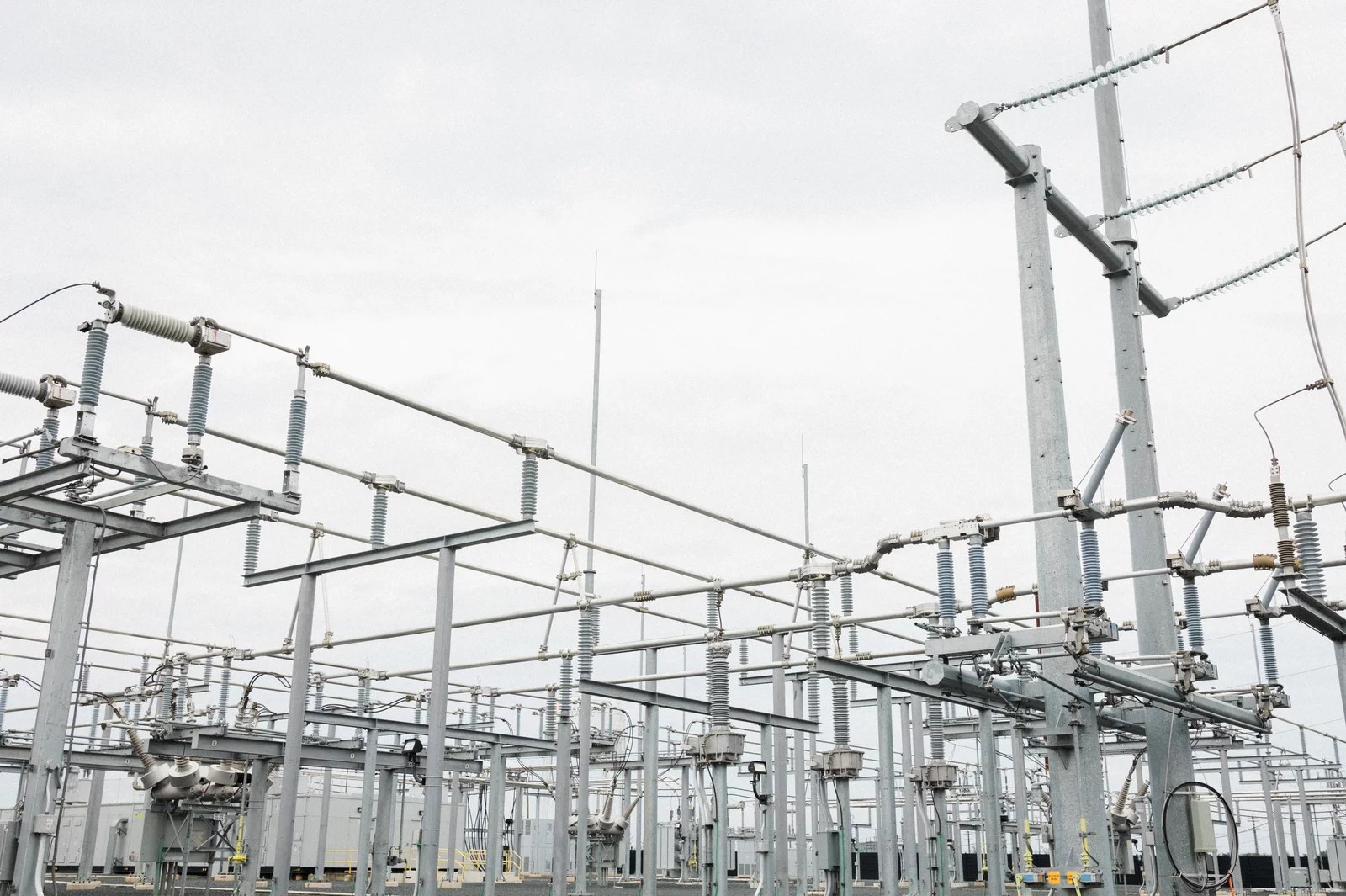

.. much, much more important, as Debbie Chachra explains in a piece featured once before in (R)D. It’s excerpted here again, with special emphasis on our power grid…
We use exogenous energy every day to exceed the limits of what our bodies can do. Artificial light compensates for our species’ poor night vision and gives us control over how we spend our time, releasing us from the constraints of sunrise and sunset. So valuable is artificial light that it’s a reliable correlate of wealth and economic development: researchers use the growing brightness of regions over time, as quantified from satellite images taken at night, as a proxy measure—more resources, more light. The southern half of the Korean Peninsula and the ocean surrounding it is ablaze with light; while North Korea has just faint threads of light leading out from Pyongyang, a result of decades of imposed scarcity.
Energy in the form of mechanical work also replaces our body’s labour, from the domestic scale—all the technologies for textiles, for example, from spinning and weaving to sewing and laundry—to scales that are nearly impossible for human bodies alone, like building skyscrapers and bridges. And we use mechanical energy to move our bodies and ferry goods around: transportation. Exogenous energy also makes our living environments more comfortable; for a long time, this was mostly limited to heating, but in the twentieth century, the technologies of refrigeration and air conditioning became widespread. The newest uses of energy are telecommunications technologies—from Morse code to TikTok, they turn electrons into bits of information, facilitating human connections on a global scale.
In fact, this ability to access more energy than our bodies themselves can provide is—all but literally—baked into being a human. All cultures eat cooked food (and no animals cook their food). While it’s not required to survive, strictly speaking, heating food breaks it down, making the nutrients more bioavailable; in essence, the food becomes more nutritious. Learning to cook our food is thought to have been an important contributor to the development of our calorie-dense brains and all that followed, helping to free humans from the ongoing labour of foraging and eating that occupies most animals. But the near-necessity of cooking food then requires a different labour: for most women on most of the planet, obtaining fuel for cooking remains their primary daily occupation.
“Care at Scale”
How is that we in the U.S. have more-or-less abundant power? Brian Potter explains the evolution of our electric grid…
Abundant electricity is a defining feature of the modern era. At the turn of the 20th century electrical power was a rare, expensive luxury: in 1900 electricity provided less than 5% of industrial power in the US, and as late as 1907 was in only 8% of US homes. Today, however, 89.6% of the world’s population has access to electricity (97.3% if you just consider urban areas), and Wikipedia’s “list of countries by electrification rate” has 123 countries sharing the top spot at 100% electrification.
Electrical service is considered critical in a way that’s different from most other services. Even a brief interruption in electrical power is considered a serious problem in industrialized countries where power outage durations are typically measured in minutes per year. To put this in perspective, the average yearly outage time in the US is around 475 minutes per year, which is considered especially unreliable despite representing ~99.9% uptime. By comparison, Germany averaged just 12.7 minutes of power outages per year in 2021—a remarkable 99.998% uptime.
Electricity’s transition from a luxury good to the foundation of modern life happened quickly. By 1930, electricity was available in nearly 70% of US homes, and supplied almost 80% of industrial mechanical power. By 1950, the US was tied together by an enormous network of high-voltage transmission lines…
“The Birth of the Grid” (and Part Two) from @_brianpotter.
Keep an eye out for @debcha‘s forthcoming book, How Infrastructure Works.
* Rem Koolhaas
###
As we think systemically, we might recall that it was on this date in 1752 that Benjamin Franklin and his son tested the relationship between electricity and lightning by flying a kite in a thunder storm. Franklin was attempting a (safer) variation on a set of French investigations about which he’d read. The French had connected lightning rods to a Leyden jar, but one of their experiments electrocuted the investigator. Franklin– who was, of course, no fool– used a kite; the increased height/distance from the strike reduces the risk of electrocution. (But it doesn’t eliminate it: Franklin’s experiment is now illegal in many states.)
In fact (other) French experiments had successfully demonstrated the electrical properties of lightning a month before, but word had not yet reached Philadelphia.

The Treasury’s Bureau of Engraving and Printing created this vignette (c. 1860), which was used on the $10 National Bank Note from the 1860s to 1890s
You must be logged in to post a comment.