Posts Tagged ‘John Jay’
“It’s easy to meet expenses – everywhere we go, there they are.”*…

… And those expenses seem to keep rising. Ben Brubaker weighs in on one ever-more-timely culprit…
Imagine a town with two widget merchants. Customers prefer cheaper widgets, so the merchants must compete to set the lowest price. Unhappy with their meager profits, they meet one night in a smoke-filled tavern to discuss a secret plan: If they raise prices together instead of competing, they can both make more money. But that kind of intentional price-fixing, called collusion, has long been illegal. The widget merchants decide not to risk it, and everyone else gets to enjoy cheap widgets.
For well over a century, U.S. law has followed this basic template: Ban those backroom deals, and fair prices should be maintained. These days, it’s not so simple. Across broad swaths of the economy, sellers increasingly rely on computer programs called learning algorithms, which repeatedly adjust prices in response to new data about the state of the market. These are often much simpler than the “deep learning” algorithms that power modern artificial intelligence, but they can still be prone to unexpected behavior.
So how can regulators ensure that algorithms set fair prices? Their traditional approach won’t work, as it relies on finding explicit collusion. “The algorithms definitely are not having drinks with each other,” said Aaron Roth, a computer scientist at the University of Pennsylvania.
Yet a widely cited 2019 paper showed that algorithms could learn to collude tacitly, even when they weren’t programmed to do so. A team of researchers pitted two copies of a simple learning algorithm against each other in a simulated market, then let them explore different strategies for increasing their profits. Over time, each algorithm learned through trial and error to retaliate when the other cut prices — dropping its own price by some huge, disproportionate amount. The end result was high prices, backed up by mutual threat of a price war.
Implicit threats like this also underpin many cases of human collusion. So if you want to guarantee fair prices, why not just require sellers to use algorithms that are inherently incapable of expressing threats?
In a recent paper, Roth and four other computer scientists showed why this may not be enough. They proved that even seemingly benign algorithms that optimize for their own profit can sometimes yield bad outcomes for buyers. “You can still get high prices in ways that kind of look reasonable from the outside,” said Natalie Collina, a graduate student working with Roth who co-authored the new study…
Read on for more on recent findings that reveal that even simple pricing algorithms can make things more expensive: “The Game Theory of How Algorithms Can Drive Up Prices,” from @benbenbrubaker.bsky.social in @quantamagazine.bsky.social.
See also the charmingly-understatedly-titled “AI-Driven Personalized Pricing May Not Help Consumers.“
* anonymous
###
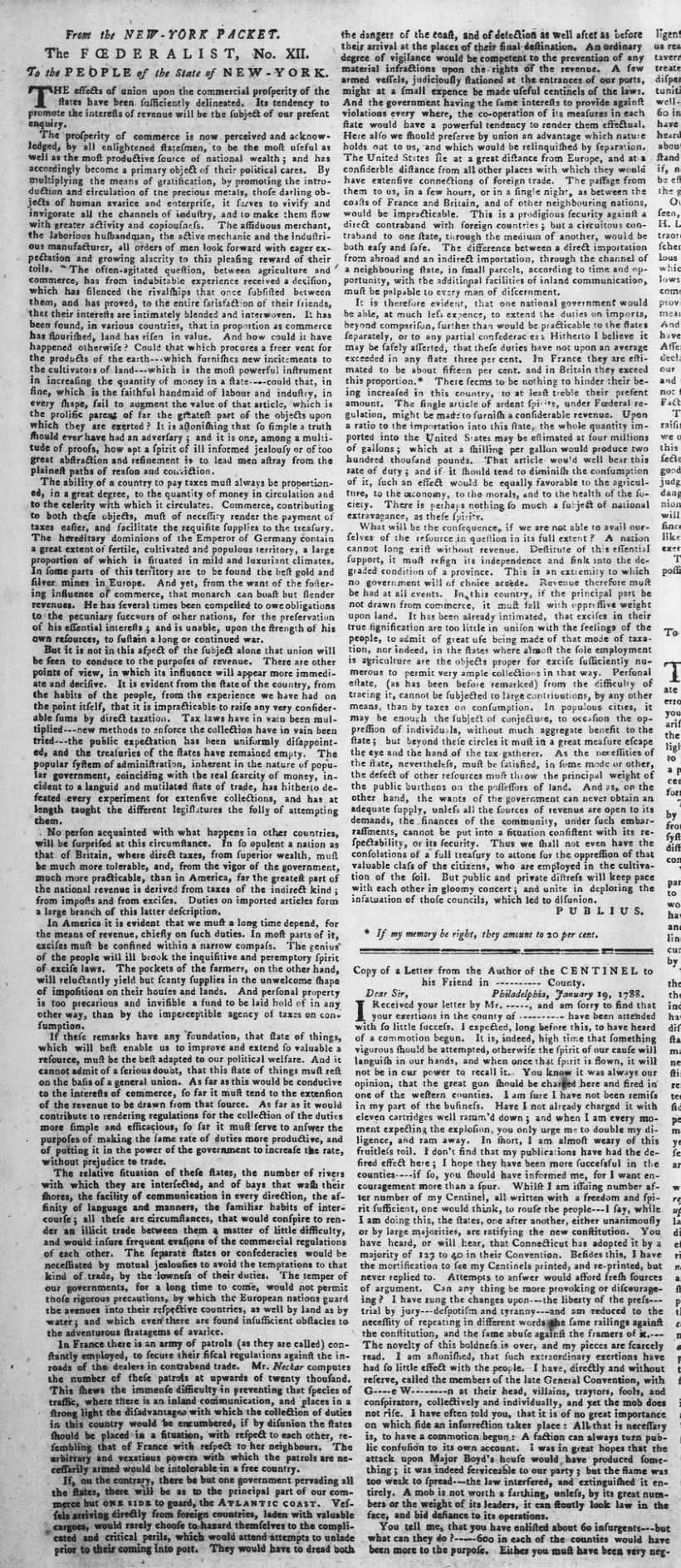
As we muse on malign mechanisms, we might recall that it was on this date in 1787 that the first in a series of eighty-five essays by “Publius,” the shared pen name of Alexander Hamilton, James Madison, and John Jay, appeared in the Independent Journal, a New York newspaper. Known collectively as The Federalist Papers, they were an effort to urge New Yorkers to support ratification of the Constitution approved by the Constitutional Convention on September 17, 1787. While aimed at New Yorkers, the essays were reprinted in newspapers (and pamphlets) across the fledgling nation.
In Federalist Paper #12, Alexander Hamilton (later the first Secretary of the Treasury) articulated an argument for the economic advantages of a united government under the proposed Constitution– and sketched the outline of the financial and commercial regime we’ve built since.
Your correspondent is heading into a series of meeting sufficiently intense that (R)D will be on brief hiatus. Regular service should resume on October 30.
“Those who believe that politics and religion do not mix, understand neither”*…

Authoritarian leaders who play the religious card are not mere hypocrites, Suzanne Schneider suggests; there’s something far more troubling going on…
Viktor Orbán reportedly does not attend church. Benjamin Netanyahu eats at non-kosher restaurants. New York libertine Donald Trump lacks all manner of evident religious virtue.
Yet it is a fact that today’s crop of aspiring authoritarians invoke religious themes and symbols, despite not being strict adherents to their respective traditions. Of course, there is nothing new about the opportunistic use of religion by politicians. The scholars Garret Martin and Carolyn Gallaher have remarked that ‘Orbán’s use of religion is no different from Ronald Reagan’s embrace of Christian evangelicals in the late 1970s.’ According to these explanations, such figures cynically appeal to religion, despite not being true believers. Given this purported sincerity deficit, a conversation in this register toggles between accusations of hypocrisy and instrumentalism. How can such obviously corrupted figures claim to speak on behalf of a Christian or Jewish nation? And how can voters who claim to be animated by religious values be so blind?
Tempting as it is, the hypocrisy diagnosis does not quite map onto the emerging social landscape. There is instead a deeper and more interesting shift occurring in the world toward a new post-liberal or illiberal order of religion and politics. Understanding the nature of this transformation enables critics to break out of the cycle of allegations of hypocrisy or inconsistency, and to grasp an emergent worldview that is both coherent and deeply troubling…
Read on for her (troubling) explication: “An unholy alliance,” from @suzy_schneider in @aeonmag.
For the Washington Post‘s examination of the global tilt toward authoritarian nationalism: “Leaders of democracies increasingly echo Putin in authoritarian tilt” (gift article, so no paywall).
Apposite: “When the Hindu Right Came for Bollywood” (“The industry used to honor India’s secular ideals—but, since the rise of Narendra Modi, it’s been flooded with stock Hindu heroes and Muslim villains…”)


* Albert Einstein (also attributed to Gandhi)
###
As we take the measure of the metamorphosis, we might recall that it was on this date in 1789 that John Jay was sworn in as the first Chief Justice of the U.S. Supreme Court. A founding father (co-author of The Federalist Papers with Hamilton and Madison, and President of the second Continental Congress), he had previously served as the young nation’s Secretary of Foreign Affairs (in which position he helped negotiate the Treaty of Paris), as the first Secretary of State, then as Governor of New York.
Jay was an ally of Hamilton, a proponent of a strong national government. While Governor of New York, he presided over a state constitutional convention in which religious tolerance was enshrined… within limits: he succeeded in adding special provisions for Catholics to the constitution’s article on the naturalization of foreigners. Under Jay’s amendment, aliens were required to take an oath of allegiance to the state that included renunciation of all allegiance and subjection to “all and every foreign king, prince potentate and state, in all matters ecclesiastical as well as civil.” Scholars suggest that the persecution of Jay’s Huguenot ancestors by the Catholic Church and his adherence to traditional Whig views identifying Protestantism with liberty and Catholicism with oppression, foreign influence, and sedition motivated his actions.

Turning two bits into… well, about 1.6 bits…
In case the economic turmoil of the last year or so hasn’t done enough to reduce the size of one’s assets, the good folks at Stoneridge Engineering (motto: “wreaking havoc with electrons for over forty years”) have gone public with information which can help: “All About Quarter Shrinking (or “Makin’ Small Change”©).”
 Before and After
As Stoneridge explains:
The Quarter Shrinker uses a technology called high velocity electromagnetic forming, or “Magneforming.” This is a “high energy rate” process that was originally developed by the aerospace industry in conjunction with NASA… It involves quickly discharging a high energy capacitor bank through a work coil to generate an extremely powerful, rapidly changing magnetic field which then “forms” the metal to be fabricated. The technique uses pulsed power to generate a very high current pulse over a very short time interval… To shrink coins, I charge up a large high voltage capacitor bank consisting of a number of large “energy discharge” capacitors. Each capacitor is specially designed to reliably store up to 12,000 volts and deliver 100,000 ampere discharges.
The initial energy stored within the capacitor bank is typically in the range of 3,500 – 6,300 Joules (watt-seconds). Because this energy is discharged in as little as 20 millionths of a second, the instantaneous power is very large and, for a brief instant, is roughly equivalent to the electrical power consumed by a good sized city. The repulsion forces between the work coil and the coin create tremendous radial compressive forces that easily overcome the yield strength of the metal alloys in the coin, causing the coin to plastically deform into a smaller diameter. The higher the initial energy, the greater the degree of “shrinkage”. Applying a 6,300 joule pulse results in a quarter whose final diameter is about 0.1″ SMALLER than a dime!
See a video demo and more photos– the technique works on other coins too!– here.
(Oh, and lest one wonder: the title of this post notwithstanding, a shrunken coin weighs exactly the same as before, and its density is unchanged. The coin becomes thicker as its diameter is reduced; the overall volume stays the same.)
As we call it, heads or tails, we might note– or then again, we might not be able to note– that on this date in 1775 invisible ink was developed by James Jay, a physician and the brother of John Jay. Dr. Jay was knighted by George III before the “unpleasantness with the Colonies”… he might have rethought the bestowal had he known that Jay was using the “stain” for reporting military information from London to America.
 source: LoneRanger on Final4Ever
You must be logged in to post a comment.