Posts Tagged ‘France’
“We all know that an angry electorate is a voting electorate”*…

Further to yesterday’s post…
The final vote tallies still aren’t known, but the media verdict of this presidential election is in: it’s 2016 all over again. Four years ago, in the hours after Donald Trump declared victory on the strength of 306 Electoral College votes and the ballots of nearly sixty-three million Americans, I wrote a column about the failures of the press throughout that campaign, and declared that “journalism’s moment of reckoning” had arrived. “Reporters’ eagerness first to ridicule Trump and his supporters, then to dismiss them, and finally to actively lobby and argue for their defeat have led us to a moment when the entire journalistic enterprise needs to be rethought and rebuilt,” I wrote then.
It is astonishing, today, how little we seem to have learned since. Once again, opinion polls were overhyped and under-scrutinized. Some of them were also wildly off—and, though that’s different from 2016, when the polls were largely accurate but widely misunderstood, it doesn’t let media organizations off the hook for their treatment of the numbers. Newsrooms leaned too heavily on polls as a substitute for on-the-ground reporting, and they were led astray. Journalists spent too much time talking to each other on Twitter, inhabiting an alternate algorithmic reality that bore little resemblance to the life of the country. And major media institutions made it all but impossible to envision that, despite the wealth of reporting on the president’s lies and his racism and his circus—nearly half the country remains beholden to the man and his beliefs. “We can’t go back to assuming, just because we think Donald Trump is an outlier, that he is not connecting to a lot of American people in ways that, frankly, a lot of us cannot understand,” Claire McCaskill, a former Missouri senator, said Wednesday morning on MSNBC. The feeling of déjà vu, and of lost journalistic opportunity, is inescapable…
Kyle Pope (@kylepope), editor of the Columbia Journalism Review on lessons unlearned: “What the polls show, and the press missed, again.”
On the problem(s) with polls, pair with “Of course Trump’s voters lie to pollsters. You call us all racists” (with an eye to the phenomenon it addresses– and the questions raised by the rationale it offers…)
For one (very compelling) account of why Pope’s project matters, see Fintan O’Toole’s “Democracy’s Afterlife.” (For more, see also Ron Brownstein, Roxane Gay, and George Packer on the same family of issues… there are lots of diagnoses abroad in the infosphere at the moment; these are among the best your correspondent has found.)
And for a resonant but different take on the necessary role of “honest journalism” going forward, see also Jay Rosen’s “America’s Press and the Asymmetric War for Truth.”
###
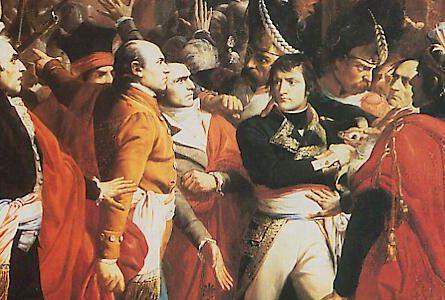
As we look more deeply, we might recall that it was on this date (18 Brumaire in the French Republican Calendar) in 1799 that thirty-year-old Corsican General Napoleon Bonaparte overthrew the Directory in France and established the Consulate, ending the power of the revolutionary oligarchy and creating himself as First Consul… or dictator.
“He got his fat dreams, he got his slaves / He got his profits, he owns our cage”*…

Plan, profile and layout of the slave ship The Séraphique Marie
For a generation, the relationship between slavery and capitalism has preoccupied historians. The publication of several major pieces of scholarship on the matter has won attention from the media. Scholars demonstrate that the Industrial Revolution, centred on the mass production of cotton textiles in the factories of England and New England, depended on raw cotton grown by slaves on plantations in the American South. Capitalists often touted the superiority of the industrial economies and their supposedly ‘free labour’. ‘Free labour’ means the system in which workers are not enslaved but free to contract with any manufacturer they chose, free to sell their labour. It means that there is a labour market, not a slave market.
But because ‘free labour’ was working with and dependent on raw materials produced by slaves, the simple distinction between an industrial economy of free labour on the one hand and a slave-based plantation system on the other falls apart. So too does the boundary between the southern ‘slave states’ and northern ‘free states’ in America. While the South grew rich from plantation agriculture that depended on slave labour, New England also grew rich off the slave trade, investing in the shipping and maritime insurance that made the transport of slaves from Africa to the United States possible and profitable. The sale of enslaved Africans brought together agriculture and industry, north and south, forming a global commercial network from which the modern world emerged.
It is only in the past few decades that scholars have come to grips with how slavery and capitalism intertwined. But for the 18th-century French thinkers who laid the foundations of laissez-faire capitalism, it made perfect sense to associate the slave trade with free enterprise. Their writings, which inspired the Scottish philosopher Adam Smith’s Wealth of Nations (1776), aimed to convince the French monarchy to deregulate key businesses such as the sale of grain and trade with Asia. Only a few specialists read them today. Yet these pamphlets, letters and manuscripts clearly proclaim a powerful message: the birth of modern capitalism depended not only on the labour of enslaved people and the profits of the slave trade, but also on the example of slavery as a deregulated global enterprise…
[Adam] Smith became far more influential than his teacher. As his own version of laissez-faire ideas came to seem like common sense in the following century, the pioneering Gournay Circle was largely forgotten. Their sense that the slave trade was a prime example of free trade in action disappeared. Yet the writings of Gournay and Morellet reveal that modern capitalism is entangled with slavery in multiple, profound ways. Slave labour supplied the cotton, sugar and other vital commodities. The profits from the sale of slaves created fortunes on both sides of the Atlantic. And, in a disturbing paradox, the founding fathers of laissez-faire saw the slave trade as a showcase of liberty.
The chilling tale of a “secret ingredient” in capitalism-as-we-know-it and of the 18th-century thinkers behind the laissez-faire economics that power it: “Slavery as Free Trade.”
* Richie Havens, “Fate”
###
As we face history, we might recall that it was on this date in 1789 that partisans of the Third Estate, impatient for social and legal reforms (and economic relief) in France, attacked and took control of the Bastille. A fortress in Paris, the Bastille was a medieval armory and political prison; while it held only 8 inmates at the time, it resonated with the crowd as a symbol of the monarchy’s abuse of power. Its fall ignited the French Revolution. This date is now observed annually as France’s National Day.
See the estimable Robert Darnton’s “What Was Revolutionary about the French Revolution?”

Storming of The Bastile, Jean-Pierre Houël
“There is no sincerer love than the love of food”*…

As the rest of the world had begun to (re)discover their own cuisines and innovate, the French restaurant seemed to be stagnating in a pool of congealing demi-glace.
Elsewhere, places such as Balthazar in New York and the Wolseley in London seemed to be doing the French restaurant better than the French. In France, the old guard of critics and restaurateurs remained convinced that French cuisine was still the best in the world and a point of national pride. The bistros cleaved to the traditional red-and-white checked table cloths and chalked-up menus even as they were microwaving pre-prepared boeuf bourguignon in the back. In 2010, when the French restaurant meal was added to Unesco’s list of the world’s “intangible cultural heritage”, it felt as if the French restaurant had become a museum piece, and a parody of itself.
The perceived excellence of their cuisine and restaurants has long represented a vital part of French national identity. It was too easy to ascribe this decline to a certain national conservatism, complacency and parochialism – facile Anglo-Saxon taunts. The real story is more complicated. The restaurant business always has been subject to changes in society and economic circumstances. Food – what we eat and how we go out to eat it – is constantly evolving, according to trend and time…
French food was the envy of the world – before it became trapped by its own history. Can a new school of traditionalists revive its glories? “The rise and fall of French cuisine.”
* George Bernard Shaw
###
As we ponder prandial progress, we might recall that it was on this date in 1904 (as the Library of Congress notes) that the first ice cream cone was served.
On July 23, 1904, according to some accounts, Charles E. Menches conceived the idea of filling a pastry cone with two scoops of ice-cream and thereby invented the ice-cream cone. He is one of several claimants to that honor: Ernest Hamwi, Abe Doumar, Albert and Nick Kabbaz, Arnold Fornachou, and David Avayou all have been touted as the inventor(s) of the first edible cone. Interestingly, these individuals have in common the fact that they all made or sold confections at the 1904 Louisiana Purchase Exposition, known as the St. Louis World’s Fair. It is from the time of the Fair that the edible “cornucopia,” a cone made from a rolled waffle, vaulted into popularity in the United States.
Another claimant, Italo Marchiony, actually received a patent in 1903 for a device to make edible cups with handles. However the patent drawings show the device as a molded container rather than the rolled waffle seen at the Fair. Although paper and metal cones were used by Europeans to hold ice cream and pita bread was used by Middle Easterners to hold sweets, the ice-cream cone seems to have come to America by way of “the Pike” (as the entertainment midway of the St. Louis World’s Fair was called).
 Randolph Smith Lyon, Mildred Frances Lyon, Mrs. Montague Lyon (Frances Robnett Smith Lyon), Montague Lyon, Jr., eating ice cream cones at the 1904 World’s Fair. Snapshot photograph, 1904. (Missouri History Museum)
 The 1904 World’s Fair in St. Louis: site of the national debuts of peanut butter, the hot dog, Dr Pepper, iced tea, cotton candy– and of course, ice cream cones. (source)
“Eternity is a long time, especially towards the end”*…

A soldier, an urn, and “Faith,” all available from the 1882 Monumental Bronze Co. catalog
In 1898, the people of Elberton, Georgia—like those of many Southern towns a few decades after the Civil War—commissioned a granite statue to honor those local men who had fought for the Confederate army. Two years later, late one night, those same people took their own monument down. Public opinion of the war hadn’t shifted much: the statue was just ugly, with bug eyes, and what looked suspiciously like a Union-style overcoat. The citizens had nicknamed it Dutchy, because it resembled, one said, “a cross between a Pennsylvania Dutchman and a hippopotamus.”
According to the Elberton Star, on August 13, 1900, around midnight, a group of men tugged Dutchy down via “a rope around his neck.” A few days later, they buried him. And after they’d dusted themselves off, what did they do? They ordered a brand new “white bronze” statue from Monumental Bronze Co.—because one of those, they had been told, would last forever.
Today—117 years later—Dutchy’s replacement still stands. (It has been moved several times, and is now at Confederate Memorial Park, in Lee County.) A bunch of his Confederate clones still stand, too, in town squares and courthouses across the American South, while their Union brothers, in slightly different uniforms, remain stationed all around the North.
As recent events have reminded us, many of the South’s Confederate monuments went up not immediately after the war, but half a century later, in the first two decades of the 1900s. During this time, organizations like the United Daughters of the Confederacy were looking to reframe and glorify the Confederate cause, and in many states, the descendants of slaves had been stripped of the right to vote, which impeded their ability to effectively voice opposition.
Today, historians argue that the rush to erect Civil War statues, especially in former Confederate states, was part of that project. “It is hardly coincidence that the cluttering of the state’s landscape with Confederate monuments coincided with two major national cultural projects: first, the “reconciliation” of the North and the South, and second, the imposition of Jim Crow [racial segregation laws] and white supremacy in the South,” writes historian W. Fitzhugh Brundage, at Vox. By memorializing the dead in this particular way, Brundage argues, those who put up statues sought to reframe the story of the war, “making the Confederate cause virtually sacred.” In the spirit of peacemaking, Northerners went along with it, and put up their own statues, too. These goals may have been political, but the means were material: they almost certainly couldn’t have gotten so many statues up, in the North or South, without white bronze…
The role of white bronze– which is neither white nor bronze– in the “memorializing” of the Civil War: “Those Mass-Produced Civil War Statues Were Meant to Stand Forever.”
* Stephen Hawking
###
As we remove those eyesores to the museum (or the scrap heap), we might recall that it was on this date in 1715 that the reign of Louis XIV– the Sun King– ended with his death; at 72 years and 110 days, it was the longest recorded reign of any monarch of a sovereign country in European history. A centralizer of power, he used his ever-grander palace at Versailles (formerly his father’s hunting lodge) to lure, then lull the nobles around him; the system of absolute monarchical rule that he established survived to the French Revolution.
Louis was a patron of the arts (he restored and expanded the Louvre)– and a vigorous promoter of his own image. With the help of his Minister of Finance, Jean-Baptiste Colbert, he had himself portrayed heroically in painting, sculpture, tapestry, theatre, dance, music, and in the almanacs that diffused royal propaganda to the population at large. Beyond the 300+ formal portraits he had done, he commissioned over 20 statues of himself to stand in Paris and the Provincial capitals as physical manifestations of his rule.

“He was a bold man that first ate an oyster”*…

“Speaking to the oysters”: a scene from “The Walrus and the Carpenter”, by Lewis Carroll, drawn by Sir John Tenniel in 1871.
In a change from chocolates and fizzy drinks, the French are starting to offer fresh oysters from vending machines in the hope of selling more of the delicacy outside business hours.
One pioneer is Tony Berthelot, an oyster farmer whose automatic dispenser of live oysters on the Ile de Re island off France’s western coast offers a range of quantities, types and sizes 24 hours a day, seven days a week.
French oyster farmers are following in the footsteps of other producers of fresh food who once manned stalls along roadsides for long hours but now use machines…
Oysters on demand at “French oysters go on sale in vending machines.”
* Jonathan Swift
###
As we dispose of the shells, we might recall that it was on this date in 1943 that Sgt. Edward Dzuba received the Legion of Merit award in recognition of his talent for “using food scraps in unusual and appetizing recipes.”

Sgt. Dzuba encouraging one of his patrons
You must be logged in to post a comment.