Posts Tagged ‘Charles Darwin’
“Remember kids: brush your greens, eat your teeth, stay in milk, drink your school, don’t do sleep, and get your eight hours of drugs!”*…

On the preservation of a Southern staple…
In the American South, many people have fond memories of a pot of collard greens simmering on the stove for hours, seasoned with a ham hock and stirred by a parent or grandparent. Cousins to cauliflower and broccoli, collards are a hearty green known for their robust, slightly bitter taste and the rich, nutritious “pot liquor” they produce when cooked. These greens and their liquor have been lauded for generations, but few in the South know that there’s more than one kind of collard green. Even fewer know that there are dozens of different varieties, and that many are now on the verge of disappearing forever.
That’s where the Heirloom Collard Project comes in. By distributing and growing rare and unique collards, this massive collaboration has created ties between chefs, gardeners, farmers, and seedsmen who hope to preserve the plant’s genetic diversity.
Collards are not native to the United States. Instead, they’re Eurasian in origin, and ancient Romans and Greeks feasted on them thousands of years ago. As for how they became prevalent in the American South, scholars have a number of theories. Collard seeds may have been brought over from Portugal in the 18th century, or from the British Isles to the early colonies. However, the most prevalent theory is that enslaved Africans introduced them to the region, since collard greens were a staple crop in many parts of Africa. Historian John Egerton, in his 1987 book Southern Food, declared that “from Africa with the people in bondage came new foods,” such as okra, black-eyed peas, yams, and collard greens…
Seed savers are preserving and celebrating the enormous genetic diversity of collard greens: “The Farmers and Gardeners Saving the South’s Signature Green,” by Debra Freeman (@audiophilegirl) in @atlasobscura.
###
As we dig in, we might recall that it was on this date in 1804 that John Wedgwood, son of industrialist potter Josiah Wedgwood (and so uncle of Charles Darwin), chaired the inaugural meeting of the Royal Horticultural Society, a group that he proposed and co-founded.

We might also send hearty, healthy birthday greetings to Luther Burbank; he was born on this date in 1849. A botanist, horticulturist and pioneer in agricultural science, he developed more than 800 strains and varieties of plants– fruits, flowers, grains, grasses, and vegetables– over his 55-year career.

“The element of mystery to which you want to draw attention should be surrounded and veiled by a quite obvious, readily recognisable commonness”*…
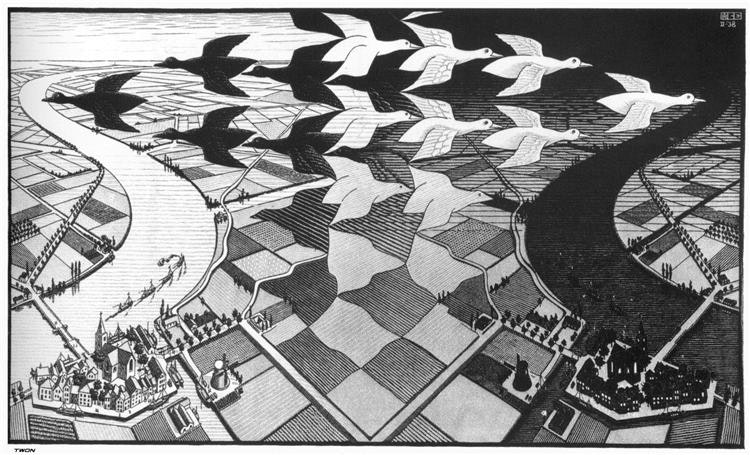
An appreciation of the marvelous M.C. Escher…
Despite being a fan of Rennaisance Art and the work of the Impressionists, he feels increasingly pulled in a different direction…
When you look at this picture, you’re flipping between world views. Either you’re seeing the white birds, and the bright, presumably sunlit day scene with its cheerful flotilla of steam ships puffing their way upriver – or you’re seeing the black birds, and your eye is drawn to the night-shrouded landscape where the houses have their lights on and the sky’s already eaten the horizon & is creeping nearer…
Except, that’s not quite right. The black birds are in the daylight side, and the white ones are flying into the night. These aren’t just mirror images: they’re like the Ancient Chinese yin-yang symbol, each side containing part of its opposite…
Escher’s love of the fantastical is primarily inspired by what he sees around him, not what he can dream up out of next to nothing… By looking closely at the real world, and trying to understand how it works, Escher will invite his initially small but intensely loyal fanbase to explore some very strange mysteries indeed.
…

It’s the 1960s now, and nonconformity is all the rage. Hair is getting longer, psychedelics-powered artistry is flourishing, and anything that seems to scream to hell with the rules is increasingly in vogue… Because of the fantastical elements of his work, Escher is acquiring a reputation as a surrealist. As a self-identifying “reality enthusiast,” it’s the very last thing he wants. Take Ascending & Descending, where he’s clearly turning his imagination to the futility of so much in the human-centred world. In a letter to a friend, he says:
“Yes, yes, we climb up and up, we imagine we are ascending; one step is about 10 inches high, terribly tiring – and where does it get us? Nowhere.”
But until the end of his career, his work will continue to speak to something deeper – a rebellion against human incuriosity, or a constant rallying-cry for the act of paying attention…
Read it in full: “Fooling With Certainty: The Impossibly Real Worlds Of MC Escher,” from Mike Sowden (@Mikeachim)
* M. C. Escher
###
As we look closely, we might recall that it was on this date in 1859 that our perspective was shifted in a different kind of way: Charles Darwin published The Origin of the Species. Actually, on that day he published On the Origin of Species by Means of Natural Selection, or the Preservation of Favoured Races in the Struggle for Life; the title was shortened to the one we know with the sixth edition in 1872.

(Roughly) Daily will be on a brief Thanksgiving hiatus, returning when the the tryptophan haze has passed…
“24 hours in a day, 24 beers in a case. Coincidence?”*…

Social distancing makes a soul thirsty– and as the Journal of the American Medical Association reports, that has had consequences…
Alcohol consumption has substantially increased during the COVID-19 pandemic… We examined national changes in waiting list registration and liver transplantation for ALD and the association with alcohol sales during the COVID-19 pandemic. We hypothesized that waiting list registrations and deceased donor liver transplants (DDLTs) for alcoholic hepatitis (AH), which can develop after a short period of alcohol misuse, would disproportionately rise…
This cross-sectional study found that waiting list registrations and DDLTs for AH increased significantly during COVID-19, exceeding the volumes forecasted by pre–COVID-19 trends by more than 50%, whereas trends for AC and non-ALD remained unchanged. While we cannot confirm causality, this disproportionate increase in association with increasing alcohol sales may indicate a relationship with known increases in alcohol misuse during COVID-19. Since less than 6% of patients with severe AH are listed for transplantation, increasing waiting list volume during COVID-19 represents a small fraction of the increase in AH, a preventable disease with 6-month mortality up to 70%.
Pandemic drinking is up– way up. So, it turns out, is serious liver disease: “Association of COVID-19 With New Waiting List Registrations and Liver Transplantation for Alcoholic Hepatitis in the United States.”
And lest we think think that waning COVID-19 pressure will be the end of all of this, a warning: “The Coming Age of Climate Trauma.”
[Image above: source]
* Steven Wright
###
As we muse on moderation, we might recall that it was on this date in 2012 that Charles Darwin received about 4,000 write-in votes in the election in Georgia’s 10th Congressional District. Republican Paul Broun, an M.D. who was running unopposed for re-election, had given (the September before) a campaign speech at the Liberty Baptist Church Sportsman’s Banquet in which he said “All that stuff I was taught about evolution and embryology and the Big Bang Theory, all that is lies straight from the pit of Hell.”
In response, radio talk show host Neil Boortz and University of Georgia plant biology professor Jim Leebens-Mack spearheaded a campaign to run the English naturalist and evolutionary theorist against Broun, a young earth creationist. They had no expectation of unseating him (and indeed, Broun carried his district handily) but hoped to draw attention to these comments from the scientific community and to have Broun removed from his post on the House Science Committee– at which they also failed.

“Nothing so much assists learning as writing down what we wish to remember”*…
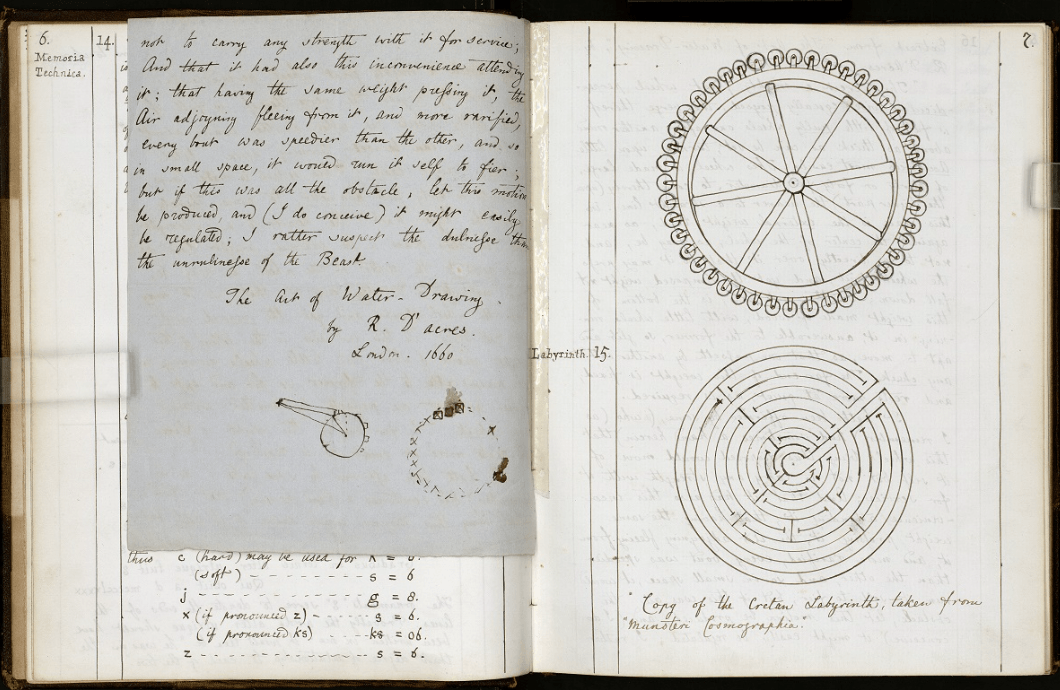
Your correspondent is away for the rest of this month; regular service will resume on or around September 1st. For the hiatus, a little something to occupy you…
As readers of this blog will have deduced, (Roughly) Daily is a kind of commonplace book…
Commonplace books (or commonplaces) are a way to compile knowledge, usually by writing information into books. They have been kept from antiquity, and were kept particularly during the Renaissance and in the nineteenth century. Such books are similar to scrapbooks filled with items of many kinds: sententiae, notes, proverbs, adages, aphorisms, maxims, quotes, letters, poems, tables of weights and measures, prayers, legal formulas, and recipes… Commonplaces are used by readers, writers, students, and scholars as an aid for remembering useful concepts or facts. Each one is unique to its creator’s particular interests but they almost always include passages found in other texts, sometimes accompanied by the compiler’s responses.
“Commonplace book“
As Steven Johnson points out, commonplace books have a storied history…
Scholars, amateur scientists, aspiring men of letters — just about anyone with intellectual ambition in the seventeenth and eighteenth centuries was likely to keep a commonplace book. In its most customary form, “commonplacing,” as it was called, involved transcribing interesting or inspirational passages from one’s reading, assembling a personalized encyclopedia of quotations. It was a kind of solitary version of the original web logs: an archive of interesting tidbits that one encountered during one’s textual browsing. The great minds of the period — Milton, Bacon, Locke — were zealous believers in the memory-enhancing powers of the commonplace book. There is a distinct self-help quality to the early descriptions of commonplacing’s virtues: in the words of one advocate, maintaining the books enabled one to “lay up a fund of knowledge, from which we may at all times select what is useful in the several pursuits of life.”
The philosopher John Locke first began maintaining a commonplace book in 1652, during his first year at Oxford. Over the next decade he developed and refined an elaborate system for indexing the book’s content. Locke thought his method important enough that he appended it to a printing of his canonical work, An Essay Concerning Human Understanding…
“The Glass Box And The Commonplace Book“
Perhaps because in these interconnected days almost anything seems re-retrievable at a click, not too many bother keeping commonplaces. That’s a shame. Your correspondent can testify that the habit– whether practiced in a book or digitally– is a powerful aid both to learning and to writing.
Happily, there are lots of sources of good advice for getting started, e.g., here, here (source of the image above), and here. There’s even a Masterclass.
* Marcus Tullius Cicero
###
As we live and learn, we might recall that it was on this date in 1858 that (prodigious journaler and commonplace keeper) Charles Darwin and Alfred Russel Wallace published “On the tendency of species to form varieties; and on the perpetuation of varieties and species by natural selection” in the Journal of the Proceedings of the Linnean Society. This was the first printed formal exposition of the theory of evolution by natural selection.
Darwin had developed the essential elements of his theory by 1838 and set them on paper in 1844; however, he chose to keep his work on evolution unpublished for the time, instead concentrating his energies first on the preparation for publication of his geological work on the Beagle voyage , and then on an exhaustive eight-year study of the barnacle genus Cirripedia.
In 1856, at the urging of Charles Lyell, Darwin began writing a vast encyclopedic work on natural selection; however, it is possible that the extremely cautious Darwin might never have published his evolutionary theories during his lifetime had not Alfred Russel Wallace, a naturalist born in New Zealand, independently discovered the theory of natural selection. Wallace conceived the theory of natural selection during an attack of malarial fever in Ternate in the Mollucas, Indonesia (Febuary, 1858) and sent a manuscript summary to Darwin, who feared that his discovery would be pre-empted.
In the interest of justice Joseph Dalton Hooker and Charles Lyell suggested joint publication of Wallace’s paper prefaced by a section of a manuscript of a work on species written by Darwin in 1844, when it was read by Hooker, plus an abstract of a letter by Darwin to Asa Gray, dated 1857, to show that Darwin’s views on the subject had not changed between 1844 and 1857. The papers by Darwin and Wallace were read by Lyell before the Linnean Society on July 1, 1858 and published on August 20.
“Darwin & Wallace Issue the First Printed Exposition of the Theory of Evolution by Natural Selection“

“In a long voyage… the map of the world ceases to be a blank”*…

One of the first-known maps of the Pacific, shown above, was a collaboration between the crew of Captain Cook’s Endeavour and a Tahitian man named Tupaia in 1769.
In the book Sea People, Christina Thompson tells the story behind the map. Cook and his crew wanted a chart to navigate the South Seas, so they questioned Tupaia (“a tall, impressive man of about forty, with the bearing and tattoos of a member of the chiefly class“) and tried to transcribe what he told them, on their coordinate system of north–south and east–west.
From Sea People:
“It is a truly remarkable artifact: a translation of Tahitian geographical knowledge into European cartographic terms at the very first moment in history when such a thing might have been possible; a collaboration between two brilliant navigators coming from geographical traditions with essentially no overlap; a fusion of completely different sets of ideas. There was no precedent for it; it has no known equal; and, with the benefit of hindsight, it looks like something of a miracle that it was ever created at all.”
But she continues:
“Unfortunately for Cook—though interestingly for us—Tupaia’s chart is ‘opaque with trans-cultural confusion.'”
In a more literal way than Korzybski meant, “the map is not the territory“: “Tupaia’s Map.”
(Many thanks to MK)
* Voyage of the Beagle
###
As we get lost in translation, we might recall that it was on this date in 1826 that the HMS Beagle set sail from Plymouth on its first voyage, an expedition to conduct a hydrographic survey of Patagonia and Tierra del Fuego in support of the larger ship HMS Adventure,
The Beagle‘s second voyage (1831-1836) is rather better remembered, as it was on that expedition that the ship’s naturalist, a young Charles Darwin (whose published journal of the journey, quoted above, earned him early fame as a writer) made the observations that led him to even greater fame for his theory of evolution.

You must be logged in to post a comment.