Posts Tagged ‘information management’
“Nothing so much assists learning as writing down what we wish to remember”*…
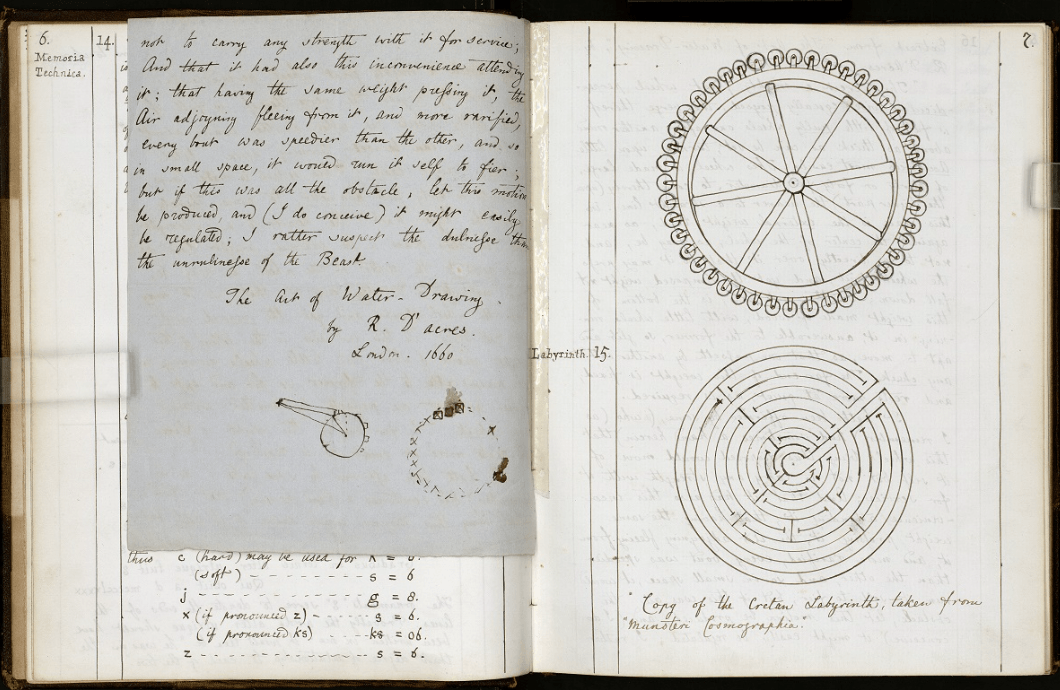
Your correspondent is away for the rest of this month; regular service will resume on or around September 1st. For the hiatus, a little something to occupy you…
As readers of this blog will have deduced, (Roughly) Daily is a kind of commonplace book…
Commonplace books (or commonplaces) are a way to compile knowledge, usually by writing information into books. They have been kept from antiquity, and were kept particularly during the Renaissance and in the nineteenth century. Such books are similar to scrapbooks filled with items of many kinds: sententiae, notes, proverbs, adages, aphorisms, maxims, quotes, letters, poems, tables of weights and measures, prayers, legal formulas, and recipes… Commonplaces are used by readers, writers, students, and scholars as an aid for remembering useful concepts or facts. Each one is unique to its creator’s particular interests but they almost always include passages found in other texts, sometimes accompanied by the compiler’s responses.
“Commonplace book“
As Steven Johnson points out, commonplace books have a storied history…
Scholars, amateur scientists, aspiring men of letters — just about anyone with intellectual ambition in the seventeenth and eighteenth centuries was likely to keep a commonplace book. In its most customary form, “commonplacing,” as it was called, involved transcribing interesting or inspirational passages from one’s reading, assembling a personalized encyclopedia of quotations. It was a kind of solitary version of the original web logs: an archive of interesting tidbits that one encountered during one’s textual browsing. The great minds of the period — Milton, Bacon, Locke — were zealous believers in the memory-enhancing powers of the commonplace book. There is a distinct self-help quality to the early descriptions of commonplacing’s virtues: in the words of one advocate, maintaining the books enabled one to “lay up a fund of knowledge, from which we may at all times select what is useful in the several pursuits of life.”
The philosopher John Locke first began maintaining a commonplace book in 1652, during his first year at Oxford. Over the next decade he developed and refined an elaborate system for indexing the book’s content. Locke thought his method important enough that he appended it to a printing of his canonical work, An Essay Concerning Human Understanding…
“The Glass Box And The Commonplace Book“
Perhaps because in these interconnected days almost anything seems re-retrievable at a click, not too many bother keeping commonplaces. That’s a shame. Your correspondent can testify that the habit– whether practiced in a book or digitally– is a powerful aid both to learning and to writing.
Happily, there are lots of sources of good advice for getting started, e.g., here, here (source of the image above), and here. There’s even a Masterclass.
* Marcus Tullius Cicero
###
As we live and learn, we might recall that it was on this date in 1858 that (prodigious journaler and commonplace keeper) Charles Darwin and Alfred Russel Wallace published “On the tendency of species to form varieties; and on the perpetuation of varieties and species by natural selection” in the Journal of the Proceedings of the Linnean Society. This was the first printed formal exposition of the theory of evolution by natural selection.
Darwin had developed the essential elements of his theory by 1838 and set them on paper in 1844; however, he chose to keep his work on evolution unpublished for the time, instead concentrating his energies first on the preparation for publication of his geological work on the Beagle voyage , and then on an exhaustive eight-year study of the barnacle genus Cirripedia.
In 1856, at the urging of Charles Lyell, Darwin began writing a vast encyclopedic work on natural selection; however, it is possible that the extremely cautious Darwin might never have published his evolutionary theories during his lifetime had not Alfred Russel Wallace, a naturalist born in New Zealand, independently discovered the theory of natural selection. Wallace conceived the theory of natural selection during an attack of malarial fever in Ternate in the Mollucas, Indonesia (Febuary, 1858) and sent a manuscript summary to Darwin, who feared that his discovery would be pre-empted.
In the interest of justice Joseph Dalton Hooker and Charles Lyell suggested joint publication of Wallace’s paper prefaced by a section of a manuscript of a work on species written by Darwin in 1844, when it was read by Hooker, plus an abstract of a letter by Darwin to Asa Gray, dated 1857, to show that Darwin’s views on the subject had not changed between 1844 and 1857. The papers by Darwin and Wallace were read by Lyell before the Linnean Society on July 1, 1858 and published on August 20.
“Darwin & Wallace Issue the First Printed Exposition of the Theory of Evolution by Natural Selection“

“Pam, this is from corporate. How many times have I told you that there is a special filing cabinet for things from corporate? Called the waste paper basket!”*…

The subject of this essay emerged by chance. I was researching the history of the U.S. passport, and had spent weeks at the National Archives, struggling through thousands of reels of unindexed microfilm records of 19th-century diplomatic correspondence; then I arrived at the records for 1906. That year, the State Department adopted a numerical filing system. Suddenly, every American diplomatic office began using the same number for passport correspondence, with decimal numbers subdividing issues and cases. Rather than scrolling through microfilm images of bound pages organized chronologically, I could go straight to passport-relevant information that had been gathered in one place.
I soon discovered that I had Elihu Root to thank for making my research easier. A lawyer whose clients included Andrew Carnegie, Root became secretary of state in 1905. But not long after he arrived, the prominent corporate lawyer described himself as “a man trying to conduct the business of a large metropolitan law-firm in the office of a village squire.” The department’s record-keeping practices contributed to his frustration. As was then common in American offices, clerks used press books or copybooks to store incoming and outgoing correspondence in chronologically ordered bound volumes with limited indexing. For Root, the breaking point came when a request for a handful of letters resulted in several bulky volumes appearing on his desk. His response was swift: he demanded that a vertical filing system be adopted; soon the department was using a numerical subject-based filing system housed in filing cabinets.
The shift from bound volumes to filing systems is a milestone in the history of classification; the contemporaneous shift to vertical filing cabinets is a milestone in the history of storage…
It is easy to dismiss the object: a rectilinear stack of four drawers, usually made of metal. With suitable understatement, one design historian has noted that “manufacturers did not address the subject of style with regard to filing units.” The lack of style figures into the filing cabinet’s seeming banality. It is not considered inventive or original; it is simply there, especially in 20th-century office spaces; and this ubiquity, along with the absence of style, perhaps paradoxically contributes to the easy acceptance of its presence, which rarely causes comment…
But if it appears to be banal and pervasive, it cannot be so easily ignored. The filing cabinet does not just store paper; it stores information; and because the modern world depends upon and is indeed defined by information, the filing cabinet must be recognized as critical to the expansion of modernity. In recent years scholars and critics have paid increasing attention to the filing systems used to store and retrieve information critical to government and capitalism, particularly information about people — case dossiers, identification photographs, credit reports, et al. But the focus on filing systems ignores the places where files are stored. Could capitalism, surveillance, and governance have developed in the 20th century without filing cabinets? Of course, but only if there had been another way to store and circulate paper efficiently. The filing cabinet was critical to the infrastructure of 20th-century nation states and financial systems; and, like most infrastructure, it is often overlooked or forgotten, and the labor associated with it minimized or ignored.
The vertical filing cabinet was invented in the United States in the 1890s, and quickly became a fixture throughout North America and around the world. It spread globally because it provided a way to store large amounts of paper so that individual sheets could be retrieved easily. The technique of using drawers for storing a sheet of paper on its long edge was significant because loose papers cannot stand upright on their own. Put another way, the filing cabinet technology enabled loose paper to stand on edge so that more sheets could be stored in less space but still be accessed with minimal difficulty. It allowed loose papers to do the work of paperwork…
The filing cabinet had at least two inventors — and likely several others who remain lost to the historical record. The current accepted version attributes the invention to the Library Bureau, the Boston-based company founded in 1876 by Melvil Dewey, inventor of the eponymous decimal system of library classification. Although the Library Bureau would proudly claim the invention, critical developments happened elsewhere. It was the secretary of a charity organization based in Buffalo, New York, a man identified as Dr. Nathaniel Rosenau, who provided the initial impetus for construction of a vertical filing cabinet. Inspired by the use of cabinets to store index cards on their edges, Rosenau sought a bigger container for papers.
In 1892, he took his idea to the Library Bureau’s Chicago office, which built a prototype. But no matter the inventor, the turn of the 20th century saw the filing cabinet develop as a part of the rapid growth of an office equipment industry in which dozens of companies manufactured practically identical products with little respect for the hundreds of patents issued for products and parts. To underscore their uniqueness and modernity, this industry explicitly labeled its products “equipment,” “appliances,” and “machines” — not furniture. And it made these products indispensable to offices, and thus helped to constitute the office as a “modern” workspace. The office with a vertical filing cabinet was decidedly not a 19th-century office…
The filing cabinet was critical to the information infrastructure of the 20th-century; like most infrastructure, it was usually overlooked– an oversight that Craig Robertson (@craig2robertson) rectifies: “The Filing Cabinet.”
* “Michael Scott,” The Office (Pilot episode)
###
As we savor storage, we might spare a thought for Malcolm Purcell McLean; he died on this date in 2001. A transportation entrepreneur, he parlayed his experience as a trucker into the development of the modern shipping container— which revolutionized transport and international trade in the second half of the twentieth century. Containerization led to a significant reduction in the cost of freight transportation by eliminating the need for repeated handling of individual pieces of cargo, and also improved reliability, reduced cargo theft, and cut inventory costs (thus, working capital needs) by shortening transit time.
When McLean died in 1987, then Secretary of Transportation Norm Minetta said:
Malcom revolutionized the maritime industry in the 20th century. His idea for modernizing the loading and unloading of ships, which was previously conducted in much the same way the ancient Phoenicians did 3,000 years ago, has resulted in much safer and less-expensive transport of goods, faster delivery, and better service. We owe so much to a man of vision, “the father of containerization,” Malcolm P. McLean.
In an editorial shortly after his death, the Baltimore Sun wrote that “he ranks next to Robert Fulton as the greatest revolutionary in the history of maritime trade,” and Forbes Magazine called McLean “one of the few men who changed the world.” On the morning of McLean’s funeral, container ships around the world blew their whistles in his honor.

You must be logged in to post a comment.