Posts Tagged ‘commonplace book’
“Paper is to write things down that we need to remember. Our brains are used to think.”*…

Henrik Karlsson argues that it can be more symbiotic than that…
Every few months I will read a tweet, or have a conversation, that makes me feel this is important, I must remember this. Often, these epiphanies are accompanied by a sense that I actually know this already, it had just somehow slipped my mind.
And for a few days, I do remember: my life shimmers with a new intensity, and I live the truth of what I grasped. But then, inevitably, the conveyor belt of things to pay attention to keeps churning, and my mind gets filled with small problems I need to solve, or new epiphanies or random noise, like news, and the shining fades from my eyes—I regress to being the same person as ever.
The Latin word for the tendency to lose track of what matters in the cacophony of things that attract our attention is stultitia. “Stultitia,” writes Michel Foucault in “Self-writing,”
is defined by mental agitation, distraction, change of opinions and wishes, and consequently weakness in the face of all the events that may occur; it is also characterized by the fact that it turns the mind toward the future, makes it interested in novel ideas, and prevents it from providing a fixed point for itself in the possession of acquired truth.
You can’t just read a blog post about high agency, get filled with a sense of possibility, and become, from then on, an agentic person. As John Gray puts it in his monograph on J.S. Mill, our character is “a cluster of habitual willings.” For changes to our behavior to become permanent, we must become different people.
In the same way that it is not enough to make a resolution that you will learn the piano, it is not enough to realize that when the kids act out, you shouldn’t lose your temper but slow down, listen, and regulate their nervous systems with the help of yours. Imagine how good a person I would be if having insights were enough! But reacting to the frustrations of your children with calm and curiosity is a skill as much as playing the piano is—and as with the piano, the act of learning it requires rewiring your nervous system through sustained attention and practice. Realizing the value of acting in a certain way might give you a temporary motivation to do it. But in order to actually live in accordance with what you believe in long-term, you must make it a habit.
And this is much harder than making a habit out of playing the piano. When you’re trying to make something like piano practice a habit, the standard advice is to chain it onto some already existing habit—to practice immediately after you brush your teeth in the morning, for example, or after you change out of your work clothes in the afternoon. Chaining the new habit to an already existing one provides a predictable trigger that helps remind you to practice. But the habits that make up our characters often do not follow a predictable schedule like this. I never know, for instance, when our children will act out (except that it will usually be when I’m least capable of handling it with grace—whenever both they and I are unusually hungry and tired). The conflicts seem to come out of nowhere, so I have to, somehow, always be ready to act in the proper way. I need to have the right reaction “ready at hand” (procheiron), as the Greek-philosopher-Roman-slave Epictetus put it. If Johanna and I talked about how we want to deal with the kids’ conflicts the night before, I will nearly always handle the situation well. The problem is to keep it top of mind.
During the first two centuries of the Roman Empire, there spread a practice known as hypomnēmata, a type of notetaking system, used as a tool for meditation, in which the writer would store quotes from books they had read. Each day, often in the morning, the notetaker would open their notebook and look for a passage relevant to something they were struggling with, and then they would meditate on that—unpacking it, making the idea top of mind, ensuring it was alive in them. If they needed courage, for instance, they could meditate on an anecdote that made it real for them what it meant to act bravely. The idea was that over time, the insights they gathered by reading would be transformed into character, something deeply ingrained in their way of thinking and seeing and acting.
This was, as I understand it, an exercise designed to combat the problem I outlined above. Meditating on what matters is a simple habit, which you can chain onto your morning routine, but it reinforces the habits you can’t plan, the habits that make up your character. It was, in the words of the French classicist Pierre Hadot, a spiritual exercise—an exercise because it required work and discipline, spiritual because it engaged the whole person, not just their intellect, but their emotions and their moral character. It was an attempt to treat the formation of character as a skilled practice, as something you can deliberately train and improve through targeted exercises…
…
… I have often noticed that my experience of reality improves if I write and think about something.
But it strikes me now that the practice Foucault wrote about was probably more transformative than what I’ve ended up doing. Essay writing is incredibly time-consuming, and a lot of that time is spent on things that aren’t self-transforming: I spend less time reshaping my mind than I spend solving literary-technical problems that help me write more functional and beautiful essays, for the joy of the craft and for the benefit of readers. Another limitation of my practice is that when an essay is done, I move on. The ideas—though they have been much deepened and more firmly lodged in my mind—fall out of attention and start to fade.
There is an element of self-deception involved here. I like to write essays, so it is comforting to think of it as a powerful practice, something that helps me live more fully and grow as a person. But if I look at it soberly, it is clear to me that essay writing is not a practice that is ideal for the purpose of ethopoiesis.6 It is common to think that what we do achieves what we want it to achieve, even if there is no evidence for it. There are many practices that promise to transform and improve us—therapy, meditation, psychedelics—, but that branding doesn’t mean that they actually do much for us: it is common to see people use these techniques for years without any obvious progress on their problems. If you want to achieve a particular outcome, it is important to start from that goal and evaluate which practices actually help you.
The most important ideas we need to return to weekly, even daily. Essay-writing, then, is not a functional substitute for having a practice that keeps the important truths top of mind, day after day. But it did help me reach that conclusion…
On a particular kind of commonplace book and staying centered: “How not to forget what matters,” from @henrikkarlsson.bsky.social.
* Abert Einstein
###
As we contemplate contemplation, we might that it was on this date in 1949 that the first science fiction series debuted on American television, the DuMont Network’s Captain Video and His Video Rangers. Written by such luminaries as Isaac Asimov, Arthur C. Clarke, James Blish, and Jack Vance, it was– even in its time, when early television productions often were thrown-together affairs– considered crude, owing much to the fact that the daily show was done live on a meager budget. Indeed, the actors were paid so little they actually made more money from appearing in character at supermarket openings, county fairs, and the like than they did from their salaries.
Still, it ran for a total of 1,537 episodes, and quickly spawned competitive sci-fi offerings like Tom Corbet, Space Cadet and Space Patrol.
For episodes on YouTube, see here.

“The mind is not a vessel to be filled, but a fire to be kindled”*…

(Roughly) Daily is, in effect, a kind of notebook, a commonplace book. So it will be no surprise that your correspondent found today’s featured piece fascinating.
Jillian Hess, a professor who studies the history of note-taking, shares the lessons she took from her review of the papers of the remarkable Richard Feynman…
Formal education, at its best, prepares us for a life of learning. After all, we are only in school for a fraction of our lives and there is so much to learn!
Richard Feynman (1918-1988) understood the value of self-education. He was a Nobel Prize-winning theoretical physicist, a member of the Manhattan Project at the age of 25, and a dynamic public intellectual who never stopped learning.
Often touted as one of history’s greatest learners, Feynman taught himself a dizzying amount of science. I wanted to see his notes for myself—to observe the great autodidact thinking on the page. So, I visited his archives at Caltech in February…
… In the archives, I saw… for myself: Feynman’s notebooks contain imprints of thinking in real-time—the work as it happened. They were instruments for thinking through uncertainty.
What follows is a list of note-taking principles for self-education that I gathered while studying Feynman’s notebooks.
Start with First Principles: Feynman’s “Things I Don’t Know About” Notebook
Discussions about Feynman’s learning process usually draw from this notebook, which he compiled as a Ph.D. student at Princeton. The contents include mechanics, mathematical methods, and thermodynamics. Clearly, he knew something about these topics, but he found his understanding superficial. So, his response was to take the subject apart—to break it down into “the essential kernels” …
[Hess illustrates this principle, then unpacks two others: “create a reading index” and “keep learning.” She continues…]
… Uncertainty is Interesting
This is my biggest takeaway: We should fear certainty more than doubt. Learning to live with uncertainty is an essential aspect of learning, as Feynman said in 1981:
You see, one thing is, I can live with doubt and uncertainty and not knowing. I think it’s much more interesting to live not knowing than to have answers which might be wrong.
And then, in an echo of his “Notebook of Things I Know Nothing About,” compiled four decades prior, he adds:
…I’m not absolutely sure of anything, and there are many things I don’t know anything about.
If a man as celebrated for his genius as Feynman felt that way, certainly the rest of us have a lot more to learn…
[And she concludes…]
… Notes on Feynman’s Notes:
Use notes to think: Feynman didn’t think through problems in his head and then turn to his notebooks. Instead, he used his notebooks to think through problems. His thought process required paper.
Start with first principles: “Why” is a very powerful question. And asking why can lead us back to the fundamentals and help us understand them in an entirely new light. This applies to any subject. Feynman has helped me think of note-taking as a kind of expedition. Use your notes to dig deeper into topics you think you already understand.
Never stop learning: How wonderful would it be if we could hold onto the excitement of learning we had as children? After all, the world didn’t get less interesting. It’s worth returning to the note-taking methods you used in school to see if they are still useful in adulthood. I particularly like Feynman’s high school method of taking 30 minutes to understand a subject before he allowed himself to take notes on it.
[Then leaves us with the man himself, “in all his radiant, enthusiastic, brilliance”…]
On “Richard Feynman’s Notes For Self-Education.”
Pair with: “Curiosity Is No Solo Act“: “it gains its real power when embedded in webs of relationship and shared meaning-making”… something that Feynman’s life also demonstrated (as you can see in his autobiography and/or in James Gleick‘s biography, Genius)
* Plutarch
###
As we light that fire, we might spare a thought for Jeremy Bernstein; he died on this date last year. A physicist who woked on nuclear propulsion for Project Orion and held research and teaching positions at Stevens Institute of Technology, the Institute for Advanced Study, Brookhaven National Laboratory, CERN, Oxford University, University of Islamabad, and École Polytechnique, he is better remembered as a gifted popular science writer and profiler of scientists.
Bernstein wrote 30 books, and scores of magazine articles for “general readers”– for The New Yorker, where he was a staff writer from 1961 to 1995, and for The Atlantic Monthly, the New York Review of Books, and Scientific American, among others.
Of Feynman, Bernstein wrote “[his] Mozartean genius in physics seemed to be combined with an almost equally Mozartean urge to play the clown.” (in which, of course, Feynman was in the good company of Einstein, Claude Shannon, and others :-)

“Nothing so much assists learning as writing down what we wish to remember”*…
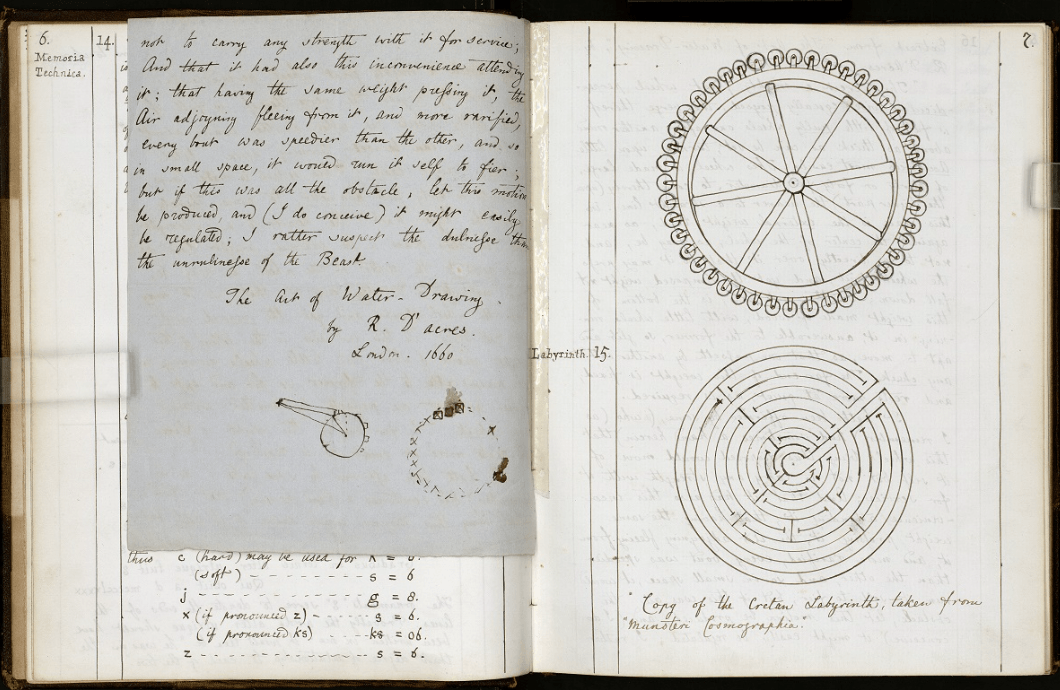
Your correspondent is away for the rest of this month; regular service will resume on or around September 1st. For the hiatus, a little something to occupy you…
As readers of this blog will have deduced, (Roughly) Daily is a kind of commonplace book…
Commonplace books (or commonplaces) are a way to compile knowledge, usually by writing information into books. They have been kept from antiquity, and were kept particularly during the Renaissance and in the nineteenth century. Such books are similar to scrapbooks filled with items of many kinds: sententiae, notes, proverbs, adages, aphorisms, maxims, quotes, letters, poems, tables of weights and measures, prayers, legal formulas, and recipes… Commonplaces are used by readers, writers, students, and scholars as an aid for remembering useful concepts or facts. Each one is unique to its creator’s particular interests but they almost always include passages found in other texts, sometimes accompanied by the compiler’s responses.
“Commonplace book“
As Steven Johnson points out, commonplace books have a storied history…
Scholars, amateur scientists, aspiring men of letters — just about anyone with intellectual ambition in the seventeenth and eighteenth centuries was likely to keep a commonplace book. In its most customary form, “commonplacing,” as it was called, involved transcribing interesting or inspirational passages from one’s reading, assembling a personalized encyclopedia of quotations. It was a kind of solitary version of the original web logs: an archive of interesting tidbits that one encountered during one’s textual browsing. The great minds of the period — Milton, Bacon, Locke — were zealous believers in the memory-enhancing powers of the commonplace book. There is a distinct self-help quality to the early descriptions of commonplacing’s virtues: in the words of one advocate, maintaining the books enabled one to “lay up a fund of knowledge, from which we may at all times select what is useful in the several pursuits of life.”
The philosopher John Locke first began maintaining a commonplace book in 1652, during his first year at Oxford. Over the next decade he developed and refined an elaborate system for indexing the book’s content. Locke thought his method important enough that he appended it to a printing of his canonical work, An Essay Concerning Human Understanding…
“The Glass Box And The Commonplace Book“
Perhaps because in these interconnected days almost anything seems re-retrievable at a click, not too many bother keeping commonplaces. That’s a shame. Your correspondent can testify that the habit– whether practiced in a book or digitally– is a powerful aid both to learning and to writing.
Happily, there are lots of sources of good advice for getting started, e.g., here, here (source of the image above), and here. There’s even a Masterclass.
* Marcus Tullius Cicero
###
As we live and learn, we might recall that it was on this date in 1858 that (prodigious journaler and commonplace keeper) Charles Darwin and Alfred Russel Wallace published “On the tendency of species to form varieties; and on the perpetuation of varieties and species by natural selection” in the Journal of the Proceedings of the Linnean Society. This was the first printed formal exposition of the theory of evolution by natural selection.
Darwin had developed the essential elements of his theory by 1838 and set them on paper in 1844; however, he chose to keep his work on evolution unpublished for the time, instead concentrating his energies first on the preparation for publication of his geological work on the Beagle voyage , and then on an exhaustive eight-year study of the barnacle genus Cirripedia.
In 1856, at the urging of Charles Lyell, Darwin began writing a vast encyclopedic work on natural selection; however, it is possible that the extremely cautious Darwin might never have published his evolutionary theories during his lifetime had not Alfred Russel Wallace, a naturalist born in New Zealand, independently discovered the theory of natural selection. Wallace conceived the theory of natural selection during an attack of malarial fever in Ternate in the Mollucas, Indonesia (Febuary, 1858) and sent a manuscript summary to Darwin, who feared that his discovery would be pre-empted.
In the interest of justice Joseph Dalton Hooker and Charles Lyell suggested joint publication of Wallace’s paper prefaced by a section of a manuscript of a work on species written by Darwin in 1844, when it was read by Hooker, plus an abstract of a letter by Darwin to Asa Gray, dated 1857, to show that Darwin’s views on the subject had not changed between 1844 and 1857. The papers by Darwin and Wallace were read by Lyell before the Linnean Society on July 1, 1858 and published on August 20.
“Darwin & Wallace Issue the First Printed Exposition of the Theory of Evolution by Natural Selection“

You must be logged in to post a comment.