Posts Tagged ‘Charles Darwin’
Lower head, insert into sand…
 Exhibit at the Creation Museum: humans and dinosaurs existing together peacefully…
From Talking Points Memo:
[In a vote in Congress last week] thirty-one Republicans on the House Energy And Commerce Committee — the entire Republican contingent on the panel — declined on Tuesday to vote in support of the very idea that climate change exists.
Democrats on the panel had suggested three amendments that said climate change is a real thing, is caused by humans and has potentially dire consequences for the future. The amendments came on a Republican bill to block the EPA from offering regulations to mitigate the results of global climate shifts. The global scientific community is in near unanimous agreement that climate change is real, and that humans contribute to it…
One appreciates that the dialectic machinery of partisan politics was at work here; still…
Read the full report, including the “offending” language in the proposed amendments, here.
As we prepare for an(other) epic flood, we might recall that it was on this date in 1827 that Charles Darwin made his earliest scientific discovery, at age 18. He dissected some specimens of a barnacle-like marine organism, the polyzoan Flustra… Thus beginning what became a lifelong commitment to natural history.
 Young Darwin (source)
So many books! So little time!…
Daniel Rourke– a contributor to the terrific Three Quarks Daily, and proprietor of the equally-nifty MachineMacine— reminds us that the problems of coping with information overload are nothing new…
Agostino Ramelli’s Rotary Reader

In 1588, the Italian Engineer Agostino Ramelli described a novel invention to facilitate the reading of multiple books at once:
A beautiful and ingenious machine, which is very useful and convenient to every person who takes pleasure in study, especially those who are suffering from indisposition or are subject to gout: for with this sort of machine a man can see and read a great quantity of books, without moving his place: besides, it has this fine convenience, which is, of occupying a little space in the place where it is set, as any person of understanding can appreciate from the drawing.
The precursor, no doubt, to internet surfing… Gout beget Carpal Tunnel Syndrome beget Muscle Atrophy beget Internet Addiction Disorder. Will mankind stop at nothing in the pursuit of pure information?!?
As we meditate on multi-tasking, we might wish an admiring and grateful Happy Birthday to one of the most accomplished multi-taskers of all time, the mathematician, biologist, historian of science, literary critic, poet and inventor Jacob Bronowski; he was born on this date in 1908. Bronowski is probably best remembered as the writer (and host) of the epochal 1973 BBC television documentary series (and accompanying book), The Ascent of Man (the title of which was a play on the title of Darwin’s second book on evolution, The Descent of Man)… the thirteen-part series (which is available at libraries, on DVD, or Netflix), a survey of the history of science– from rock tools to relativity– and its place in civilizations, is still an extraordinary treat.

It’s a Bard! it’s a plain (Jane)! It’s…


Literary Action Figures! Shakespeare, Ms. Austen, plus Oscar Wilde, Edgar Allan Poe, and Charles Dickens…
Order now, and as a special bonus receive:
(TotH to Brainpickings)
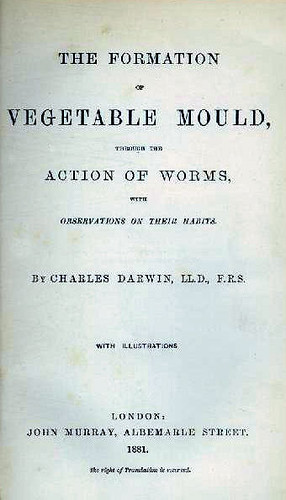
As we save up our allowance, we might recall that it was on this date in 1881 that Charles Darwin published The Formation of Vegetable Mould Through the Action of Worms-– the work he considered a more important accomplishment than The Origin of Species (1859).
Well that changes everything…
 source: Imperial College, London
As all of one’s assumptions about the future (and thus the past) seem to be weakening, two dispatches from the world of science are genuinely foundation-shaking…
First, from New Scientist (and though NS doesn’t mention it, earlier from Freeman Dyson in NYRB):
Just suppose that Darwin’s ideas were only a part of the story of evolution. Suppose that a process he never wrote about, and never even imagined, has been controlling the evolution of life throughout most of the Earth’s history. It may sound preposterous, but this is exactly what microbiologist Carl Woese and physicist Nigel Goldenfeld, both at the University of Illinois at Urbana-Champaign, believe. Darwin’s explanation of evolution, they argue, even in its sophisticated modern form, applies only to a recent phase of life on Earth.
At the root of this idea is overwhelming recent evidence for horizontal gene transfer – in which organisms acquire genetic material “horizontally” from other organisms around them, rather than vertically from their parents or ancestors. The donor organisms may not even be the same species. This mechanism is already known to play a huge role in the evolution of microbial genomes, but its consequences have hardly been explored. According to Woese and Goldenfeld, they are profound, and horizontal gene transfer alters the evolutionary process itself. Since micro-organisms represented most of life on Earth for most of the time that life has existed – billions of years, in fact – the most ancient and prevalent form of evolution probably wasn’t Darwinian at all, Woese and Goldenfeld say…
Woese can’t put a date on when the transition to Darwinian evolution happened, but he suspects it occurred at different times in each of the three main branches of the tree of life, with bacteria likely to have changed first…
As we remember that what has changed can change again, we can read the whole story here.
Second, from ArXiv and ITWire, a suggestion that we might not have as long to figure this out as we have been thinking: entropy in the universe is much higher than previously expected; thus the “heat death” of existence as we’ve known it, much closer. As Tapecutter observes in Slashdot,
In a paper soon to be published in the Astrophysical Journal [ArXiv link, above], Australian researchers have estimated the entropy of the universe is about 30 times higher than previous estimates. According to their research, super-massive black holes “are the largest contributor to the entropy of the observable universe, contributing at least an order of magnitude more entropy than previously estimated.” For those of us who like their science in the form of a car analogy, Dr. Lineweaver compared their results to a car’s gas tank. He states, ‘It’s a bit like looking at your gas gauge and saying “I thought I had half a gas tank, but I only have a quarter of a tank.”
Happily a quarter of a tank should be good for hundreds of thousands (if not millions) of years.
As we regain our bearings, we might note that this was a bad day for revolutionaries of another stripe: it was on this date in 1606 that Guy Fawkes was executed for his role in the Catholic Restorationist “Gunpowder Plot.”

Our Town…
In 1885, Charles Van Schaick opened a photography studio in his wife’s home town, Black River Falls, Wisconsin, where he served as “town photographer” for the next fifty-seven years. The Wisconsin Historical Society (along with the Jackson County Historical Society) have collected over 5,600 of Van Schaick’s glass plates, and are in the process of moving them to WHS’ web site.

Van Schaick’s photos from 1890-1910 were the basis of Michael Lesy’s 1973 book Wisconsin Death Trip. Readers can find a selection of the portraits and “small town life candids” in the Wisconsin Death Trip Flickr Pool…


More, here.
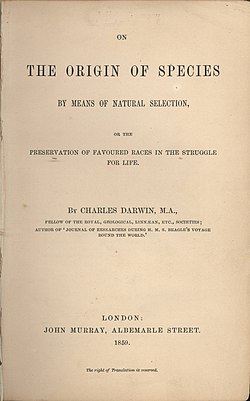
As we engage our inner Thornton Wilder, we might consider just how far we have– and haven’t– come, as it was on this date in 1859 that Charles Darwin published The Origin of the Species. Actually, on that day he published On the Origin of Species by Means of Natural Selection, or the Preservation of Favoured Races in the Struggle for Life; the title was shortened to the one we know with the sixth edition in 1872.
You must be logged in to post a comment.